📋 Quick Summary
In this article:
Quick Answer: What Is AI-Powered Real Estate Marketing?
Why AI Matters in Real Estate Marketing in 2026
1. Use AI to Create Better Property Listing Descriptions
2. Create Multiple Marketing Versions From One Listing
3. Personalize Marketing Messages
4. Use AI for Lead Scoring and Qualification
5. Build AI-Powered Lead Nurturing
6. Use AI Chatbots for First-Level Questions
7. Use AI to Recommend Relevant Properties
8. Use Predictive Analytics for Better Marketing Decisions
9. Improve Real Estate Advertising With AI
10. Use AI for Marketing Attribution
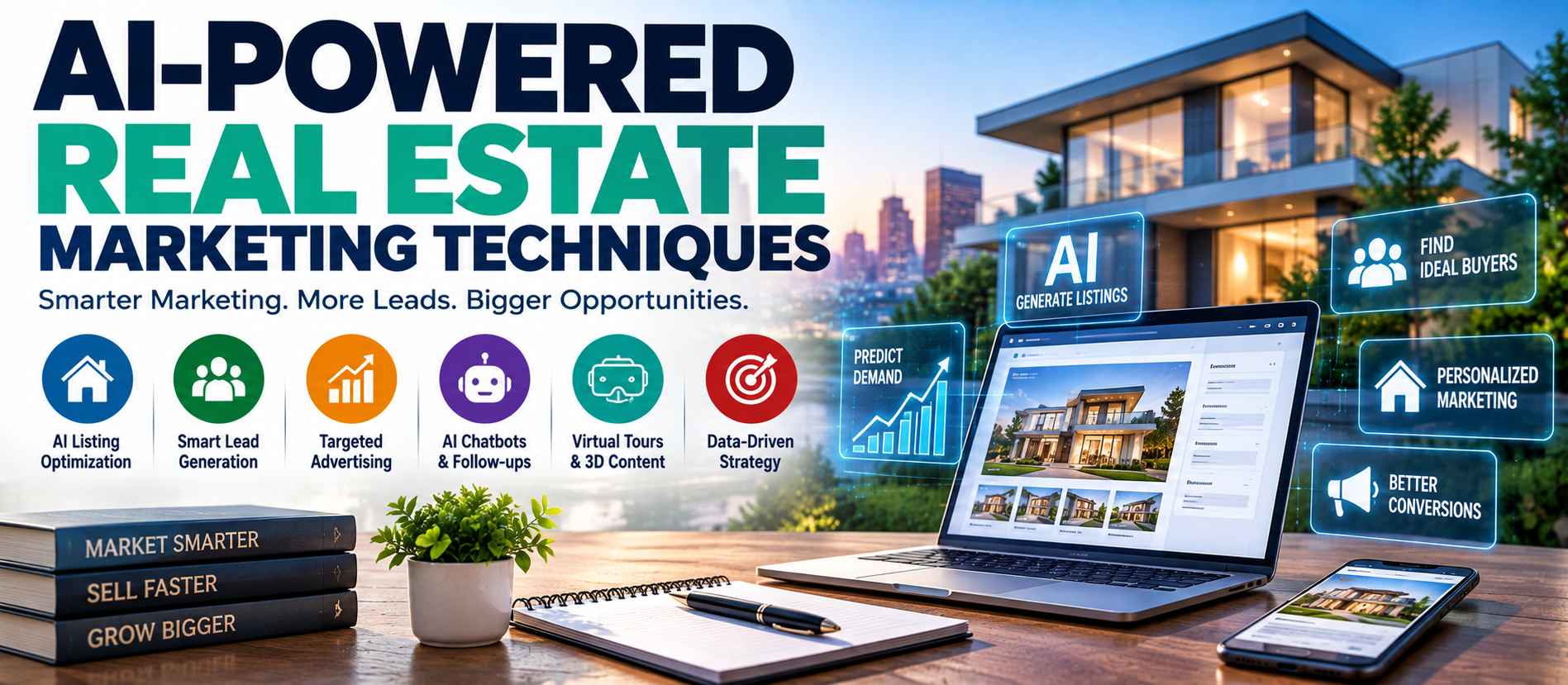
Artificial intelligence is becoming part of this process. Real estate businesses can use AI to create content, qualify leads, personalize campaigns, analyze customer behavior, improve property descriptions, automate follow-up, and understand which marketing channels generate real business.
AI is also changing search itself. Buyers can ask conversational questions instead of typing short keywords. They may ask an AI assistant to find homes in a certain area, compare neighborhoods, explain a listing, or identify an agent with a specific specialty.
In March 2026, Zillow introduced an AI mode designed to connect natural-language housing questions with live listing information and actions such as scheduling tours and connecting with agents. This is a useful example of how AI is moving from simple content generation toward guided action in the housing journey.
For real estate companies, the opportunity is not simply to use more AI tools. The bigger opportunity is to build a better marketing system around good data, useful content, fast follow-up, strong customer service, and clear brand information.
This guide explains the most useful AI-powered real estate marketing techniques for 2026. It focuses on practical methods that agents, brokers, developers, builders, property managers, and real estate marketing teams can apply.
Quick Answer: What Is AI-Powered Real Estate Marketing?
AI-powered real estate marketing uses artificial intelligence to improve how properties and real estate services are promoted, discovered, personalized, measured, and followed up.
Common applications include:
- AI-generated listing content.
- Personalized email and social campaigns.
- Automated lead qualification.
- AI chatbots and conversational assistants.
- Predictive lead scoring.
- Property recommendation systems.
- AI-powered advertising optimization.
- Virtual staging and image enhancement.
- Virtual property tours.
- Market and customer analysis.
- Automated CRM workflows.
- Generative Engine Optimization and AI Search optimization.
The most effective approach is usually a human-plus-AI workflow. AI handles repetitive analysis and production. Real estate professionals provide local knowledge, judgment, relationship management, compliance review, and final approval.
Why AI Matters in Real Estate Marketing in 2026
AI is moving from experimentation into daily business operations.
💡 Key Insight
NAR's technology and innovation coverage in July 2026 described a shift from AI pilots toward deeper integration into everyday workflows, with data, governance, and security becoming important parts of successful adoption.
Real estate is especially suitable for AI because the industry produces large amounts of structured and unstructured information. Listings, prices, locations, property features, inquiries, calls, emails, website behavior, social engagement, and transaction data can all contribute to marketing decisions.
AI can help turn this information into useful actions.
For example:
- A buyer visits several property pages. AI can help identify likely preferences.
- A lead asks about a property late at night. An AI assistant can answer basic questions.
- A marketing team has one listing. AI can help create multiple campaign variations.
- A broker has thousands of leads. Predictive scoring can help prioritize follow-up.
- A website receives search traffic. AI and analytics can identify questions visitors are asking.
1. Use AI to Create Better Property Listing Descriptions
Listing descriptions are one of the easiest areas to improve with AI.
AI can turn structured property information into readable descriptions for websites, portals, email campaigns, brochures, social media, and advertisements.
However, the goal should not be to publish generic AI text.
A strong workflow is:
- Collect verified property facts.
- Give the AI clear instructions about the target buyer.
- Generate several draft versions.
- Remove unsupported claims.
- Add useful local context.
- Review the final copy manually.
AI should not invent room sizes, amenities, views, renovation dates, distances, prices, or legal claims. Accuracy matters more than writing speed.
2. Create Multiple Marketing Versions From One Listing
One property can require many pieces of content.
A marketing team may need a website description, short social caption, email subject line, video script, paid-ad copy, brochure text, WhatsApp message, and FAQ.
AI can help convert one approved property brief into these formats.
This saves time and creates a more consistent message across channels.
The human reviewer should confirm that every version uses the same verified facts.
3. Personalize Marketing Messages
Not every buyer wants the same information.
A first-time buyer may care about affordability and financing. A luxury buyer may care about design, privacy, location, and amenities. An investor may care about rental potential, operating costs, and market conditions.
AI can help divide audiences into meaningful groups and adjust messaging accordingly.
Examples include:
- First-time homebuyers.
- Move-up buyers.
- Luxury buyers.
- Relocation buyers.
- Real estate investors.
- Commercial property buyers.
- Rental property seekers.
- New construction buyers.
Personalization should be based on relevant customer-provided information and lawful business data. Avoid using sensitive information in ways that could create discrimination or privacy problems.
4. Use AI for Lead Scoring and Qualification
Real estate teams often receive more leads than they can immediately contact.
AI can help prioritize them.
A lead-scoring system can consider signals such as:
- Property pages viewed.
- Price range selected.
- Location preferences.
- Form submissions.
- Tour requests.
- Response behavior.
- Time since last contact.
- Requested property type.
Call Rail reported in its 2026 real estate marketing research that lead scoring and qualification was one of the leading AI uses among the marketers it surveyed, alongside attribution and ROI measurement.
A score should support human follow-up, not make irreversible decisions automatically.
5. Build AI-Powered Lead Nurturing
Many property leads are not ready to buy immediately.
A buyer may need several months to arrange financing, sell another property, move cities, or decide between neighborhoods.
AI can help create a structured nurture journey.
For example:
- Day 1: Send a property summary.
- Day 3: Share similar listings.
- Day 7: Send a useful neighborhood guide.
- Day 14: Share financing or buying information.
- Later: Recommend relevant new listings.
The timing and content should depend on the customer's preferences and consent. Automation should not become spam.
6. Use AI Chatbots for First-Level Questions
Real estate websites receive many repetitive questions.
Visitors may ask about price, bedrooms, location, availability, amenities, parking, viewing times, or contact information.
An AI assistant can answer simple questions when it has access to reliable information.
It can also collect useful details before handing the conversation to a human agent.
For example, it can ask:
- What type of property are you looking for?
- Which location are you considering?
- What is your approximate budget?
- How many bedrooms do you need?
- When are you planning to move?
- Would you like to schedule a viewing?
Important legal, financial, fair-housing, and transaction questions should be escalated to qualified professionals.
7. Use AI to Recommend Relevant Properties
Traditional property search relies heavily on filters.
AI can make the process more conversational.
A buyer could describe a need in natural language, such as a home near public transportation with three bedrooms, outdoor space, and a certain budget.
An AI system can translate that request into structured search criteria and rank matching properties.
Zillow's 2026 AI mode illustrates this direction by allowing users to ask conversational questions about homes, affordability, comparisons, and next steps such as tour scheduling.
8. Use Predictive Analytics for Better Marketing Decisions
AI can analyze historical marketing and customer data to identify patterns.
Possible applications include:
- Predicting which leads are more likely to respond.
- Identifying high-performing marketing channels.
- Estimating campaign conversion trends.
- Finding properties that attract unusual attention.
- Detecting changes in customer demand.
- Comparing campaign performance across locations.
Predictions should be treated as decision support. Historical patterns do not guarantee future results.
9. Improve Real Estate Advertising With AI
Paid advertising can become expensive when campaigns are not well managed.
AI can help marketers test creative variations, identify audience segments, optimize bids where supported, and analyze performance.
A practical testing system might compare:
- Different headlines.
- Different property images.
- Different calls to action.
- Different audience segments.
- Different landing pages.
- Different offer messages.
Do not allow AI to optimize only for cheap clicks. Real estate businesses should measure meaningful outcomes such as qualified leads, appointments, applications, and completed transactions.
10. Use AI for Marketing Attribution
Real estate customers often interact with several channels before converting.
A buyer may discover a property on Google, watch a video, visit the website, receive an email, speak to an agent, and then schedule a tour.
Simple last-click attribution may not explain the complete journey.
AI can help analyze multiple touchpoints and identify patterns across campaigns.
The goal is to answer questions such as:
- Which channels generate qualified leads?
- Which campaigns generate appointments?
- Which sources generate transactions?
- Where do leads stop responding?
- Which content assists conversions?
11. Generate AI-Powered Social Media Content
Real estate marketing requires frequent publishing.
AI can help turn property information and market insights into social content.
Useful formats include:
- Instagram captions.
- Facebook posts.
- LinkedIn updates.
- Short video scripts.
- Carousel copy.
- Neighborhood tips.
- Market FAQs.
- Buyer education posts.
- Seller education posts.
Do not publish identical AI-generated content everywhere. Add local experience, original observations, real photographs, and useful details.
12. Create AI-Assisted Video Marketing
Video is useful for showing properties and explaining real estate topics.
AI can help create scripts, captions, scene ideas, subtitles, translations, and short-form variations.
Agents can create content around:
- Property walkthroughs.
- Neighborhood guides.
- Home-buying tips.
- Market updates.
- Seller preparation.
- Investment education.
- Frequently asked questions.
The video should remain factually accurate. AI-generated visuals should not make a property look different from reality without clear disclosure.
13. Use AI With Virtual Property Tours
Virtual tours can become more useful when combined with AI.
AI can help organize property information, describe rooms, generate navigation labels, summarize features, and connect tour data with listing information.
Modern real estate platforms are increasingly combining computer vision, interactive floor plans, 3D experiences, and AI-powered search. Zillow has described its use of computer vision and multimodal technology to build richer representations of homes and connect them to its AI experiences.
The important rule is accuracy. AI should improve understanding, not hide defects or create features that do not exist.
14. Use AI for Virtual Staging Carefully
AI can digitally add furniture or change a room's visual style.
This can help buyers imagine how an empty room could be used.
But digitally staged images should be clearly identified when necessary. Buyers need to know what is physically present.
Zillow has emphasized transparency around AI-generated listing imagery and described its approach of pairing virtual staging with original unaltered images so consumers can distinguish visualization from reality.
15. Improve Real Estate Websites With AI
AI can help websites become more useful.
Possible features include:
- Conversational property search.
- AI-powered FAQs.
- Personalized property recommendations.
- Automated lead capture.
- Smart content suggestions.
- Property comparison tools.
- Affordability calculators.
- Neighborhood question assistants.
The website should still provide clear access to basic information without forcing every visitor to use AI.
16. AI-Powered Email Marketing
Email remains useful for real estate because property decisions often take time.
AI can help personalize subject lines, organize audiences, recommend properties, summarize market updates, and identify inactive leads.
A good email strategy should provide value.
Examples include:
- New listings that match saved preferences.
- Price-change alerts.
- Neighborhood market updates.
- Buyer checklists.
- Seller preparation guides.
- Investment opportunities.
- Open-house notifications.
17. Use AI for Local Real Estate Content
Local content is important for real estate marketing.
People often search for information about neighborhoods, schools, transport, amenities, property types, commute patterns, and local market conditions.
AI can help organize research into content outlines and FAQs.
But local content must be based on accurate information. Do not allow AI to invent neighborhood statistics, school ratings, travel times, development plans, or demographic claims.
18. Generative Engine Optimization for Real Estate
Traditional SEO focuses heavily on ranking web pages in search results. Generative Engine Optimization, or GEO, focuses on making information easier for AI systems to discover, understand, and potentially cite or recommend.
Real estate businesses should build clear digital entities.
That means the business name, location, specialties, services, contact details, reviews, website content, and other public information should be consistent.
Content should answer specific questions directly.
Examples of AI-Friendly Real Estate Questions
- Who are the real estate agents specializing in luxury homes in this city?
- What should first-time buyers know about this neighborhood?
- What types of homes are common in this area?
- What questions should a seller ask before listing a property?
- How can an investor evaluate a rental property?
A 2026 study from Notable tested 240 real estate queries across Chat GPT, Perplexity, and Gemini in ten U.S. markets. Its findings suggest that AI visibility can depend on clear specialties, online profiles, reviews, and other digital signals, although the study is limited to its selected markets and methodology. =
19. Build Entity Consistency Across the Web
AI systems need reliable information about businesses.
Keep these details consistent:
- Business name.
- Office location.
- Phone number.
- Website.
- Business category.
- Service areas.
- Agent specialties.
- Professional profiles.
- Social accounts.
- Customer reviews.
Inconsistent information can make a business harder to understand.
20. Use Structured Data for Real Estate Websites
Structured data can help search engines understand a page.
Depending on the website, useful structured information may include business details, organization information, property-related content, breadcrumbs, FAQs where eligible, and other appropriate schema types.
Structured data should describe real information on the page. It should not be used to create false claims.
21. Create Answer-First Real Estate Content
AI search systems often need clear answers.
Instead of beginning every article with a long introduction, answer the main question early.
For example:
Question: How can AI help real estate marketing?
Direct answer: AI can help real estate businesses create content, qualify leads, personalize campaigns, analyze marketing data, automate follow-up, improve property discovery, and support AI Search visibility.
Then explain each point in more detail.
This structure improves readability for humans and makes the content easier to parse.
22. AI-Powered Customer Segmentation
AI can identify patterns across customer behavior.
For example, a CRM might show that one group frequently views new construction, another group focuses on investment properties, and another group repeatedly searches for homes within a specific price range.
Marketers can use these patterns to create more relevant campaigns.
Segmentation should be based on appropriate business data and handled according to privacy requirements.
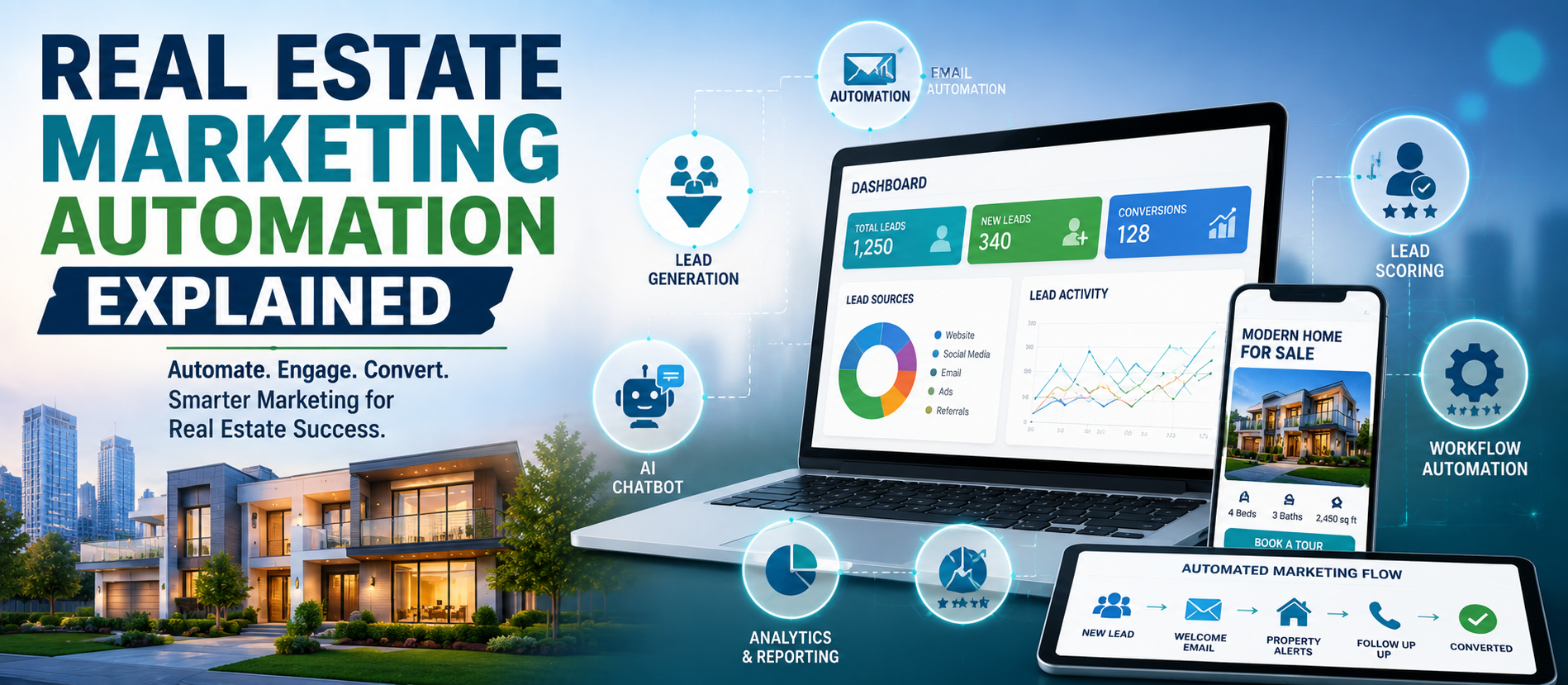
23. Automate Lead Follow-Up Without Losing the Human Touch
Speed matters in real estate. A lead may contact several agents or properties in a short period.
AI automation can send an immediate acknowledgement, collect basic requirements, provide relevant information, and alert a human agent.
A useful workflow is:
- Lead submits an inquiry.
- AI sends a confirmation.
- AI asks basic qualification questions.
- CRM stores the information.
- Lead is assigned a priority.
- Agent receives the lead with context.
- Human agent continues the conversation.
This approach can reduce response delays without making the entire customer experience robotic.
24. AI for Real Estate Market Research
Marketing decisions become stronger when they use current market information.
AI can help organize public market reports, listing data, customer questions, competitor content, and campaign performance.
Potential research areas include:
- Property demand.
- Price trends.
- Buyer questions.
- Neighborhood interest.
- Competitor messaging.
- Content gaps.
- Ad performance.
Always verify important statistics against authoritative sources. AI can summarize information, but it can also misunderstand or combine data incorrectly.
25. AI-Powered Marketing for Real Estate Developers
Developers can use AI across a much larger marketing workflow.
Applications can include demand analysis, buyer segmentation, campaign personalization, project content, lead scoring, sales forecasting, customer communication, and post-sales support.
An EY-Parthenon-CREDAI report published in June 2026 estimated that Gen AI could improve sales velocity by 30–50% for Indian real estate developers and accelerate product launches by around 30%, based on the report's analysis. It also identified use cases across planning, design, construction, sales, and customer engagement. These are reported potential gains, not guaranteed results for every developer.
26. AI Governance and Data Quality
AI marketing needs good governance.
Before deploying AI, define:
- What data the system can access.
- Who can approve AI-generated content.
- Which claims require human verification.
- How customer data is stored.
- Which tasks AI can automate.
- Which decisions require human review.
- How errors are reported and corrected.
Data quality is equally important. An AI system trained on outdated listing information can produce outdated answers.
27. Fair Housing and Responsible AI
Real estate marketing has important legal and ethical responsibilities.
AI should not be used to steer people toward or away from neighborhoods or properties based on protected characteristics. Automated lead scoring and personalization should also be reviewed carefully for discriminatory outcomes.
Zillow has described a housing-specific Fair Housing Classifier in its AI mode to evaluate prompts and responses and help maintain compliance with housing protections.
Every real estate business should understand the laws that apply to its market and use qualified legal advice when necessary.
28. Measure the Right AI Marketing KPIs
AI adoption should be measured by business outcomes, not the number of prompts generated.
| KPI What It Measures | |
| Qualified lead rate | Quality of incoming prospects |
| Lead response time | Speed of follow-up |
| Appointment rate | Movement from inquiry to conversation or tour |
| Cost per qualified lead | Marketing efficiency |
| Conversion rate | Progress toward business outcomes |
| Customer acquisition cost | Total cost of gaining customers |
| Content engagement | Audience response to marketing content |
| AI Search visibility | Presence in relevant AI-generated answers |
| Revenue influenced | Business value associated with marketing activity |
29. Common AI Real Estate Marketing Mistakes
Publishing Unedited AI Content
AI can produce fluent text that contains incorrect facts. Human review is essential.
Using Generic Content
AI makes content production easier. That means generic content can become even more common. Add real expertise, local information, original data, and useful examples.
Optimizing Only for Search Rankings
Modern discovery includes traditional search, property portals, social media, maps, and AI assistants. Build a complete digital presence.
Ignoring Data Quality
AI cannot compensate for inaccurate property or customer data.
Over-Automating Customer Communication
Real estate is a relationship-driven industry. Use automation for speed, but keep human professionals involved in important conversations.
Using AI to Alter Property Reality
Do not use AI to hide defects or make a property appear to have features that do not exist. Transparency is essential.
30. A Practical AI-Powered Real Estate Marketing Workflow
- Collect verified data: Property facts, business information, customer requirements, and campaign data.
- Build the content foundation: Website pages, listings, FAQs, neighborhood content, and professional profiles.
- Add AI production: Generate drafts for descriptions, social posts, emails, and scripts.
- Add AI qualification: Score and route leads using appropriate data.
- Automate follow-up: Create helpful, permission-based nurture sequences.
- Add conversational search: Help visitors find relevant properties using natural language.
- Improve AI visibility: Publish clear, factual, entity-focused content.
- Measure outcomes: Track qualified leads, appointments, conversions, cost, and revenue.
- Review and improve: Check AI outputs, update data, and refine workflows.
Frequently Asked Questions
What is AI-powered real estate marketing?
It is the use of artificial intelligence to improve real estate content, lead generation, personalization, advertising, customer communication, property discovery, analytics, and marketing automation.
How can AI help real estate agents?
AI can help agents create content, respond to basic questions, qualify leads, personalize follow-up, analyze marketing data, prepare listing materials, and improve online visibility.
Can AI generate real estate listing descriptions?
Yes. AI can create drafts from verified property facts. The final description should be reviewed by a human for accuracy, compliance, and local relevance.
Can AI help generate real estate leads?
Yes. AI can support content creation, advertising, lead capture, qualification, recommendations, and automated follow-up. Results depend on the quality of the strategy, data, audience, offer, and execution.
What is GEO in real estate marketing?
GEO, or Generative Engine Optimization, is the practice of making business and informational content easier for AI systems to understand and potentially surface in conversational answers.
How can a real estate business appear in AI search?
Build a consistent digital identity, publish useful factual content, maintain accurate business profiles, develop relevant expertise pages, earn credible reviews and mentions, and answer specific buyer and seller questions clearly.
Can AI replace real estate agents?
AI can automate parts of research, communication, and administration, but real estate transactions still involve human judgment, negotiation, local knowledge, professional services, and legal responsibilities.
Is AI-generated property imagery safe to use?
It can be useful when clearly presented and accurately disclosed. AI should not be used to misrepresent a property's condition, size, features, or appearance.
What should real estate businesses measure when using AI?
Measure business outcomes such as qualified leads, response time, appointments, conversion rate, cost per qualified lead, customer acquisition cost, revenue, and AI Search visibility.
Final AI Real Estate Marketing Checklist
- Use verified property data.
- Use AI to speed up content production.
- Review every important AI-generated claim.
- Personalize marketing based on appropriate data.
- Use AI for lead qualification.
- Automate helpful follow-up.
- Use conversational search where it improves the customer experience.
- Optimize content for traditional search and AI Search.
- Keep business information consistent across the web.
- Publish original local expertise.
- Use virtual tours and accurate visual media.
- Disclose meaningful AI-generated or digitally altered imagery where required.
- Protect customer privacy.
- Review AI workflows for fair-housing risks.
- Measure revenue and qualified leads, not just clicks.
- Keep humans involved in high-impact decisions.
Conclusion
AI-powered real estate marketing is becoming a practical part of the industry. The strongest use cases are not limited to content generation. AI can help businesses understand leads, personalize communication, automate follow-up, improve property discovery, analyze campaigns, support virtual experiences, and build stronger visibility across search and AI platforms.
The biggest opportunity is to connect these capabilities into one system.
Start with accurate data. Build useful content. Create a consistent digital identity. Add automation where it saves time. Use AI to support lead qualification and customer service. Optimize for both traditional search and AI-driven discovery. Then measure the business results.
AI should make real estate marketing more useful, faster, and more relevant. It should not replace accuracy, transparency, local expertise, or human relationships.
Digiifrog: Digital Growth for Modern Businesses
Digiifrog helps businesses build stronger digital visibility through practical content, digital marketing, website strategy, SEO, AEO, GEO, and AI Search-focused solutions.
For more information, visit www.digiifrog.com.
Source Notes
Current 2026 examples and market observations in this article are supported by public information from Zillow, NAR Tech & Innovation, EY-Parthenon and CREDAI, Call Rail, and a 2026 AI Search study from Notable. Platform-specific statistics and reported potential gains are attributed to their original sources and should not be treated as universal guarantees.
Disclaimer: This article is for educational and informational purposes only. AI tools, advertising platforms, privacy requirements, fair-housing rules, and real estate regulations vary by market. Verify current requirements and important business information with qualified professionals before implementation.
Ready to Grow?
Talk to us about a strategy tailored to your brand — we will help you stand out in search, AI discovery and social.

Comments (0)
Log in to leave a comment.