
📋 Quick Summary
In this article:
1. AI Agents Will Move From Assistants to Digital Workers
2. Human-AI Teams Will Become the Normal Work Model
3. AI Will Change Skills More Than It Changes Job Titles
4. AI Coding Will Become a Standard Development Layer
5. AI Will Become a Core Layer of Business Software
6. Robotics Will Expand, but the Physical World Will Be Harder Than the Digital World
7. Autonomous Vehicles Will Expand in More Regions
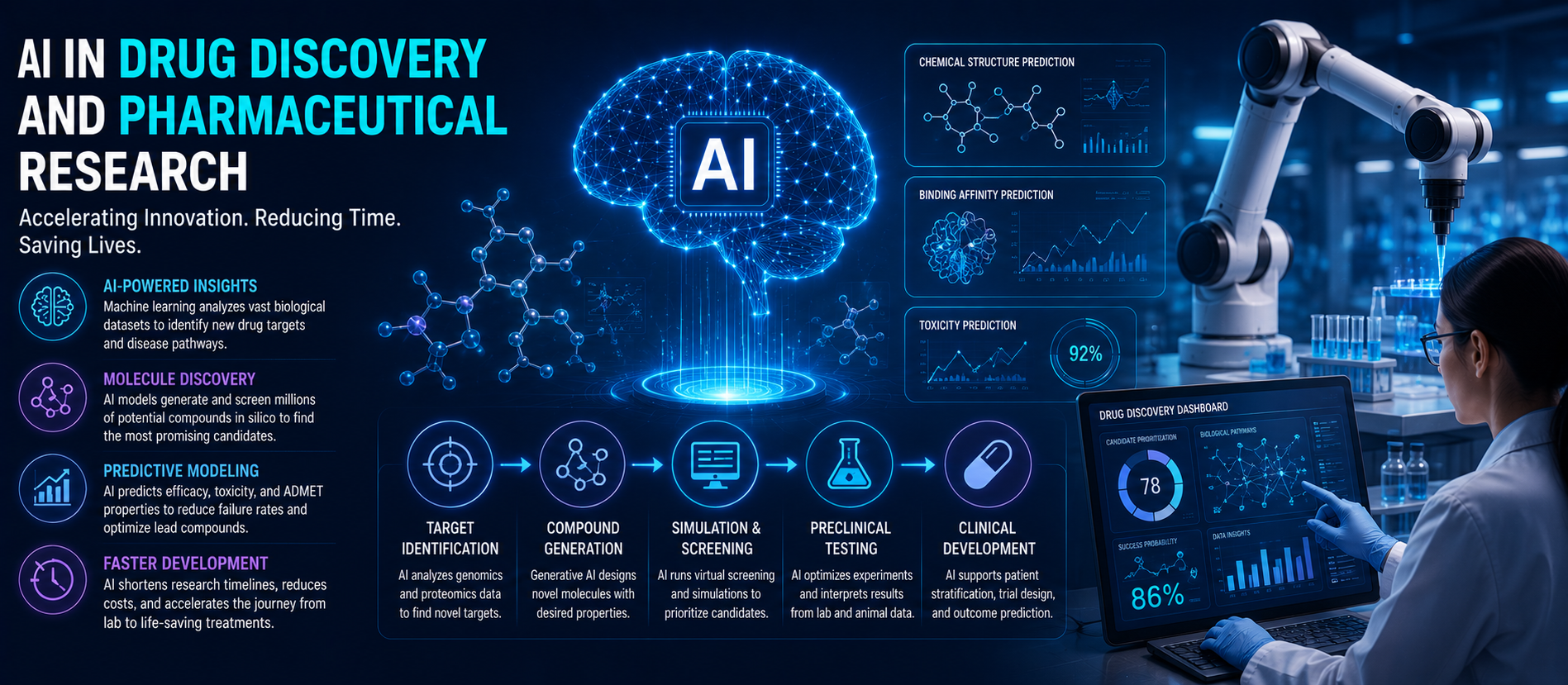
8. AI Will Transform Healthcare, but Medical Oversight Will Remain Essential
9. AI Will Accelerate Scientific Discovery
10. Personalized Education Will Become More Common
11. AI Search Will Change Digital Marketing and SEO
12. AI-Generated Content Will Become Common, but Originality Will Matter More
Artificial intelligence is moving from an experimental technology into a general business and consumer capability. Over the next ten years, AI is likely to become more embedded in software, workplaces, education, healthcare, manufacturing, search, customer service, and everyday devices.
But the future of AI is not certain. Some changes are already visible. Others depend on technical progress, energy availability, regulation, investment, public adoption, and how safely organizations deploy increasingly capable systems.
The 2026 Stanford AI Index reports that AI capability continued to accelerate, organizational adoption reached 88%, and generative AI was used in at least one business function by 70% of surveyed organizations. It also reports rapid progress in AI agents, while noting that agents still fail a significant share of structured computer tasks and robots remain much less capable in unpredictable household environments. These results show both the speed of progress and the limits that remain. Stanford AI Index 2026.
This article explores what the next decade may look like. These are informed predictions, not guarantees. The goal is to identify the major directions that businesses, professionals, educators, and technology leaders should prepare for.
1. AI Agents Will Move From Assistants to Digital Workers
One of the biggest changes will be the growth of AI agents.
Today's AI tools often answer questions or generate content. More advanced agents can plan a task, use software, access approved data, call tools, evaluate results, and continue working through several steps.
Over the next decade, many businesses are likely to use specialized digital workers for repetitive knowledge tasks.
Examples may include:
- Sales research agents.
- Customer support agents.
- SEO research agents.
- Finance reconciliation agents.
- Software testing agents.
- Procurement agents.
- Marketing campaign agents.
- Internal knowledge agents.
- Data analysis agents.
- IT operations agents.
💡 Key Insight
The important change will be workflow ownership. Instead of asking AI to complete one isolated action, employees will increasingly give an agent a goal and a set of permissions.
However, agents will still need boundaries. Stanford's 2026 AI Index reports that AI agents improved sharply on OS World, but still failed roughly one in three structured computer tasks. That suggests that reliable autonomy will require better planning, verification, monitoring, and recovery mechanisms. Stanford AI Index: Technical Performance.
2. Human-AI Teams Will Become the Normal Work Model
The next decade is unlikely to be simply “humans versus AI.” A more practical model is human-AI collaboration.
People will continue to provide goals, judgment, context, accountability, creativity, and relationship management. AI will increasingly handle information processing, drafting, analysis, monitoring, simulation, and repetitive execution.
This will change job descriptions.
A marketing professional may spend less time preparing reports and more time deciding which market opportunities matter. A software developer may spend less time writing routine code and more time designing systems, reviewing AI-generated code, and managing architecture. A customer service employee may spend less time searching internal documents and more time handling complex cases.
The value of human work will increasingly depend on how effectively people can direct, verify, and improve AI systems.
3. AI Will Change Skills More Than It Changes Job Titles
Job titles will not disappear overnight. But the tasks inside many jobs will change.
The World Economic Forum's 2026 report on AI and talent explores multiple possible futures for jobs through 2030 and emphasizes uncertainty rather than one fixed outcome. Its broader workforce research also shows that AI, robotics, energy, and network technologies can affect major job families across agriculture, manufacturing, construction, retail, transport, business, and healthcare. World Economic Forum: AI and Talent in 2030.
Over the next ten years, skills likely to become more valuable include:
- AI literacy.
- Critical thinking.
- Problem framing.
- Data interpretation.
- Cybersecurity awareness.
- Domain expertise.
- Communication.
- AI workflow design.
- Quality assurance.
- Human relationship skills.
The strongest professionals may not be the people who know the most AI prompts. They may be the people who understand their industry and know where AI can safely create leverage.
4. AI Coding Will Become a Standard Development Layer
Software development is already one of the areas where AI has shown strong practical value.
AI coding systems can generate code, explain unfamiliar code, write tests, identify bugs, document functions, refactor modules, and help developers explore solutions.
Over the next decade, the software development process is likely to become more agentic. Developers may describe a feature, provide requirements, review a proposed implementation, and ask AI systems to build and test large parts of the change.
This does not remove the need for developers. It changes the developer's role.
Architecture, security, testing, requirements, data modeling, performance, integration, and long-term maintainability will remain important. AI-generated code still requires review because an apparently correct implementation can contain security or reliability problems.
5. AI Will Become a Core Layer of Business Software
Today's business applications often have AI features added to existing products. Over the next decade, AI is likely to become a basic layer of business software.
CRM systems may summarize customer histories and recommend next actions. Accounting platforms may detect unusual transactions. Project management tools may identify delivery risks. Marketing platforms may generate and test campaign variations. Help-desk systems may resolve routine issues automatically.
This means the question will change from “Should we use AI?” to “Where should AI have permission to act?”
That is a governance question as much as a technology question.
6. Robotics Will Expand, but the Physical World Will Be Harder Than the Digital World
AI is excellent at working with digital information. The physical world is harder.
Real environments contain unpredictable objects, lighting, surfaces, people, weather, obstacles, and unusual situations.
Stanford's 2026 AI Index reports that robots succeed on only about 12% of real household tasks, despite much higher performance in controlled or simulated environments. This gap suggests that physical AI will progress, but deployment will likely expand first in structured environments such as warehouses, factories, logistics facilities, hospitals, and controlled commercial settings. Stanford AI Index 2026.
Over ten years, expect more robots in:
- Warehouses.
- Manufacturing.
- Food production.
- Logistics.
- Agriculture.
- Healthcare support.
- Construction.
- Inspection and maintenance.
Home robots may also improve, but household environments will remain a demanding test of general-purpose physical intelligence.
7. Autonomous Vehicles Will Expand in More Regions
Autonomous driving is already moving beyond laboratory demonstrations.
The 2026 Stanford AI Index reports mass-scale autonomous vehicle deployment in 2025, including large-scale fully driverless ride activity in the United States and China. It also notes that current deployments are concentrated in environments where conditions are relatively favorable and remote human support remains part of the operating model. Stanford AI Index 2026.
Over the next decade, autonomous mobility may expand into more cities and use cases. Robotaxis, autonomous delivery, industrial vehicles, and logistics fleets are likely to develop at different speeds.
The key challenges will remain safety validation, regulation, infrastructure, weather, edge cases, insurance, cybersecurity, and public trust.
8. AI Will Transform Healthcare, but Medical Oversight Will Remain Essential
Healthcare is likely to become one of the most important AI application areas.
AI can support medical imaging, clinical documentation, drug discovery, patient monitoring, administrative work, medical research, and decision support.
Over the next decade, AI may become a routine assistant for clinicians. It may summarize patient histories, identify relevant information, compare records, prepare documentation, and flag patterns for human review.
However, healthcare decisions involve high stakes. Accuracy alone is not enough. Systems must be validated for the relevant population and clinical environment. Privacy, security, explainability, bias, accountability, and human oversight will remain essential.
9. AI Will Accelerate Scientific Discovery
AI is likely to become an important research partner.
Scientists can use AI to search literature, generate hypotheses, analyze experimental data, simulate systems, design molecules, and automate parts of laboratory workflows.
The International AI Safety Report 2026 notes that current AI progress is particularly strong in mathematics, coding, and science-related tasks, while future capability trajectories remain uncertain. It also notes that AI systems may contribute to AI research itself, potentially accelerating progress. International AI Safety Report 2026.
Over the next ten years, the biggest scientific impact may come from systems that connect reasoning, simulation, tools, data, and laboratory automation.
10. Personalized Education Will Become More Common
Education is another area where AI can provide highly personalized support.
An AI tutor can adjust explanations, create practice questions, identify knowledge gaps, and provide feedback at a student's level.
Teachers may use AI to prepare lesson materials, analyze learning patterns, create differentiated exercises, and reduce administrative work.
But education is not only about information delivery. Students also need motivation, social interaction, judgment, collaboration, and human mentorship.
The future classroom is therefore likely to combine human teaching with AI-supported personalization rather than replace teachers entirely.
11. AI Search Will Change Digital Marketing and SEO
Search will become more conversational and multimodal.
Users will ask longer questions. AI systems will summarize information. Search interfaces will combine text, images, video, maps, products, and generated answers.
This means SEO will expand beyond traditional rankings.
Businesses will need to think about:
- Traditional search visibility.
- Answer engine optimization.
- Generative Engine Optimization.
- AI citations.
- Brand mentions.
- Entity consistency.
- Structured content.
- First-party expertise.
- Multimodal search.
AI Search will make content quality even more important. Businesses will need clear facts, useful explanations, strong topic coverage, credible sources, and consistent brand information.
12. AI-Generated Content Will Become Common, but Originality Will Matter More
Over the next decade, generating text, images, video, audio, presentations, and software will become increasingly easy.
This creates a paradox.
When content production becomes cheap, content itself becomes less scarce. Attention and trust become more valuable.
Businesses will therefore need to distinguish themselves through original research, first-party data, real customer experience, expert analysis, unique examples, and useful products.
AI will make publishing easier. It will not automatically make content valuable.
13. AI Video and Synthetic Media Will Grow Rapidly
Text-to-video and multimodal generation will become more capable and accessible.
Businesses will use AI for product demonstrations, training, advertising, localization, education, social media, internal communication, and simulations.
At the same time, synthetic media will make verification more important. Organizations will need stronger provenance practices, identity verification, media literacy, and security controls.
The challenge will not simply be detecting fake media. It will also be establishing reliable evidence for authentic media.
14. AI Cybersecurity Will Become a Two-Sided Battle
Defenders will use AI to analyze alerts, detect anomalies, summarize incidents, identify suspicious behavior, and automate routine security operations.
Attackers can also use AI to scale phishing, social engineering, malware development, reconnaissance, and fraud.
The International AI Safety Report 2026 identifies misuse, malfunction, and systemic risks as major categories of concern and notes that AI-generated content is already being used in deception and fraud. International AI Safety Report 2026.
Over the next decade, cybersecurity teams will increasingly need AI-aware defenses. Security will also need to be built into AI agents themselves.
15. AI Safety and Governance Will Become Core Business Functions
As AI systems become more capable, businesses will need clearer controls.
AI governance may include:
- AI system inventories.
- Risk classification.
- Approval workflows.
- Data governance.
- Model evaluations.
- Human oversight.
- Access controls.
- Audit logs.
- Incident response.
- Vendor assessments.
- Continuous monitoring.
The International AI Safety Report 2026 emphasizes that future AI capability trajectories are uncertain. It also describes risks from misuse, malfunctions, and widespread systemic effects. This uncertainty makes ongoing evaluation more important than one-time certification. International AI Safety Report 2026.
16. AI Regulation Will Become More Detailed
Governments are developing frameworks for AI safety, transparency, privacy, accountability, and high-impact uses.
Over the next decade, organizations will likely face more detailed requirements around documentation, risk management, transparency, data governance, and accountability. Requirements will differ by country and industry.
Businesses should therefore avoid treating compliance as a one-time legal project. AI governance should be integrated into product development and operational processes.
17. AI Infrastructure Will Become a Strategic Resource
Advanced AI requires large amounts of computing infrastructure. Data centers, chips, networking, cooling, and electricity will become increasingly important to AI economics.
Stanford's 2026 AI Index reports that the United States hosts the largest number of AI data centers and that the AI hardware supply chain remains highly concentrated. It also highlights energy consumption as an important part of the AI infrastructure story. Stanford AI Index 2026.
Over the next decade, access to compute may become a strategic business consideration. Companies will care about inference cost, latency, energy use, hardware availability, model efficiency, and infrastructure resilience.
18. Smaller and Specialized AI Models Will Remain Important
Not every task needs the largest possible model.
Businesses will increasingly use a mix of large frontier models, smaller models, domain-specific models, local models, and traditional software.
Smaller models can offer lower cost, faster response times, greater privacy, and easier deployment for focused tasks.
The future AI stack will therefore be heterogeneous. Businesses will choose models based on the job rather than using one model for everything.
19. AI Will Become More Multimodal
AI systems will increasingly work across text, images, audio, video, documents, sensor data, and software interfaces.
A customer may upload a product image and ask a question. A technician may show a machine through a camera and receive troubleshooting assistance. A doctor may combine clinical notes, images, and test results within an AI-supported workflow.
Multimodal AI will make digital interfaces more natural, but it will also create new privacy and security questions.
20. AI Will Become More Context-Aware
Future AI systems will need more than raw intelligence. They will need context.
Business AI systems may understand approved company policies, customer histories, product catalogs, internal documentation, workflows, and user permissions.
This could make AI far more useful because the system can act within a specific environment.
But context creates security risks. Sensitive business information must be protected. Permissions must be limited. AI agents should not automatically access everything available to an employee.
21. AI Memory Will Become a Major Product Feature
Today's AI conversations can be temporary and fragmented. Over the next decade, persistent context may become a normal part of AI systems.
AI assistants may remember preferences, projects, workflows, previous decisions, and approved information.
This could make AI dramatically more useful. It could also create new privacy questions.
Organizations will need clear policies about what an AI system can remember, how long it can retain information, who can access it, and how users can correct or remove information.
22. AI Will Create New Business Models
AI will not only automate existing businesses. It will enable new ones.
Small teams may build products that previously required large operations. AI-native agencies may deliver highly automated services. Specialized AI applications may serve narrow industries such as legal research, logistics, manufacturing, education, or agriculture.
The cost of launching certain digital services may fall. This could increase competition and create new opportunities for entrepreneurs.
23. AI Adoption Will Depend on Trust
Technical capability alone will not determine adoption.
People need to trust that AI systems are accurate enough, secure enough, understandable enough, and controllable enough for the task.
Businesses will increasingly compete on AI reliability. A system that occasionally produces impressive results but frequently fails in important workflows may be less useful than a narrower system that behaves consistently.
24. AI Evaluation Will Become More Important Than AI Demonstrations
AI demos can look impressive. Real-world reliability is harder.
Stanford's 2026 AI Index reports that AI benchmarks are increasingly facing saturation, reliability, and gaming concerns. It also shows a “jagged” capability profile: systems can perform extremely well on some difficult tasks while still failing surprisingly simple ones. Stanford AI Index 2026.
Over the next decade, organizations will increasingly need task-specific evaluations.
Instead of asking, “How intelligent is this model?” businesses will ask:
- How accurate is it for our workflow?
- How often does it fail?
- What types of errors occur?
- Can we detect those errors?
- Can a human recover from them?
- What does the system cost?
- How secure is it?
- How does performance change over time?
25. AI Will Accelerate AI Research Itself
One of the most important long-term possibilities is that AI systems will increasingly assist researchers who build AI systems.
AI can help write code, test algorithms, analyze experiments, optimize workflows, and search research literature.
If AI-assisted research becomes more effective, progress could accelerate. But the International AI Safety Report 2026 stresses that future trajectories remain highly uncertain. Technical limits, energy constraints, economics, and other factors could slow progress, while positive feedback loops could accelerate it. International AI Safety Report 2026.
What the Next 10 Years May Look Like
A useful way to think about the next decade is through stages.
2026–2028: AI Moves Into Workflows
Businesses will expand AI copilots, agents, automation, coding tools, customer service systems, research assistants, and content workflows. Evaluation and governance will become more important as organizations move from experiments to production.
2029–2031: AI Becomes an Operating Layer
AI may become deeply integrated into business software. Agents may coordinate tasks across several systems. More organizations will build AI governance into normal operations.
2032–2035: AI Becomes More Embedded in the Physical and Economic World
Robotics, autonomous systems, personalized services, scientific AI, multimodal assistants, and AI-powered infrastructure may become more widespread. The difference between “software with AI” and “AI-native software” may become less important because AI will be part of the basic computing environment.
These time periods are not fixed forecasts. Adoption will differ across countries, industries, and organizations.
How Businesses Should Prepare for the Next 10 Years
1. Build an AI Inventory
List the AI tools and systems already used by employees. Include unofficial or shadow AI usage where possible.
2. Start With High-Value Workflows
Look for repetitive processes with measurable outcomes. Good candidates often involve research, documentation, customer support, reporting, classification, and data processing.
3. Keep Humans in High-Impact Decisions
Use stronger review controls when AI affects employment, finance, healthcare, legal matters, safety, or other sensitive decisions.
4. Invest in Data Quality
AI systems depend on useful data. Improve data governance, access controls, quality checks, and documentation.
5. Measure Before Scaling
Define success metrics before deploying AI. Track accuracy, time saved, cost, customer outcomes, failure rates, security incidents, and business value.
6. Train Employees
Employees need more than prompt-writing skills. They need to understand verification, privacy, security, AI limitations, automation boundaries, and responsible use.
7. Design for Change
AI technology will evolve quickly. Avoid building systems that depend too heavily on one model or one vendor when flexibility is practical.
AI Predictions: What Is Certain and What Is Uncertain?
Some trends are already visible. AI adoption is rising. Models are becoming more capable. Agents are improving. AI is entering business workflows. Robotics is advancing. Autonomous driving is expanding in selected markets. AI infrastructure is growing.
Other questions remain uncertain.
It is difficult to know exactly how fast frontier capabilities will improve, how quickly general-purpose robotics will mature, which AI business models will dominate, how regulation will differ across countries, and how labor markets will adjust.
The International AI Safety Report 2026 explicitly presents a range of possible capability trajectories and notes that there is little expert consensus about which trajectory is most likely. That uncertainty should be part of every serious long-term AI strategy. International AI Safety Report 2026.
Conclusion
The next ten years of AI are likely to be defined by integration rather than a single dramatic invention.
AI agents will become more capable. Human-AI teams will become common. Software development will become more AI-assisted. Robotics will expand into structured physical environments. Healthcare and education will become more personalized. AI Search will change how people discover information. Cybersecurity will become an AI-versus-AI competition. AI governance and evaluation will become standard business practices.
But the future will not be determined by model capability alone. Trust, infrastructure, energy, economics, regulation, security, data quality, and human adoption will shape what actually happens.
The most useful preparation is not to predict one exact future. It is to build organizations that can adapt as AI changes.
For businesses, the key principle is simple: experiment early, measure carefully, protect sensitive information, keep humans accountable, and build systems that can evolve.
AI will change the way people work and interact with technology. The organizations that learn how to combine AI capability with human judgment will be better positioned to navigate the next decade.
Digiifrog helps businesses explore modern digital marketing, AI, automation, and technology strategies. Learn more at www.digiifrog.com.
Frequently Asked Questions About AI Predictions for the Next 10 Years
What will AI be able to do in 10 years?
AI may become substantially better at reasoning, software development, research, multimodal interaction, automation, and agentic workflows. The exact level of capability is uncertain.
Will AI replace human jobs?
AI is likely to automate some tasks and change many jobs. The effect will vary by occupation, industry, country, and adoption strategy. Many roles are more likely to be redesigned than simply eliminated.
Will AI agents replace employees?
AI agents may take over some repetitive digital workflows, but reliable autonomy remains limited. Organizations will need to decide which tasks can be automated and where human review is required.
Will robots become common in homes?
Robots are likely to improve, but household environments are much harder than controlled industrial settings. Wider home adoption will depend on reliability, cost, safety, and practical usefulness.
How will AI change SEO?
SEO will increasingly include traditional rankings, answer-focused content, AI citations, entity visibility, multimodal search, and generative AI discovery. Strong technical SEO and useful content will remain important.
Will AI make content creation free?
AI can reduce the cost of producing drafts and media, but valuable content still requires research, expertise, originality, verification, editing, and distribution.
What is the biggest AI risk over the next decade?
There is no single agreed biggest risk. Current research discusses misuse, system failures, cybersecurity threats, labor-market disruption, information harms, systemic effects, and more uncertain frontier risks.
How should a small business prepare for AI?
Start with a small number of measurable workflows. Improve data quality, train employees, establish basic AI-use policies, protect confidential information, test tools carefully, and measure business outcomes.
Ready to Grow?
Talk to us about a strategy tailored to your brand — we will help you stand out in search, AI discovery and social.

Comments (0)
Log in to leave a comment.