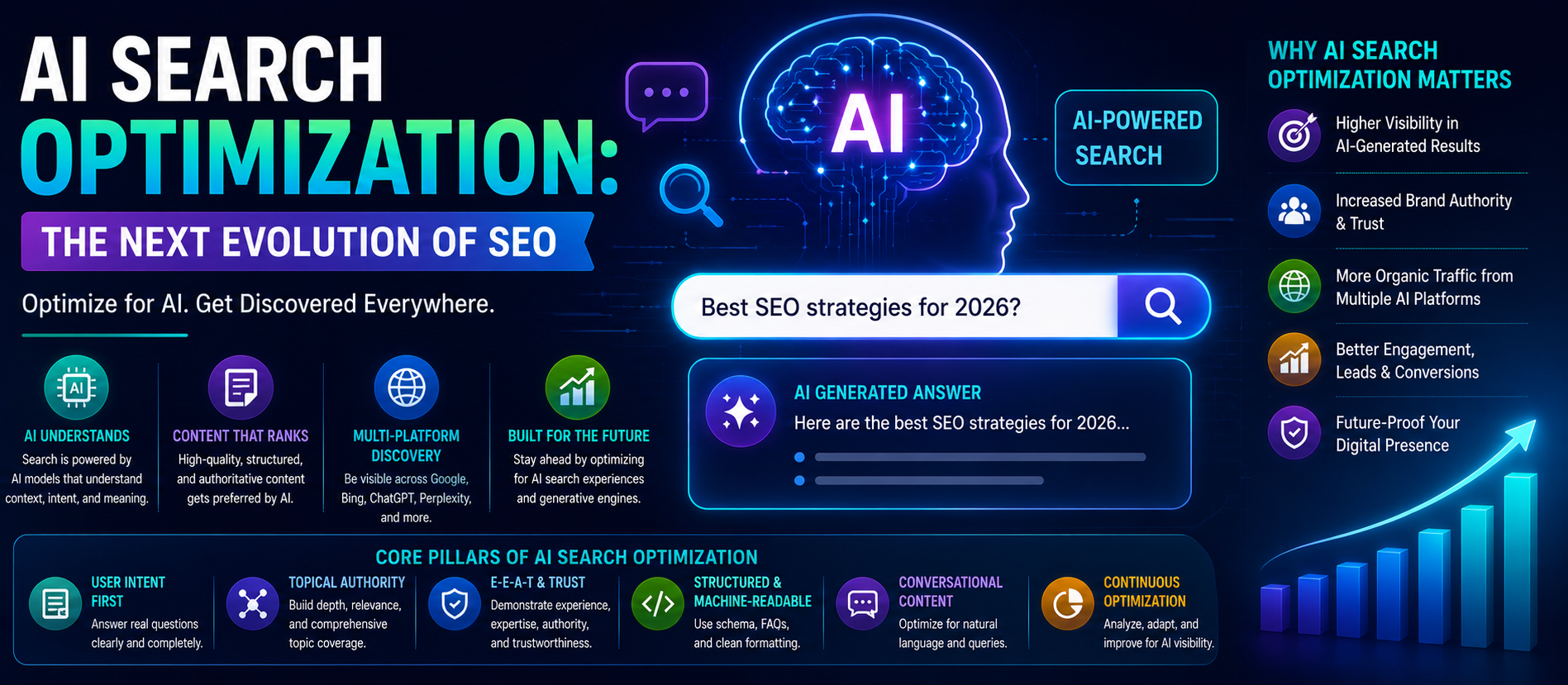
📋 Quick Summary
In this article:
What Is AI Search Optimization?
The Evolution from SEO to AI Search Optimization
The Relationship Between SEO, AEO, GEO, and AI Search Optimization
How AI Systems Evaluate Content
Build Strong E-E-A-T Signals
Focus on Conversational Content
💡 Key Insight
The digital marketing landscape is experiencing one of the most significant transformations since the birth of search engines. Artificial Intelligence is changing how users discover information, interact with content, and make purchasing decisions. Traditional Search Engine Optimization (SEO) remains important, but a new discipline is rapidly emerging: AI Search Optimization.
In 2026, search behavior is no longer limited to typing keywords into Google. Users increasingly interact with AI-powered assistants, conversational search platforms, answer engines, and generative AI systems that provide direct responses rather than lists of website links.
This shift has created new challenges and opportunities for businesses seeking online visibility. Organizations that adapt to AI Search Optimization (AISO) will gain competitive advantages, while those relying solely on traditional SEO may struggle to maintain visibility.
This comprehensive guide explores AI Search Optimization, explains why it matters, and outlines practical strategies businesses can use to succeed in the next evolution of search.
What Is AI Search Optimization?
AI Search Optimization refers to the process of optimizing content, websites, and digital assets so they can be discovered, understood, and referenced by artificial intelligence-powered search systems.
Unlike traditional search engines that primarily rank web pages, AI-powered systems generate responses by analyzing, interpreting, and synthesizing information from multiple sources.
Examples of AI-powered search experiences include:
- Conversational AI assistants
- AI-generated search summaries
- Answer engines
- Generative search experiences
- Voice assistants
- Knowledge-based AI systems
AI Search Optimization helps businesses remain visible within these emerging environments.
The Evolution from SEO to AI Search Optimization
Traditional SEO focused on ranking web pages for specific keywords.
Businesses optimized title tags, meta descriptions, backlinks, content, and technical SEO to improve rankings.
Today, AI-powered search systems increasingly provide direct answers instead of directing users to multiple websites.
This evolution requires marketers to think beyond rankings and focus on becoming trusted information sources.
SEO is evolving rather than disappearing.
AI Search Optimization represents the next stage of search visibility.
Why AI Search Matters in 2026
Consumer behavior is changing rapidly.
Users increasingly prefer conversational interactions because they provide faster, more personalized experiences.
Benefits of AI-powered search include:
- Direct answers
- Personalized recommendations
- Contextual understanding
- Natural language interactions
- Improved efficiency
As adoption grows, businesses must optimize for AI-driven discovery channels.
The Relationship Between SEO, AEO, GEO, and AI Search Optimization
AI Search Optimization does not replace SEO.
Instead, it builds upon existing optimization strategies.
Modern search visibility now involves four interconnected disciplines:
- SEO (Search Engine Optimization)
- AEO (Answer Engine Optimization)
- GEO (Generative Engine Optimization)
- AI Search Optimization
Together, these approaches help businesses maintain visibility across traditional and AI-powered search environments.
Understanding AEO
Answer Engine Optimization focuses on helping content appear within direct-answer environments.
Examples include:
- Featured snippets
- Answer boxes
- Voice search responses
- FAQ results
AEO prepares content for answer-focused experiences.
Understanding GEO
Generative Engine Optimization focuses on improving visibility within AI-generated responses.
AI systems increasingly synthesize information from trusted sources to create answers.
Businesses must establish authority, trustworthiness, and expertise to become reference-worthy sources.
GEO has become a crucial component of AI Search Optimization.
How AI Systems Evaluate Content
Modern AI systems analyze far more than keywords.
Important evaluation factors include:
- Content quality
- Authority
- Expertise
- Trustworthiness
- Contextual relevance
- Semantic relationships
- Entity recognition
Businesses must optimize for meaning and value rather than keyword density alone.
Create Authoritative Content
Authority has become one of the most important visibility factors.
Businesses should create content that:
- Demonstrates expertise
- Provides original insights
- Includes research and data
- Solves user problems
- Maintains accuracy
Authoritative content is more likely to be referenced by AI systems.
Build Strong E-E-A-T Signals
Experience, Expertise, Authoritativeness, and Trustworthiness remain essential.
Strong E-E-A-T signals help both search engines and AI systems evaluate content quality.
Businesses can improve E-E-A-T by:
- Publishing expert content
- Displaying author credentials
- Providing transparent information
- Maintaining accuracy
- Earning reputable mentions
Optimize for Entities
AI systems increasingly rely on entities rather than keywords.
Entities represent people, organizations, products, locations, and concepts.
Businesses should clearly define:
- Brand identity
- Products
- Services
- Industry expertise
- Relationships between concepts
Entity optimization improves AI understanding.
Implement Structured Data
Schema markup helps AI systems interpret content more effectively.
Important schema types include:
- Article Schema
- FAQ Schema
- Organization Schema
- Product Schema
- Review Schema
Structured data improves discoverability and comprehension.
Focus on Conversational Content
Users increasingly interact with AI systems using natural language.
Businesses should create content that mirrors real conversations.
Strategies include:
- Question-based headings
- FAQ sections
- Natural language phrasing
- Direct answers
Conversational content aligns with AI search behavior.
Optimize for Voice Search
Voice search continues growing alongside AI assistants.
Voice optimization involves:
- Natural language content
- Local SEO optimization
- Question-based queries
- Fast website performance
Voice search and AI search increasingly overlap.
Develop Topic Clusters
AI systems favor websites demonstrating comprehensive expertise.
Topic clusters help establish authority by covering entire subject areas.
Effective clusters include:
- Pillar pages
- Supporting articles
- Internal linking
- Related resources
Topic depth improves AI understanding and visibility.
Strengthen Brand Authority
AI systems increasingly prioritize trusted brands.
Authority-building strategies include:
- Digital PR
- Thought leadership
- Media coverage
- Industry recognition
- Expert contributions
Brand authority influences AI recommendations.
Improve Technical SEO Foundations
Technical SEO remains critical.
AI systems benefit from websites that are:
- Fast
- Secure
- Mobile-friendly
- Well-structured
- Easily crawlable
Technical excellence supports AI Search Optimization.
Measure AI Search Visibility
Businesses should track emerging AI visibility metrics.
Potential indicators include:
- AI-driven traffic
- Brand mentions
- Content citations
- Featured answer appearances
- Conversational search visibility
Measurement helps guide optimization efforts.
Common AI Search Optimization Mistakes
- Relying only on keywords
- Ignoring authority signals
- Publishing thin content
- Neglecting structured data
- Failing to optimize for entities
- Ignoring conversational search behavior
Avoiding these mistakes improves long-term visibility.
The Future of AI Search
AI-powered discovery will continue expanding.
Future trends may include:
- More personalized results
- Improved contextual understanding
- Advanced conversational interfaces
- Greater reliance on trusted sources
- Enhanced predictive recommendations
Businesses that adapt early will gain lasting advantages.
Why Businesses Must Act Now
AI Search Optimization is not a future concept—it is already shaping online visibility.
Organizations that invest in authority, expertise, content quality, structured data, AEO, and GEO will be better positioned for success.
Waiting too long may result in lost visibility and reduced competitiveness.
Conclusion
AI Search Optimization represents the next evolution of SEO. As AI-powered search systems increasingly influence how users discover information, businesses must evolve their strategies beyond traditional rankings.
Success requires combining SEO, AEO, GEO, content authority, technical excellence, and AI-friendly content structures.
Organizations that embrace AI Search Optimization today will gain stronger visibility, greater trust, and sustainable digital growth tomorrow.
Digiifrog helps businesses succeed in the AI era through advanced SEO, AEO, GEO, AI Search Optimization, content marketing, authority building, and performance-driven digital growth strategies.
Website: www.digiifrog.com
Whether you are a startup, local business, eCommerce brand, or enterprise organization, Digiifrog provides innovative AI Search Optimization solutions designed to maximize visibility across both traditional and AI-powered search environments.
Ready to Grow?
Talk to us about a strategy tailored to your brand — we will help you stand out in search, AI discovery and social.


Comments (0)
Log in to leave a comment.