📋 Quick Summary
In this article:
Why AI Is Changing Cyber Security
The Growing Need for AI Security Tools in 2026
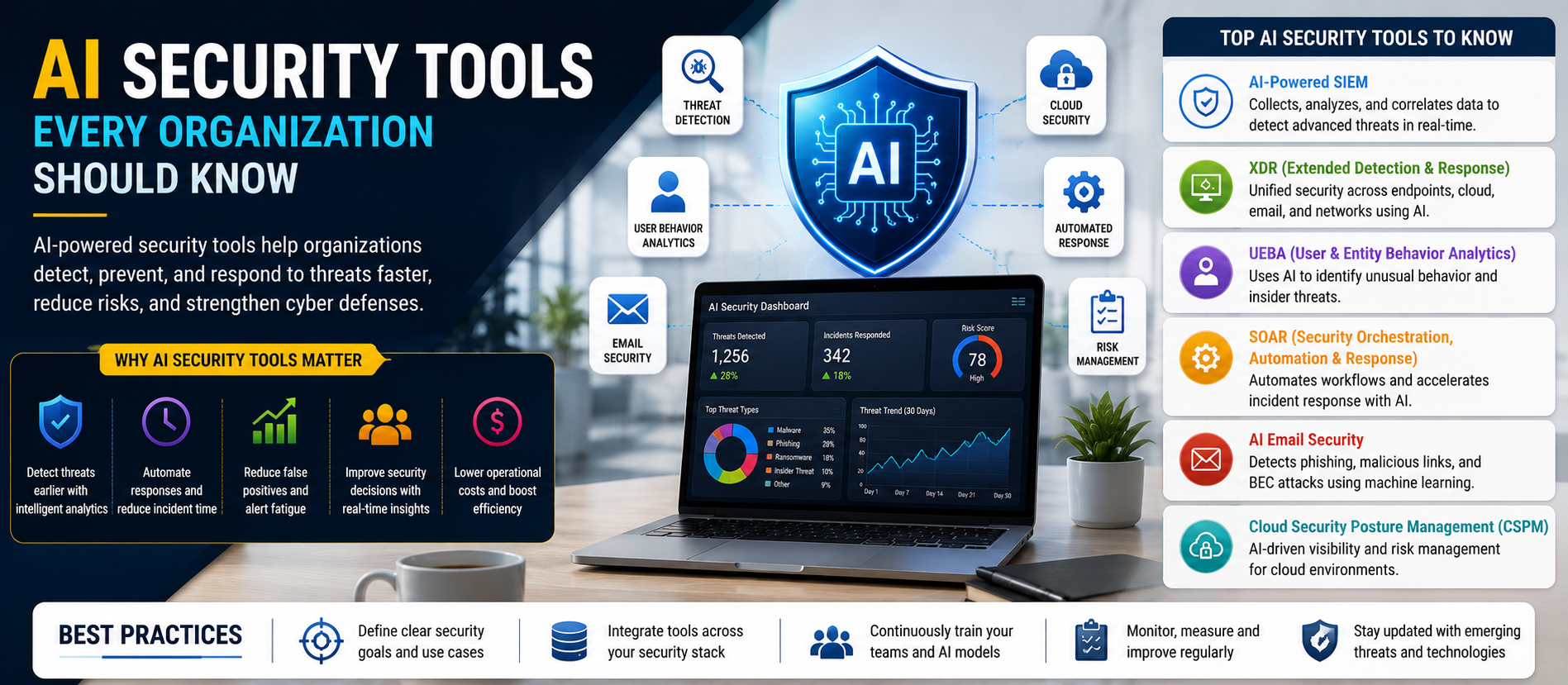
1. AI-Powered Threat Detection Platforms
2. Security Information and Event Management (SIEM) with AI
3. Extended Detection and Response (XDR)
4. Endpoint Detection and Response (EDR)
5. User and Entity Behavior Analytics (UEBA)
6. AI-Powered Email Security Solutions
7. AI Threat Intelligence Platforms
8. AI Security Orchestration, Automation, and Response (SOAR)
9. Network Detection and Response (NDR)
10. AI-Powered Vulnerability Management
Artificial Intelligence (AI) has transformed the cyber security landscape. While cyber criminals are increasingly using AI to automate attacks, create sophisticated phishing campaigns, and identify vulnerabilities, organizations are leveraging AI-powered security tools to strengthen defenses, improve threat detection, and accelerate incident response.
In 2026, traditional security tools alone are no longer sufficient to defend against modern cyber threats. Businesses need intelligent systems capable of analyzing massive amounts of data, detecting anomalies, predicting attacks, and responding to incidents in real time.
💡 Key Insight
This comprehensive guide explores the most important AI security tools and technologies every organization should know, how they work, their benefits, implementation strategies, and future trends shaping cyber defense.
Why AI Is Changing Cyber Security
Modern networks generate enormous amounts of security data every second. Human analysts alone cannot effectively process this volume of information.
AI-powered security tools help organizations:
- Detect threats faster
- Reduce alert fatigue
- Automate investigations
- Improve incident response
- Identify anomalies
- Predict future risks
- Strengthen security operations
AI enhances human expertise rather than replacing security professionals.
The Growing Need for AI Security Tools in 2026
Organizations face an increasingly complex threat landscape.
Key challenges include:
- Ransomware attacks
- Advanced persistent threats (APTs)
- Insider threats
- Cloud security risks
- Supply chain attacks
- AI-powered cybercrime
- Remote workforce security
AI security tools provide the scalability and speed needed to address these challenges.
1. AI-Powered Threat Detection Platforms
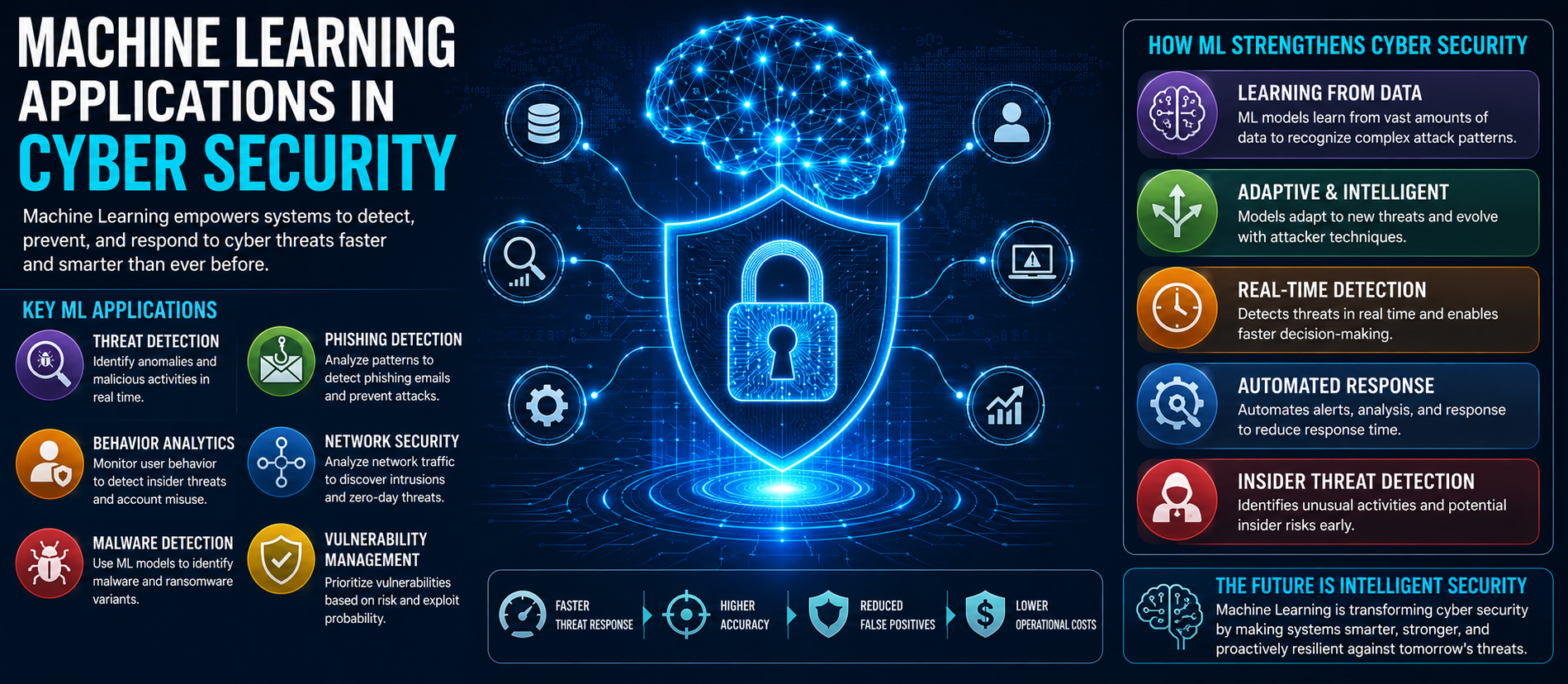
Threat detection platforms use machine learning algorithms to identify suspicious activity across networks, endpoints, cloud environments, and applications.
Capabilities include:
- Behavior analysis
- Anomaly detection
- Threat prioritization
- Risk scoring
- Real-time monitoring
These tools help organizations identify threats before significant damage occurs.
2. Security Information and Event Management (SIEM) with AI
Modern SIEM solutions increasingly incorporate artificial intelligence and machine learning.
AI-enhanced SIEM platforms provide:
- Threat correlation
- Automated investigations
- Predictive analytics
- Behavioral monitoring
- Advanced threat hunting
AI improves detection accuracy while reducing false positives.
3. Extended Detection and Response (XDR)
XDR platforms combine security telemetry from multiple sources into a unified system.
AI-driven XDR solutions analyze data from:
- Endpoints
- Networks
- Email systems
- Cloud environments
- Identity platforms
This holistic visibility improves threat detection and response capabilities.
4. Endpoint Detection and Response (EDR)
Endpoints remain primary targets for cyber attackers.
AI-powered EDR tools monitor:
- User activity
- Application behavior
- File access patterns
- System changes
- Malware indicators
EDR platforms can automatically isolate compromised devices to contain threats.
5. User and Entity Behavior Analytics (UEBA)
UEBA tools use AI to establish normal behavior patterns for users and devices.
These solutions detect:
- Insider threats
- Account compromise
- Privilege abuse
- Suspicious logins
- Data exfiltration attempts
Behavioral analytics provide valuable context for security teams.
6. AI-Powered Email Security Solutions
Email remains one of the most common attack vectors.
AI email security tools identify:
- Phishing emails
- Spear phishing attacks
- Business Email Compromise (BEC)
- Malicious attachments
- Suspicious URLs
Machine learning models continuously adapt to evolving phishing tactics.
7. AI Threat Intelligence Platforms
Threat intelligence solutions aggregate information from multiple sources and use AI to identify emerging threats.
Capabilities include:
- Threat prediction
- Risk assessment
- Campaign tracking
- Threat prioritization
- Indicator correlation
Organizations gain proactive visibility into the threat landscape.
8. AI Security Orchestration, Automation, and Response (SOAR)
SOAR platforms automate repetitive security tasks and workflows.
Benefits include:
- Automated investigations
- Incident response automation
- Workflow orchestration
- Faster remediation
- Reduced analyst workload
AI enables more intelligent decision-making during incident response.
9. Network Detection and Response (NDR)
NDR tools use AI to analyze network traffic and identify abnormal behavior.
They help detect:
- Lateral movement
- Data exfiltration
- Command-and-control communications
- Malware activity
- Unauthorized access attempts
Network monitoring becomes significantly more effective with AI-driven analytics.
10. AI-Powered Vulnerability Management
Traditional vulnerability scanning often produces overwhelming numbers of findings.
AI-enhanced vulnerability management solutions help:
- Prioritize vulnerabilities
- Assess exploitability
- Predict attack likelihood
- Recommend remediation actions
Organizations can focus resources on the highest-risk vulnerabilities.
11. AI-Based Identity Security Platforms
Identity has become the new security perimeter.
AI-powered identity tools monitor:
- Authentication behavior
- Login locations
- Device trust
- Access requests
- Credential misuse
Adaptive authentication improves security while maintaining user convenience.
12. Cloud Security AI Solutions
Cloud adoption continues accelerating across industries.
AI-powered cloud security tools assist with:
- Configuration monitoring
- Access management
- Threat detection
- Compliance tracking
- Resource visibility
Cloud security remains a top priority for modern organizations.
Benefits of AI Security Tools
Organizations adopting AI security technologies experience several advantages:
- Faster threat detection
- Reduced response times
- Improved threat visibility
- Enhanced automation
- Greater scalability
- Lower operational costs
- Better risk management
AI enables security teams to focus on strategic tasks rather than repetitive investigations.
Challenges of AI Security Implementation
Despite their benefits, AI security tools also present challenges.
Common concerns include:
- Implementation complexity
- Data quality issues
- Model bias
- False positives
- Skills shortages
- Privacy concerns
Organizations must carefully evaluate and manage AI deployments.
Best Practices for Deploying AI Security Tools
- Define security objectives clearly
- Integrate AI with existing tools
- Train security teams properly
- Maintain high-quality data sources
- Monitor AI performance continuously
- Conduct regular audits
- Implement Zero Trust principles
Successful deployment requires a strategic approach.
Future Trends in AI Security
Several innovations will shape the future of AI-powered cyber defense:
- Autonomous threat response
- Generative AI security assistants
- Predictive threat intelligence
- AI-powered threat hunting
- Self-healing security systems
- Quantum-resistant security frameworks
Organizations that embrace these developments will gain stronger cyber resilience.
AEO & GEO Optimized Frequently Asked Questions
What are AI security tools?
AI security tools use artificial intelligence and machine learning to detect, analyze, and respond to cyber threats more efficiently.
Why are AI security tools important?
They improve threat detection, automate investigations, reduce alert fatigue, and enhance incident response capabilities.
Can AI stop cyber attacks completely?
No. AI significantly improves security but should be combined with human expertise, policies, and traditional security controls.
What is AI-powered threat detection?
AI-powered threat detection analyzes behavior patterns and anomalies to identify potential cyber threats in real time.
How can businesses adopt AI security tools?
Organizations should evaluate risks, define objectives, integrate AI with existing security infrastructure, and train staff appropriately.
Conclusion
AI security tools have become essential components of modern cyber defense strategies. As cyber threats grow more sophisticated, organizations need intelligent systems capable of processing massive amounts of data, detecting hidden threats, and responding rapidly.
From SIEM and XDR platforms to AI-powered email security, threat intelligence, vulnerability management, and behavioral analytics, these technologies help businesses strengthen security while improving operational efficiency.
Organizations that invest in AI-powered security solutions today will be better prepared to defend against the evolving cyber threats of tomorrow.
For more expert insights on Cyber Security, Artificial Intelligence, Cloud Security, SEO, AEO, GEO, AI Search Optimization, and Digital Transformation, visit Digiifrog at www.digiifrog.com.
Ready to Grow?
Talk to us about a strategy tailored to your brand — we will help you stand out in search, AI discovery and social.

Comments (0)
Log in to leave a comment.