📋 Quick Summary
In this article:
What Is AI in Energy Management?
Why Energy Management Needs Artificial Intelligence
How AI-Powered Energy Management Works
AI for Energy Demand Forecasting
AI and Renewable Energy Integration
Predictive Maintenance for Energy Assets
AI in Building Energy Management
Industrial Energy Optimization
AI, Energy Storage, and Electric Vehicles
The Energy Cost of Artificial Intelligence
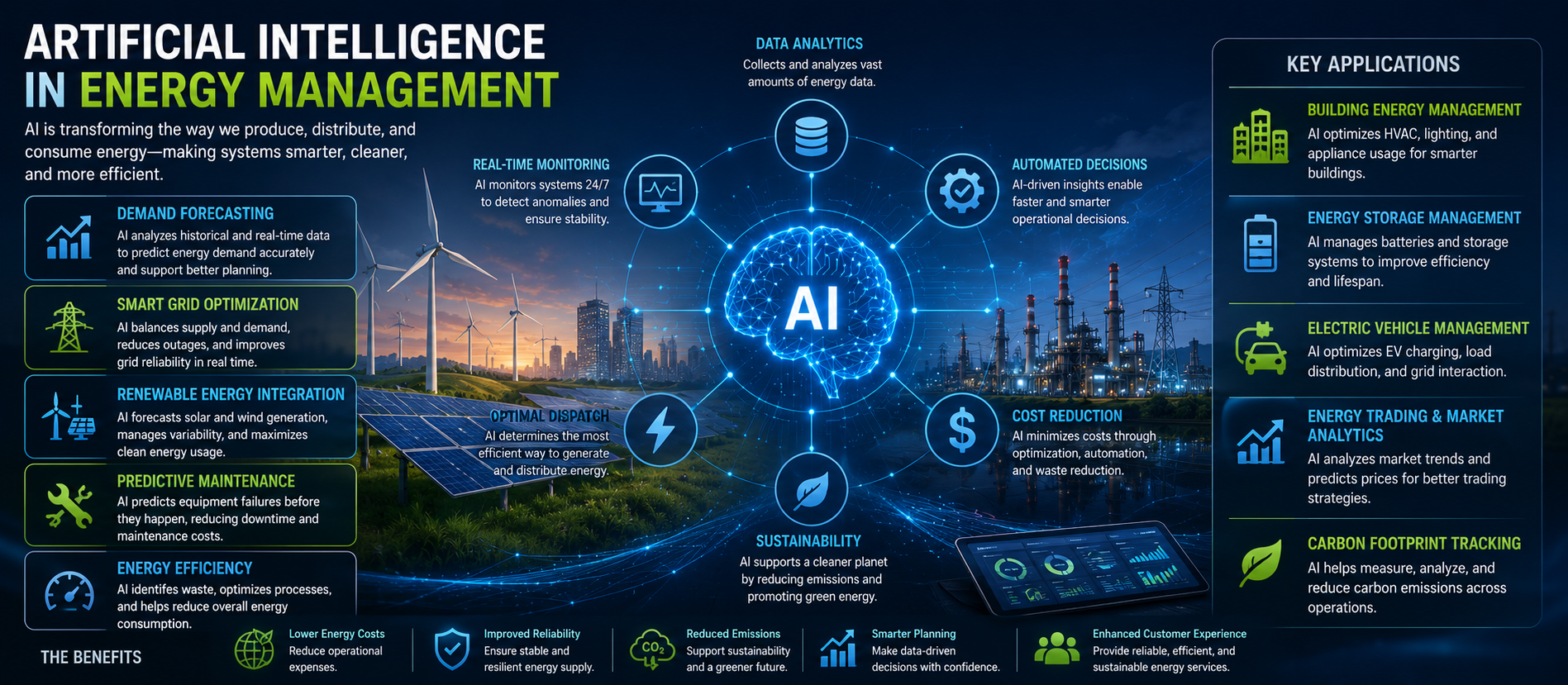
Artificial intelligence in energy management is transforming how businesses, utilities, cities, and consumers monitor, predict, optimize, and control energy use. As electricity systems become more complex, AI can help analyze large volumes of data, forecast demand, improve grid operations, integrate renewable energy, detect equipment problems, and reduce unnecessary consumption.
The energy sector faces a major balancing challenge. Electricity demand is growing through electrification, industrial development, cooling, transportation, digital infrastructure, and artificial intelligence itself. At the same time, energy systems must become more reliable, efficient, secure, and sustainable.
💡 Key Insight
AI is not a single solution to every energy problem. Its value depends on high-quality data, reliable infrastructure, appropriate human oversight, cybersecurity, and careful validation. When used responsibly, however, AI can become an important layer of intelligence across the energy ecosystem.
This WordPress-ready HTML article is prepared for Digiifrog (www.digiifrog.com) with SEO, AEO, GEO, and AI Search optimization.
What Is AI in Energy Management?
AI in energy management refers to the use of machine learning, predictive analytics, optimization algorithms, computer vision, and other intelligent technologies to improve decisions about energy production, distribution, storage, and consumption.
Traditional energy management often relies on historical reports, fixed schedules, manual controls, and predefined rules. AI systems can add predictive and adaptive capabilities. They can identify patterns in energy data, estimate future demand, detect unusual behavior, and recommend or automate selected actions.
- Forecasting: Predicting electricity demand and generation.
- Optimization: Improving how energy resources are scheduled and used.
- Monitoring: Detecting changes, waste, and abnormal conditions.
- Predictive maintenance: Identifying possible equipment problems before failure.
- Demand response: Helping reduce or shift electricity use during critical periods.
- Renewable integration: Managing variable solar and wind generation.
Why Energy Management Needs Artificial Intelligence
Modern energy systems generate enormous amounts of information. Smart meters, building systems, weather services, renewable installations, electric vehicles, industrial equipment, and grid sensors all produce data.
AI can process these data streams faster than traditional manual analysis and identify relationships that may not be obvious in simple reports. For example, an AI model may learn how outside temperature, occupancy, production schedules, and equipment behavior influence a building's electricity demand.
The U.S. Department of Energy has identified opportunities for AI to support grid planning, permitting, operations and reliability, and resilience. These applications illustrate how AI can support—not simply replace—energy professionals and existing control systems.
How AI-Powered Energy Management Works
An AI energy management system generally follows a continuous cycle:
- Collect data: Gather information from meters, sensors, equipment, weather sources, and operational systems.
- Analyze patterns: Identify normal consumption behavior and important relationships.
- Forecast: Estimate future demand, prices, renewable output, or equipment conditions.
- Optimize: Compare possible actions and identify efficient operating strategies.
- Act or recommend: Send recommendations to operators or automate approved controls.
- Learn and improve: Update models as new data and operating conditions emerge.
The effectiveness of this process depends on data quality and governance. Inaccurate, incomplete, or biased data can produce poor predictions and decisions.
AI for Energy Demand Forecasting
Demand forecasting is one of the most valuable AI applications in energy management. Utilities and organizations need to estimate how much electricity will be required at different times.
AI models can analyze factors such as:
- Historical electricity consumption.
- Weather and temperature forecasts.
- Time of day and seasonal patterns.
- Holidays and special events.
- Industrial or business activity.
- Building occupancy and operational schedules.
- Electric vehicle charging patterns.
More accurate forecasts can help energy providers schedule resources, reduce inefficiencies, and prepare for periods of high demand. Businesses can also use forecasts to understand expected consumption and plan energy-intensive activities more effectively.
Smart Grids and AI
A smart grid uses digital communication, automation, sensors, and data to improve electricity system visibility and control. AI can add an intelligence layer that helps operators interpret complex conditions and respond more effectively.
Potential applications include:
- Predicting demand at different locations.
- Identifying possible equipment failures.
- Detecting abnormal grid behavior.
- Optimizing distributed energy resources.
- Supporting outage response and restoration.
- Managing battery storage.
- Improving renewable generation forecasts.
Grid AI must be designed carefully because electricity systems are safety- and reliability-critical. Automated recommendations and controls require appropriate testing, safeguards, cybersecurity, and human oversight.
AI and Renewable Energy Integration
Solar and wind power are essential parts of the energy transition, but their output changes with weather and other environmental conditions. AI can improve forecasts by analyzing weather data, historical generation, sensor information, and other variables.
Better forecasting can help operators prepare for changes in renewable output and coordinate generation, storage, and demand. AI may also support maintenance by detecting performance patterns that suggest equipment degradation.
AI does not eliminate the variability of renewable energy. Instead, it can help organizations understand and manage that variability more effectively.
Predictive Maintenance for Energy Assets
Energy infrastructure depends on equipment such as transformers, turbines, pumps, batteries, HVAC systems, and other critical assets. Traditional maintenance schedules may service equipment at fixed intervals regardless of its actual condition.
⚠ Watch Out
Predictive maintenance uses sensor data and AI models to identify warning signs before a serious failure occurs. Possible signals include unusual vibration, temperature changes, declining efficiency, pressure variation, or unexpected power consumption.
Benefits can include:
- Reduced unplanned downtime.
- Better maintenance scheduling.
- Longer equipment life.
- Improved reliability.
- Earlier identification of performance problems.
AI in Building Energy Management
Commercial buildings can consume significant amounts of energy through heating, ventilation, air conditioning, lighting, computing, and other systems. AI-powered building management can analyze occupancy, weather, equipment performance, and historical consumption.
Instead of operating equipment according to a rigid timetable, an intelligent system may recommend or automate adjustments based on actual conditions. For example, HVAC operation can be optimized according to occupancy forecasts and outdoor temperature.
Human comfort, safety, and operational requirements must remain part of the optimization process. The goal is not simply to minimize energy consumption but to use energy efficiently while maintaining the required environment.
Industrial Energy Optimization
Manufacturing and industrial facilities often operate complex equipment with substantial energy requirements. AI can analyze production data and energy use together to identify opportunities for greater efficiency.
Possible applications include optimizing production schedules, detecting inefficient operating conditions, forecasting peak demand, and identifying equipment that consumes more energy than expected.
AI can also help organizations understand energy intensity: how much energy is required to produce a unit of output. This creates a clearer connection between operational efficiency and energy performance.
AI, Energy Storage, and Electric Vehicles
Batteries and other storage systems can provide flexibility by storing energy for later use. AI can help determine when to charge, discharge, or reserve stored energy based on demand forecasts, electricity prices, renewable availability, and system constraints.
Electric vehicles add both demand and flexibility to electricity systems. Large numbers of vehicles charging simultaneously can increase local demand, while managed charging may help shift consumption to more suitable periods.
AI can analyze charging patterns and system conditions to support smarter charging strategies. These applications require clear user controls, security, and reliable communication between connected systems.
Reducing Energy Waste with AI
One of the most practical uses of AI is identifying waste that would otherwise remain hidden. An energy management system may detect equipment operating outside normal hours, unexpected increases in consumption, inefficient HVAC behavior, or unusual load patterns.
Anomaly detection can provide early warnings and help facility managers investigate the cause. In many cases, AI creates value not by making a dramatic decision but by making everyday inefficiencies easier to see and address.
The Energy Cost of Artificial Intelligence
AI can help optimize energy systems, but AI itself requires electricity. Training and operating models largely depend on data centres, which consume power for servers, networking, cooling, and supporting infrastructure.
The International Energy Agency estimated that data centres consumed about 415 terawatt-hours of electricity in 2024, around 1.5% of global electricity consumption. In its 2026 update, the IEA projected data-centre electricity consumption to roughly double to around 950 TWh by 2030, with AI-focused facilities growing faster than the overall data-centre sector.
This creates an important dual challenge: AI should be developed and deployed efficiently, while its capabilities are also used to improve the wider energy system.
Benefits of Artificial Intelligence in Energy Management
- Improved forecasting: Better predictions for demand and renewable generation.
- Higher efficiency: Identification of waste and optimization opportunities.
- Greater reliability: Earlier detection of equipment and system problems.
- Better renewable integration: Improved management of variable generation.
- Operational support: Faster analysis of complex energy data.
- Cost control: More informed decisions about consumption and operations.
- Resilience: Better preparation for changing conditions and disruptions.
Challenges and Risks
AI in energy management also introduces significant challenges.
Data Quality
AI models depend on reliable and representative data. Missing, inaccurate, or poorly governed data can reduce performance and lead to incorrect recommendations.
Cybersecurity
Energy systems are critical infrastructure. AI platforms connected to operational technology can create additional attack surfaces. Strong authentication, access controls, monitoring, secure software practices, and incident-response planning are essential.
Model Reliability
Energy conditions can change because of weather, new equipment, consumer behavior, or unexpected events. Models must be monitored for performance degradation and retrained or adjusted when appropriate.
Human Oversight
High-impact energy decisions should not rely blindly on an AI output. Operators need understandable information, clear escalation procedures, and the ability to override automated systems when necessary.
Privacy and Governance
Smart meters and connected devices can generate detailed information about energy behavior. Organizations must manage data responsibly and follow applicable privacy and security requirements.
How Businesses Can Start Using AI for Energy Management
- Audit energy data: Identify available meters, sensors, systems, and data gaps.
- Define a clear use case: Start with forecasting, anomaly detection, maintenance, or building optimization.
- Establish a baseline: Measure current energy performance before evaluating AI improvements.
- Run a pilot: Test the system in a controlled environment.
- Validate results: Compare predictions and recommendations with real outcomes.
- Build cybersecurity controls: Protect connected energy and operational systems.
- Keep humans involved: Define approval processes for important actions.
- Scale gradually: Expand successful applications while monitoring performance.
AI, Sustainability, and the Future of Energy
The future of energy management will likely involve more distributed resources, electric vehicles, storage, smart buildings, digital monitoring, and renewable generation. This complexity creates a growing need for systems that can analyze conditions quickly and coordinate many connected assets.
AI may become an important orchestration layer across these systems. Instead of optimizing one device at a time, intelligent platforms could help coordinate buildings, batteries, renewable generation, charging infrastructure, and grid operations within defined safety and operational limits.
The most successful approach will combine AI with energy expertise, reliable infrastructure, transparent governance, and responsible human decision-making.
SEO, AEO, GEO, and AI Search Strategy for Energy Content
As online search becomes more conversational and answer-oriented, energy content should address complete questions clearly. Strong SEO remains the foundation, while AEO helps structure direct answers and GEO supports visibility in generative search experiences.
For AI Search optimization, businesses should create original, well-structured content that explains technologies, benefits, limitations, use cases, and practical decisions. Descriptive headings, concise answers, FAQs, internal links, relevant data, and accurate updates can make content more useful for both people and modern search systems.
Frequently Asked Questions
What is AI in energy management?
AI in energy management uses technologies such as machine learning and predictive analytics to analyze energy data, forecast demand, optimize operations, detect anomalies, and support decisions across energy production and consumption.
How does AI improve energy efficiency?
AI can identify waste, predict future demand, optimize equipment operation, detect abnormal consumption, and recommend changes based on real-world conditions.
Can AI help renewable energy systems?
Yes. AI can improve solar and wind forecasting, analyze equipment performance, and help coordinate renewable generation with storage, demand, and other energy resources.
What are the risks of using AI in energy systems?
Key risks include poor data quality, cybersecurity threats, model errors, performance degradation, privacy concerns, and excessive reliance on automated decisions without human oversight.
Does AI itself consume significant energy?
Yes. AI training and deployment depend on electricity-intensive data centres. At the same time, AI can be used to improve efficiency and operations across the wider energy sector.
Conclusion
Artificial intelligence in energy management is creating new opportunities to make energy systems more intelligent, efficient, reliable, and responsive. From forecasting electricity demand and optimizing buildings to improving renewable integration and predictive maintenance, AI can help organizations make better use of energy data.
The technology also comes with responsibilities. Data quality, cybersecurity, privacy, model validation, human oversight, and the growing electricity demand of AI infrastructure must all be considered.
The future is not simply about adding AI to every energy system. It is about applying the right technology to meaningful problems, validating the results, and combining artificial intelligence with human expertise and responsible governance.
For businesses looking to strengthen their digital strategy with AI solutions, automation, SEO, AEO, GEO, and AI Search optimization, Digiifrog can help. Visit www.digiifrog.com.
Quick Answer: How Does AI Improve Energy Management?
AI improves energy management by analyzing large volumes of energy data, forecasting demand, detecting waste and abnormal behavior, optimizing equipment and operations, supporting renewable energy integration, and predicting maintenance needs. Its greatest value comes from combining accurate data, reliable systems, cybersecurity, human oversight, and clearly defined business or operational goals.
Important Note
Energy technologies, AI capabilities, regulations, and electricity-demand forecasts continue to evolve. Organizations should review current technical standards, regulations, and authoritative guidance before making major operational or investment decisions.
Ready to Grow?
Talk to us about a strategy tailored to your brand — we will help you stand out in search, AI discovery and social.

Comments (0)
Log in to leave a comment.