📋 Quick Summary
In this article:
Quick Answer: How Is AI Used in Film Production?
What Does Artificial Intelligence Mean in Filmmaking?
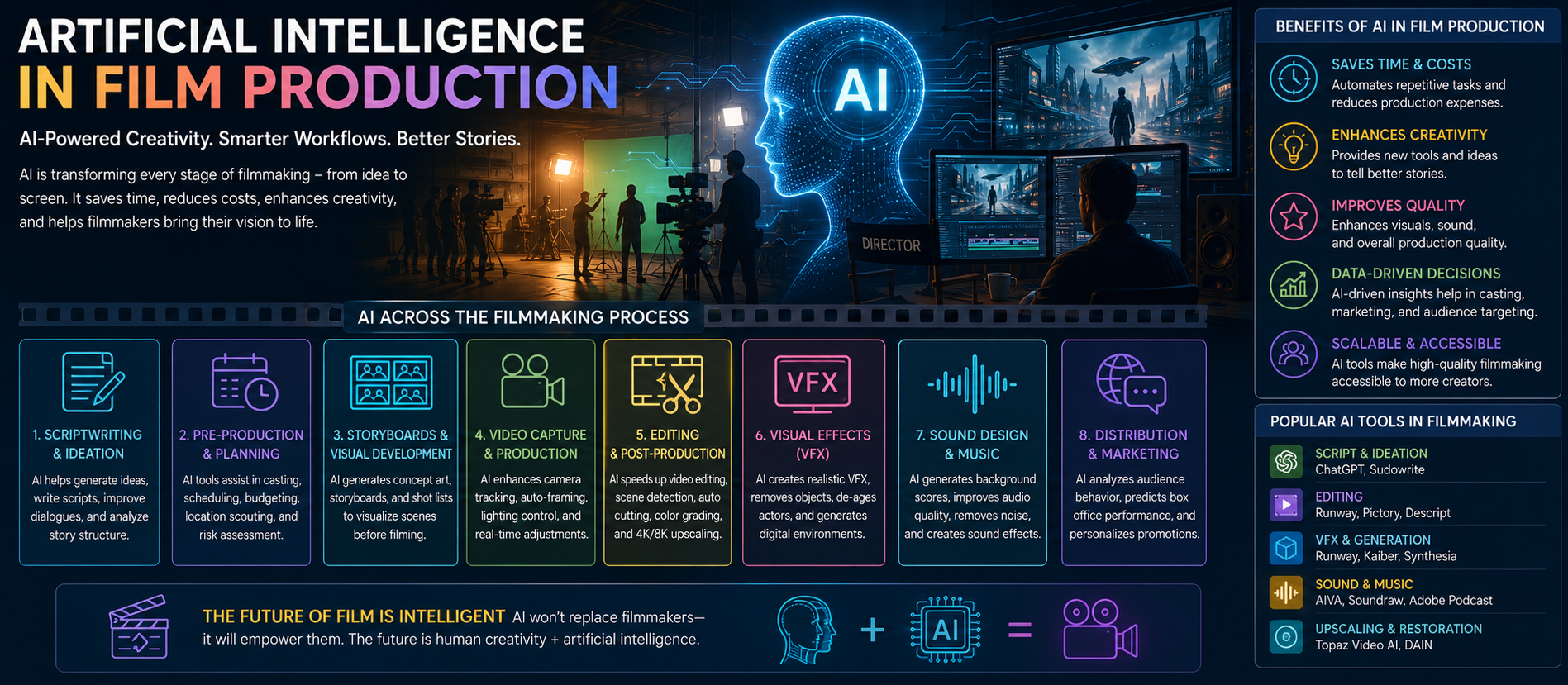
AI Across the Film Production Workflow
AI in Pre-Production
Introduction
Artificial Intelligence in film production is changing how movies and video content are planned, created, edited, and distributed. AI can help filmmakers analyze scripts, organize production data, create early visual concepts, improve editing workflows, generate subtitles, enhance sound, and support marketing decisions.
AI is not replacing every filmmaker. Film production still depends on human creativity, storytelling, performance, judgment, and collaboration. However, AI can reduce repetitive work and give creative teams new tools.
The use of AI in filmmaking is growing quickly. Independent creators can now access technologies that were once available mainly to large studios. At the same time, professional film companies are exploring AI for production planning, visual effects, post-production, localization, and audience analysis.
This article explains how AI is used across the filmmaking process, its benefits and limitations, and what the future may look like for the film industry.
Quick Answer: How Is AI Used in Film Production?
AI is used in film production to support script analysis, pre-production planning, concept development, visual effects, video editing, sound processing, subtitling, localization, marketing, and production workflows. AI can automate repetitive tasks and generate creative options, but human filmmakers remain responsible for artistic direction, storytelling, ethical decisions, and final quality.
What Does Artificial Intelligence Mean in Filmmaking?
Artificial Intelligence refers to computer systems that can perform tasks associated with learning, prediction, recognition, generation, and decision-making.
In filmmaking, AI systems may work with different types of information:
- Text from scripts and production documents
- Images and video footage
- Audio and dialogue
- Production schedules
- Audience and market data
Modern filmmaking can use several forms of AI, including machine learning, computer vision, speech recognition, natural language processing, and generative AI.
Each technology can support a different part of the production process.
AI Across the Film Production Workflow
Film production is often divided into several stages:
- Development
- Pre-production
- Production
- Post-production
- Distribution and marketing
AI can potentially support every stage.
AI in Script Development
The filmmaking process often begins with an idea and a script.
AI can help writers and development teams analyze large amounts of text. For example, AI-assisted tools can identify characters, locations, scenes, dialogue patterns, and repeated themes.
Script Analysis
AI can help production teams examine a screenplay and organize information.
A system may help identify:
- Main characters
- Supporting characters
- Locations
- Props
- Action scenes
- Scene changes
- Production requirements
This information can help teams during early planning.
Creative Assistance
Generative AI can also be used as a brainstorming assistant. Writers may use it to explore possible story ideas, character backgrounds, scene variations, or research questions.
However, AI-generated text should not automatically become a finished screenplay. A human writer should review every creative output for originality, quality, tone, accuracy, and legal or ethical concerns.
AI in Pre-Production
Pre-production is one of the most important stages of filmmaking. This is where the team plans how the film will be made.
AI can help organize large amounts of information and speed up planning tasks.
Production Breakdown
A production breakdown identifies everything needed for each scene.
AI-assisted tools may help extract information from scripts and organize production elements.
This can help identify:
- Cast requirements
- Locations
- Costumes
- Props
- Special effects
- Vehicles
- Animals
- Complex production scenes
Human production managers still need to verify the results.
Scheduling Support
Film schedules can be complex. A production must consider actor availability, locations, weather, equipment, travel, budget, and crew requirements.
AI-based planning systems may help analyze scheduling possibilities and identify conflicts.
The goal is not to let AI make every decision. The goal is to provide better information to production managers.
AI for Storyboards and Visual Development
Before cameras begin recording, directors and production designers often create visual references.
Generative AI can help teams quickly explore visual concepts.
Possible uses include:
- Early concept art
- Location mood boards
- Costume inspiration
- Lighting references
- Set design ideas
- Storyboard exploration
These outputs can speed up early discussions.
However, a generated image is not automatically a final production design. Professional artists and designers may need to refine concepts and ensure that the work supports the director's vision.
AI in Casting and Character Analysis
AI may help casting teams organize auditions and production information. Computer systems can process large databases and help search for candidates based on selected criteria.
However, casting decisions involve human judgment.
Performance, chemistry, artistic interpretation, diversity, and creative vision cannot be reduced to a simple automated score.
AI should therefore be used carefully as a support system rather than a final decision-maker.
AI During Film Production
During production, crews must manage cameras, lighting, sound, actors, equipment, and many other moving parts.
AI can support technical workflows and production management.
Camera and Shot Assistance
Computer vision can help analyze footage and detect objects, people, movement, or visual patterns.
AI-assisted systems may also support camera tracking and virtual production workflows.
These technologies can help filmmakers work more efficiently, especially when handling complex visual scenes.
Virtual Production
Virtual production combines physical filmmaking with digital environments.
AI can support the creation and management of digital assets and environments. It may also help automate some technical processes related to visual production.
Virtual production is especially useful for scenes that would be expensive, difficult, or unsafe to create entirely on location.
Artificial Intelligence in Video Editing
Post-production is one of the areas where AI is already having a major impact.
Editors often work with many hours of raw footage. Reviewing and organizing this material takes time.
AI can help with:
- Footage tagging
- Scene detection
- Face recognition
- Speech transcription
- Searching dialogue
- Finding specific clips
- Organizing media files
These features can reduce repetitive work and help editors find the material they need faster.
Rough Cut Assistance
Some AI tools can help create a preliminary edit based on selected rules or instructions.
A rough cut can give editors a starting point.
However, editing is an artistic process. Timing, emotion, rhythm, suspense, humor, and storytelling require human creative judgment.
AI can organize the material, but the final edit should remain under professional human control.
AI in Visual Effects
Visual effects, commonly called VFX, require large amounts of technical work.
AI can help automate or accelerate some tasks.
Rotoscoping and Object Selection
Rotoscoping involves separating a subject or object from its background.
AI-based computer vision can help identify objects and speed up mask creation.
Artists may still need to correct complex frames, hair, reflections, motion blur, and other difficult visual details.
Background and Environment Work
AI can help generate early visual concepts and assist with digital environment workflows.
Artists can use AI-generated material as a starting point, reference, or temporary element during development.
Professional quality control is essential because generated visual material may contain errors or inconsistent details.
Generative AI in Film Production
Generative AI is one of the most discussed technologies in modern filmmaking.
Generative systems can create new text, images, audio, video, and other content based on patterns learned from training data.
Possible filmmaking applications include:
- Concept images
- Storyboard drafts
- Temporary visual effects
- Background elements
- Voice and audio experiments
- Video concepts
- Marketing materials
Generative AI can make creative experimentation faster.
However, it also creates serious questions about copyright, training data, consent, performer rights, and creative ownership.
AI and Sound Production
Sound is essential to storytelling.
AI can support audio production through:
- Noise reduction
- Dialogue cleanup
- Speech transcription
- Audio separation
- Sound classification
- Automated captioning
AI-powered audio tools can help clean recordings and improve workflow efficiency.
Dialogue Enhancement
Film dialogue can be affected by background noise, wind, equipment sounds, and recording conditions.
AI-assisted audio processing can help identify and reduce unwanted sounds.
Sound professionals still need to review the results carefully. Too much automated processing can create unnatural audio artifacts.
AI for Dubbing and Localization
Movies and video content often need to reach audiences in different languages.
AI can help with:
- Speech recognition
- Transcription
- Translation support
- Subtitle generation
- Captioning
- Localization workflows
AI can speed up the first stages of translation and subtitling.
However, human translators and localization experts remain important. Dialogue contains cultural references, humor, emotion, and context that automated systems may misunderstand.
AI and Film Marketing
AI can also support film marketing and audience research.
Marketing teams may use AI to analyze:
- Audience behavior
- Content trends
- Campaign performance
- Social media engagement
- Advertising data
AI can help teams identify patterns, but creative marketing decisions still require human understanding of audiences and culture.
Audience Prediction and Data Analysis
Film companies collect large amounts of data.
Machine learning systems can analyze patterns in historical information and audience behavior.
Possible applications include:
- Demand forecasting
- Audience segmentation
- Campaign optimization
- Content recommendations
Prediction models are not perfect.
Movies can become successful for unexpected reasons. Culture, timing, reviews, social media, and audience emotion can change outcomes quickly.
Benefits of AI in Film Production
1. Faster Workflows
AI can automate repetitive tasks such as transcription, media tagging, object detection, and basic organization.
2. Lower Barriers for Independent Creators
Smaller production teams can access tools for concept development, editing, audio processing, and visual experimentation.
3. Better Production Organization
AI can help teams process scripts, schedules, footage, and production data.
4. More Creative Experimentation
Filmmakers can quickly test visual ideas and explore multiple creative directions.
5. Improved Accessibility
AI can support subtitles, captions, transcription, and localization.
Challenges and Risks of AI in Filmmaking
AI also creates important risks.
Copyright and Intellectual Property
Filmmakers need to understand where AI-generated material comes from and what rights apply to the final output.
Copyright laws and policies can vary by country and continue to evolve.
Consent and Performer Rights
AI can create or modify realistic images, voices, and performances.
Clear consent and contractual protections are important when using a person's likeness or voice.
Bias
AI systems can reflect biases present in data.
This can affect recommendations, casting support systems, audience analysis, and generated content.
Job Changes
AI will likely change many film industry jobs.
Some repetitive tasks may become more automated. At the same time, new roles may emerge around AI supervision, data management, model evaluation, AI ethics, and AI-assisted production.
Quality and Consistency
AI-generated video and images can contain visual errors.
Characters, objects, lighting, and details may change unexpectedly between generated scenes.
Professional review remains essential.
Will AI Replace Filmmakers?
No, AI is unlikely to replace the entire filmmaking profession.
Filmmaking is a collaborative art form.
Directors make creative choices. Writers build stories. Actors bring characters to life. Cinematographers create visual language. Editors shape emotion and pacing. Sound designers build atmosphere.
AI can support these professionals, but it does not automatically understand artistic intention in the same way a human creative team does.
The more realistic future is likely to involve human filmmakers working with AI tools.
How Independent Filmmakers Can Use AI Responsibly
Independent creators can use AI without giving up creative control.
Use AI for Repetitive Tasks
Start with transcription, media organization, subtitle creation, and audio cleanup.
Use AI for Early Concepts
Generate references and explore ideas before investing in expensive production work.
Verify Every Output
AI systems can make mistakes. Check facts, visual details, dialogue, and technical results.
Protect Privacy
Do not upload sensitive production material to a platform without understanding its privacy and data policies.
Respect Creative Rights
Use AI tools in ways that respect copyright, contracts, performer consent, and intellectual property rights.
The Future of AI in Film Production
The future of filmmaking will likely involve deeper integration between AI and traditional production tools.
Potential developments include:
- More intelligent editing assistance
- Improved virtual production
- Better visual effects automation
- Real-time localization support
- Advanced production planning
- More powerful AI agents for production workflows
- Improved accessibility tools
However, the future will also depend on legal rules, industry agreements, ethical standards, and audience expectations.
Technology alone will not determine how AI is used.
Filmmakers, studios, workers, audiences, regulators, and technology companies will all influence the future.
SEO, AEO, GEO, and AI Search Optimization
Technology content should be easy for people and modern search systems to understand.
SEO helps content become discoverable through traditional search engines.
AEO, or Answer Engine Optimization, focuses on giving direct and useful answers to questions.
GEO, or Generative Engine Optimization, focuses on creating clear, structured information that generative AI systems can understand and summarize accurately.
Content about AI in filmmaking can benefit from:
- Clear headings
- Simple definitions
- Direct answers
- Practical examples
- Updated information
- Question-and-answer sections
Simple language improves readability and helps readers quickly understand complex technology.
❓ Frequently Asked Questions
How is AI used in film production?▾
AI is used in film production for script analysis, production planning, concept development, footage organization, video editing, visual effects, sound processing, subtitles, localization, marketing, and data analysis.
Can AI make an entire movie?▾
AI can generate parts of a movie, including text, images, audio, and video. However, creating a high-quality complete film still requires human direction, creative judgment, quality control, legal review, and production management.
Will AI replace film editors?▾
AI can automate tasks such as transcription, clip searching, tagging, and rough organization. However, film editing requires creative judgment about story, timing, emotion, and pacing, so human editors remain important.
How does AI help with visual effects?▾
AI can assist with object selection, rotoscoping, tracking, image processing, environment development, and other repetitive visual tasks. Artists still need to review and refine the results.
What are the risks of generative AI in filmmaking?▾
Major risks include copyright uncertainty, consent issues, performer rights, privacy concerns, bias, misinformation, inconsistent output, and possible misuse of realistic synthetic media.
Can independent filmmakers use AI?▾
Yes. Independent filmmakers can use AI for concept development, transcription, subtitles, editing support, audio cleanup, research, and workflow organization. They should review platform policies and respect legal and ethical requirements.
Featured Snippet Answer▾
Question: How is Artificial Intelligence changing film production? Direct Answer: Artificial Intelligence is changing film production by supporting script analysis, pre-production planning, concept development, video editing, visual effects, sound processing, subtitling, localization, marketing, and audience analysis. AI can automate repetitive tasks and speed up creative workflows, while human filmmakers remain responsible for artistic direction, storytelling, quality, ethics, and final decisions.
Key Takeaways
- AI can support every major stage of film production.
- Script analysis can help teams organize production requirements.
- Generative AI can speed up concept development and visual experimentation.
- AI-powered tools can help editors organize large amounts of footage.
- Computer vision can support visual effects workflows.
- AI can improve transcription, subtitles, audio cleanup, and localization.
- AI can help marketing teams analyze campaign and audience data.
- Human creative judgment remains essential in filmmaking.
- Copyright, consent, privacy, and performer rights are major concerns.
- The future of filmmaking will likely combine human creativity with AI-assisted tools.
Conclusion
Artificial Intelligence in film production is not simply about replacing cameras, actors, writers, or filmmakers.
Its biggest impact may come from changing workflows.
AI can help production teams work faster, organize information, explore creative ideas, automate repetitive tasks, and improve accessibility. These benefits can help both large studios and independent creators.
At the same time, filmmaking must remain responsible.
Creative teams need to consider copyright, consent, privacy, bias, and the rights of artists and performers. AI-generated content should be reviewed carefully rather than accepted automatically.
The most successful future workflow may be a human-first model.
Filmmakers will continue to provide imagination, emotion, storytelling, cultural understanding, and artistic judgment. AI will provide new technical capabilities and faster ways to explore ideas.
For filmmakers, the key question is not simply whether to use AI. The more important question is how to use AI in a way that improves creativity, protects people, and supports better storytelling.
About Digiifrog
Digiifrog creates clear, useful, and search-optimized content for modern SEO, AEO, GEO, and AI Search environments. Visit www.digiifrog.com for more articles about Artificial Intelligence, technology, digital innovation, automation, and the future of business.
Disclaimer
This article is for educational and informational purposes only. AI tools, laws, industry standards, copyright policies, platform rules, and film production technologies can change. Filmmakers should obtain appropriate legal, contractual, and professional advice when using AI for commercial productions or when working with copyrighted material, personal likenesses, voices, or sensitive production data.
Ready to Grow?
Talk to us about a strategy tailored to your brand — we will help you stand out in search, AI discovery and social.

Comments (0)
Log in to leave a comment.