
📋 Quick Summary
In this article:
Quick Answer: What Is Artificial Intelligence?
Why Should Beginners Learn About AI?
A Simple History of Artificial Intelligence
How Does Artificial Intelligence Work?
Step 1: Data
Step 4: Prediction or Generation
Introduction
Artificial Intelligence, commonly called AI, is one of the most important technologies of the modern world. AI is changing how people search for information, create content, write software, analyze data, communicate with customers, and run businesses.
For beginners, Artificial Intelligence can seem difficult. Terms such as machine learning, neural networks, algorithms, large language models, generative AI, and deep learning may sound confusing.
The good news is that you do not need to understand everything at once.
This guide explains Artificial Intelligence for beginners using simple and direct language. You will learn what AI is, how it works at a basic level, where it is used, what types of AI exist, and how you can begin learning AI step by step.
AI is a large field. The goal of this article is not to turn you into an AI engineer in one day. The goal is to give you a strong foundation and help you understand where to go next.
Quick Answer: What Is Artificial Intelligence?
Artificial Intelligence is a field of technology that enables computer systems to perform tasks that normally require human intelligence. These tasks can include recognizing patterns, understanding language, making predictions, solving problems, generating content, and learning from data.
AI does not always think like a human. Different AI systems work in different ways. Many modern AI systems use mathematical models and large amounts of data to identify patterns and produce useful results.
Why Should Beginners Learn About AI?
AI is becoming part of everyday life.
You may already use AI when you:
- Search online
- Watch recommended videos
- Use voice assistants
- Receive product recommendations
- Translate text
- Use navigation applications
- Write with AI assistants
- Edit photos or videos
Learning the basics of AI can help you understand these systems better.
AI knowledge can also be valuable for students, professionals, entrepreneurs, developers, marketers, designers, and business owners.
You do not need to become a programmer to benefit from understanding AI.
A Simple History of Artificial Intelligence
The idea of intelligent machines has existed for a long time. However, modern AI developed through advances in mathematics, computing, data, and algorithms.
Early AI research focused on building systems that could solve logical problems.
Over time, researchers developed methods that allowed computers to learn patterns from data. This approach became known as machine learning.
As computers became more powerful and large amounts of digital data became available, machine learning systems improved.
Deep learning later made it possible to train more complex neural networks for tasks involving images, speech, language, and other forms of information.
Today, generative AI and large language models have introduced AI to a much larger audience.
How Does Artificial Intelligence Work?
AI systems work in different ways, but many follow a similar basic process.
Step 1: Data
Many AI systems learn from data.
Data may include:
- Text
- Images
- Audio
- Video
- Numbers
- Sensor information
The quality and relevance of the data can have a major effect on the system.
Step 2: A Model
An AI model is a mathematical system designed to find patterns and relationships in data.
During training, the model adjusts its internal parameters to improve its ability to perform a specific task.
Step 3: Training
Training is the process of helping a model learn patterns from examples.
For example, a model designed to recognize cats might be trained using many examples of images.
The system does not simply memorize every image in the same way a human stores photographs. Instead, it learns patterns that can help it make predictions about new data.
Step 4: Prediction or Generation
After training, an AI system can process new information.
Depending on the system, it may:
- Classify an image
- Predict a value
- Recommend a product
- Recognize speech
- Generate text
- Create an image
The Main Types of Artificial Intelligence
AI can be described in several ways. For beginners, it is useful to understand two broad ideas: AI based on capability and AI based on technology.
Narrow AI
Most AI systems used today are examples of narrow AI.
Narrow AI is designed to perform specific tasks.
Examples include:
- Spam filters
- Recommendation systems
- Speech recognition
- Image recognition
- Language translation
A system may be very effective at one task without being able to perform every type of human activity.
Artificial General Intelligence
Artificial General Intelligence, sometimes called AGI, is a concept describing a system with broad, general capabilities across many types of intellectual tasks.
AGI remains a subject of research and discussion. Beginners should understand that the AI systems commonly available today should not automatically be treated as having human-like general intelligence.
Machine Learning Explained
Machine learning is one of the most important parts of modern AI.
Instead of programming every rule manually, developers can train a system to identify patterns from examples.
For example, imagine a company wants to predict whether a customer may cancel a subscription.
A machine learning model might analyze historical patterns such as:
- Product usage
- Customer activity
- Support requests
- Subscription history
The model can then estimate the probability of a similar outcome for new customers.
The Three Main Types of Machine Learning
1. Supervised Learning
Supervised learning uses labeled examples.
For example, a dataset may contain pictures labeled as either "cat" or "dog."
The model learns the relationship between the input and the correct label.
2. Unsupervised Learning
Unsupervised learning works with data that does not have the same type of predefined labels.
The system attempts to discover patterns, groups, or relationships.
For example, a business might use clustering to identify groups of customers with similar behavior.
3. Reinforcement Learning
Reinforcement learning involves learning through actions and feedback.
A system receives rewards or penalties based on its actions and gradually learns strategies that can improve results.
What Is Deep Learning?
Deep learning is a branch of machine learning.
It uses complex neural networks with multiple layers to learn patterns from large amounts of data.
Deep learning has contributed to advances in:
- Image recognition
- Speech recognition
- Natural language processing
- Generative AI
Deep learning can be powerful, but training large models may require significant computing resources and data.
What Are Neural Networks?
Neural networks are computing systems inspired loosely by the structure of biological neural networks.
A neural network contains connected units that process information.
During training, the system adjusts numerical values called parameters to improve its performance.
Neural networks are used in many areas of modern AI.
You do not need to understand advanced mathematics to begin learning AI. However, mathematics becomes more important as you move deeper into machine learning and AI engineering.
What Is Generative AI?
Generative AI is AI that can create new content.
Depending on the model, generative AI can produce:
- Text
- Images
- Audio
- Video
- Software code
Generative AI systems are trained to recognize patterns in large amounts of information and generate outputs based on those patterns.
Generative AI can be useful for brainstorming, drafting, research support, software development, content creation, and many other tasks.
However, generated output can contain mistakes. Users should review important information instead of assuming that every answer is correct.
What Are Large Language Models?
Large language models, often called LLMs, are AI models designed to work with language.
They can process and generate text based on patterns learned during training.
LLMs can be used for:
- Answering questions
- Summarizing information
- Drafting content
- Translating languages
- Writing software code
- Supporting customer service
A language model does not automatically guarantee factual accuracy.
For important decisions involving health, law, finance, safety, or other high-stakes areas, users should verify information with qualified sources.
Natural Language Processing
Natural Language Processing, or NLP, is an area of AI focused on helping computers work with human language.
NLP can be used for:
- Text classification
- Translation
- Sentiment analysis
- Speech recognition
- Chatbots
- Search systems
Modern language AI has made NLP one of the most visible areas of Artificial Intelligence.
Computer Vision
Computer vision helps computers analyze and understand images and video.
Applications include:
- Object detection
- Image classification
- Medical image analysis
- Manufacturing inspection
- Video analysis
Computer vision systems can identify patterns in visual data, but their accuracy depends on the model, training data, testing, and real-world conditions.
Where Is AI Used Today?
AI is used across many industries.
Healthcare
AI can support research, medical imaging, administrative tasks, and data analysis. However, medical AI should be used with appropriate clinical oversight.
Education
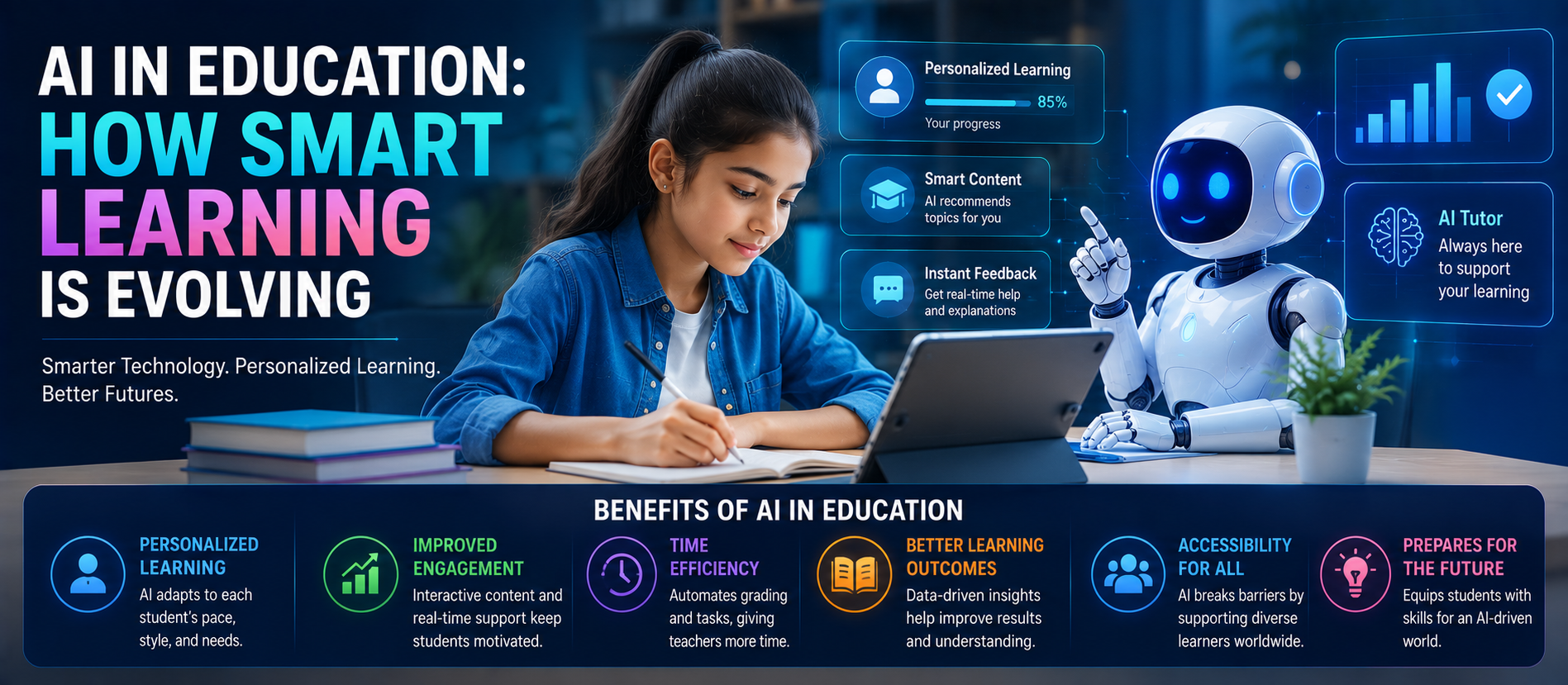
AI can support personalized learning, tutoring, content creation, and educational administration.
Business
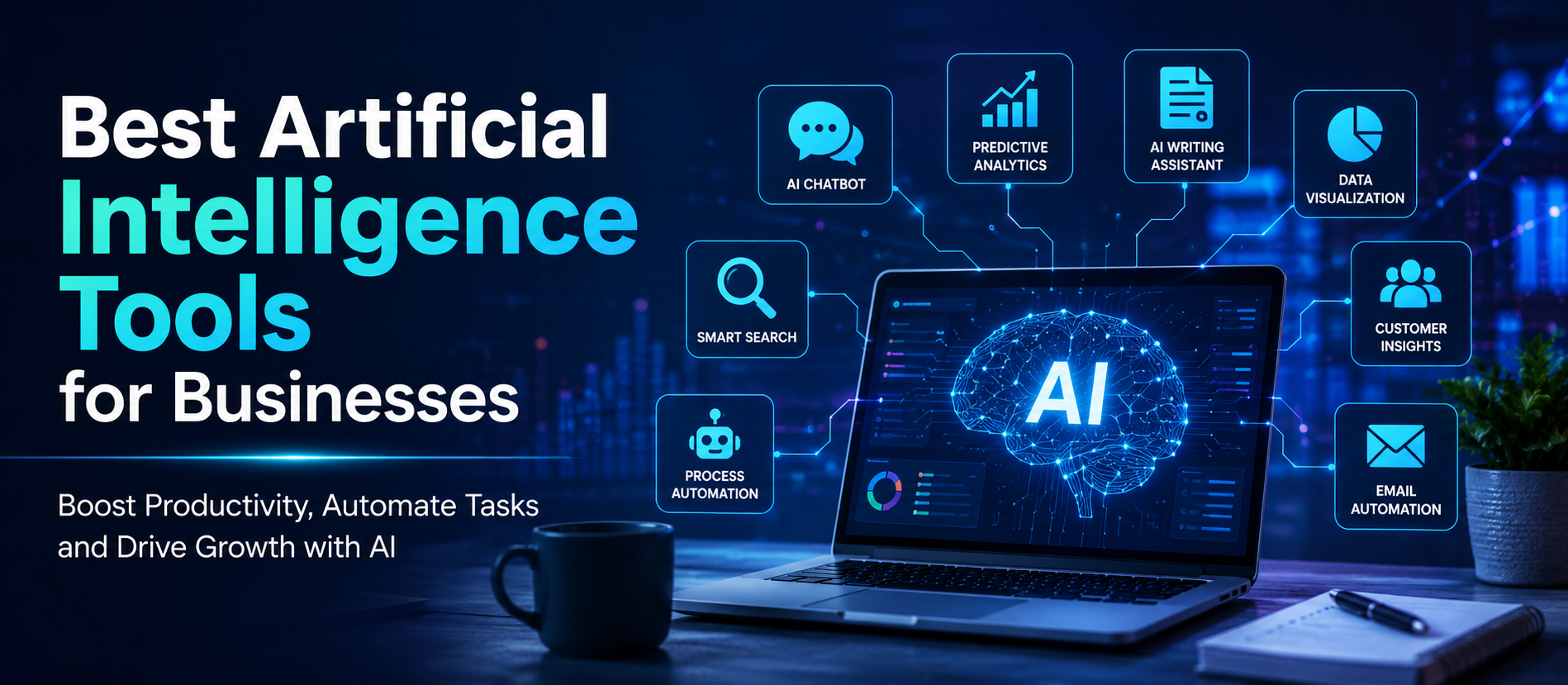
Businesses use AI for customer service, document processing, forecasting, marketing, automation, and analytics.
Marketing
AI can help analyze audiences, generate content ideas, improve workflows, and support campaign optimization.
Software Development
AI can assist developers with coding, testing, documentation, debugging, and software analysis.
Finance
AI can support fraud detection, data analysis, customer service, and risk-related processes.
AI in Everyday Life
You may interact with AI without thinking about it.
Examples include:
- Email spam detection
- Search suggestions
- Social media recommendations
- Navigation systems
- Smartphone cameras
- Voice typing
- Online shopping recommendations
AI is often built into existing products rather than appearing as a separate application.
What Are AI Agents?
AI agents are systems designed to perform tasks with some level of autonomy.
An AI agent may use a language model to:
- Understand a goal
- Plan steps
- Use tools
- Retrieve information
- Complete parts of a workflow
For example, an AI agent could help organize research, process documents, respond to routine customer questions, or perform structured business tasks.
AI agents require careful design because autonomy can create risks. Reliable systems need permissions, testing, monitoring, security, and human oversight.
Benefits of Artificial Intelligence
Automation
AI can help automate repetitive tasks and reduce manual work.
Speed
AI can process large amounts of information quickly.
Pattern Recognition
Machine learning can identify patterns that may be difficult to notice manually.
Personalization
AI can help adapt recommendations and experiences to different users.
Accessibility
AI can support translation, captions, speech-to-text, and other accessibility tools.
Limitations and Risks of AI
AI is powerful, but it has limitations.
Incorrect Answers
AI systems can produce incorrect or misleading information.
Bias
If training data contains biases, an AI system may produce biased results.
Privacy
Users should understand what information they share with AI systems and how that information may be processed.
Security
AI applications can face security risks, including misuse and malicious manipulation.
Over-Reliance
People should not allow AI to replace critical thinking.
The best approach is to treat AI as a useful tool while continuing to apply human judgment.
What Skills Do You Need to Learn AI?
The skills you need depend on your goal.
For Non-Technical Learners
Focus on:
- AI concepts
- AI tools
- Prompting
- AI limitations
- Responsible AI
For Technical Learners
You may eventually need:
- Python
- Statistics
- Mathematics
- Machine learning
- Data analysis
- Software engineering
You do not need to master every skill before starting.
Do You Need Math to Learn AI?
Basic AI literacy does not require advanced mathematics.
💡 Key Insight
However, mathematics becomes important for understanding machine learning deeply.
Useful areas include:
- Algebra
- Statistics
- Probability
- Linear algebra
- Calculus
Start with simple concepts. Learn more mathematics when your learning path requires it.
Do You Need Python to Learn AI?
No. You can learn AI concepts and use many AI tools without programming.
However, Python is useful if you want to:
- Build machine learning models
- Create AI applications
- Analyze data
- Work as an AI engineer
Python is popular because it has many libraries and resources for AI development.
A Simple AI Learning Roadmap for Beginners
Step 1: Learn the Basic Concepts
Understand AI, machine learning, deep learning, data, and generative AI.
Step 2: Explore AI Tools
Use AI tools for writing, research, image creation, data analysis, and automation. Learn both their strengths and limitations.
Step 3: Choose Your Direction
Decide whether you want to focus on AI for business, AI tools, data science, software development, machine learning, or AI engineering.
Step 4: Learn Python if Needed
Technical learners should begin learning Python and basic programming concepts.
Step 5: Study Machine Learning
Learn supervised learning, unsupervised learning, model evaluation, and basic algorithms.
Step 6: Learn About Generative AI
Study language models, embeddings, prompting, retrieval, evaluation, and AI safety.
Step 7: Build Projects
Projects help transform knowledge into practical skills.
Beginner AI Project Ideas
When you are ready, try small projects.
- A simple chatbot
- An image classification project
- A recommendation system
- A document summarization workflow
- A basic AI-powered search tool
- A customer support assistant
- A data prediction project
Start small. A completed simple project is often more useful for learning than an unfinished complex project.
How to Use AI Responsibly
Responsible AI use should be part of every beginner's education.
Verify Important Information
Check important answers using reliable sources.
Protect Private Information
Do not share sensitive personal or business information unless you understand the privacy policy and have appropriate permission.
Understand Bias
AI systems may produce unfair or inaccurate results.
Respect Copyright and Ownership
Understand the rules related to content, data, images, software, and creative work.
Keep Humans in Control
Human review is important, especially for high-impact decisions.
Common AI Terms Every Beginner Should Know
Algorithm
A set of instructions or mathematical processes used to solve a problem.
Dataset
A collection of information used for analysis or training.
Model
A trained mathematical system used to make predictions or generate outputs.
Training
The process of adjusting a model using data.
Inference
The process of using a trained model to make a prediction or generate an output.
Prompt
An instruction or input provided to a generative AI system.
Hallucination
A term commonly used when a generative AI system produces information that sounds convincing but is inaccurate or unsupported.
Embedding
A numerical representation of information that can help AI systems compare meaning and relationships.
SEO, AEO, GEO, and AI Search Optimization
Artificial Intelligence is also changing how people find information online.
SEO, or Search Engine Optimization, focuses on helping useful content become discoverable in search engines.
AEO, or Answer Engine Optimization, focuses on answering questions clearly and directly.
GEO, or Generative Engine Optimization, focuses on creating structured, accurate, and useful content that generative AI systems can understand and reference.
For beginners creating AI content, simple writing is important.
Useful content should include:
- Clear headings
- Simple definitions
- Direct answers
- Helpful examples
- Logical structure
- Frequently asked questions
Clear language helps both people and AI-powered information systems understand content.
❓ Frequently Asked Questions
What is Artificial Intelligence in simple words?▾
Artificial Intelligence is technology that enables computer systems to perform tasks such as recognizing patterns, understanding language, making predictions, and generating content.
Can a beginner learn AI?▾
Yes. Beginners can start by learning basic concepts such as AI, machine learning, generative AI, data, and responsible AI. You can then choose a technical or non-technical learning path.
How long does it take to learn AI?▾
You can understand basic AI concepts in a relatively short time. Developing advanced professional AI skills can take months or years depending on your background, goals, and practice.
Do I need coding to learn Artificial Intelligence?▾
No. Basic AI knowledge and many AI tools can be learned without coding. Programming is more important for learners who want to build AI models or applications.
Is machine learning the same as AI?▾
No. Machine learning is a branch of Artificial Intelligence. AI is the broader field, while machine learning focuses on systems that learn patterns from data.
What is the difference between AI and generative AI?▾
AI is a broad field that includes many technologies. Generative AI is a type of AI that creates new content such as text, images, audio, video, or code.
What should I learn first in AI?▾
Start with AI fundamentals. Learn the difference between AI, machine learning, deep learning, and generative AI. Then choose a learning path based on your goals.
Featured Snippet Answer▾
Question: How can a beginner start learning Artificial Intelligence? Direct Answer: A beginner can start learning Artificial Intelligence by understanding basic concepts such as AI, machine learning, data, deep learning, and generative AI. Next, explore practical AI tools and choose a learning path based on your goals. Technical learners can then study Python, statistics, machine learning, and AI application development. The best way to improve is to combine learning with small practical projects.
Key Takeaways
- Artificial Intelligence enables computers to perform tasks associated with learning and problem-solving.
- Machine learning is an important branch of AI.
- Deep learning uses complex neural networks to learn patterns.
- Generative AI can create text, images, audio, video, and code.
- Large language models are designed to process and generate language.
- You do not need coding to understand basic AI concepts.
- Python is valuable for technical AI careers.
- AI can improve productivity, automation, analysis, and accessibility.
- AI can also produce incorrect, biased, or unsafe outputs.
- Responsible AI use requires privacy awareness, verification, security, and human judgment.
- The best way to learn AI is to begin with the basics and build practical skills over time.
Conclusion
Artificial Intelligence may seem complex at first, but every beginner can start with the basics.
You do not need to understand advanced mathematics or build a neural network on your first day.
Start by learning what AI is and how it differs from machine learning and generative AI. Explore practical tools. Learn about the benefits and risks. Then choose a learning path that matches your personal or professional goals.
The world of AI will continue to change.
New tools will appear. Existing technologies will improve. Some skills will become more important, while others may become easier through automation.
However, one principle will remain valuable: understanding the fundamentals helps you adapt.
Learn gradually. Practice regularly. Ask questions. Verify information. Build projects when you are ready.
AI is not only for scientists and engineers. Beginners, students, professionals, creators, and business owners can all learn how to use Artificial Intelligence more effectively and responsibly.
Your AI journey can begin with one simple step: understand the basics and keep learning.
About Digiifrog
Digiifrog creates clear, useful, and search-optimized content for modern SEO, AEO, GEO, and AI Search environments. Visit www.digiifrog.com for more articles about Artificial Intelligence, technology, digital marketing, automation, and online innovation.
Disclaimer
This article is for educational and informational purposes only. Artificial Intelligence technologies, tools, regulations, and best practices can change over time. Always verify important information and use appropriate professional advice for legal, medical, financial, security, or other high-stakes decisions.
Ready to Grow?
Talk to us about a strategy tailored to your brand — we will help you stand out in search, AI discovery and social.
Comments (0)
Log in to leave a comment.