📋 Quick Summary
In this article:
What Is AI Cybersecurity Software?
Why AI Matters for Threat Detection
1. Data Collection
2. Data Normalization
3. Detection and Analytics
4. Correlation
5. Alert Prioritization
6. Investigation Assistance
Best AI Cybersecurity Software Categories
AI-Powered SIEM
Cyberattacks are becoming faster, more automated, and harder to detect. Security teams must monitor endpoints, identities, cloud services, applications, networks, data, and users at the same time. The amount of security information can be enormous.
💡 Key Insight
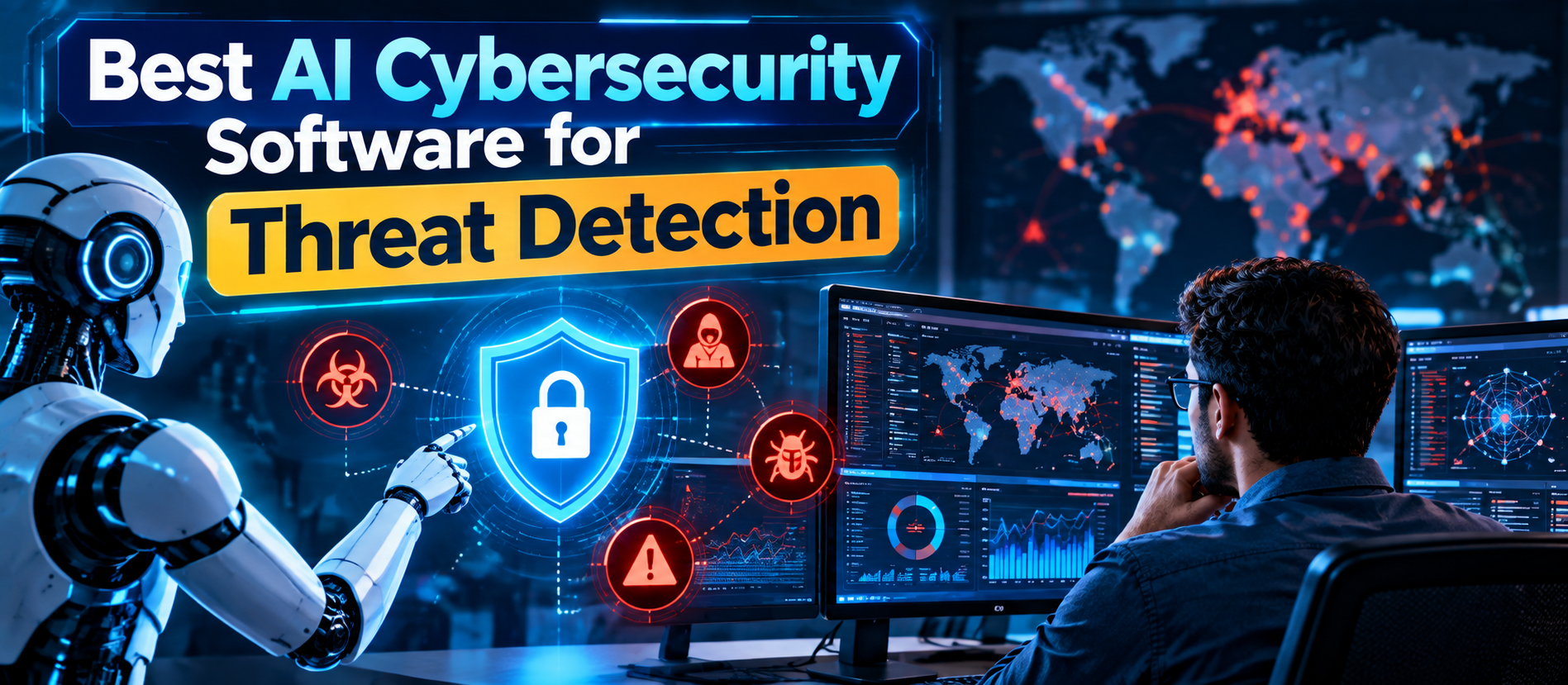
This is why AI cybersecurity software for threat detection has become an important part of modern security operations. Artificial intelligence and machine learning can help security teams analyze large volumes of signals, identify unusual behavior, connect related events, prioritize alerts, investigate incidents, and automate parts of the response process.
But AI is not a magic solution. The quality of detection still depends on visibility, data, configuration, threat intelligence, security processes, and human expertise.
The best AI cybersecurity software is therefore not simply the product that uses the most AI. It is the platform that helps an organization detect meaningful threats earlier, reduce unnecessary alerts, investigate incidents efficiently, and respond with appropriate human oversight.
This guide explains how AI threat detection works, which features matter, how leading platforms differ, and how businesses can choose the right solution.
What Is AI Cybersecurity Software?
AI cybersecurity software uses artificial intelligence, machine learning, automation, analytics, or related techniques to improve security monitoring and response.
Traditional security systems often rely heavily on predefined rules and signatures. These remain useful. However, modern attacks can change techniques, use legitimate tools, hide inside normal activity, or move across multiple systems.
AI can add another layer of analysis. It can learn patterns, compare current activity with historical behavior, identify anomalies, correlate signals, summarize incidents, and help analysts determine what deserves attention.
Modern security platforms may combine AI with:
- Security information and event management (SIEM)
- Extended detection and response (XDR)
- Endpoint detection and response (EDR)
- User and entity behavior analytics (UEBA)
- Threat intelligence
- Security orchestration, automation, and response (SOAR)
- Cloud security monitoring
- Identity security
- Vulnerability and exposure management
- Generative AI assistants
- AI-agent security
Why AI Matters for Threat Detection
Security teams often face an alert-volume problem. A large environment can generate thousands of events, many of which are harmless. Analysts cannot investigate everything manually.
AI can help by looking for patterns across large datasets and highlighting activity that appears unusual or risky.
For example, a user may normally log in from one location during business hours. A sudden sequence of unusual logins, privilege changes, access to sensitive systems, and suspicious downloads could represent a compromised account.
No single event may be enough to trigger a high-confidence investigation. Together, however, the signals may tell a different story.
This is where correlation and behavioral analysis become valuable.
How AI Threat Detection Works
AI-based threat detection is not one technology. It is a collection of techniques working together.
1. Data Collection
The platform collects security telemetry from sources such as endpoints, servers, identity systems, cloud services, applications, firewalls, email systems, network devices, and security products.
The broader the visibility, the more context the detection engine can use. However, organizations should balance visibility with storage cost, privacy requirements, data quality, and operational needs.
2. Data Normalization
Different systems produce information in different formats. A modern security platform needs to organize and normalize this information so that related events can be analyzed together.
3. Detection and Analytics
AI and machine learning can analyze behavior and identify patterns that may indicate malicious activity.
Rule-based detections remain important. AI can complement them by identifying unusual or complex patterns that may not fit a simple rule.
4. Correlation
Correlation connects multiple events into a larger security story.
For example:
Phishing email → suspicious login → privilege change → unusual data access → outbound transfer
Looking at these events separately can hide the broader attack chain. Correlation can help analysts see the relationship.
5. Alert Prioritization
AI can help rank alerts based on risk and context. This can reduce the time analysts spend reviewing low-value events.
6. Investigation Assistance
Generative AI can help summarize incidents, explain technical findings, create queries, and suggest investigation steps. Microsoft, for example, describes Security Copilot capabilities that summarize incidents, generate Kusto Query Language queries, and recommend next steps within Microsoft Sentinel.
7. Automated Response
Some platforms can trigger predefined response actions. These may include isolating an endpoint, disabling an account, blocking an indicator, or opening a case.
High-impact actions should be governed carefully. Automation should not blindly make irreversible decisions.
Best AI Cybersecurity Software Categories
Before comparing individual vendors, it helps to understand the main categories.
AI-Powered SIEM
A SIEM collects and analyzes security events from across an organization.
AI can improve detection, correlation, investigation, alert prioritization, and threat hunting. Microsoft Sentinel is one example of a cloud-native SIEM that combines AI, automation, threat intelligence, UEBA, and security orchestration capabilities.
AI-Powered XDR
XDR connects detection and response across security layers such as endpoints, identities, email, cloud workloads, and applications.
The goal is to reduce security silos and give analysts a broader view of an attack.
AI-Powered EDR
EDR focuses on endpoint activity. It can monitor processes, files, connections, user activity, and other endpoint signals.
AI can help detect suspicious behavior and investigate activity across large numbers of devices.
AI-Driven Threat Intelligence
Threat intelligence helps security teams understand indicators, adversaries, tactics, techniques, vulnerabilities, and campaigns.
AI can help process and enrich large amounts of intelligence so analysts can connect external information with internal security events.
AI Security Operations Platforms
Modern security operations platforms increasingly combine SIEM, XDR, threat intelligence, automation, exposure management, and AI assistants.
Google Security Operations, for example, describes an AI-powered security operations platform that uses Gemini for natural-language search and detection creation.
Leading AI Cybersecurity Software Options
The following platforms are examples of major solutions businesses may evaluate. They are not presented as a universal ranking. The right choice depends on your environment, technology stack, security team, compliance needs, and budget.
Microsoft Sentinel and Microsoft Security
Microsoft Sentinel is a cloud-native SIEM designed for security monitoring across multi cloud and multiplatform environments.
Microsoft describes Sentinel as combining AI, SOAR, UEBA, threat intelligence, analytics, and data-lake capabilities. It also integrates with Microsoft's broader security ecosystem and Security Copilot.
Best suited for: Organizations already invested in Microsoft security, Azure, Microsoft Defender, Entra, and related services, as well as organizations looking for broad cloud-based SIEM capabilities.
Google Security Operations
Google Security Operations is designed around cloud-scale security operations, detection, investigation, and response.
Google highlights curated detections, threat research, data pipeline capabilities, and Gemini-powered natural-language assistance for searching security data and creating detections.
Best suited for: Organizations that want cloud-native security operations and strong analytics capabilities, especially those working extensively with Google Cloud or large-scale security telemetry.
Crowd Strike Falcon
Crowd Strike Falcon is a broad cloud-native security platform with strong endpoint, identity, cloud, and threat intelligence capabilities.
Crowd Strike increasingly emphasizes AI-native security and AI detection and response. Its current AI security offering addresses threats involving AI applications, agents, data, identities, and infrastructure.
Best suited for: Organizations looking for a broad cloud-native security platform with strong endpoint protection, threat intelligence, and expanding AI security capabilities.
Other Platforms to Evaluate
Depending on requirements, organizations may also evaluate platforms from vendors such as Palo Alto Networks, Sentinel One, Sophos, Fortinet, Splunk, and other established cybersecurity providers.
The correct evaluation should focus on actual detection coverage, integration, data visibility, investigation workflow, response automation, total cost, and analyst experience rather than marketing claims alone.
Key Features to Look For
Behavioral Analytics
Behavioral analytics can establish patterns of normal activity and identify significant deviations.
This is useful for detecting compromised accounts, insider risk, unusual access, privilege abuse, and other behavior-based threats.
Machine Learning Detection
Machine learning can help identify patterns that are difficult to express through static rules.
Ask vendors how their models are trained, updated, evaluated, and monitored. Also ask how false positives are handled.
Threat Intelligence Integration
Threat intelligence can add context to security events. The platform should make it easy to understand why an indicator or behavior may be associated with a known threat.
Real-Time Detection
Speed matters. A detection platform should process important signals quickly enough to support the organization's response requirements.
Threat Hunting
Security teams should be able to investigate suspicious activity proactively instead of waiting for automated alerts.
Natural-language assistance can make threat hunting easier for some analysts, but advanced teams should still have access to powerful query and investigation capabilities.
Automated Response
Look for playbooks and workflows that automate repetitive tasks without removing necessary human review.
Cross-Platform Visibility
Modern organizations may use Windows, Linux, macOS, multiple cloud providers, SaaS applications, mobile devices, identity platforms, and on-premises infrastructure.
A security platform should provide useful visibility across the environments that matter to your business.
AI Security Capabilities
If your organization uses generative AI or autonomous agents, ask whether the security platform can monitor AI-specific risks.
Google Security Command Center, for example, describes AI protection across agents, data, models, applications, platforms, and infrastructure, including controls aimed at risks such as prompt injection and sensitive-data leakage.
Crowd Strike also describes AI Detection and Response capabilities covering AI data, models, prompts, agents, identities, infrastructure, and interactions.
AI Cybersecurity Software Comparison
| Platform Core Strength AI/Analytics Focus Good Fit For | |||
| Microsoft Sentinel | Cloud SIEM and unified Sec Ops | AI detection, investigation, Copilot, UEBA, automation | Microsoft and multi cloud environments |
| Google Security Operations | Cloud-native security operations | Gemini-assisted search and detection, analytics | Cloud-scale security operations |
| Crowd Strike Falcon | Endpoint, cloud, identity and threat protection | AI-native security and AI detection/response | Organizations seeking broad cloud-native protection |
| Other leading XDR/SIEM platforms | Integrated detection and response | ML, behavioral analytics, automation and threat intelligence | Organizations with varied security stacks |
Note: Product capabilities, pricing, licensing, integrations, and AI features change frequently. Always validate current capabilities with the vendor before purchasing.
AI Threat Detection for Small Businesses
Small businesses often do not have a large security operations team. This makes automation and managed security services especially important.
Instead of building a complex security stack, a small organization may benefit from a platform or managed service that provides endpoint protection, identity monitoring, email security, cloud visibility, alert triage, and response support.
The goal should be practical protection rather than maximum feature count.
Small businesses should prioritize:
- Easy deployment
- Clear alerts
- Automatic updates
- Endpoint visibility
- Identity protection
- Cloud and email monitoring
- Managed detection and response options
- Simple reporting
- Predictable costs
AI Threat Detection for Mid-Sized Businesses
Mid-sized organizations often have a mix of internal IT staff and security specialists. They need stronger visibility without creating an overly complex SOC.
They should consider SIEM or XDR platforms that can integrate with existing infrastructure and provide centralized detection.
Resource efficiency matters. AI-assisted investigation and automation can help a small security team handle more alerts, but the organization should establish clear escalation rules.
AI Threat Detection for Enterprises
Large organizations often operate complex environments with many business units, cloud accounts, applications, identities, endpoints, and regulatory requirements.
Enterprise buyers should evaluate:
- Data ingestion scale
- Multi-cloud visibility
- Identity and endpoint coverage
- Advanced threat hunting
- Detection engineering
- Security automation
- Threat intelligence
- Compliance reporting
- Role-based access
- Data residency
- Integration architecture
- AI governance
How to Evaluate AI Cybersecurity Software
1. Start With Threat Scenarios
Do not begin with a vendor feature list. Begin with your most important threats.
Examples include ransomware, credential theft, phishing, insider threats, cloud account compromise, data exfiltration, supply-chain attacks, and attacks against AI applications.
2. Map Your Technology Environment
List your endpoints, cloud platforms, identity systems, network devices, applications, databases, SaaS platforms, and security tools.
3. Check Data Coverage
A sophisticated AI model is not useful if it cannot access the data needed to detect the threat.
4. Test Detection Quality
Ask vendors to demonstrate detection against realistic scenarios. Look at both detection accuracy and false-positive rates.
5. Test Investigation
Give analysts a realistic incident and measure how quickly they can understand it.
6. Test Automation
Review what the platform can automate and which actions require approval.
7. Evaluate AI Explain ability
Security analysts need to understand why an alert was generated. An AI system that provides a conclusion without useful evidence can be difficult to trust.
8. Review Human Oversight
Define which actions AI can perform automatically and which actions require human approval.
9. Calculate Total Cost
Consider licensing, data ingestion, storage, integrations, implementation, training, administration, and managed services.
10. Run a Proof of Concept
A controlled proof of concept can reveal gaps that are not obvious during a sales demonstration.
Common Mistakes When Buying AI Cybersecurity Software
Choosing AI Because It Sounds Advanced
AI is not a substitute for strong security fundamentals. Look for measurable outcomes.
Ignoring Data Quality
Bad or incomplete telemetry can lead to weak detection. Security teams should know what data is available and what is missing.
Automating High-Risk Actions Too Quickly
Automatic response can be valuable, but a wrong action can disrupt business operations. Start with low-risk automation and expand after testing.
Ignoring Alert Fatigue
More alerts do not mean better security. The objective is useful detection and efficient investigation.
Creating Too Many Security Tools
Adding another product for every new threat can create fragmented workflows. Current security thinking increasingly emphasizes consolidation and context sharing because excessive tool sprawl can increase analyst workload.
Forgetting AI-Specific Risks
If your organization uses AI applications and agents, traditional security controls may not cover every AI-specific risk. Prompt injection, sensitive-data leakage, excessive agent permissions, insecure integrations, and model-related threats should be considered in the security architecture.
AI Cybersecurity and the Future of Threat Detection
Cybersecurity is moving toward more integrated, context-driven security operations.
AI agents are also changing the risk model. An AI agent may have access to data, applications, tools, and permissions. If compromised or manipulated, it could perform actions at machine speed.
This means security teams will increasingly need to protect not only users and devices, but also AI models, agents, prompts, data, and the connections between them.
Modern platforms are already moving in this direction. Microsoft is developing AI-ready security operations around unified security data and intelligent agents. Google is adding AI protection for the AI stack. Crowd Strike is expanding AI detection and response across AI environments.
The future of threat detection will likely combine machine-speed analysis with human judgment rather than replace security professionals completely.
Frequently Asked Questions
What is the best AI cybersecurity software for threat detection?
There is no single best solution for every organization. Microsoft Sentinel, Google Security Operations, Crowd Strike Falcon, and other leading SIEM, XDR, and security platforms can be strong options depending on the environment, threat model, integrations, team size, and budget.
Can AI detect cyberattacks automatically?
AI can detect many suspicious patterns automatically, but no system detects every attack perfectly. Strong cybersecurity combines AI with rules, threat intelligence, telemetry, human investigation, and response processes.
What is AI-powered threat detection?
AI-powered threat detection uses machine learning, behavioral analytics, advanced analytics, and related techniques to identify suspicious activity, correlate events, prioritize alerts, and support investigations.
Is AI better than traditional cybersecurity?
AI should complement traditional security controls rather than replace them. Signatures, rules, access controls, endpoint protection, network controls, vulnerability management, and human expertise remain important.
What is the difference between SIEM and XDR?
SIEM primarily collects and analyzes security events from many sources. XDR focuses on coordinated detection and response across multiple security layers. Modern platforms increasingly integrate SIEM and XDR capabilities.
Can AI reduce false positives?
AI and behavioral analytics can help prioritize alerts and identify higher-confidence activity. Results depend on data quality, detection configuration, environment, and the platform's analytics.
Should small businesses use AI cybersecurity software?
Yes. Small businesses can benefit from AI-assisted detection, endpoint monitoring, managed detection and response, and automated security workflows. The solution should match the organization's size and technical capabilities.
What should businesses look for in AI cybersecurity software?
Prioritize visibility, detection quality, behavioral analytics, threat intelligence, investigation tools, response automation, integrations, AI explain ability, security controls, scalability, and total cost of ownership.
Final Thoughts
The best AI cybersecurity software for threat detection is not necessarily the platform with the most impressive AI claims. It is the platform that gives your security team better visibility, higher-quality detections, faster investigations, and safer response.
Start with your threat scenarios. Understand your technology environment. Make sure the platform can access the right data. Test detection quality. Evaluate investigation workflows. Review automation carefully. Then compare cost and scalability.
AI can help security teams work faster and analyze more information. But successful cybersecurity still depends on good architecture, reliable data, strong controls, trained people, and clear processes.
As organizations adopt more cloud services and AI agents, security platforms will need to understand more than traditional endpoint and network activity. They will need to connect context across identities, applications, data, cloud infrastructure, models, and AI agents.
For businesses planning their next cybersecurity investment, the strongest approach is to choose technology that can grow with this changing environment while keeping humans in control of important security decisions.
Article by Digiifrog
Digital Marketing, SEO, AI Search, AEO, GEO, Content Marketing and Web Solutions
Ready to Grow?
Talk to us about a strategy tailored to your brand — we will help you stand out in search, AI discovery and social.
Comments (0)
Log in to leave a comment.