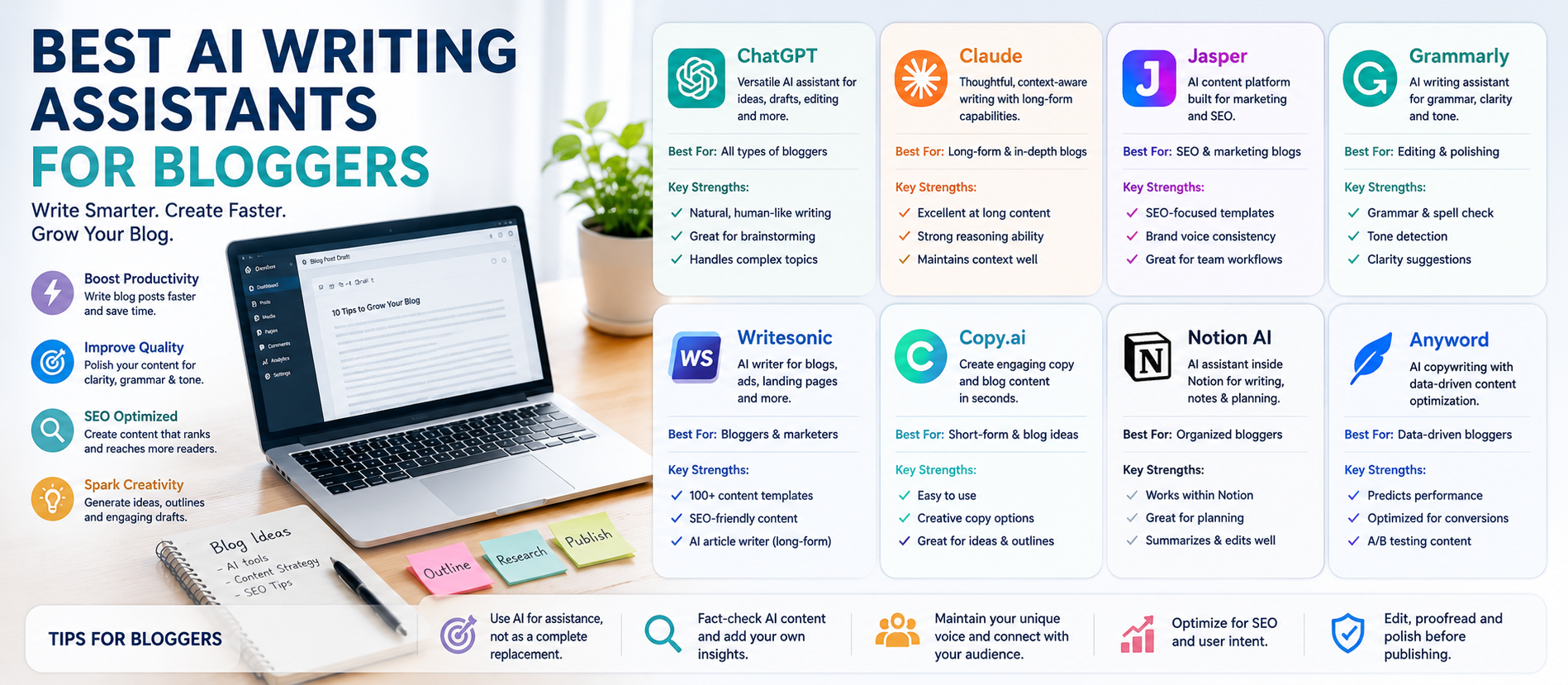
📋 Quick Summary
In this article:
What Is an AI Writing Assistant?
1. ChatGPT – Best for Flexible Blogging Workflows
2. Claude – Strong for Long-Form and Natural Prose
3. Jasper – Best for Brand-Focused Content Teams
4. Grammarly – Best for Editing and Final Polish
5. Writesonic – Useful for SEO-Oriented Content Workflows
6. Copy.ai – Useful for Content Repurposing and Marketing
7. Notion AI – Best for Bloggers Already Using Notion
How to Choose the Best AI Writing Assistant
Common AI Blogging Mistakes to Avoid
A Practical AI Blogging Workflow
Frequently Asked Questions About AI Writing Assistants for Bloggers
AI writing assistants for bloggers have evolved from simple text generators into tools that can help with brainstorming, research, outlining, drafting, editing, optimization, repurposing, and content planning. The best choice depends on the type of blog you publish, how much content you create, your budget, your SEO workflow, and how much control you want over the final writing.
In 2026, the AI writing market is increasingly divided between general-purpose assistants and specialized content platforms. Current comparisons commonly place tools such as ChatGPT and Claude among the strongest general writing options, while Jasper, Writesonic, Copy.ai, Grammarly, and other platforms focus on specific marketing, SEO, editing, or workflow needs. citeturn0search0turn0search7
💡 Key Insight
For bloggers, the important question is not simply which tool generates the longest article. The better question is which assistant helps you produce accurate, useful, original, well-structured, audience-focused content with less unnecessary editing.
This WordPress-ready HTML article is prepared for Digiifrog (www.digiifrog.com) with SEO, AEO, GEO, and AI Search optimization.
What Is an AI Writing Assistant?
An AI writing assistant is software that uses artificial intelligence to help create or improve written content. Bloggers can use these tools to generate ideas, build outlines, draft sections, rewrite paragraphs, improve clarity, adjust tone, summarize research, create FAQs, and repurpose long-form content.
AI should generally be treated as a writing partner rather than an automatic publishing system. OpenAI's current writing guidance recommends a workflow of planning, drafting, revising, and packaging, while also emphasizing that users should review outputs and verify factual claims. citeturn1search0
1. ChatGPT – Best for Flexible Blogging Workflows
ChatGPT is a strong choice for bloggers who want one flexible assistant for brainstorming, outlining, drafting, rewriting, research support, content repurposing, and editorial feedback.
It is particularly useful when you want to control the process instead of pressing a single “generate article” button. You can ask for multiple headlines, compare article structures, create an outline, draft one section at a time, and then revise the finished article for clarity and consistency.
OpenAI's writing guidance specifically recommends giving the assistant context, audience, constraints, desired format, and feedback. Its brainstorming guidance also positions ChatGPT as a structured thought partner rather than a replacement for the writer's expertise. citeturn1search0turn1search1
Best for: Solo bloggers, general-purpose writing, brainstorming, editing, and customized workflows.
2. Claude – Strong for Long-Form and Natural Prose
Claude is frequently recommended for long-form writing because it can handle detailed instructions and large amounts of context. It can be useful when a blogger wants to provide a style guide, research notes, existing articles, and a long outline before asking for a draft.
Recent 2026 comparisons commonly rate Claude highly for natural long-form prose and instruction following. citeturn0search2turn0search7
Claude can be especially useful for pillar articles, technical explainers, detailed guides, and editing projects where maintaining the meaning and structure of a long document matters.
Best for: Long-form articles, nuanced writing, editing, and writers who prioritize natural prose.
3. Jasper – Best for Brand-Focused Content Teams
Jasper is designed around marketing content workflows and can be attractive to bloggers who publish at higher volume or work with multiple writers. Brand voice, reusable workflows, templates, and marketing-focused features can make it more useful for teams than a basic chatbot.
Current 2026 comparisons frequently position Jasper as a strong choice for brand-controlled marketing content and content teams. citeturn0search0turn0search14
Its value comes from workflow, consistency, brand controls, and marketing-oriented features.
Best for: Content teams, marketing departments, agencies, and bloggers with strict brand-voice requirements.
4. Grammarly – Best for Editing and Final Polish
Grammarly is especially useful when you already have a draft and want to improve grammar, clarity, tone, conciseness, and readability. It works well as an editing layer after content has been created with another AI assistant.
For bloggers, this can be valuable because AI-generated drafts often require human-style editing even when the information is generally useful. A final editorial pass can remove repetition, awkward phrasing, unnecessary filler, and inconsistent tone.
Recent 2026 tool comparisons continue to position Grammarly strongly for editing and polishing rather than as the primary long-form content generator. citeturn0search7
Best for: Proofreading, editing, readability, tone, and final content quality.
5. Writesonic – Useful for SEO-Oriented Content Workflows
Writesonic is aimed at marketers and content teams that want AI writing combined with search-oriented workflows. It can be useful for bloggers who care about producing content around target topics and building repeatable content processes.
Current 2026 comparisons often place Writesonic among tools focused more heavily on SEO and AI-search visibility than general-purpose writing assistants. citeturn0search0turn0search11
Before choosing any SEO writing platform, bloggers should remember that software recommendations are not a substitute for genuine research, useful information, strong sources, and human editorial judgment.
Best for: SEO-focused bloggers, marketers, and content production workflows.
6. Copy.ai – Useful for Content Repurposing and Marketing
Copy.ai has developed beyond basic article generation into a broader marketing and go-to-market platform. For bloggers, its value can be strongest when one article needs to become multiple marketing assets.
A long article can be adapted into social posts, email copy, promotional snippets, campaign messages, and other short-form content. Current 2026 comparisons commonly identify Copy.ai with marketing and go-to-market workflows. citeturn0search0turn0search11
Best for: Bloggers who also manage social media, email marketing, or broader content campaigns.
7. Notion AI – Best for Bloggers Already Using Notion
Notion AI can be convenient when your editorial calendar, research notes, outlines, drafts, and project documentation already live inside Notion. The major advantage is workflow integration rather than simply generating better prose than every competing assistant.
For bloggers who want ideas, notes, content briefs, and drafts in one workspace, an integrated writing assistant can reduce switching between applications.
Best for: Bloggers and teams already using Notion as their content workspace.
How to Choose the Best AI Writing Assistant
Start by identifying your actual workflow. A blogger publishing two carefully researched articles per month may need a different tool from a content agency publishing dozens of articles every week.
- For flexible writing: Choose a general assistant such as ChatGPT.
- For long-form prose: Consider Claude.
- For brand-focused teams: Consider Jasper.
- For editing: Use Grammarly or a similar editing layer.
- For SEO workflows: Consider a specialized SEO content platform.
- For content repurposing: Consider Copy.ai.
- For an integrated workspace: Consider Notion AI if you already use Notion.
Common AI Blogging Mistakes to Avoid
- Publishing AI drafts without fact-checking.
- Using generic introductions that add little value.
- Writing for word count instead of reader intent.
- Repeating the same ideas across multiple sections.
- Adding unsupported statistics or quotations.
- Ignoring the blogger's own expertise and experience.
- Using AI-generated content without a consistent editorial standard.
- Assuming an SEO score guarantees search success.
- Choosing an expensive platform without testing the workflow first.
A Practical AI Blogging Workflow
- Step 1: Choose a clear audience and search intent.
- Step 2: Research the topic and collect trustworthy sources.
- Step 3: Ask AI to brainstorm angles and build an outline.
- Step 4: Add your own expertise, examples, and perspective.
- Step 5: Generate or write the first draft.
- Step 6: Fact-check important claims.
- Step 7: Edit for voice, clarity, originality, and usefulness.
- Step 8: Optimize headings, internal links, FAQs, and metadata.
- Step 9: Perform a final human review before publishing.
Frequently Asked Questions About AI Writing Assistants for Bloggers
What is the best AI writing assistant for bloggers?
There is no single best tool for every blogger. ChatGPT and Claude are strong general-purpose choices, Jasper is useful for brand-focused marketing teams, Grammarly is valuable for editing, and specialized SEO platforms can help with search-oriented workflows. citeturn0search0turn0search7
Can AI write an entire blog post?
Yes, AI assistants can generate complete drafts, but bloggers should treat those drafts as starting material. Review facts, add original insight, improve structure, and edit the final article before publishing.
Is AI-generated content good for SEO?
AI can help produce well-structured content, but SEO performance depends on usefulness, relevance, accuracy, originality, search intent, technical SEO, and overall site quality. The method used to produce text should not replace editorial quality.
Should bloggers use more than one AI tool?
Often, yes. A practical workflow may use one assistant for brainstorming and drafting, another tool for editing, and an SEO platform for optimization. The best combination depends on publishing volume and workflow complexity.
How can bloggers keep AI content sounding human?
Provide clear context and style guidance, include personal experience and original examples, remove generic filler, vary sentence structure, and perform a real human editing pass. AI should support your voice rather than replace it.
Conclusion
The best AI writing assistants for bloggers are not necessarily the tools that generate the most text. They are the tools that help bloggers think faster, write better, edit more efficiently, and publish genuinely useful content.
For solo bloggers, a general assistant can handle brainstorming, outlines, drafts, and revisions. Long-form writers may prefer Claude, marketing teams may benefit from Jasper, editors can use Grammarly, and SEO-focused publishers may prefer specialized platforms. Current 2026 comparisons support this increasingly specialized view of the AI writing market. citeturn0search0turn0search7
The strongest strategy is to build an editorial workflow in which AI accelerates repetitive tasks while the blogger remains responsible for research, expertise, fact-checking, originality, and final judgment.
For businesses seeking modern websites, AI content, automation, SEO, AEO, GEO, and AI Search optimization, Digiifrog can help. Visit www.digiifrog.com.
Quick Answer: Which AI Writing Assistant Is Best for Bloggers?
ChatGPT is a strong all-purpose option for flexible blogging workflows, Claude is well suited to long-form and nuanced writing, Jasper is useful for brand-focused content teams, Grammarly is strong for editing and polishing, Writesonic and other SEO platforms can support search-focused workflows, Copy.ai is useful for marketing repurposing, and Notion AI is convenient for bloggers who already manage their content inside Notion.
Important Note
AI writing tools, features, pricing, usage limits, and integrations can change frequently. Check the current official product information before purchasing a subscription. Always review AI-generated content for accuracy, originality, copyright considerations, privacy, and suitability for your audience.
Ready to Grow?
Talk to us about a strategy tailored to your brand — we will help you stand out in search, AI discovery and social.


Comments (0)
Log in to leave a comment.