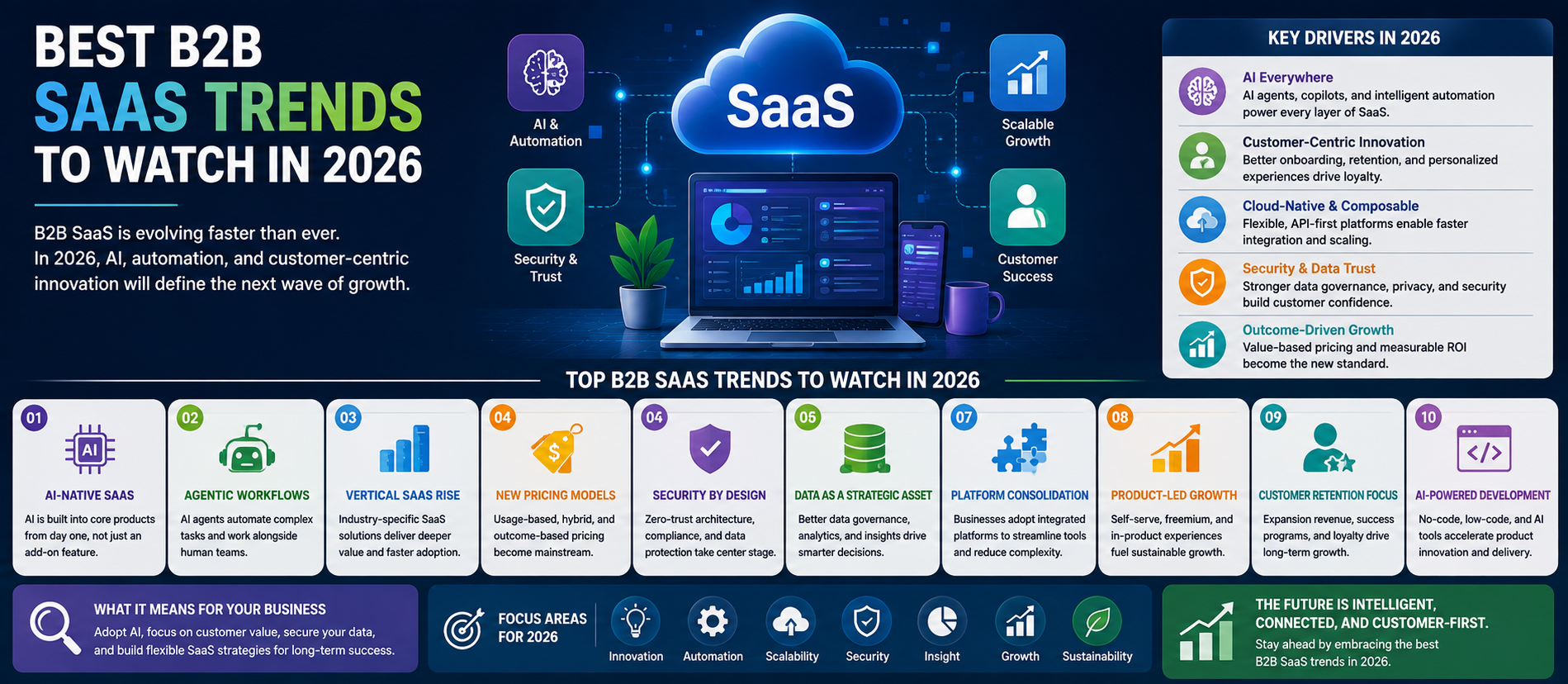
📋 Quick Summary
In this article:
Quick Answer: What Are the Biggest B2B SaaS Trends in 2026?
1. AI Agents Move from Feature to Workflow
2. Agentic Workflows Will Change the SaaS User Experience
3. Human Oversight Will Become a Product Requirement
4. SaaS Pricing Will Move Beyond Simple Per-Seat Models
5. Outcome-Based SaaS Will Gain More Attention
6. Vertical SaaS Will Continue to Create Strong Opportunities
7. Data Governance Will Become a Competitive Advantage
8. Cybersecurity and AI Security Will Become Core Buying Criteria
9. Platform Consolidation Will Continue
10. Interoperability Will Matter More
Focus Keyword: B2B SaaS Trends 2026
The B2B SaaS market is changing quickly. For many years, the standard SaaS model was simple: build software, charge a monthly or annual subscription, and increase revenue by adding more users.
💡 Key Insight
That model is still important, but 2026 is creating new pressure. Artificial intelligence is changing how users interact with software. AI agents can complete multi-step tasks. Customers are questioning software costs more closely. Security and data governance are becoming bigger buying factors. SaaS companies are also competing for visibility in search engines, answer engines, and AI-powered discovery systems.
The result is a major shift in how B2B SaaS products are built, sold, priced, implemented, and measured.
This guide explains the best B2B SaaS trends to watch in 2026. It uses clear and direct language and is structured to support SEO, AEO, GEO, and AI Search Optimization.
Digiifrog creates structured, readable, and search-friendly content for businesses, SaaS companies, technology brands, and digital growth strategies.
Website: www.digiifrog.com
Quick Answer: What Are the Biggest B2B SaaS Trends in 2026?
The biggest B2B SaaS trends in 2026 include AI agents, agentic workflows, human-AI collaboration, hybrid and outcome-based pricing, vertical SaaS, stronger security and governance, platform consolidation, embedded analytics, customer retention, product-led growth, AI-powered software development, and optimization for AI search experiences.
The common theme is simple: SaaS is moving from software that only helps people perform tasks toward software that can assist, automate, coordinate, and in some cases execute parts of a workflow.
1. AI Agents Move from Feature to Workflow
One of the biggest B2B SaaS trends in 2026 is the rise of AI agents.
A traditional AI feature may summarize a document, write an email, or answer a question. An AI agent can potentially handle a broader sequence of work. It may receive a goal, gather information, use connected tools, perform defined actions, and return a result for human review.
Microsoft's 2026 Work Trend Index describes a growing progression from using AI as an assistant to directing agents and orchestrating multiple agents across workflows. The broader implication for B2B SaaS is important: customers increasingly expect software to reduce execution work, not only provide another interface.
Examples may include:
- Customer support agents that resolve routine requests.
- Sales agents that research accounts and prepare outreach.
- Finance agents that help review invoices or reconcile information.
- IT agents that assist with routine operational tasks.
- Marketing agents that support campaign operations.
- Operations agents that monitor workflows and flag exceptions.
The strongest SaaS products will not simply add a chatbot to an existing dashboard. They will identify where autonomous or semi-autonomous action can create real value.
2. Agentic Workflows Will Change the SaaS User Experience
For years, software design focused on helping users navigate screens, menus, forms, and dashboards. Agentic workflows may change that relationship.
Instead of manually completing every step, a user may increasingly describe an outcome, define rules, approve important actions, and review exceptions.
This does not mean the user interface will disappear. Instead, interfaces may become more focused on:
- Setting goals.
- Defining permissions.
- Monitoring agent activity.
- Reviewing recommendations.
- Approving high-risk actions.
- Managing exceptions.
- Measuring outcomes.
Microsoft's 2026 research describes four collaboration patterns: author, editor, director, and orchestrator. For SaaS companies, this suggests that different workflows will require different levels of human control.
A high-risk financial action may require strong approval. A routine scheduling task may need much less human involvement.
3. Human Oversight Will Become a Product Requirement
More automation does not remove the need for people. In many B2B use cases, it increases the importance of human judgment.
Companies will need clear answers to questions such as:
- What can the agent do?
- What data can it access?
- Who is responsible for its actions?
- Which actions require approval?
- How can users review activity?
- How are errors detected?
- How can an action be reversed?
In 2026, trust will become part of the product experience. SaaS buyers will increasingly evaluate not only what AI can do, but also how safely and transparently it operates.
4. SaaS Pricing Will Move Beyond Simple Per-Seat Models
Traditional B2B SaaS pricing often depends on the number of users. This approach remains useful when people are the primary users of the software.
AI agents create a new problem. If an agent completes the work of many users, charging only by seat may not accurately reflect the value or cost of the service.
As a result, 2026 is likely to accelerate hybrid pricing models.
Common models may include:
- Per-user or per-seat subscriptions.
- Usage-based pricing.
- Consumption credits.
- API-based pricing.
- Per-action pricing.
- Per-task pricing.
- Outcome-based pricing.
- Hybrid pricing that combines several models.
Deloitte's 2026 technology analysis and Gartner's 2026 enterprise software research both point to pressure on traditional seat-based economics as agentic AI changes how software is used and how value is delivered.
The challenge for SaaS companies will be to create pricing that customers can understand and predict. Complex pricing may increase revenue opportunities but can also create buyer friction.
5. Outcome-Based SaaS Will Gain More Attention
Outcome-based pricing is especially interesting for agentic products.
Instead of paying only for access, a customer may pay when a defined result occurs. For example, a company could potentially pay for a resolved support issue, a completed workflow, a processed document, or another measurable business action.
This model can align the software provider more closely with customer value. However, it also creates new questions:
- How is a successful outcome defined?
- What happens when a human must intervene?
- Who controls the underlying data?
- How can customers predict monthly costs?
- How is quality measured?
Not every SaaS product is suitable for outcome pricing. Many companies will continue using subscriptions while adding consumption or agent-specific charges.
6. Vertical SaaS Will Continue to Create Strong Opportunities
Horizontal SaaS serves many industries. Vertical SaaS focuses on the needs of a specific industry or profession.
Examples may include software designed for:
- Healthcare organizations.
- Legal teams.
- Construction companies.
- Financial services.
- Education providers.
- Real estate businesses.
- Manufacturing companies.
- Logistics and supply-chain teams.
Vertical SaaS can offer deeper workflows, industry-specific terminology, specialized compliance features, and relevant integrations.
AI may strengthen this trend. A general AI model can provide broad assistance, but a domain-specific product can combine AI with structured workflows, trusted data, industry rules, and specialized context.
7. Data Governance Will Become a Competitive Advantage
AI features depend heavily on data. That makes data governance a central issue for B2B SaaS companies.
Customers increasingly want to know:
- Where is data stored?
- How is sensitive information protected?
- Is customer data used to train models?
- What permissions control AI access?
- How long is information retained?
- Can administrators audit activity?
Good governance should not be hidden in a long policy document. It should appear in product controls, permissions, documentation, and implementation processes.
For enterprise buyers, strong governance can become a reason to choose one platform over another.
8. Cybersecurity and AI Security Will Become Core Buying Criteria
Security has always been important in B2B SaaS. AI introduces additional risks because intelligent systems may access more data and interact with more tools.
Organizations must consider identity, permissions, prompt or instruction risks, connected applications, data exposure, and unauthorized automation.
A mature B2B SaaS security strategy may include:
- Strong identity management.
- Role-based access control.
- Multi-factor authentication.
- Activity logs.
- Data encryption.
- Permission boundaries for agents.
- Human approval for sensitive actions.
- Regular security testing.
- Clear incident response processes.
AI security will become part of SaaS architecture rather than an optional add-on.
9. Platform Consolidation Will Continue
Many businesses have accumulated too many SaaS tools. Different teams may use separate products for communication, analytics, automation, customer management, documentation, and project management.
This creates several problems:
- Higher costs.
- Duplicate data.
- Integration complexity.
- Security gaps.
- Poor user adoption.
- Vendor management challenges.
In 2026, buyers will continue looking for ways to simplify their technology stack.
This does not mean every company will want one giant platform. Specialized tools will remain valuable. However, SaaS vendors will face greater pressure to integrate well, prove unique value, and reduce unnecessary complexity.
10. Interoperability Will Matter More
A SaaS product rarely operates alone. Customers expect software to connect with CRM platforms, accounting systems, communication tools, data warehouses, identity providers, and other business applications.
As AI agents work across systems, interoperability becomes even more important.
B2B SaaS companies should focus on:
- Reliable APIs.
- Clear documentation.
- Secure integrations.
- Web hook support where appropriate.
- Data portability.
- Standardized connectors.
- Permission-aware access.
The goal is not to connect with everything. The goal is to connect with the systems that matter most to customers.
11. Embedded Analytics Will Become More Actionable
Traditional dashboards show what happened. The next generation of analytics will increasingly help users understand why it happened and what action may be useful next.
AI can help summarize trends, identify unusual changes, explain key drivers, and suggest possible actions.
For example, instead of simply showing that customer churn increased, a SaaS analytics system may help identify:
- Which customer segments changed.
- When the change started.
- Which product behaviors were affected.
- Possible contributing factors.
- Recommended areas for investigation.
The best analytics features will still allow users to inspect the underlying information rather than blindly trusting an AI-generated explanation.
12. Product-Led Growth Will Become More Intelligent
Product-led growth, or PLG, focuses on using the product experience itself to attract, activate, retain, and expand customers.
AI can make product experiences more personalized. Software may adapt onboarding, recommend features, identify unused capabilities, or provide contextual help.
However, more automation does not automatically create better activation.
A strong PLG strategy still requires:
- A clear first-use experience.
- Fast time to value.
- Simple onboarding.
- Relevant guidance.
- Clear pricing.
- Reliable support.
The goal is to help customers reach a meaningful result quickly.
13. Customer Retention Will Receive More Strategic Attention
Acquiring customers is expensive. Sustainable SaaS growth depends heavily on retention, expansion, and customer satisfaction.
In 2026, SaaS companies will increasingly use product data and AI-assisted analysis to identify churn risk and expansion opportunities.
Useful signals may include:
- Declining product usage.
- Reduced engagement.
- Unresolved support issues.
- Low adoption of important features.
- Contract renewal timing.
- Changes in account activity.
Prediction alone is not enough. The business must have a clear response process when risk appears.
14. AI-Powered Software Development Will Change SaaS Economics
AI coding tools are making software development faster in many situations. Developers can use AI to draft code, explain unfamiliar systems, generate tests, review changes, and accelerate routine work.
This may lower the cost of building some software features. It may also increase competition because smaller teams can create products more quickly.
At the same time, faster code generation does not remove the need for:
- Product strategy.
- Security review.
- Architecture.
- Testing.
- Compliance.
- Reliability engineering.
- Customer support.
Reuters has also highlighted the growing debate around AI-assisted “vibe coding” and the potential disruption to traditional software firms, while noting that enterprise requirements such as security, audit readiness, and scalability remain important barriers to simply replacing established platforms.
15. AI Features Must Prove Business Value
In the early stages of AI adoption, companies often added AI features because customers expected them.
In 2026, buyers are likely to ask tougher questions:
- Does this feature save time?
- Does it improve quality?
- Does it reduce costs?
- Does it increase revenue?
- Can we measure the result?
- Is the additional price justified?
SaaS companies should connect AI features to a clear customer outcome. “AI-powered” is not a value proposition by itself.
16. The Rise of AI Search Will Change SaaS Marketing
B2B buyers are discovering products through more than traditional search results. They may use AI assistants, answer engines, comparison tools, and generative search experiences.
This makes AI Search Optimization increasingly important.
A SaaS company should make its content easy to understand by both people and machines.
Useful practices include:
- Clear product descriptions.
- Direct answers to common buyer questions.
- Detailed feature and use-case pages.
- Transparent comparisons.
- Structured FAQs.
- Technical documentation.
- Original research and expert insights.
- Consistent company information across trusted sources.
This supports four related strategies:
SEO: Improving visibility in traditional search.
AEO: Creating direct, useful answers for answer engines.
GEO: Structuring content so generative systems can understand the topic and brand context.
AI Search Optimization: Making important product information clear, factual, structured, and easy to retrieve.
17. Trust and Transparency Will Influence SaaS Buying Decisions
B2B software buyers want to understand what they are purchasing.
Clear communication about pricing, AI usage, data practices, security, implementation requirements, and support can reduce friction.
Trust can be strengthened with:
- Clear documentation.
- Security information.
- Transparent pricing where appropriate.
- Case studies.
- Customer proof.
- Implementation guidance.
- Service commitments.
Complex technology does not require confusing communication.
18. SaaS Companies Will Focus More on Efficient Growth
Growth at any cost is becoming less attractive. B2B SaaS businesses are increasingly expected to understand the relationship between growth, customer acquisition cost, retention, gross margin, and operating efficiency.
Important metrics may include:
- Monthly recurring revenue.
- Annual recurring revenue.
- Net revenue retention.
- Gross revenue retention.
- Customer acquisition cost.
- Customer lifetime value.
- Churn rate.
- Payback period.
- Gross margin.
The right metrics depend on the business model. The key is to avoid optimizing one number while damaging the overall economics of the company.
Simple B2B SaaS Trends Framework for 2026
| Trend Main Impact What SaaS Companies Should Do | ||
| AI Agents | More automated work | Identify high-value workflows |
| Agentic Workflows | Less manual execution | Build approval and oversight controls |
| Hybrid Pricing | Changing SaaS economics | Test pricing that matches value and cost |
| Vertical SaaS | Deeper industry specialization | Build domain expertise and workflows |
| Security and Governance | Higher enterprise expectations | Make trust visible in the product |
| Platform Consolidation | Pressure on software budgets | Prove unique value and integrate well |
| AI Search | Changing product discovery | Create clear, structured content |
| Retention | Greater focus on sustainable growth | Use customer signals to prevent churn |
How B2B SaaS Companies Should Prepare for 2026
Companies do not need to follow every trend. A better approach is to identify the trends that match the product, customer, and business model.
A practical preparation process can include:
- Review the customer workflow. Find repetitive, high-friction tasks.
- Evaluate AI opportunities. Focus on measurable business value.
- Improve governance. Define permissions, oversight, and accountability.
- Review pricing. Decide whether seat-based pricing still reflects value.
- Strengthen integrations. Make the product work with the customer ecosystem.
- Measure retention. Understand why customers stay, expand, or leave.
- Improve documentation. Support customers, search engines, answer engines, and AI systems.
- Test carefully. Pilot new AI workflows before expanding them.
Common Mistakes to Avoid
Adding AI Without a Clear Use Case
AI should solve a real problem. A feature that looks impressive but creates little value can increase product complexity.
Removing Human Control Too Quickly
High-impact decisions may require review, approval, and clear escalation paths.
Creating Confusing Pricing
Hybrid pricing can be useful, but customers should understand what they are paying for.
Ignoring Data Governance
AI features require strong attention to data access, privacy, and security.
Measuring Only New Customer Growth
Retention and expansion are essential for sustainable SaaS economics.
Publishing Generic Marketing Content
Clear product information, original expertise, useful comparisons, and direct answers are more valuable for modern search and AI discovery.
Frequently Asked Questions
What is the biggest B2B SaaS trend in 2026?
AI agents and agentic workflows are among the biggest trends because they can change how customers interact with software and how SaaS companies price their products.
Will AI replace traditional SaaS?
AI is more likely to reshape SaaS than completely replace it. Established software systems still provide data, workflows, security, integrations, governance, and enterprise reliability.
Is per-seat SaaS pricing disappearing?
No. Per-seat pricing is likely to remain useful, but many companies are adding usage, consumption, action, or outcome-based elements for AI services.
Why is vertical SaaS important?
Vertical SaaS can provide deeper industry-specific workflows, terminology, integrations, and compliance support than general-purpose software.
How can a SaaS company improve AI search visibility?
Create clear product pages, answer common buyer questions directly, publish useful documentation, add structured FAQs, provide specific use cases, and maintain accurate brand information.
What should SaaS companies measure in 2026?
Important measures may include revenue growth, retention, churn, expansion, product adoption, customer acquisition efficiency, gross margin, and the measurable impact of AI features.
Conclusion
The most important B2B SaaS trends to watch in 2026 are connected.
AI agents are changing workflows. New workflows are changing user experiences. Those changes are creating pressure on traditional pricing. More automation increases the need for governance and security. A larger SaaS ecosystem increases demand for better integrations and platform consolidation. At the same time, SaaS companies must compete for attention in traditional search and emerging AI-powered discovery systems.
The companies most likely to benefit will not chase every new technology. They will focus on customer problems, measurable value, trustworthy AI, sustainable economics, and clear product communication.
In 2026, successful B2B SaaS companies will compete not only on features, but on outcomes, trust, integration, intelligence, and the quality of the customer experience.
Disclaimer: This article is for general educational and informational purposes. Technology trends, software capabilities, regulations, pricing models, and market conditions can change quickly. Businesses should evaluate their own product, customers, legal requirements, security needs, and financial goals before making strategic decisions.
Digiifrog
Website: www.digiifrog.com
Ready to Grow?
Talk to us about a strategy tailored to your brand — we will help you stand out in search, AI discovery and social.
Comments (0)
Log in to leave a comment.