📋 Quick Summary
In this article:
Why B2B Sales Funnels Are Different
Step 1: Define Your Ideal Customer Profile
Step 2: Identify the B2B Buyer's Pain Points
Step 3: Create a Clear Value Proposition
A Strong B2B Value Proposition Should Be:
Step 4: Build Awareness With High-Intent Content
Step 5: Optimize Your Website for Conversion
Step 6: Create High-Value Lead Magnets
Step 7: Use Landing Pages for Specific Campaigns
A high-converting B2B sales funnel is more than a sequence of web pages, emails, and sales calls. It is a structured system that moves potential business customers from initial awareness to genuine interest, qualified evaluation, and ultimately a purchase decision. Because B2B buyers often research extensively, involve multiple stakeholders, compare vendors, and take longer to make decisions than consumers, businesses need a sales funnel designed around trust, relevance, timing, and measurable value.
In 2026, the modern B2B sales funnel is also being transformed by artificial intelligence, marketing automation, CRM platforms, conversational experiences, account-based marketing, intent signals, and AI-powered search. Companies that connect these technologies with strong messaging and a customer-focused sales process can create a more predictable pipeline while reducing wasted marketing and sales effort.
This WordPress-ready HTML article is prepared for Digiifrog (www.digiifrog.com) with a strong focus on SEO, AEO, GEO, and AI Search optimization.
What Is a B2B Sales Funnel?
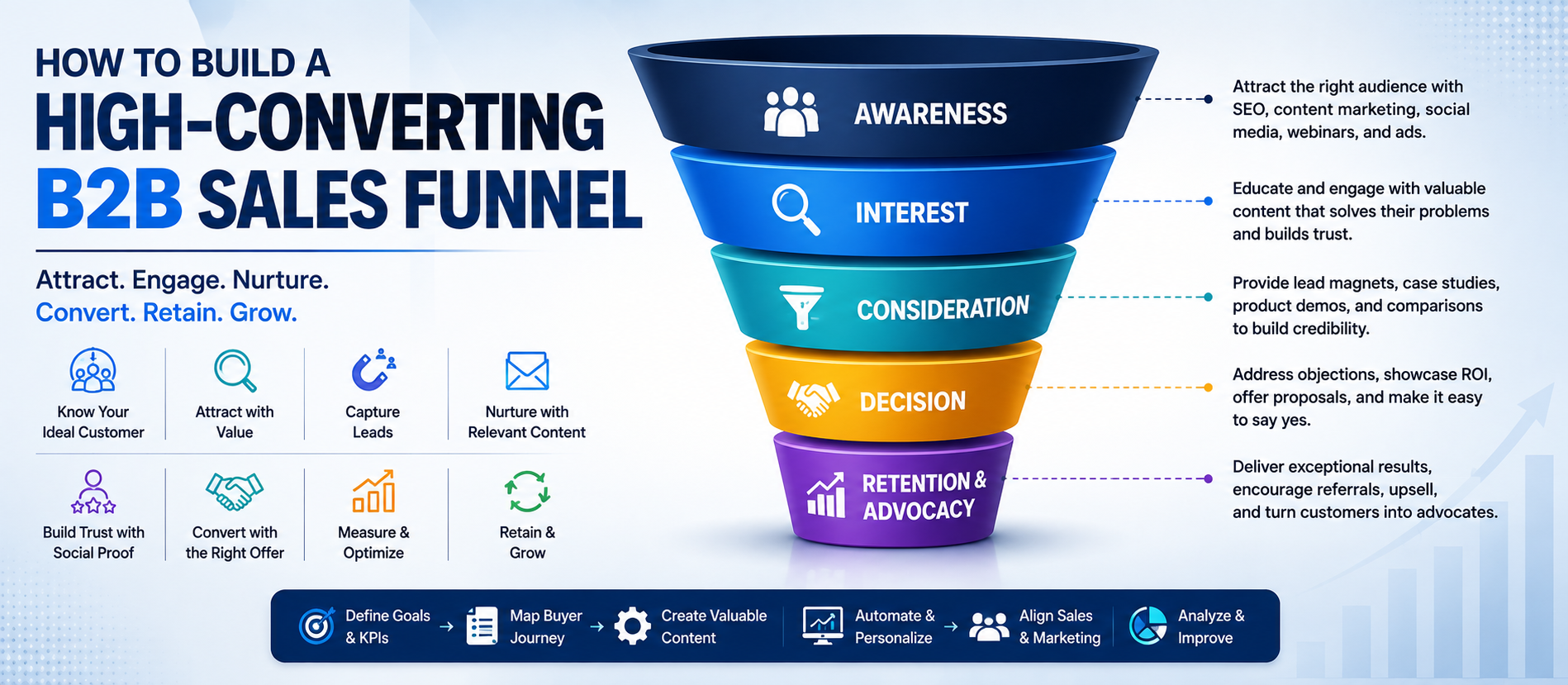
A B2B sales funnel is the journey a potential business customer takes from discovering a company to becoming a qualified prospect, evaluating its solution, making a purchase decision, and eventually becoming a retained customer or advocate.
The funnel is commonly divided into awareness, consideration, evaluation, decision, and post-purchase stages. Different businesses may use different terminology, but the underlying principle is the same: prospects need different information and experiences at different points in their buying journey.
- Awareness: The prospect discovers a problem, need, or potential solution.
- Interest: The prospect begins researching possible approaches.
- Consideration: The prospect evaluates vendors, solutions, and alternatives.
- Qualification: The business determines whether there is a strong fit.
- Decision: Stakeholders compare proposals, pricing, risk, and expected outcomes.
- Purchase: The prospect becomes a customer.
- Retention and expansion: The company delivers value and identifies future opportunities.
Why B2B Sales Funnels Are Different
B2B purchases are usually more complex than consumer purchases. A buyer may need approval from finance, management, IT, procurement, legal, security, or other departments. The purchase may also involve a significant financial commitment or operational change.
As a result, B2B prospects often need detailed evidence before they are ready to speak with sales. They may search Google, read articles, compare competitors, watch demonstrations, review case studies, ask colleagues, and use AI-powered search tools before submitting a form.
A strong funnel therefore helps prospects answer several questions:
- Do you understand my business problem?
- Can your solution solve it?
- Why should I trust your company?
- How are you different from competitors?
- What will implementation involve?
- What results can I reasonably expect?
- What will the solution cost?
- What risks should I consider?
Step 1: Define Your Ideal Customer Profile
The first step in building a high-converting B2B sales funnel is defining exactly who you want to attract. A broad audience can generate traffic, but traffic alone does not create a healthy pipeline.
An Ideal Customer Profile (ICP) describes the type of organization that is most likely to need, afford, adopt, and benefit from your solution.
Key ICP Characteristics
- Industry
- Company size
- Revenue range
- Geographic market
- Technology environment
- Business model
- Growth stage
- Common operational challenges
- Typical purchasing process
- Budget characteristics
For example, an AI automation company may decide that its strongest prospects are growing service businesses with repetitive administrative processes, an existing digital workflow, and a management team interested in improving operational efficiency.
Step 2: Identify the B2B Buyer's Pain Points
Effective B2B marketing starts with the customer's problem rather than the company's product features. Prospects respond more strongly when messaging reflects the challenges they already recognize.
Research customer interviews, sales conversations, support tickets, reviews, search queries, competitor discussions, and industry communities to identify recurring problems.
Common B2B pain points include:
- High operating costs
- Slow manual processes
- Poor lead quality
- Low sales productivity
- Disconnected software systems
- Customer retention problems
- Limited reporting visibility
- Security concerns
- Difficulty scaling operations
- Inconsistent customer experiences
Use the exact language customers use when describing these problems. This makes website copy, advertising, email campaigns, and sales conversations more relevant.
Step 3: Create a Clear Value Proposition
Your value proposition should quickly explain who you help, what problem you solve, how you solve it, and why the customer should care.
A weak statement might say, “We provide innovative digital solutions.” It sounds professional but does not communicate a specific business outcome.
A stronger value proposition could explain that the company helps growing B2B organizations automate repetitive workflows, reduce manual work, and create faster lead-response processes.
A Strong B2B Value Proposition Should Be:
- Specific
- Outcome-focused
- Easy to understand
- Relevant to the target industry
- Different from generic competitor claims
- Supported by evidence
Step 4: Build Awareness With High-Intent Content
The awareness stage is where prospects first encounter your business. Search engines, social media, referrals, industry publications, webinars, partnerships, and paid advertising can all contribute to awareness.
However, not all traffic is equally valuable. A successful funnel focuses on attracting people who have a genuine business problem or commercial need.
Useful top-of-funnel content includes:
- Educational blog articles
- Industry trend reports
- How-to guides
- Problem-focused videos
- Research reports
- Industry checklists
- Educational webinars
- Expert LinkedIn content
The objective is to educate and build recognition rather than immediately push every visitor toward a sales call.
Step 5: Optimize Your Website for Conversion
💡 Key Insight
Your website is often one of the most important components of a B2B sales funnel. A prospect may visit several pages before deciding whether your company is worth contacting.
High-converting B2B websites should make the next step obvious without creating unnecessary friction.
Important Website Elements
- Clear headline
- Specific value proposition
- Strong calls to action
- Service or product explanations
- Industry-specific pages
- Case studies
- Testimonials
- Trust indicators
- Frequently asked questions
- Contact and qualification forms
- Relevant pricing or engagement information
Each important page should have a logical next action. That action might be downloading a guide, requesting an assessment, booking a consultation, viewing a case study, or starting a conversation.
Step 6: Create High-Value Lead Magnets
Many B2B visitors are not ready to buy during their first visit. A lead magnet gives them a useful reason to exchange contact information or begin a relationship.
Effective lead magnets solve a specific problem rather than simply promoting the company.
- Industry checklist
- ROI calculator
- Implementation guide
- Audit template
- Benchmark report
- Strategy worksheet
- Case study
- Technical guide
- Webinar
⚠ Watch Out
The best lead magnet should naturally connect to the service or product you sell. If the lead magnet attracts people who will never become customers, it may increase lead volume without improving revenue.
Step 7: Use Landing Pages for Specific Campaigns
Sending every advertising visitor to a generic homepage can reduce conversion rates. Dedicated landing pages allow businesses to match the message to the campaign, audience, offer, and search intent.
A B2B landing page should usually contain:
- Relevant headline
- Specific problem statement
- Clear value proposition
- Benefits and outcomes
- Proof or evidence
- Process explanation
- Objection handling
- Focused call to action
Remove unnecessary navigation and distractions when the campaign goal is a specific conversion.
Step 8: Capture and Qualify Leads
Lead generation is only the beginning. The next challenge is determining which leads are worth sales attention.
Lead qualification can consider company size, industry, budget, urgency, business need, decision-making authority, technology environment, and expected implementation timeline.
A simple qualification framework can prevent sales teams from spending too much time on prospects that are unlikely to become customers.
Step 9: Connect Marketing Automation With CRM
A modern B2B funnel should connect marketing automation and CRM systems. When a prospect submits a form, downloads content, books a meeting, or interacts with important assets, relevant information should move into the appropriate system.
Automation can help with:
- Lead assignment
- Email follow-ups
- Lead scoring
- CRM record creation
- Sales notifications
- Task creation
- Pipeline updates
- Reporting
This reduces manual administration and helps sales representatives respond more consistently.
Step 10: Develop Lead Nurturing Campaigns
Many B2B leads are not ready to purchase immediately. Lead nurturing keeps your company relevant while the prospect continues researching.
A nurturing sequence should provide useful information based on the prospect's stage and interests.
Example Nurturing Sequence
- Welcome and resource delivery
- Educational content related to the problem
- Common mistakes and solutions
- Case study or proof
- Comparison or evaluation guide
- Implementation information
- Consultation or demo invitation
Avoid sending the same generic email to every lead. Segmentation can make nurturing much more relevant.
Step 11: Use Lead Scoring
Lead scoring assigns values to prospects based on fit and engagement. A company that matches your ICP and repeatedly engages with high-intent content may deserve more sales attention than a low-fit visitor who downloaded one general article.
Scoring can incorporate:
- Company characteristics
- Job role
- Page visits
- Content downloads
- Webinar attendance
- Demo requests
- Email engagement
- Pricing-page visits
- Meeting bookings
Lead scoring should be reviewed regularly because behavior patterns and business priorities can change.
Step 12: Add Strong Social Proof
B2B buyers want evidence that a provider can deliver. Social proof reduces perceived risk and helps prospects understand the experience of working with your company.
Useful proof includes:
- Customer case studies
- Testimonials
- Client logos where permission exists
- Performance results
- Reviews
- Certifications
- Industry awards
- Expert credentials
- Before-and-after examples
Specific evidence is generally more persuasive than vague claims such as “industry-leading service.”
Step 13: Design a Frictionless Demo or Consultation Process
Once a prospect is sales-ready, the conversion process should be simple. Avoid asking for excessive information before the prospect understands the value of the conversation.
A good booking experience should explain what happens next. For example, tell the prospect whether the meeting will involve a needs assessment, product demonstration, technical discussion, or strategy review.
Step 14: Align Sales and Marketing
B2B funnels perform better when marketing and sales share common definitions, goals, and feedback loops.
Marketing should understand which leads become customers. Sales should understand where leads came from and what content they consumed.
Both teams should agree on definitions such as:
- Marketing Qualified Lead
- Sales Qualified Lead
- Opportunity
- Customer
- Disqualified lead
Regular feedback can help marketing improve targeting and help sales improve messaging.
Step 15: Build a Multi-Touch B2B Sales Process
High-value B2B purchases rarely happen after one interaction. A multi-touch process can include email, calls, demonstrations, technical reviews, proposals, case studies, stakeholder meetings, and follow-ups.
The objective is not to contact prospects as frequently as possible. It is to provide useful information at the right time.
Step 16: Address B2B Buying Objections
Every sales funnel should anticipate objections. Common concerns include price, implementation complexity, security, integration, internal resources, switching costs, contract terms, and expected ROI.
Create content and sales resources that address these concerns before they become deal blockers.
Common Objection Content
- Implementation timeline
- Security documentation
- Integration guides
- ROI analysis
- Pricing explanation
- Migration plans
- Support model
- Customer success process
Step 17: Make the Proposal Outcome-Focused
A B2B proposal should not simply list features and prices. It should connect the proposed solution to the customer's business objectives.
A strong proposal can include the current situation, business challenges, recommended solution, expected outcomes, implementation plan, responsibilities, timeline, investment, assumptions, and next steps.
Step 18: Improve the Sales Handoff
The transition from marketing to sales should be organized. Sales representatives should receive relevant information about the lead's company, needs, interactions, source, and stated objectives.
Good handoffs reduce repetitive questions and create a more professional customer experience.
Step 19: Optimize the Post-Purchase Funnel
The sales funnel does not end at payment. Onboarding, customer success, retention, expansion, referrals, and advocacy can generate substantial long-term value.
A post-purchase process can include:
- Welcome communication
- Implementation plan
- Training
- Milestone tracking
- Customer success reviews
- Performance reporting
- Upsell opportunities
- Referral requests
Step 20: Track the Right B2B Sales Funnel Metrics
Measurement allows companies to identify where prospects are being lost and which channels create profitable customers.
Important Metrics
- Website conversion rate
- Lead volume
- Marketing qualified leads
- Sales qualified leads
- Lead-to-opportunity rate
- Opportunity-to-customer rate
- Customer acquisition cost
- Average deal size
- Sales cycle length
- Pipeline velocity
- Customer lifetime value
- Revenue by acquisition channel
Do not optimize for lead volume alone. A channel that produces fewer leads but significantly more revenue may be far more valuable.
How AI Is Changing B2B Sales Funnels
Artificial intelligence can improve multiple stages of the funnel. AI can help identify prospects, personalize content, summarize sales calls, qualify leads, predict buying signals, draft emails, analyze CRM data, and automate repetitive tasks.
AI can also support sales representatives by summarizing account history and recommending relevant next actions.
- AI lead scoring
- Predictive pipeline analysis
- Personalized email generation
- AI sales assistants
- Conversation intelligence
- Automated CRM updates
- Intent signal analysis
- AI-powered chat
- Proposal assistance
- Sales forecasting
Human oversight remains important. AI-generated recommendations should be reviewed, especially when they affect customer communication, qualification, pricing, or strategic decisions.
AI Agents in B2B Sales Funnels
The next stage of sales automation is agentic AI. Instead of simply generating a response, an AI agent can potentially perform a sequence of approved actions.
For example, an AI sales agent could identify a high-fit account, research publicly available business information, summarize the account, draft a personalized outreach message, create a CRM task, and prepare follow-up suggestions.
Agentic systems should operate with defined permissions, audit trails, human escalation rules, and clear data governance.
B2B Sales Funnel and Account-Based Marketing
Account-Based Marketing (ABM) focuses on selected high-value companies rather than treating every lead identically. ABM can be especially useful when the target market contains a relatively small number of valuable accounts.
An ABM funnel may combine account research, personalized content, targeted advertising, executive outreach, sales engagement, and account-specific landing pages.
SEO for a B2B Sales Funnel
SEO can attract prospects while they are researching business problems. Instead of targeting only broad keywords, B2B companies should create content around problems, use cases, comparisons, implementation questions, costs, alternatives, and industry-specific requirements.
Useful B2B SEO content includes:
- Problem-focused guides
- Software comparisons
- Industry solutions
- Implementation guides
- Cost and pricing explainers
- Alternative pages
- Case studies
- Frequently asked questions
AEO and GEO for B2B Sales Funnels
Answer Engine Optimization (AEO) focuses on making content useful for systems that provide direct answers to user questions. Generative Engine Optimization (GEO) focuses on improving the likelihood that valuable business information is understood and surfaced in generative search experiences.
For B2B websites, this means answering important questions clearly, using descriptive headings, providing concise definitions, demonstrating expertise, explaining processes, and supporting claims with useful evidence.
FAQ sections, structured service pages, comparison content, original research, case studies, and clearly written explanations can strengthen the overall information architecture.
AI Search Optimization for B2B Businesses
Modern buyers increasingly use conversational search and AI assistants to research vendors. B2B companies should therefore publish content that clearly explains who they serve, what they offer, how their process works, what problems they solve, and what makes their approach different.
AI Search optimization should not be treated as keyword stuffing. The goal is to create authoritative, useful, well-structured information that both people and intelligent systems can understand.
Common B2B Sales Funnel Mistakes
Targeting Everyone
A broad audience often produces low-quality leads. Define your ICP and create messaging around specific business needs.
Using Generic Messaging
Statements such as “We deliver innovative solutions” do not explain the business outcome. Make the value proposition specific.
Sending Traffic to the Homepage
Campaigns should usually direct prospects to pages aligned with their search intent, industry, problem, or offer.
Following Up Too Aggressively
Excessive sales messages can damage trust. Follow up with useful information and relevant next steps.
Ignoring Existing Customers
Retention and expansion can be more valuable than constantly acquiring new prospects.
Measuring Vanity Metrics
Traffic and impressions matter, but revenue, qualified pipeline, conversion rates, and customer acquisition economics are more meaningful business indicators.
How to Build a B2B Sales Funnel Step by Step
- Define your ideal customer profile.
- Research customer pain points and buying triggers.
- Create a specific value proposition.
- Map the complete buyer journey.
- Create problem-focused content.
- Build conversion-focused landing pages.
- Offer useful lead magnets.
- Connect forms and marketing automation to your CRM.
- Define lead qualification criteria.
- Create segmented nurturing sequences.
- Implement lead scoring.
- Give sales representatives useful account intelligence.
- Use social proof and case studies.
- Create a simple demo or consultation process.
- Develop an outcome-focused proposal process.
- Measure funnel performance.
- Run experiments and improve weak stages.
- Automate repetitive tasks.
- Strengthen onboarding and retention.
- Continuously align sales, marketing, and customer success.
How to Improve B2B Funnel Conversion Rates
Improving conversion does not always require more traffic. Often, the biggest opportunity is improving the experience between existing funnel stages.
- Improve headline clarity
- Reduce form friction
- Strengthen social proof
- Add specific case studies
- Clarify next steps
- Improve lead response speed
- Segment nurture campaigns
- Personalize sales outreach
- Address objections earlier
- Test different offers and calls to action
Use controlled experiments where possible. Change one important variable at a time and evaluate results over an appropriate period.
Example of a Modern B2B Sales Funnel
Consider a company that sells AI automation services to growing businesses.
A prospect searches for information about automating repetitive business processes and discovers an educational article. The article links to an automation checklist. The prospect downloads the checklist and enters a nurturing sequence.
After consuming several educational resources, the prospect visits a service page and requests an automation assessment. The CRM records the activity and assigns the lead to sales.
The sales representative reviews the company's needs, conducts a discovery call, and prepares an outcome-focused proposal. The prospect receives a case study and implementation plan. After approval, the customer begins onboarding.
This funnel connects content, SEO, lead capture, automation, CRM, sales, proof, and customer success into one continuous journey.
Technology Stack for a High-Converting B2B Funnel
A practical B2B funnel may use several technology layers.
- Website or CMS
- Analytics platform
- CRM
- Email marketing system
- Marketing automation
- Lead enrichment
- Scheduling software
- Sales engagement tools
- Content management system
- AI assistants or agents
- Reporting and business intelligence
The exact stack should remain as simple as possible. Adding more tools does not automatically create a better funnel.
Future of B2B Sales Funnels
The B2B sales funnel is becoming increasingly dynamic. Buyers may move between search engines, AI assistants, social platforms, review sites, websites, webinars, sales calls, and digital communities before making a decision.
Future funnels will likely combine human expertise with AI-powered research, personalization, predictive analytics, workflow automation, and agentic systems.
The most successful businesses will not simply automate everything. They will automate repetitive work while preserving human interaction where trust, strategy, negotiation, and complex decision-making matter most.
Frequently Asked Questions About B2B Sales Funnels
What is a high-converting B2B sales funnel?
A high-converting B2B sales funnel is a structured buyer journey that attracts qualified prospects, educates them, builds trust, captures and qualifies leads, supports sales conversations, and moves the right opportunities toward purchase and long-term customer value.
What are the main stages of a B2B sales funnel?
The main stages typically include awareness, interest, consideration, qualification, decision, purchase, onboarding, retention, and expansion. Businesses can adapt the stages to their specific buying process.
How can I generate more B2B leads?
Focus on a clear ICP, problem-focused SEO content, targeted advertising, industry-specific landing pages, valuable lead magnets, partnerships, social proof, webinars, referrals, and account-based marketing.
How does AI improve a B2B sales funnel?
AI can assist with lead scoring, account research, personalization, content creation, sales-call summaries, CRM updates, forecasting, customer segmentation, and repetitive workflow automation.
What is the role of a CRM in B2B sales?
A CRM centralizes prospect and customer information, tracks interactions, manages opportunities, supports sales workflows, and provides visibility into pipeline performance.
How long does a B2B sales funnel take to build?
The timeline depends on the complexity of the business, existing technology, content requirements, sales process, integrations, and traffic sources. A simple funnel can be launched quickly, while an enterprise funnel may require a longer implementation and optimization process.
What B2B funnel metrics matter most?
Important metrics include qualified lead rate, lead-to-opportunity conversion, opportunity-to-customer conversion, customer acquisition cost, average deal value, sales cycle length, pipeline velocity, win rate, retention, and revenue by channel.
Should every B2B lead talk to sales?
No. Qualification helps sales teams prioritize prospects that fit the ideal customer profile and show meaningful buying intent. Lower-intent leads can remain in automated nurture programs until they become more sales-ready.
Conclusion
Building a high-converting B2B sales funnel requires more than adding a contact form to a website. It requires a complete system that connects customer research, positioning, content, SEO, landing pages, lead capture, qualification, nurturing, CRM, sales conversations, proposals, onboarding, and retention.
The most important principle is to design the funnel around the buyer. Give prospects the information they need at each stage, demonstrate measurable value, answer objections, provide evidence, and make the next step easy.
AI and automation can make the modern B2B funnel faster and more scalable. AI can assist with research, personalization, scoring, content, forecasting, and sales operations, while AI agents can increasingly automate approved multi-step workflows. However, human expertise remains essential for trust, strategy, negotiation, complex buying decisions, and customer relationships.
For businesses looking to build AI-powered sales systems, marketing automation, intelligent websites, lead-generation workflows, and modern digital transformation solutions, Digiifrog can help develop practical strategies. Visit www.digiifrog.com to learn more.
Quick Answer: How Do You Build a High-Converting B2B Sales Funnel?
To build a high-converting B2B sales funnel, define your ideal customer profile, identify their pain points, create a clear value proposition, attract high-intent traffic, build conversion-focused landing pages, offer valuable lead magnets, connect marketing automation with a CRM, qualify and score leads, nurture prospects, provide social proof, create an efficient sales process, address objections, measure funnel metrics, and continuously optimize the customer journey. AI and automation can then be added to accelerate research, personalization, lead management, follow-up, reporting, and repetitive sales operations.
Ready to Grow?
Talk to us about a strategy tailored to your brand — we will help you stand out in search, AI discovery and social.
Comments (0)
Log in to leave a comment.