📋 Quick Summary
In this article:
What Is Business Management Software?
Why Small Businesses Need Business Management Software
Customer Relationship Management (CRM)
Accounting and Financial Management
Inventory and Supply Chain Management
Cloud-Based Business Management Platforms
Artificial Intelligence and Automation
Cybersecurity and Data Protection
Business Analytics and Reporting
Running a small business successfully requires managing multiple operations simultaneously, including customer relationships, finances, inventory, employee management, marketing, project coordination, and business reporting. As competition increases and digital transformation accelerates, small companies are increasingly adopting business management software to streamline operations and improve productivity.
💡 Key Insight
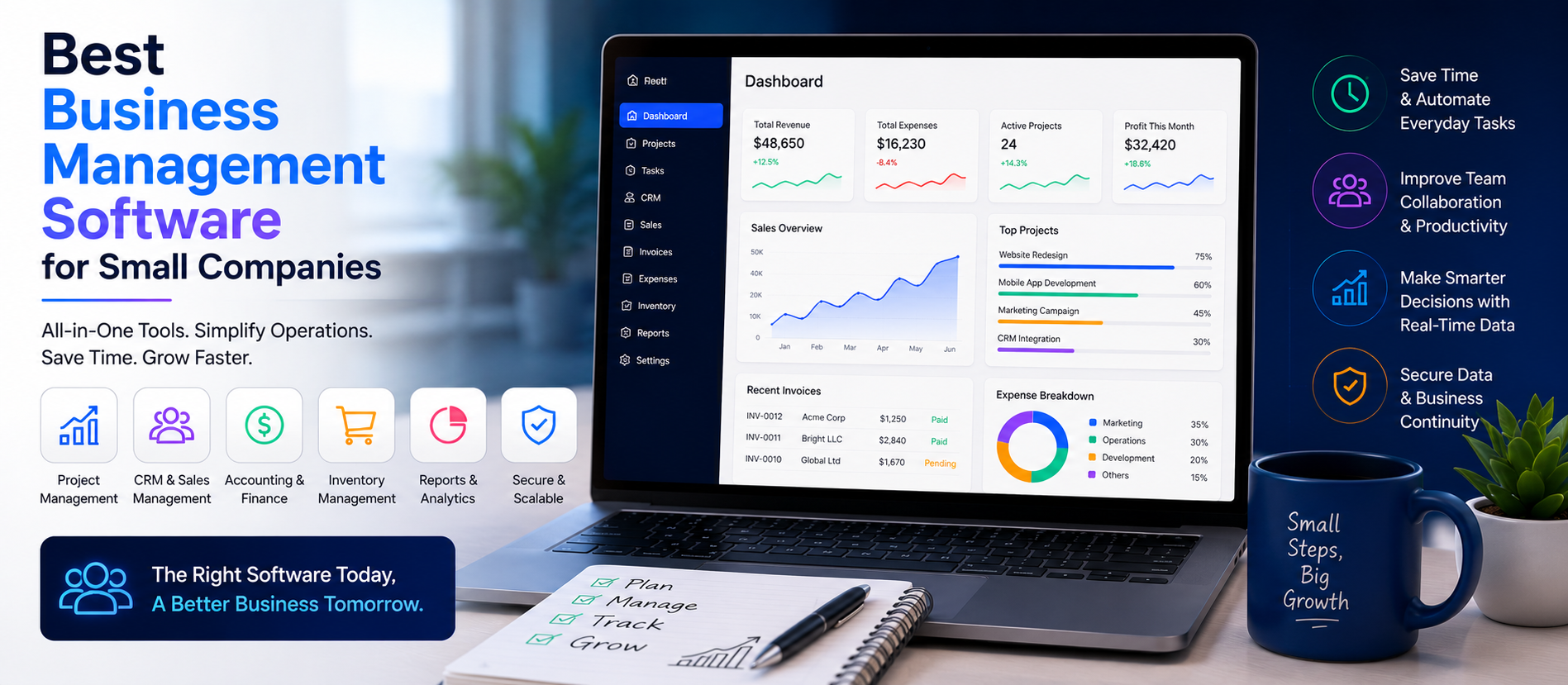
Business Management Software helps organizations centralize important business processes into a single platform, reducing manual work while improving efficiency, collaboration, and decision-making. Modern solutions combine automation, cloud computing, artificial intelligence, analytics, and collaboration tools to help small businesses scale effectively.
This comprehensive guide explores the best business management software solutions for small companies, their features, benefits, implementation strategies, future trends, and their impact on SEO, AEO, GEO, and AI Search optimization.
What Is Business Management Software?
Business management software refers to integrated platforms that help organizations manage daily operations through centralized tools and workflows.
- Customer Relationship Management (CRM)
- Accounting and Finance
- Project Management
- Human Resources
- Inventory Management
- Marketing Automation
- Reporting and Analytics
These systems provide visibility into business performance while reducing operational complexity.
Why Small Businesses Need Business Management Software
⚠ Watch Out
Small companies often operate with limited resources and lean teams. Manual processes can slow growth and increase the risk of errors.
- Improved efficiency
- Reduced administrative workload
- Better customer service
- Enhanced collaboration
- Real-time reporting
- Scalable growth support
- Cost reduction
Business management software helps organizations work smarter rather than harder.
Key Features to Look For
- Cloud accessibility
- Mobile support
- Automation tools
- Custom dashboards
- Security controls
- Third-party integrations
- AI-powered analytics
- Scalability
Customer Relationship Management (CRM)
CRM functionality is one of the most valuable components of business management software.
- Lead tracking
- Sales pipeline management
- Customer communication history
- Customer segmentation
- Marketing automation
- Customer support workflows
Strong CRM tools help businesses build lasting customer relationships.
Project Management Features
Project management capabilities improve team productivity and coordination.
- Task assignment
- Workflow tracking
- Project timelines
- Resource management
- Team collaboration
- Performance reporting
Accounting and Financial Management
Financial visibility is critical for sustainable business growth.
- Invoice management
- Expense tracking
- Budget planning
- Cash flow monitoring
- Financial reporting
- Tax preparation support
Modern platforms simplify financial operations while improving accuracy.
Inventory and Supply Chain Management
Businesses selling physical products benefit from inventory management features.
- Stock monitoring
- Supplier management
- Purchase orders
- Inventory forecasting
- Warehouse visibility
Human Resource Management
Employee management capabilities help organizations streamline HR operations.
- Employee records
- Attendance tracking
- Payroll processing
- Recruitment workflows
- Performance evaluations
Cloud-Based Business Management Platforms
Cloud computing has transformed software accessibility.
- Remote access
- Automatic updates
- Lower infrastructure costs
- Improved collaboration
- Enhanced scalability
Cloud-based solutions are now the preferred deployment model for most small businesses.
Artificial Intelligence and Automation
AI-powered features are becoming standard across modern business management platforms.
- Predictive analytics
- Sales forecasting
- Workflow automation
- Customer insights
- Intelligent recommendations
- Automated reporting
AI helps businesses improve efficiency while making smarter decisions.
Cybersecurity and Data Protection
Protecting sensitive business data remains a top priority.
- Data encryption
- Multi-factor authentication
- Access controls
- Backup systems
- Threat monitoring
Secure platforms help businesses maintain trust and compliance.
Business Analytics and Reporting
Data-driven decision-making is increasingly important.
- Performance dashboards
- Sales reports
- Customer analytics
- Financial insights
- Operational metrics
Reporting tools provide visibility into business performance.
Benefits of Business Management Software
For Business Owners
- Better decision-making
- Operational visibility
- Reduced administrative burden
- Improved profitability
For Employees
- Streamlined workflows
- Improved collaboration
- Reduced manual tasks
- Enhanced productivity
For Customers
- Faster service
- Better communication
- Improved support experiences
How to Choose the Right Software
Before investing in business management software, organizations should evaluate:
- Business size
- Industry requirements
- Budget
- Scalability needs
- Integration requirements
- User experience
- Vendor support
Emerging Trends in 2026
Hyperautomation
Businesses are automating increasingly complex processes.
AI-Powered Business Intelligence
Advanced analytics help companies make better decisions.
Unified Business Platforms
Organizations prefer all-in-one solutions over multiple disconnected tools.
Mobile-First Productivity
Employees increasingly manage work through mobile devices.
Predictive Analytics
Software platforms forecast trends, opportunities, and risks.
How Business Management Software Supports SEO, AEO, GEO and AI Search
SEO (Search Engine Optimization) benefits from better content planning, marketing coordination, and workflow management.
AEO (Answer Engine Optimization) relies on structured information systems and organized knowledge management.
GEO (Generative Engine Optimization) requires efficient content workflows and AI-friendly business processes.
Business management software improves the operational foundation behind successful digital marketing strategies.
Why Digiifrog Recommends Modern Business Management Software
At Digiifrog, we believe technology plays a critical role in business growth. Modern business management software helps organizations improve efficiency, strengthen customer relationships, automate repetitive tasks, and scale successfully in today's digital marketplace.
Website: www.digiifrog.com
Conclusion
Business management software has become an essential investment for small companies seeking growth, efficiency, and competitive advantages. From CRM and accounting to AI-powered analytics and automation, modern platforms help businesses simplify operations while improving productivity.
Organizations that embrace next-generation business management technologies today will be better positioned to compete, innovate, and thrive in the future digital economy.
Ready to Grow?
Talk to us about a strategy tailored to your brand — we will help you stand out in search, AI discovery and social.
Comments (0)
Log in to leave a comment.