📋 Quick Summary
In this article:
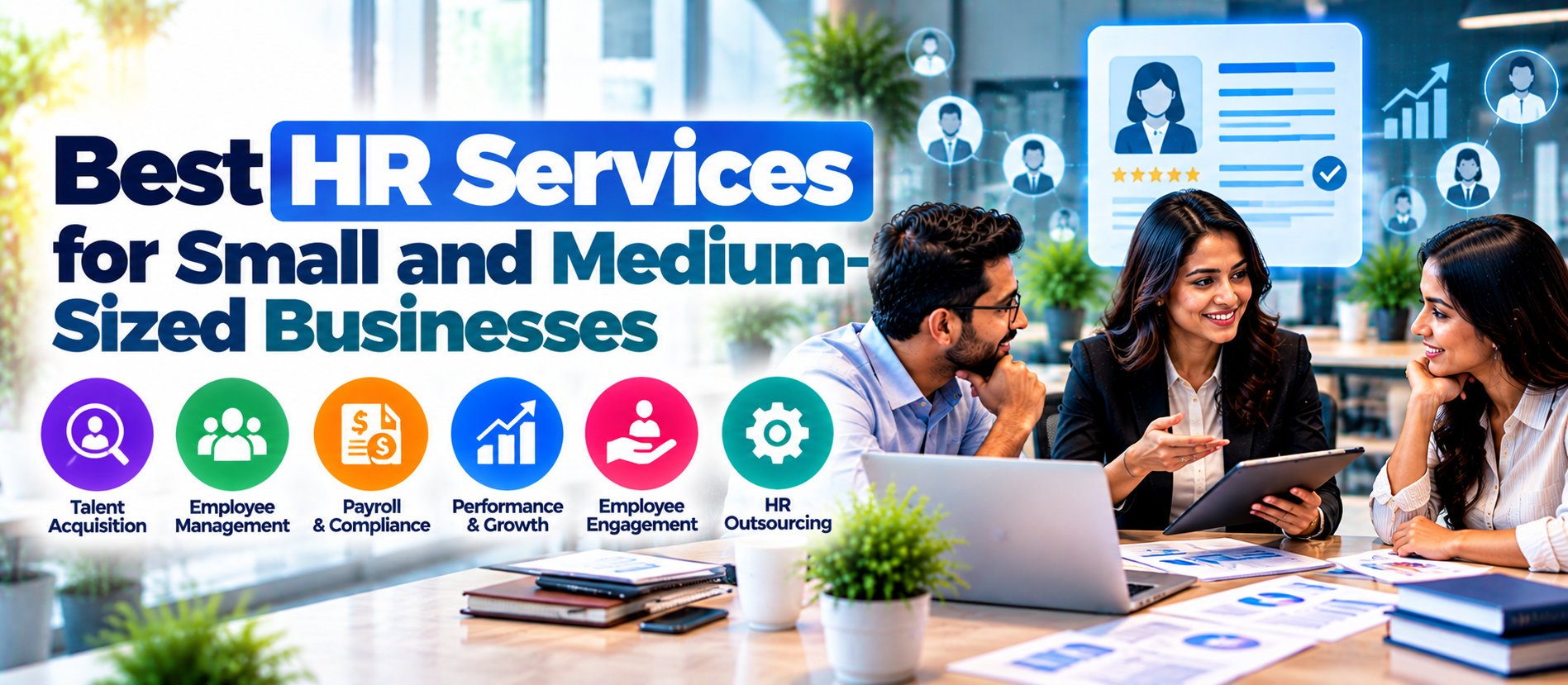
What Are HR Services for Small and Medium-Sized Businesses?
Why SMBs Need Professional HR Support
1. Recruitment and Talent Acquisition Services
2. Payroll and Compensation Services
3. HR Compliance Services
4. Employee Onboarding Services
5. HR Policies and Employee Handbook Development
6. Benefits Administration
7. Attendance, Leave, and Workforce Management
8. Performance Management Services
9. Employee Engagement and Retention Support
10. Learning, Training, and Upskilling
Human resources is no longer only an administrative function. For small and medium-sized businesses, HR affects hiring, employee productivity, payroll accuracy, compliance, retention, workplace culture, and long-term growth.
However, many SMBs do not have the budget or need for a large in-house HR department. One manager may handle recruitment, employee records, payroll coordination, leave, policies, and employee questions while also managing other business responsibilities. As the company grows, this model can become difficult to maintain.
This is why the best HR services for small and medium-sized businesses are usually flexible, practical, technology-enabled, and aligned with the company’s stage of growth. Businesses can outsource selected HR tasks, use an HR technology platform, work with an HR consultant, or combine internal staff with external specialists.
Current HR trends reinforce this shift. ADP’s 2026 research says small businesses are dealing with rising labor costs, talent shortages, and growth pressures, while AI adoption is increasing across payroll, HR, time and attendance, and benefits administration.
What Are HR Services for Small and Medium-Sized Businesses?
HR services for small and medium-sized businesses are professional or technology-based solutions that help companies manage their people and HR processes without building a large internal HR operation.
These services can cover one specific requirement or the complete employee lifecycle. Common areas include:
- Recruitment and talent acquisition
- Employee onboarding and offboarding
- Payroll administration
- Benefits administration
- Attendance and leave management
- HR policies and documentation
- Employment compliance support
- Performance management
- Employee engagement
- Training and development
- HR consulting
- Workforce planning
- HR technology and HRIS implementation
- Employee relations support
- People analytics and reporting
The right combination depends on the business size, industry, workforce structure, location, growth plans, and internal capabilities.
Why SMBs Need Professional HR Support
Small businesses often grow faster than their internal processes. A company may start with ten employees and simple spreadsheets. Later, it may have fifty or two hundred employees across multiple teams, locations, or work arrangements.
💡 Key Insight
At that point, manual HR administration creates risks. Employee information can become inconsistent. Payroll inputs may be missed. Managers may apply policies differently. Recruitment can become slow. Important employee questions may remain unanswered.
SHRM notes that modern HR software can centralize people management and automate routine work such as core HR, payroll, benefits, onboarding, performance, and compliance.
Professional HR support helps SMBs create repeatable processes before these problems become expensive.
1. Recruitment and Talent Acquisition Services
Recruitment is one of the most valuable HR services for a growing business. Hiring the wrong person can affect productivity, team morale, customer service, and management time.
A recruitment service can help with:
- Job description creation
- Candidate sourcing
- Job posting management
- Resume screening
- Candidate communication
- Interview coordination
- Skills assessment
- Reference and background checks where appropriate
- Offer management
- Recruitment reporting
For SMBs, recruitment support is particularly useful when managers are spending too much time searching for candidates instead of running the business.
2. Payroll and Compensation Services
Payroll is a high-priority HR process because employees expect accurate and timely payment. Errors can damage trust and create compliance problems.
Payroll services for small businesses may include salary calculations, deductions, tax-related processing, payslips, payroll records, payroll reporting, and coordination with attendance and leave systems.
The exact requirements depend on the country and jurisdiction. In India, for example, businesses may need systems that can handle applicable statutory requirements such as PF, ESI, professional tax, labour-related records, and TDS. HR technology providers serving Indian SMBs increasingly emphasize integrated payroll, attendance, leave, and statutory compliance.
3. HR Compliance Services
Compliance is an area where SMBs should avoid guesswork. Employment rules can change, and requirements can vary by location, workforce category, and business structure.
HR compliance services can help businesses organize:
- Employment documentation
- HR policies
- Employee records
- Leave and attendance processes
- Required notices and documentation
- Payroll-related compliance workflows
- Workplace policies
- Employee separation processes
Compliance support does not replace qualified legal advice where legal interpretation is required. Instead, it helps businesses build disciplined HR processes and identify areas that need specialist review.
4. Employee Onboarding Services
A new employee should not spend the first week asking where documents are, who approves leave, or how to access company systems.
Professional onboarding services can create a structured experience covering documentation, introductions, policies, role expectations, equipment, access, training, and first-week activities.
Good onboarding improves consistency. It also reduces the administrative workload on managers.
5. HR Policies and Employee Handbook Development
Growing businesses need clear rules. Employees and managers should understand how the organization handles attendance, leave, remote work, conduct, performance, confidentiality, workplace behavior, complaints, and other important matters.
HR consultants can help create or review employee handbooks and policies so that they are practical, understandable, and aligned with the organization’s operating model and applicable requirements.
6. Benefits Administration
Employee benefits can support recruitment and retention, but administering them can become complicated as the workforce grows.
Benefits-related HR services can help with enrollment, employee communication, documentation, vendor coordination, eligibility tracking, and reporting.
For SMBs, the goal is not to copy a large enterprise benefits package. The goal is to create a sustainable package that supports the workforce and fits the company budget.
7. Attendance, Leave, and Workforce Management
Manual attendance and leave tracking becomes difficult when a business has multiple teams, shifts, locations, or hybrid employees.
HR technology can connect attendance, leave, overtime, payroll, and workforce records. This reduces duplicate data entry and improves visibility.
SHRM’s 2026 HR technology guidance highlights the importance of integration and data quality. A standalone system that does not connect with payroll, attendance, or finance can create new manual work instead of removing it.
8. Performance Management Services
Performance management should not be limited to an annual review.
Modern performance processes can include clear goals, regular check-ins, manager feedback, development plans, recognition, and measurable outcomes.
HR consultants can help SMBs design a performance framework that is simple enough for managers to use consistently.
9. Employee Engagement and Retention Support
Hiring employees is only part of the workforce challenge. Keeping strong employees is equally important.
HR services can help identify retention risks through employee surveys, exit interviews, engagement analysis, manager feedback, career development programs, and compensation reviews.
ADP’s 2026 small-business research emphasizes employee development and upskilling as important retention strategies while hiring becomes more difficult and expensive.
10. Learning, Training, and Upskilling
Small businesses often need employees to grow with the company. Training can improve current performance while preparing employees for future responsibilities.
Useful HR training services include:
- Leadership development
- Manager training
- Communication skills
- Technical skills
- Customer service training
- Compliance training
- AI and digital skills
- Career development programs
Upskilling can also reduce the pressure to hire externally for every new capability.
11. HR Consulting Services
An HR consultant can provide strategic support without the cost of hiring a full-time senior HR leader.
Consulting services may cover workforce planning, organizational structure, HR policies, compensation, performance systems, employee relations, HR technology, recruitment strategy, and change management.
This model works well when a company has basic HR administration but needs experienced guidance for more complex decisions.
12. Fractional HR Services
Fractional HR is another practical option for SMBs. Instead of hiring a full-time HR executive, the company receives HR leadership for a defined number of hours or days each month.
A fractional HR leader can help build processes, coach managers, manage priorities, create policies, review workforce data, and advise leadership.
This model provides access to senior expertise while keeping the internal structure lean.
13. HR Technology and HRIS Services
An HR information system, or HRIS, can centralize employee data and automate routine HR workflows.
Common capabilities include employee records, onboarding, payroll connections, attendance, leave, benefits, performance, documents, reporting, and employee self-service.
The best HR software for an SMB is not necessarily the platform with the largest feature list. It is the system that fits the company’s processes, budget, integration needs, security requirements, and growth plans.
Technology Advice’s 2026 review of small-business HR software highlights differences between platforms in areas such as core HR, payroll, benefits, workforce management, usability, customer support, and automation.
14. HR Automation and AI Services
AI is becoming an important part of HR technology. SMBs can use AI to support repetitive and information-heavy processes, but automation should not remove human judgment from sensitive employee decisions.
Potential applications include:
- Candidate sourcing assistance
- Job description drafting
- Employee FAQ support
- HR document search
- Workforce analytics
- Training recommendations
- HR workflow automation
- Employee self-service
- Data classification and reporting
SHRM’s 2026 research emphasizes a balanced approach in which AI is combined with human judgment, experience, and empathy.
Best HR Services by Business Need
| Business Need Recommended HR Service Main Benefit | ||
| Hiring faster | Recruitment services | Better candidate pipeline and lower hiring workload |
| Accurate payroll | Payroll outsourcing or integrated payroll | Less manual work and better process control |
| Compliance support | HR compliance consulting | More structured policies and records |
| Employee retention | Engagement and performance services | Better employee experience and development |
| HR leadership | Fractional HR | Access to experienced HR guidance |
| Manual HR administration | HRIS and automation | Faster workflows and centralized data |
| Rapid growth | Workforce planning | Better hiring and capacity decisions |
How to Choose the Best HR Services for Your SMB
Do not start by asking which HR provider has the most features. Start by identifying the business problem.
- Audit current HR processes. List the tasks that consume time and create errors.
- Identify risk areas. Review payroll, documentation, compliance, employee relations, and data security.
- Separate strategic and administrative needs. Decide what should be automated, outsourced, or kept internal.
- Define service requirements. Specify the exact activities the provider must handle.
- Check integrations. Confirm that HR systems can connect with payroll, attendance, finance, identity, and other critical tools.
- Review security. HR systems contain sensitive employee information, so access controls and data protection matter.
- Evaluate support. A good provider should offer clear escalation and support processes.
- Compare total cost. Consider software, implementation, support, internal administration, and switching costs.
- Start with a manageable scope. A phased implementation is often easier than changing every HR process at once.
- Measure outcomes. Track time saved, hiring speed, payroll accuracy, employee response time, and other relevant KPIs.
Outsourced HR vs In-House HR
| Factor Outsourced HR In-House HR | ||
| Expertise | Access to external specialists | Built internally |
| Cost model | Flexible service cost | Salary and employee overhead |
| Scalability | Usually easier to scale selected services | Requires internal hiring or restructuring |
| Control | Shared with provider depending on scope | Direct internal control |
| Best fit | SMBs needing expertise without a large HR team | Larger or HR-intensive organizations |
A hybrid model is often the strongest option. An SMB can keep employee relationships and strategic decisions internal while outsourcing payroll, recruitment support, HR technology, or specialist compliance work.
Important HR Technology Considerations for SMBs
Technology should simplify HR, not create another layer of administration.
Before choosing an HR platform, check:
- Ease of use
- Employee self-service
- Payroll integration
- Attendance and leave integration
- Reporting and analytics
- Workflow automation
- Role-based access controls
- Audit history
- Data export
- API and integration options
- Mobile access
- Vendor support
- Implementation and training
Data quality is equally important. SHRM’s 2026 guidance warns that poor data can undermine HR technology before the system even goes live. Integration gaps can also force employees to enter the same information into multiple systems.
How AI Can Improve HR Services
AI can help HR teams work faster, but the strongest use cases are usually those that support employees and HR professionals rather than blindly automating sensitive decisions.
For example, an AI HR assistant can answer common policy questions using approved company information. An AI recruiting assistant can help organize candidates. An HR analytics system can identify patterns in workforce data. An AI workflow can remind managers about pending onboarding tasks or performance reviews.
However, businesses should establish clear rules for privacy, access, human review, bias monitoring, data quality, and acceptable AI use.
Common Mistakes SMBs Make When Choosing HR Services
- Choosing based only on price: A cheap service may create higher internal costs later.
- Buying too many features: Complexity can reduce adoption.
- Ignoring integrations: Disconnected systems create duplicate work.
- Skipping data cleanup: Bad employee data produces bad reports.
- Automating sensitive decisions: Human review remains important.
- Failing to define ownership: Employees should know who handles each HR issue.
- Ignoring employee experience: HR technology should be easy for employees and managers.
- Treating implementation as the finish line: Adoption requires ongoing support.
A Simple 90-Day HR Improvement Plan
Days 1–30: Assess
Map the current employee lifecycle. Review recruitment, onboarding, payroll, attendance, policies, performance, employee records, and HR technology. Identify the three biggest sources of HR workload or risk.
Days 31–60: Design
Choose the right service model. Decide what should remain internal, what should be outsourced, and what should be automated. Create a clear process for each priority area.
Days 61–90: Implement and Measure
Launch the selected service or technology in phases. Train managers and employees. Measure adoption and results. Fix process gaps before expanding the scope.
HR KPIs Small and Medium-Sized Businesses Should Track
- Time to hire
- Cost per hire
- Offer acceptance rate
- New-hire retention
- Employee turnover
- Absence rate
- Payroll error rate
- HR request resolution time
- Training completion
- Employee engagement
- Performance review completion
- HR administration hours per employee
Tracking a small set of meaningful metrics is better than creating a dashboard full of numbers that nobody uses.
How HR Services Support Business Growth
The business value of HR services goes beyond saving administrative time.
Better recruitment improves access to talent. Better onboarding helps employees become productive faster. Better payroll processes improve trust. Better policies create consistency. Better performance management helps teams focus on results. Better workforce analytics supports planning.
Deloitte describes the evolution of HR operations as a move beyond transactions toward measurable business value, integrated solutions, better experiences, and intelligent automation.
This is especially important for SMBs because every employee and every hour of management time can have a visible impact on business performance.
Best HR Services for SMBs: AEO and AI Search Perspective
Businesses researching HR services increasingly use search engines, AI assistants, and conversational search to compare providers and understand solutions.
To make HR service content easier for AI systems to understand, businesses should use clear service names, direct definitions, structured headings, concise answers, FAQs, comparison tables, real examples, and trustworthy supporting information.
For example, a business searching “What are the best HR services for a small business?” should quickly find a direct answer:
Answer: The best HR services for a small business usually include recruitment, payroll, compliance support, onboarding, employee management, HR technology, benefits administration, performance management, training, and strategic HR consulting. The right mix depends on workforce size, industry, growth stage, location, and internal HR capability.
This clear answer structure supports Answer Engine Optimization (AEO), Generative Engine Optimization (GEO), and broader AI Search Optimization.
Frequently Asked Questions
What are the best HR services for small businesses?
The most useful HR services for small businesses usually include payroll, recruitment, onboarding, compliance support, employee records, attendance and leave management, HR consulting, performance management, and HR technology.
Should a small business outsource HR?
Outsourcing can be useful when the business lacks internal HR expertise or when administrative work is taking too much management time. A hybrid model can also work well.
What HR services should an SME outsource first?
Payroll, recruitment support, HR administration, compliance-related workflows, and HR technology implementation are common starting points. The best choice depends on the company’s biggest operational problem.
Is HR software enough for a small business?
HR software can automate and centralize many processes, but software does not replace HR judgment, manager support, employee communication, or specialist advice when complex issues arise.
How much do HR services cost for an SMB?
Costs vary significantly by employee count, location, service scope, technology, and provider model. Businesses should compare total cost rather than looking only at the monthly provider fee.
Can HR services help with employee retention?
Yes. HR services can support onboarding, employee engagement, performance management, career development, compensation reviews, manager training, and workforce analytics, all of which can contribute to stronger retention.
How can AI help small business HR?
AI can support HR knowledge search, employee FAQs, recruiting workflows, reporting, workforce analytics, document processing, and repetitive administrative tasks. Sensitive employment decisions should include appropriate human review.
Conclusion
The best HR services for small and medium-sized businesses are not necessarily the biggest or most expensive services. They are the solutions that remove unnecessary administrative work, reduce risk, improve employee experience, and give leaders better workforce visibility.
For many SMBs, the right approach is a combination of services. Recruitment may be outsourced. Payroll may be automated. Compliance may receive specialist support. HR leadership may be fractional. Employee relationships and business decisions can remain internal.
The goal is simple: build an HR operating model that is reliable today and scalable tomorrow.
As AI and HR technology continue to evolve, SMBs have more options than ever. The strongest strategy is to combine technology with clear processes, good data, responsible automation, and human judgment.
Digiifrog helps businesses build stronger digital and technology-driven operations through practical strategies, automation, content, SEO, AI Search, and digital transformation solutions. Visit www.digiifrog.com to explore business growth and digital solutions.
Research References
- ADP, “The 2026 HR Trends Small Businesses Can’t Ignore.”
- SHRM, “New for 2026: 5 Top-Rated HR Software for Small Businesses.”
- SHRM, “The State of AI in HR 2026.”
- SHRM, “4 Common Challenges in HR Tech Implementation and How to Address Them.”
- Deloitte, “The Power of a Multidimensional Workforce: Outsourcing for Strategic Advantage.”
- Deloitte, “HR Shared Services.”
- Technology Advice, “Best Human Resources (HR) Software for Small Businesses in 2026.”
- Gusto, “Best HRIS Systems for Small Businesses in 2026.”
- greyt HR, “Top 10 Full-Suite HRMS for Small Businesses in India 2026.”
Ready to Grow?
Talk to us about a strategy tailored to your brand — we will help you stand out in search, AI discovery and social.
Comments (0)
Log in to leave a comment.