📋 Quick Summary
In this article:
Increase Confidence Through Preparation
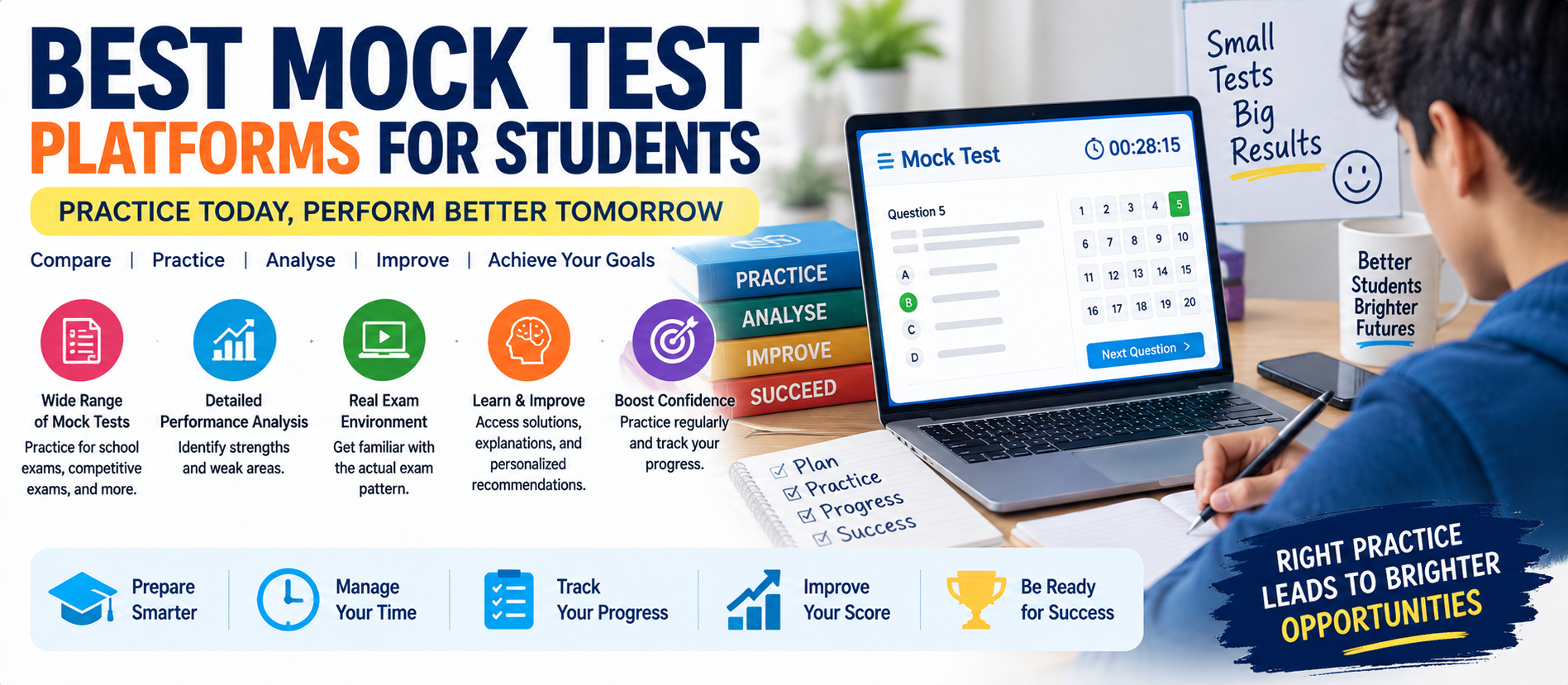
Features of the Best Mock Test Platforms
1. Relevant and Updated Content
2. High-Quality Explanations
3. Detailed Performance Analytics
4. Realistic Timed Practice
5. Easy Access and Good User Experience
Mock tests are one of the most useful tools for modern exam preparation. They allow students to practice questions, test their knowledge, improve time management, and understand their weak areas before the actual examination.
Today, students can access practice tests through websites, mobile applications, learning platforms, educational institutions, and coaching providers. Because there are many options, choosing the best mock test platforms for students can feel difficult.
The right platform depends on the examination, subject, learning level, available time, budget, and personal study style. A platform designed for school examinations may not be suitable for a competitive entrance test or professional certification.
This guide explains what students should look for in a mock test platform, how to compare available options, and how to turn every practice test into a useful learning experience.
What Is a Mock Test Platform?
A mock test platform provides practice examinations that simulate or support real exam preparation. Tests may include multiple-choice questions, written tasks, timed sections, topic-based exercises, and full-length examinations.
Modern platforms may also provide:
- Instant scores.
- Detailed explanations.
- Performance reports.
- Topic-wise analysis.
- Progress tracking.
- Personalized practice suggestions.
A useful mock test platform does more than tell students whether an answer is right or wrong. It should help them understand mistakes and decide what to study next.
Why Mock Tests Are Important
Identify Knowledge Gaps
Students may understand a chapter while reading it but struggle to apply the concept in an examination. A mock test reveals whether knowledge can be used correctly under realistic conditions.
Improve Time Management
Many students lose marks because they spend too much time on difficult questions. Timed mock tests teach students how to pace themselves and decide when to skip and return to a question.
Build Exam Familiarity
Practice helps students become familiar with question formats, test navigation, and time limits. Students should always verify that practice material matches the current official examination requirements.
Increase Confidence Through Preparation
Regular practice can make the exam environment feel less unfamiliar. Real confidence should come from understanding and improvement, not from one high practice score.
Features of the Best Mock Test Platforms
1. Relevant and Updated Content
The questions should match the student's subject and expected examination level. Check whether the platform offers relevant topics, suitable difficulty levels, and updated practice material.
2. High-Quality Explanations
A score alone provides limited educational value. Strong explanations show why the correct answer is correct and why other choices may be wrong.
3. Detailed Performance Analytics
Analytics can show total score, accuracy, time spent, strong topics, weak topics, and repeated mistakes. The best reports help students turn results into an improvement plan.
4. Realistic Timed Practice
Useful test features may include countdown timers, section-wise timing, question navigation, and the ability to mark questions for review.
5. Easy Access and Good User Experience
Students should be able to use the platform comfortably on the devices available to them. A confusing interface can waste study time and create unnecessary stress.
Different Types of Mock Test Platforms
School Subject Platforms
These platforms provide tests for subjects such as mathematics, science, languages, and social studies. They can support chapter revision and school examination preparation.
Competitive Exam Platforms
Competitive examinations often require intensive practice. Useful features may include full-length tests, topic-specific practice, timed sections, and performance analysis.
Entrance Examination Platforms
Students preparing for college or university entrance examinations may need practice based on specific exam patterns and subject requirements.
Professional Certification Platforms
Professional exams often require specialized knowledge. Students should choose practice material that closely follows the official learning objectives and current requirements.
How to Compare Mock Test Platforms
Students should compare platforms before paying for a subscription.
- Content quality: Are questions clear and relevant?
- Explanations: Do solutions help students learn?
- Test variety: Are topic tests and full tests available?
- Analytics: Does the platform identify useful patterns?
- Usability: Is the platform easy to navigate?
- Value: Does the price match the student's actual needs?
More tests do not automatically mean a better platform. Quality and relevance are more important than quantity.
Free vs Paid Mock Test Platforms
Benefits of Free Platforms
Free mock tests can be useful for students who want to explore a platform or practice basic concepts without a major financial commitment.
Possible Limitations
Free versions may provide fewer tests, limited explanations, advertisements, or restricted performance analysis.
Benefits of Paid Platforms
Paid services may offer larger question banks, additional full-length tests, structured study tools, and detailed analytics.
However, students should never assume that the most expensive platform is automatically the best educational choice.
How to Use Mock Tests Effectively
Step 1: Take the Test Seriously
When practicing for a timed examination, remove unnecessary distractions and follow the available time limit.
Step 2: Review Every Mistake
After the test, identify why each mistake happened. Common reasons include lack of knowledge, misunderstanding the question, poor time management, or careless errors.
Step 3: Find Repeated Patterns
One incorrect answer may be accidental. Repeated mistakes can reveal a genuine weakness in a topic, question type, or exam strategy.
Step 4: Create an Improvement Plan
Use the results to decide what to revise. You may need to review a concept, practice a specific question type, or improve your timing.
Step 5: Test Again
After revision, complete another practice test. Compare your new performance with earlier results and focus on long-term improvement.
How Often Should Students Take Mock Tests?
There is no single perfect number. During the early stage of preparation, students may benefit more from learning concepts and completing topic-based exercises.
As the examination approaches, full-length timed tests may become more useful. Taking many tests without reviewing mistakes is usually less effective than taking fewer tests and learning deeply from each one.
Common Mock Test Mistakes to Avoid
Ignoring Test Analysis
A mock test should not end when the score appears. The review process is often where the most important learning happens.
Focusing Only on Scores
Students should also review accuracy, time management, difficult topics, and repeated mistakes.
Ignoring Easy Errors
Careless mistakes can often be reduced through better reading habits, careful calculation, and checking important answers.
Changing the Entire Strategy After One Poor Result
One low score does not always indicate a major problem. Look for repeated patterns before making major changes to your study strategy.
Using Outdated Material
Students should verify whether a mock test reflects the current examination structure, syllabus, and official requirements.
Topic-Wise Tests vs Full-Length Mock Tests
Both formats are useful at different stages.
Topic-wise tests are useful for identifying and strengthening weaknesses in specific subjects or chapters.
Full-length mock tests are useful for practicing endurance, time management, and overall exam strategy.
A balanced preparation plan can use both types of practice.
How Performance Analytics Can Help Students
Modern platforms can collect useful learning information. Students should look beyond the final score.
Important questions include:
- Which topics produce the most errors?
- Which questions take the longest?
- Is accuracy improving?
- Are the same mistakes happening repeatedly?
Data becomes useful only when it leads to action.
How Teachers Can Use Mock Test Platforms
Teachers can use assessment results to identify common learning gaps in a classroom.
For example, if many students struggle with one topic, the teacher may provide additional explanation and practice.
Assessment data should support students rather than label them permanently based on one score.
How Parents Can Support Students
Parents can encourage regular practice without creating excessive pressure.
Instead of asking only, “What score did you get?” consider asking:
- What did you learn from the test?
- Which questions were difficult?
- What will you improve next?
This approach encourages learning and reflection.
Artificial Intelligence and Mock Test Preparation
Artificial intelligence is becoming part of educational technology. AI-supported platforms may recommend questions, identify weak areas, adjust difficulty levels, and provide personalized study suggestions.
AI can support learning, but students should still think independently and check important information. Strong exam preparation continues to depend on concept understanding, practice, revision, and consistent effort.
Privacy and Student Data
Students should consider privacy before using digital learning platforms. It is useful to understand what information is collected and how it may be used.
Students should avoid sharing unnecessary personal information and should use account security features when available.
Choosing a Platform Based on Your Study Style
The best platform should solve a real learning problem.
If you struggle with one topic, choose a service with strong topic-wise practice. If timing is your main challenge, prioritize realistic full-length timed tests. If you need structure, look for progress tracking and clear study organization.
A Simple Mock Test Selection Checklist
- Does the platform cover my examination or subject?
- Is the content relevant and current?
- Are explanations easy to understand?
- Does it provide useful performance analysis?
- Can I review completed tests?
- Does the platform fit my budget?
- Is it easy to use?
Creating a Smart Mock Test Routine
A practical routine can combine concept study, topic practice, full tests, and review.
During the first part of the week, focus on learning and revising concepts. Use topic-based tests to check understanding. Later, complete a timed mock test when appropriate for your preparation stage.
After every test, schedule time for analysis. Review incorrect answers, identify repeated patterns, and decide what to study next.
Why Rankings Are Not Everything
Some platforms provide leaderboards and rankings. Competition can motivate some students, but rankings do not provide the complete picture.
Personal questions are often more useful:
- Am I improving over time?
- Do I understand difficult concepts better?
- Is my accuracy improving?
- Am I managing time more effectively?
Consistent personal improvement is more valuable than becoming distracted by every comparison.
The Future of Mock Test Platforms
Future educational platforms may offer more adaptive and personalized practice. Possible developments include AI-supported feedback, dynamic difficulty levels, personalized learning pathways, and improved accessibility features.
Technology should remain focused on one important purpose: helping students learn more effectively.
SEO, AEO, GEO and AI Search Optimization for Education Content
Students now discover learning resources through search engines, answer engines, AI assistants, and generative search experiences.
SEO, or Search Engine Optimization, helps useful educational content become easier to discover. AEO, or Answer Engine Optimization, focuses on answering common questions clearly and directly. GEO, or Generative Engine Optimization, focuses on organizing information so generative AI systems can understand topics and context.
Educational content about mock tests should use clear headings, direct answers, practical examples, and easy-to-read language. This improves readability for students and can also support visibility across modern AI-powered search experiences.
Digiifrog focuses on modern digital growth through SEO, AEO, GEO, and AI Search optimization. Helpful, structured, and easy-to-understand content can support stronger discovery in the changing future of search.
Frequently Asked Questions
What is the best mock test platform for students?
The best choice depends on the examination, subject, learning needs, and budget. Look for relevant content, quality explanations, realistic practice, and useful performance analysis.
Are free mock tests useful?
Yes. Free tests can provide useful practice, especially when the questions are relevant and explanations are available.
How many mock tests should I take?
The right number depends on your preparation stage. Reviewing mistakes and improving weak areas is more important than simply taking the largest number of tests.
Should I focus only on my score?
No. Review accuracy, time management, weak topics, and repeated mistakes in addition to the final score.
Can AI improve mock test preparation?
AI can support personalized practice and performance analysis. Students should still verify important information and focus on real concept understanding.
How do I choose a mock test platform?
Compare content quality, relevance, explanations, analytics, ease of use, privacy practices, and price before making a decision.
Conclusion
The best mock test platforms for students do more than provide questions and scores. They help students practice effectively, identify weak areas, understand mistakes, improve time management, and measure progress.
💡 Key Insight
The right platform should match your examination and personal learning needs. Choose quality over quantity, review every important mistake, and use performance data to create a realistic improvement plan.
Mock tests should not be treated as final judgments. They are learning tools. Every practice result can provide useful information about what to revise, practice, or improve next.
A strong exam strategy combines concept learning, regular practice, detailed analysis, revision, and consistent effort. Used wisely, a good mock test platform can become an important part of successful exam preparation.
Digiifrog
Website: www.digiifrog.com
Digital Growth Through SEO, AEO, GEO & AI Search Optimization.
Ready to Grow?
Talk to us about a strategy tailored to your brand — we will help you stand out in search, AI discovery and social.
Comments (0)
Log in to leave a comment.