📋 Quick Summary
In this article:
Why Mock Tests Matter in Competitive Exam Preparation
1. Start Mock Tests at the Right Time
2. Choose Quality Mock Tests
3. Treat Every Mock Test Like the Real Exam
4. Do Not Chase Mock Test Scores Alone
5. Analyze Every Mock Test
6. Keep a Mock Test Error Log
7. Understand the Four Major Types of Mistakes
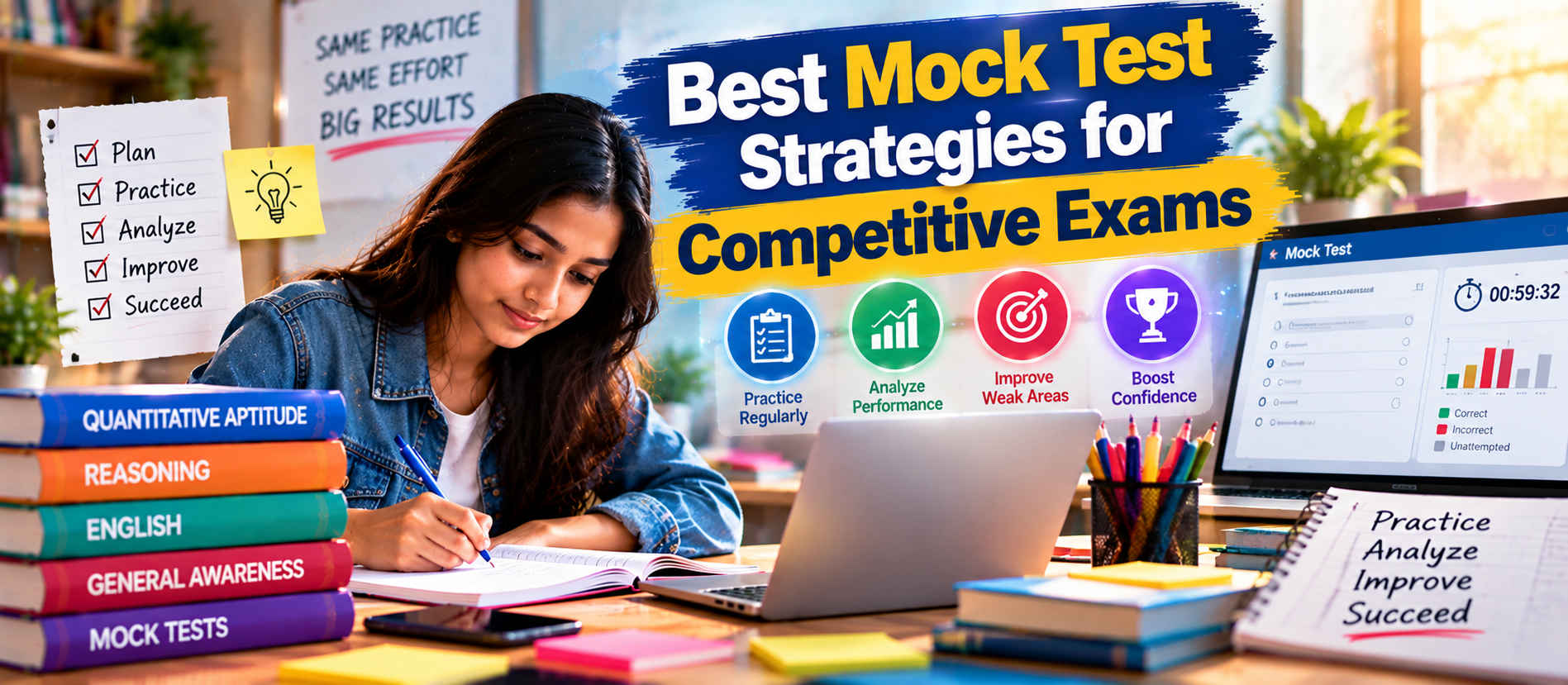
Mock tests are one of the most useful tools for competitive exam preparation. They help students understand the exam pattern, practice time management, identify weak areas, improve accuracy, and build confidence. But simply taking many mock tests does not guarantee better performance.
The real benefit comes from how you take a mock test, how you review it, and how you change your preparation after the review. A student who takes ten tests without analysis may learn less than a student who takes five tests and studies every mistake carefully.
This guide from Digiifrog explains the best mock test strategies for competitive exams. The approach can be adapted for entrance exams, government recruitment tests, management exams, scholarship tests, aptitude tests, and other time-bound competitive examinations.
What Is a Mock Test?
A mock test is a practice examination designed to resemble the real exam. A good mock test usually follows a similar structure, question style, time limit, marking system, and difficulty level.
Mock tests can be full-length or sectional. A full-length test covers the complete exam pattern. A sectional test focuses on one subject, topic, or section. Both are useful. Sectional tests help build concepts and correct weaknesses, while full-length tests become increasingly important as the exam approaches.
Why Mock Tests Matter in Competitive Exam Preparation
Competitive exams test more than knowledge. They often test speed, accuracy, decision-making, concentration, and the ability to work under pressure. Mock tests allow students to practice these skills in a controlled environment.
- Exam familiarity: You become comfortable with the question pattern and test interface.
- Time management: You learn how much time to spend on each section.
- Accuracy: You identify careless and conceptual mistakes.
- Question selection: You learn when to attempt, skip, or return to a question.
- Confidence: Repeated practice reduces uncertainty about the exam experience.
- Weakness detection: Your results reveal topics that require more work.
- Performance tracking: Scores over time show whether your strategy is improving.
1. Start Mock Tests at the Right Time
Do not wait until the final week to take your first mock test. At the same time, taking full-length tests before learning basic concepts may create unnecessary frustration.
During early preparation, use topic-wise and sectional tests. During the middle stage, combine sectional tests with occasional full-length tests. During the final stage, make full-length mock tests a regular part of preparation. The exact frequency should depend on the exam schedule, your preparation level, and the quality of your analysis.
2. Choose Quality Mock Tests
Not every mock test is equally useful. A poor-quality test can create confusion about difficulty, question style, or expected performance.
Before selecting a mock test series, check whether it reflects the current exam structure. Look for realistic question formats, balanced difficulty, clear explanations, and useful performance reports. Also compare the test with official information about the exam. The official syllabus, notification, sample material, and previous-year papers should remain important references.
3. Treat Every Mock Test Like the Real Exam
One of the most important mock test strategies is to create realistic conditions. When possible, sit at a fixed desk. Keep your phone away. Use the actual time limit. Avoid checking notes. Do not pause the test simply because a question feels difficult.
If the real exam is online, practice on a similar interface when possible. If the exam requires rough work, practice that as well. The purpose is to train your brain for the pressure and rhythm of the real examination.
4. Do Not Chase Mock Test Scores Alone
A score is useful, but it is not the complete story. Suppose you score 70 in one test and 78 in another. The second score looks better. But what if the second test was much easier? What if you guessed several answers? What if you spent too much time on one section?
A better review considers total score, accuracy, attempts, correct answers, incorrect answers, unattempted questions, time spent per section, time spent on difficult questions, and the type of mistakes.
5. Analyze Every Mock Test
Mock test analysis is more important than simply taking the test. After completing a test, do not immediately move to another test. Spend enough time reviewing your performance.
Divide questions into these categories:
- Correct and confident.
- Correct but guessed.
- Correct but took too much time.
- Incorrect because of a concept gap.
- Incorrect because of a calculation or careless error.
- Incorrect because the question was misunderstood.
- Unattempted because of lack of knowledge.
- Unattempted because of lack of time.
- Unattempted because of a poor question-selection decision.
This classification tells you what needs to change.
6. Keep a Mock Test Error Log
An error log is one of the simplest ways to turn test mistakes into learning opportunities. Create a notebook or digital document with columns for the question or topic, your answer, the correct answer, the reason for the mistake, the concept to revise, the correct method, and the action to take in future tests.
Do not write only the correct answer. Write why you made the mistake. “Wrong answer” is not useful. “Misread the word ‘except’ in the question” is useful. “Used the wrong formula” is useful. “Spent four minutes on a question that should have been skipped” is also useful.
7. Understand the Four Major Types of Mistakes
Conceptual Mistakes
You do not fully understand the topic. The solution is targeted concept revision followed by practice questions.
Application Mistakes
You understand the concept but struggle to apply it to a new question. More varied practice is needed.
Careless Mistakes
You know the answer but make an avoidable error. Common examples include calculation mistakes, incorrect marking, skipped words, and copying errors.
Strategy Mistakes
You spend too much time on difficult questions, attempt questions with low confidence, or follow an inefficient section order.
Each mistake needs a different solution. More studying will not automatically fix every problem.
8. Build a Question Selection Strategy
Competitive exams often reward smart decision-making. You do not always need to solve every question.
During practice, classify questions as easy, moderate, or difficult. Start by collecting questions where you can earn marks efficiently. Then return to moderate questions. Difficult questions should be attempted only when the expected benefit justifies the time and risk.
9. Practice the Skip-and-Return Method
Many students lose valuable time because they become emotionally attached to one question. If you cannot see a clear path after reasonable thinking, mark the question and move forward when the exam rules allow it.
This is not giving up. It is resource management. Mock tests are the right place to practice this skill. Record which questions you skipped and whether you were later able to solve them. Over time, you will develop a better sense of when to continue and when to move on.
10. Improve Time Management With Sectional Analysis
Do not only look at total test time. Examine time at the section and question level. If you consistently spend too long on quantitative questions, you may need faster calculation methods or better question selection. If reading questions consume too much time, you may need to improve reading speed and comprehension.
| SectionAttemptsCorrectIncorrectTime Used | ||||
| Section A | -- | -- | -- | -- |
| Section B | -- | -- | -- | -- |
| Section C | -- | -- | -- | -- |
11. Work on Accuracy Before Chasing Speed
Speed is important, but speed without accuracy can reduce your score. If you answer 20 questions quickly but make six avoidable mistakes, increasing speed further may not help. First identify why the errors happen.
Once accuracy becomes stable, gradually reduce the time needed for familiar question types. A useful progression is: understand the concept, solve correctly, practice similar questions, reduce solution time, and test the skill under exam conditions.
12. Use Previous-Year Papers With Mock Tests
Previous-year papers can complement mock tests because they show the style and level of questions actually used in past examinations. Use them to understand recurring concepts, question framing, section balance, and difficulty patterns. Then use mock tests to practice broader combinations under time pressure.
Do not assume that a future paper will repeat old questions. The value of previous-year papers is mainly in understanding the exam and practicing relevant thinking patterns.
13. Use Sectional Mock Tests to Repair Weak Areas
Full-length tests tell you what is happening. Sectional tests help you fix specific problems. If your reasoning performance is weak, take focused reasoning tests. If a particular mathematics topic causes repeated errors, practice that topic before returning to another full-length test.
Mock test → identify weakness → targeted practice → sectional test → full mock test.
14. Review Questions You Got Correct
Do not review only wrong answers. A correct answer can still reveal a problem if you guessed it or took too long. Ask whether you knew the concept, used a reliable method, could solve a similar question under pressure, and answered through logic rather than guessing.
15. Compare Performance Across Multiple Tests
One mock test can be unusual. A trend across several tests is more useful. Track date, test name, score, accuracy, attempts, and major weaknesses. Look for patterns rather than reacting emotionally to individual scores.
If your score falls once, investigate the reason. If the same issue appears across several tests, it deserves immediate attention.
16. Do Not Take Mock Tests Without Time for Analysis
Taking multiple tests in a single day may feel productive, but it can become counterproductive if you do not review them properly. A useful rule is simple: quality of analysis should determine test frequency.
If one test takes an hour and the review takes two hours, that review time is part of your preparation. It is not wasted time.
17. Practice Under Different Pressure Conditions
As the exam approaches, introduce realistic pressure. Practice at the same time of day as the expected examination when possible, use a strict timer, avoid interruptions, and complete the full test in one sitting.
Occasionally practice after a normal study session rather than only when you feel fresh. This helps you understand how concentration changes under realistic conditions.
18. Learn From Low Scores Instead of Fearing Them
A low mock score is information, not a final result. Ask whether concepts were incomplete, the test was unusually difficult, time was poorly managed, negative marking affected the result, too many uncertain questions were attempted, or concentration dropped.
The goal is to make the next test better, not to protect yourself from seeing a low number.
19. Develop a Final-Month Mock Test Strategy
During the final month, the focus should gradually shift from learning everything from scratch to improving performance on the actual exam task. Use full-length tests regularly. Between tests, revise weak topics, review the error log, and practice questions related to repeated mistakes.
Do not spend the entire final month taking tests without revision. Mock tests diagnose problems; revision and targeted practice solve them.
20. Create a Final-Week Mock Test Plan
The final week should not be a period of uncontrolled testing. Use selected mock tests to maintain rhythm and confidence. Review important mistakes. Revise formulas, facts, concepts, vocabulary, or other high-value material according to your exam.
Protect sleep and concentration. A tired student may know the material but fail to use it effectively.
A Simple Mock Test Analysis Framework
After every mock test, answer these seven questions:
- What went well?
- Where did I lose marks?
- Which mistakes were conceptual?
- Which mistakes were careless?
- Where did I waste time?
- Which questions should I have skipped?
- What will I change in the next test?
Write the answers down. A written action plan is easier to follow than a vague intention to “study harder.”
Mock Test Strategy Example
Imagine a student scores 68 in a mock test. The student attempts many questions but loses marks because of negative marking. The analysis shows that eight incorrect answers came from low-confidence guesses.
The correct response is not simply to study more chapters. The student should practice question selection and controlled attempts. In the next mock, the student reduces uncertain attempts and focuses on high-confidence questions. The score may improve even without learning a large amount of new material.
This example shows why exam strategy can be as important as additional content study.
How Technology Can Improve Mock Test Preparation
Digital test platforms can make mock test preparation easier to organize. Many platforms can calculate scores, display accuracy, show time spent, and identify question-level performance.
Students can also use spreadsheets to track performance over time. Digital error logs can be searched and grouped by topic.
AI-based study tools may help explain mistakes, generate additional practice questions, or summarize repeated weak areas. However, students should verify important explanations and avoid relying on automatically generated answers without checking them.
Common Mock Test Mistakes to Avoid
- Taking tests without reviewing them: This turns mock tests into repeated exams instead of learning tools.
- Focusing only on rank: Rank can provide context, but your personal error pattern is more actionable.
- Changing strategy after every test: Look for consistent evidence before making major changes.
- Ignoring easy questions: Difficult questions can distract you from efficient marks.
- Practicing only favorite subjects: Competitive exams reward balanced preparation.
- Taking too many tests: More tests do not automatically mean better preparation.
Best Mock Test Routine for Students
A practical weekly routine can look like this:
- Day 1: Revise weak concepts.
- Day 2: Take sectional tests.
- Day 3: Review errors and practice weak topics.
- Day 4: Take another sectional or mixed test.
- Day 5: Review and revise.
- Day 6: Take a full-length mock test.
- Day 7: Perform detailed analysis and plan the next week.
This is only a model. Adjust it based on the exam, available study time, preparation level, and remaining days.
Frequently Asked Questions
How many mock tests should I take for a competitive exam?
There is no universal number. Take enough tests to build exam familiarity and improve strategy, but leave sufficient time for analysis, revision, and targeted practice. Quality is more important than a fixed test count.
When should I start taking mock tests?
Start with sectional or topic-based tests after learning basic concepts. Add full-length tests as your syllabus coverage and exam readiness improve.
Should I take a mock test every day?
Not necessarily. Daily full-length tests can reduce the time available for analysis and revision. Choose a frequency that allows you to learn from each test.
Why is my mock test score not improving?
Your score may remain stable if you repeat the same mistakes. Analyze errors, identify the main cause, practice the weak skill, and test the improvement again.
Should I attempt every question in a mock test?
Not always. Follow the actual exam's marking rules and practice selecting questions based on confidence, difficulty, time, and expected marks.
Are online mock tests useful for competitive exams?
Yes, when they accurately reflect the exam format and provide useful analysis. Online tests are especially useful for practicing timed computer-based examinations.
What is more important: mock test score or accuracy?
Both matter, but accuracy helps explain the score. Track score, attempts, accuracy, and time together.
Conclusion
The best mock test strategy is not to take the maximum number of tests. It is to learn the maximum amount from every test.
Use mock tests to understand the exam. Use analysis to understand yourself. Use targeted practice to correct weaknesses. Then take another test to measure the change.
💡 Key Insight
Focus on accuracy before speed. Practice question selection. Learn when to skip and return. Maintain an error log. Track performance across multiple tests. Combine full-length tests with sectional practice. Most importantly, treat every mistake as useful feedback.
Competitive exams reward preparation, but they also reward decision-making under pressure. A disciplined mock test routine can help you build both.
With a clear process and consistent review, mock tests can become one of the strongest tools in your competitive exam preparation.
About Digiifrog: Digiifrog publishes practical, search-friendly content on education, technology, AI, digital marketing, and career development.
Ready to Grow?
Talk to us about a strategy tailored to your brand — we will help you stand out in search, AI discovery and social.

Comments (0)
Log in to leave a comment.