📋 Quick Summary
In this article:
What Is Productivity Software for Remote Teams?
Why Remote Teams Need Productivity Software
What Makes Productivity Software Effective for Remote Teams?
Best Productivity Software for Remote Teams
1. Microsoft Teams
2. Slack
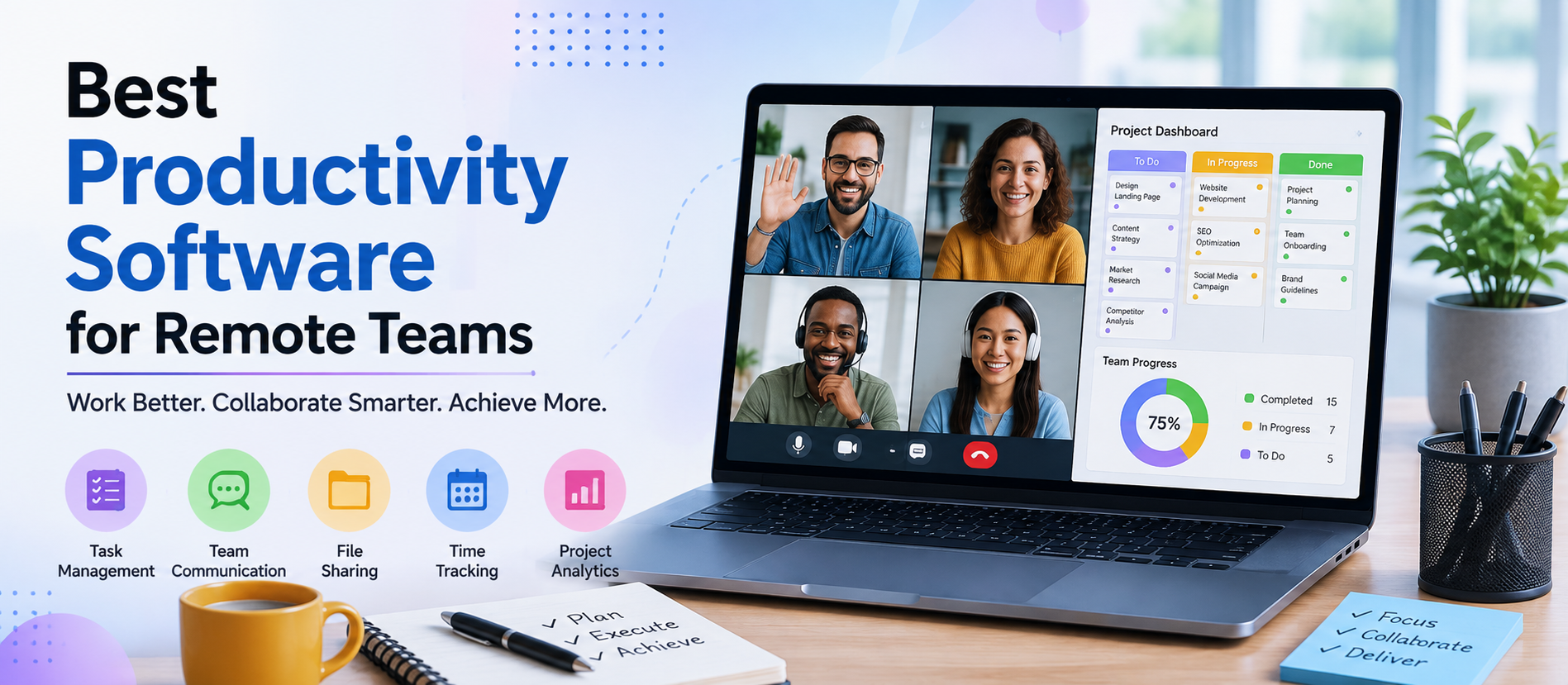
Remote work has changed how modern businesses organize people, projects, communication, documents, meetings, and daily operations. Teams can now work across cities, countries, and time zones while collaborating on the same projects. However, remote work also creates challenges: information can become scattered across applications, employees may struggle to understand priorities, meetings can become excessive, and managers may find it difficult to maintain visibility into progress.
This WordPress-ready HTML article is prepared for Digiifrog (www.digiifrog.com) with a strong focus on SEO, AEO, GEO, and AI Search optimization.
What Is Productivity Software for Remote Teams?
Productivity software for remote teams refers to digital applications that help distributed employees communicate, organize work, manage projects, share information, complete tasks, and maintain productivity without being physically located in the same office.
A remote team may use several categories of productivity software, including project management platforms, communication tools, video conferencing applications, cloud storage, collaborative document systems, time management software, workflow automation platforms, knowledge bases, CRM systems, and AI productivity assistants.
- Project and task management
- Team communication
- Video meetings
- Collaborative documents
- Cloud file storage
- Knowledge management
- Time and scheduling management
- Workflow automation
- AI productivity assistance
- Performance and project reporting
Why Remote Teams Need Productivity Software
💡 Key Insight
In a traditional office, employees can often walk over to a colleague's desk and ask a question. Remote teams do not have the same physical environment. Information must move through digital channels, which makes organization and documentation particularly important.
Without a structured technology stack, remote teams can experience duplicated work, missed messages, unclear responsibilities, scattered documents, delayed approvals, and unnecessary meetings.
The right productivity software can create a central digital workspace where employees understand what needs to be done, where information is stored, who is responsible for a task, and when work is expected to be completed.
- Improve communication across locations
- Make responsibilities clearer
- Reduce unnecessary meetings
- Centralize project information
- Improve task visibility
- Support asynchronous collaboration
- Automate repetitive workflows
- Help managers monitor project progress
What Makes Productivity Software Effective for Remote Teams?
The best productivity platform is not necessarily the software with the most features. Remote teams need tools that are easy to understand, accessible from different locations, reliable, secure, and capable of integrating with the other systems the organization already uses.
Ease of Use
Remote employees should be able to understand the software quickly. Complicated interfaces can reduce adoption and create additional administrative work.
Cloud Accessibility
Cloud-based applications allow employees to access work from different locations and devices, making them particularly useful for distributed teams.
Collaboration Features
Comments, mentions, shared documents, real-time editing, notifications, task assignments, and discussion threads help employees work together without being physically present.
Integration
Productivity tools become more valuable when they connect with calendars, email, CRM systems, storage platforms, communication applications, and automation systems.
Security
Remote work increases the importance of identity management, access controls, permissions, encryption, device security, and secure information sharing.
AI Capabilities
Modern productivity platforms increasingly use AI to summarize information, generate content, automate routine tasks, organize work, and help employees find relevant information faster.
Best Productivity Software for Remote Teams
There is no single productivity platform that is ideal for every remote organization. The best choice depends on team size, communication style, project complexity, budget, security requirements, and existing software. The following categories and platforms represent popular approaches to remote productivity.
1. Microsoft Teams
Microsoft Teams combines workplace communication, meetings, collaboration, file sharing, and integration with the broader Microsoft ecosystem. It can provide remote teams with channels for departments or projects, direct messaging, video meetings, document collaboration, and integration with Microsoft 365 applications.
Teams can be particularly useful for organizations already using Microsoft 365 because employees can work across applications such as Word, Excel, PowerPoint, Outlook, SharePoint, and other connected services.
- Team and channel communication
- Video meetings
- File and document collaboration
- Microsoft 365 integration
- Calendar and meeting coordination
- AI-assisted productivity capabilities
Best suited for: Small businesses, mid-sized companies, enterprises, and organizations already invested in Microsoft 365.
2. Slack
Slack is a communication and collaboration platform designed around channels, direct messages, integrations, and searchable team conversations. It is particularly useful for organizations that need fast communication while keeping project discussions organized by topic.
Remote teams can create channels for departments, customers, projects, technical issues, announcements, or specific initiatives. Integrations can bring notifications and information from other applications directly into relevant conversations.
- Channels and direct messaging
- Team collaboration
- Application integrations
- Searchable conversations
- Workflow automation
- AI-assisted information features
Best suited for: Remote-first companies, technology teams, agencies, startups, and organizations with integration-heavy workflows.
3. Asana
Asana is a project and work management platform designed to help teams organize tasks, projects, deadlines, responsibilities, and workflows.
Remote teams can use Asana to establish project structures, assign tasks, set due dates, create dependencies, monitor progress, and organize work by teams or initiatives.
Its structured project management approach can be valuable when employees need clear visibility into who is doing what and when work is expected to be completed.
- Task management
- Project planning
- Deadlines and assignments
- Workflow management
- Project reporting
- Automation capabilities
Best suited for: Project-based teams, agencies, marketing departments, operations teams, and organizations managing multiple initiatives.
4. Trello
Trello uses a visual board-and-card approach to task management. This simple structure can make it easy for remote teams to understand project status and move work through stages.
Teams can create columns such as Backlog, To Do, In Progress, Review, and Completed. Cards can contain checklists, due dates, attachments, comments, and other information.
Trello can be particularly useful for small teams that want a straightforward project management system without excessive complexity.
Best suited for: Small teams, content teams, simple projects, marketing workflows, and businesses that prefer visual task management.
5. ClickUp
ClickUp positions itself as a broad work management platform combining tasks, documents, goals, dashboards, collaboration, and project management capabilities.
For remote organizations that want to consolidate multiple productivity functions into a more centralized workspace, an all-in-one platform can reduce the number of separate tools employees need to use.
- Task management
- Project management
- Documents
- Goals and dashboards
- Team collaboration
- Workflow automation
- AI productivity features
Best suited for: Growing businesses, project-heavy organizations, agencies, operations teams, and companies seeking an all-in-one work management platform.
6. Notion
Notion combines documents, knowledge management, databases, project organization, and collaborative workspaces. It can be particularly valuable for remote teams because documentation is critical when employees cannot simply ask a nearby colleague for information.
Teams can use Notion to build company wikis, project documentation, onboarding resources, meeting notes, process documentation, content calendars, and internal knowledge bases.
AI features can also assist with summarization, writing, information retrieval, and workspace productivity.
Best suited for: Remote-first teams, startups, creative teams, agencies, product organizations, and companies focused on knowledge management.
7. Google Workspace
Google Workspace provides a collection of cloud-based productivity applications including Gmail, Google Drive, Docs, Sheets, Slides, Meet, Calendar, and other collaboration services.
For remote teams, its cloud-first approach allows employees to collaborate on documents and spreadsheets without needing to exchange multiple file versions.
- Cloud documents
- Spreadsheets
- Presentations
- Video meetings
- Cloud storage
- Calendar management
- AI-assisted productivity features
Best suited for: Small businesses, remote teams, education organizations, agencies, startups, and companies that want a broad cloud productivity suite.
8. Zoom
Zoom is widely used for video meetings, online collaboration, webinars, and remote communication. Video meetings remain important when teams need real-time discussion, presentations, workshops, interviews, or customer conversations.
⚠ Watch Out
However, remote teams should avoid turning every communication into a meeting. Video conferencing is most effective when used for conversations that genuinely benefit from real-time interaction.
Best suited for: Remote teams that require reliable video communication, client meetings, presentations, interviews, training, and webinars.
9. Monday.com
Monday.com is a work management platform that provides visual boards, workflows, project tracking, dashboards, and automation capabilities.
Remote teams can use visual project structures to understand task ownership, deadlines, progress, and project status. Different departments can configure workflows for marketing, sales, operations, customer projects, and other business processes.
Best suited for: Growing organizations, project teams, marketing departments, operations teams, and businesses that prefer visual work management.
10. Jira
Jira is widely associated with software development and agile project management. Development teams can use it to manage issues, sprints, backlogs, releases, workflows, and technical projects.
For remote software teams, a structured project-management platform can provide visibility into development progress and help coordinate work across engineers, product managers, designers, and other stakeholders.
Best suited for: Software development teams, engineering organizations, product teams, and technology companies using agile methodologies.
11. Miro
Miro is a collaborative visual workspace that can help remote teams conduct brainstorming, workshops, planning sessions, process mapping, product discovery, and visual collaboration.
Remote teams can use digital whiteboards to recreate some of the visual collaboration that naturally occurs in physical offices.
Best suited for: Product teams, design teams, consultants, agencies, educators, and organizations that need visual collaboration.
12. Todoist
Todoist focuses on personal and team task management. It can help employees organize responsibilities, deadlines, recurring tasks, and priorities.
For smaller remote teams, a lightweight task-management tool may be preferable to a complex project management platform when the work does not require extensive project structures.
Best suited for: Individuals, freelancers, small teams, and businesses seeking simple task organization.
How to Choose the Best Productivity Software for Your Remote Team
Choosing productivity software should begin with the way your team actually works. A tool that is excellent for a software engineering company may not be appropriate for a creative agency or professional services business.
Identify Communication Requirements
Determine whether your team primarily needs asynchronous communication, real-time messaging, video meetings, customer communication, or a combination of these channels.
Map Your Workflows
Document how projects move from idea to completion. Identify where tasks are assigned, reviewed, approved, delivered, and reported. The software should support these workflows rather than forcing employees into unnecessary complexity.
Evaluate Integrations
Check whether the platform integrates with email, calendars, CRM systems, cloud storage, accounting software, automation platforms, and other applications your business already uses.
Consider Team Size
A five-person startup may need a different productivity stack from a 500-person enterprise. Choose software that matches the organization's current requirements while allowing reasonable growth.
Review Security
Remote employees access company information from different locations and devices. Evaluate user permissions, authentication, security controls, administrative features, and data protection before deployment.
Measure Adoption
The best productivity software is useless if employees do not use it consistently. Choose tools that are intuitive enough for the team to adopt and establish clear internal rules for how they should be used.
AI Productivity Software for Remote Teams
Artificial intelligence is becoming an important part of modern productivity software. AI can help remote employees reduce repetitive work and find information more quickly.
Common AI productivity use cases include:
- Meeting summaries
- Action-item extraction
- Email drafting
- Document summarization
- Task generation
- Information retrieval
- Content drafting
- Data analysis
- Workflow automation
- Priority recommendations
The strongest approach is to use AI as an assistant rather than assuming every AI-generated output is automatically correct. Human review remains important for customer-facing, financial, legal, strategic, and sensitive business activities.
Asynchronous Productivity for Remote Teams
One of the most important principles of remote work is asynchronous collaboration. Employees should not need to be online at exactly the same time for every decision or task.
Good productivity software supports asynchronous work through documented decisions, project updates, task descriptions, comments, shared documents, recorded meetings, knowledge bases, and clear deadlines.
Reducing unnecessary meetings can improve focus and give employees more control over their working schedules.
How Productivity Software Improves Remote Communication
Remote communication becomes more effective when each type of message has an appropriate channel. Urgent matters may require direct messaging, project discussions can remain inside task or project spaces, long-term information should be documented, and meetings should be reserved for topics that benefit from real-time conversation.
A clear communication framework prevents employees from searching through dozens of channels to find important information.
- Use chat for quick coordination
- Use project tools for task-specific discussions
- Use documents for permanent information
- Use meetings for complex real-time conversations
- Use knowledge bases for repeatable company information
Productivity Software for Remote Project Management
Project management is one of the most important productivity areas for distributed teams. Employees need visibility into project scope, deadlines, responsibilities, dependencies, and progress.
A strong project management workflow should answer four basic questions: What needs to be done? Who owns it? When is it due? What is blocking progress?
When these answers are visible in a shared system, managers spend less time asking for manual status updates and employees spend less time preparing unnecessary reports.
Productivity Software for Remote Meetings
Remote teams need meetings, but excessive meetings can reduce productivity. Video conferencing software should be supported by good meeting practices.
- Create an agenda before important meetings
- Invite only necessary participants
- Document important decisions
- Assign action items
- Record meetings when appropriate
- Share summaries with relevant team members
AI meeting assistants can also help generate summaries and identify action items, but employees should understand the organization's privacy and recording policies before using such features.
Productivity Software for Remote Employee Onboarding
Remote onboarding can be difficult because new employees cannot simply observe colleagues in an office. A centralized knowledge base can provide onboarding checklists, company policies, process documentation, training materials, role expectations, software instructions, and frequently asked questions.
Automation can also create onboarding tasks automatically when a new employee joins, assign responsibilities to managers, and track completion of required activities.
Common Mistakes When Choosing Productivity Software
Buying Too Many Tools
Adding a separate application for every small task can create fragmentation. Employees may need to check multiple systems to understand what is happening.
Ignoring Existing Workflows
Software should support real business processes. A platform that looks impressive but does not match how employees work can reduce productivity.
Overusing Notifications
Too many notifications can create digital distraction. Teams should establish notification rules and use priority-based communication where possible.
Making Everything a Meeting
Remote teams can accidentally replace office interruptions with constant video calls. Documentation and asynchronous updates should handle routine communication whenever possible.
Ignoring Adoption
Employees need clear instructions about which tool should be used for which purpose. Without a shared system of usage, information can become fragmented.
How to Build a Remote Productivity Technology Stack
A practical remote productivity stack can be built around several core layers.
Communication Layer
Use a primary communication platform for team messaging, announcements, and direct communication.
Project Management Layer
Use a project and task system to manage responsibilities, deadlines, dependencies, and progress.
Documentation Layer
Maintain a central knowledge base for policies, procedures, meeting notes, project information, and repeatable processes.
File and Data Layer
Use secure cloud storage and shared documents for files and collaborative work.
Automation Layer
Connect systems through workflow automation so information can move between applications without unnecessary manual entry.
AI Layer
Add AI assistants where they provide measurable value, such as summarization, drafting, data analysis, information retrieval, or repetitive workflow support.
Remote Team Productivity and AI Automation
The combination of productivity software and AI automation can create a more intelligent digital workplace. For example, a meeting can be summarized automatically, action items can be extracted, tasks can be created in a project management system, responsible employees can be notified, and follow-up reminders can be scheduled.
A customer project update could also trigger an automated report, update a dashboard, notify the account manager, and store the information in the organization's knowledge system.
These connected workflows reduce the need for employees to manually transfer information between applications.
SEO, AEO, GEO and AI Search for Productivity Software Content
Businesses publishing content about remote work and productivity software should optimize information for both traditional search and AI-driven discovery. SEO helps pages become discoverable through search engines, while AEO focuses on direct answers to user questions. GEO helps content become more useful for generative search experiences, and AI Search optimization emphasizes clear, structured, trustworthy information that intelligent systems can understand.
Useful productivity content should define software categories clearly, compare use cases, answer common questions, explain benefits and limitations, and provide practical examples.
Future of Productivity Software for Remote Teams
The future of remote productivity software will likely focus on connected workspaces, AI assistants, intelligent automation, knowledge retrieval, predictive project management, and more personalized workflows.
Instead of simply storing tasks and messages, future productivity systems will increasingly understand context. They may identify important information, summarize project activity, recommend next actions, detect potential delays, and automate routine coordination.
The long-term goal is not to create more software for employees to manage. It is to create a digital workplace where software reduces friction and allows people to concentrate on meaningful work.
Frequently Asked Questions About Productivity Software for Remote Teams
What is the best productivity software for remote teams?
There is no single best platform for every remote team. Microsoft Teams, Slack, Asana, Trello, ClickUp, Notion, Google Workspace, Zoom, Monday.com, Jira, Miro, and Todoist can all be useful depending on team size, workflow complexity, communication requirements, and budget.
What software does a remote team need?
A remote team typically needs communication software, project management, cloud document and file storage, video conferencing, scheduling, knowledge management, and potentially workflow automation and AI productivity tools.
Is Microsoft Teams good for remote work?
Microsoft Teams can be a strong option for remote work, especially for organizations already using Microsoft 365. It combines communication, meetings, collaboration, and access to connected Microsoft services.
Is Slack good for remote teams?
Slack can be useful for remote teams that need fast communication, organized channels, searchable conversations, integrations, and workflow automation.
What is the best project management software for remote teams?
The answer depends on project complexity. Asana, ClickUp, Trello, Monday.com, and Jira are all options for different types of teams and workflows.
Can AI improve remote team productivity?
Yes. AI can assist with meeting summaries, task creation, document analysis, writing, information retrieval, reporting, and workflow automation. Businesses should use appropriate human review for important decisions and sensitive information.
How can remote teams reduce meetings?
Remote teams can reduce meetings by documenting decisions, using project management tools for status updates, maintaining a knowledge base, using asynchronous communication, and reserving meetings for discussions that genuinely benefit from real-time interaction.
Conclusion
The best productivity software for remote teams creates structure around communication, projects, documents, tasks, meetings, and information. The objective is not to fill the organization with applications. The objective is to build a connected digital environment where employees know where work belongs, how information should be shared, and what needs attention.
Platforms such as Microsoft Teams, Slack, Asana, Trello, ClickUp, Notion, Google Workspace, Zoom, Monday.com, Jira, Miro, and Todoist each solve different productivity challenges. The right combination depends on the team's working style, project requirements, size, security needs, and technology environment.
As AI and automation become more deeply integrated into productivity software, remote teams have an opportunity to reduce repetitive work, improve knowledge sharing, automate coordination, and create more efficient digital workflows.
For businesses looking to build AI-powered workflows, digital transformation strategies, automation systems, and modern business technology solutions, Digiifrog can help explore practical approaches. Visit www.digiifrog.com to learn more.
Quick Answer: What Is the Best Productivity Software for a Remote Team?
The best productivity software for a remote team depends on the team's workflow and requirements. Microsoft Teams and Slack are strong communication options, Asana, ClickUp, Trello, and Monday.com support project and task management, Notion supports documentation and knowledge management, Google Workspace supports cloud collaboration, and tools such as Zoom, Jira, Miro, and Todoist address specific remote-work needs.
Ready to Grow?
Talk to us about a strategy tailored to your brand — we will help you stand out in search, AI discovery and social.

Comments (0)
Log in to leave a comment.