📋 Quick Summary
In this article:
What Is a Privacy-First Cyber Security Strategy?
Privacy and cyber security have become inseparable in today's digital world. Customers expect organizations to protect personal information while governments continue introducing stricter privacy regulations. In 2026, businesses must go beyond traditional perimeter security and adopt a privacy-first cyber security strategy that protects sensitive data throughout its entire lifecycle.
This WordPress-ready guide explains how organizations can design a privacy-first security program using Zero Trust, encryption, identity management, data governance, AI-powered monitoring, and compliance best practices. The article is optimized for SEO, AEO, GEO, and AI Search optimization.
What Is a Privacy-First Cyber Security Strategy?
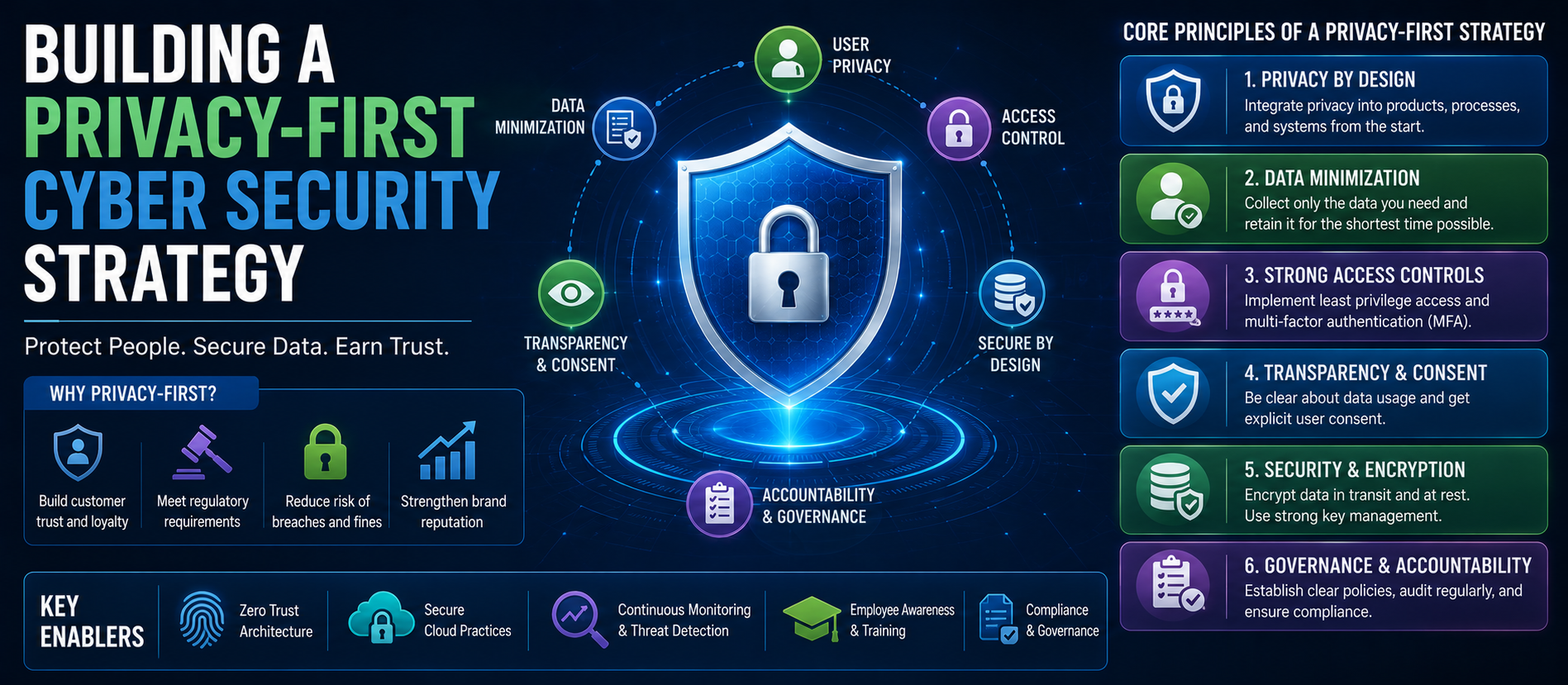
A privacy-first approach embeds data protection into every business process, application, and technology decision. Rather than treating privacy as an afterthought, organizations proactively minimize data collection, secure sensitive information, and provide transparency regarding how information is used.
Why Privacy Matters in 2026
- Growing cyber threats
- Increasing customer expectations
- Stronger privacy regulations
- Expansion of AI-powered services
- Rapid cloud adoption
Core Principles
Data Minimization
Collect only the information necessary to deliver products and services.
Privacy by Design
Integrate privacy controls during planning, development, deployment, and maintenance.
Zero Trust Security
Verify every user, device, application, and workload before granting access.
Strong Identity Protection
Implement Multi-Factor Authentication (MFA), least-privilege access, and privileged access management.
Encryption Everywhere
Protect sensitive information at rest, in transit, and during backup using modern encryption standards.
Key Technologies
- Identity and Access Management (IAM)
- Endpoint Detection & Response (EDR)
- Extended Detection & Response (XDR)
- Security Information & Event Management (SIEM)
- Data Loss Prevention (DLP)
- Cloud Security Posture Management (CSPM)
AI and Privacy
Artificial Intelligence helps detect unusual behavior, automate threat detection, classify sensitive data, and reduce response times. Organizations should also ensure AI systems process personal information responsibly and transparently.
Building a Privacy Culture
- Employee awareness training
- Regular risk assessments
- Clear data handling policies
- Incident response planning
- Vendor security reviews
Common Mistakes to Avoid
- Collecting excessive personal data
- Weak password policies
- Ignoring software updates
- Unencrypted sensitive information
- Poor third-party risk management
Future Trends
Privacy-first security will increasingly include confidential computing, passwordless authentication, AI governance, privacy-enhancing technologies, and automated compliance monitoring.
SEO, AEO & GEO Best Practices
Publish well-structured, authoritative content with clear headings, FAQs, semantic keywords, and practical examples to improve visibility across Google, Bing, ChatGPT, Gemini, Copilot, and other AI-powered search platforms.
AEO & GEO Optimized FAQs
What is a privacy-first cyber security strategy?
It is a security approach that embeds privacy protections into systems, processes, and technologies from the beginning.
Why is Zero Trust important?
Zero Trust continuously verifies identities and reduces the risk of unauthorized access to sensitive information.
How does AI improve privacy protection?
AI supports anomaly detection, sensitive data classification, automated monitoring, and faster incident response.
Conclusion
A privacy-first cyber security strategy helps organizations build trust, strengthen compliance, and reduce cyber risk. By combining Zero Trust, strong identity controls, encryption, AI-powered monitoring, employee education, and continuous improvement, businesses can protect both customer data and their reputation throughout 2026 and beyond.
For more expert insights on Cyber Security, SEO, AEO, GEO, AI Search Optimization, Cloud Security, and Digital Transformation, visit Digiifrog at www.digiifrog.com.
Ready to Grow?
Talk to us about a strategy tailored to your brand — we will help you stand out in search, AI discovery and social.


Comments (0)
Log in to leave a comment.