📋 Quick Summary
In this article:
1. Start With Clearly Defined Business Requirements
2. Define Vendor Evaluation Criteria
3. Evaluate Vendor Experience and Track Record
4. Check References and Customer Reviews
5. Assess Product or Service Quality
6. Compare Total Cost of Ownership
7. Evaluate Vendor Financial Stability
8. Assess Scalability
9. Evaluate Technology Capabilities
10. Examine Cybersecurity and Data Protection
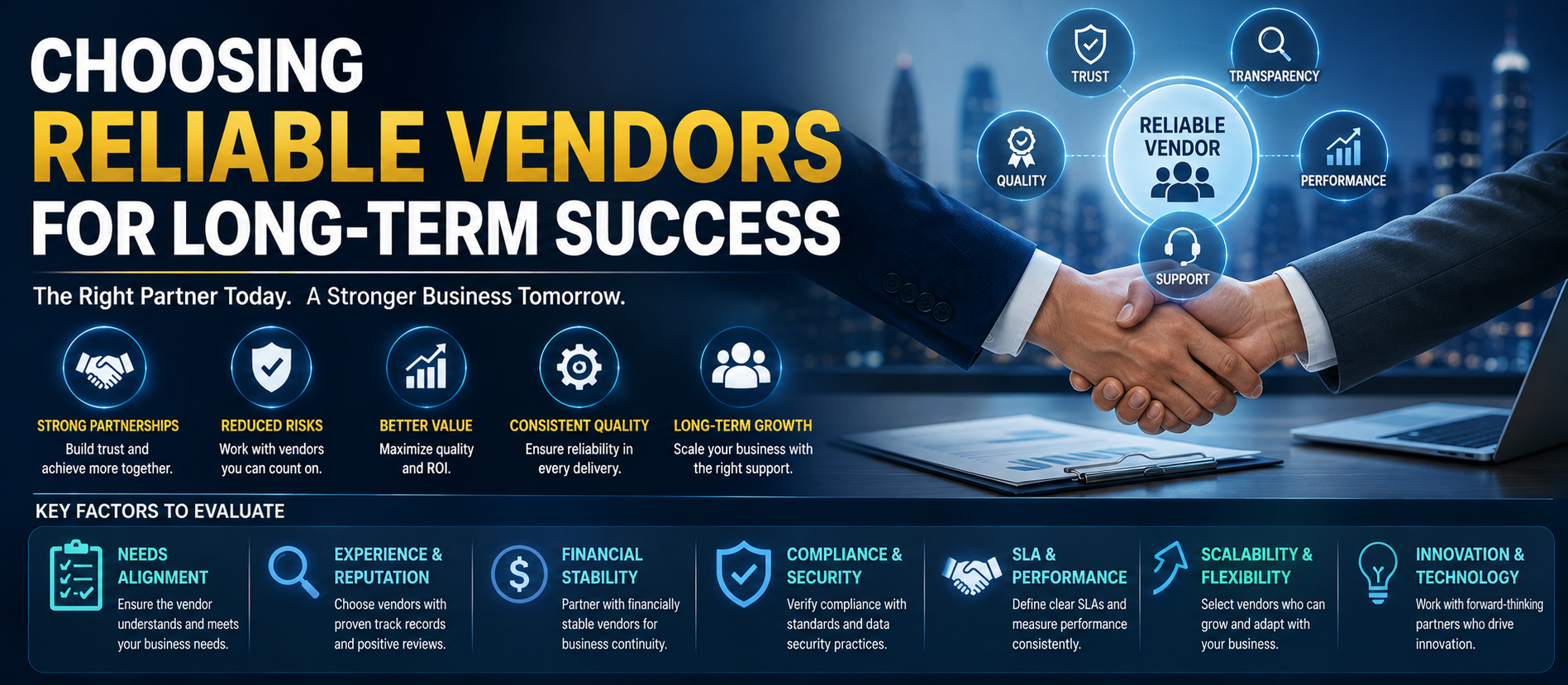
Choosing the right vendors is one of the most important decisions a business can make. Suppliers and service providers influence product quality, operating costs, delivery performance, customer satisfaction, technology capabilities, security, compliance, and the organization's ability to grow. A vendor may provide raw materials, software, logistics, marketing, professional services, equipment, cloud infrastructure, staffing, or specialized expertise. When the relationship works well, the vendor becomes a valuable extension of the business. When it fails, the impact can spread across multiple departments.
Choosing reliable vendors for long-term success requires more than comparing prices. Businesses need to evaluate capability, reliability, financial stability, communication, technology, security, scalability, service quality, risk management, and cultural alignment. A vendor that offers the lowest initial price may not deliver the lowest total cost over the life of the relationship.
💡 Key Insight
In 2026, vendor selection is becoming more complex because businesses increasingly depend on cloud services, AI platforms, global outsourcing, digital systems, specialized suppliers, and interconnected technology ecosystems. A vendor can have access to sensitive data or become critical to daily operations, making due diligence and ongoing vendor management more important than ever.
This WordPress-ready HTML article is prepared for Digiifrog (www.digiifrog.com) with a strong focus on SEO, AEO, GEO, and AI Search optimization.
What Is Vendor Selection?
Vendor selection is the structured process of identifying, evaluating, comparing, and choosing an external supplier or service provider. The process should begin by defining the business requirement and then assessing potential vendors against objective criteria.
Vendor selection can apply to many business relationships:
- Software and SaaS providers
- Raw material suppliers
- Manufacturing partners
- Logistics providers
- Marketing agencies
- IT service providers
- Cloud infrastructure providers
- Professional consultants
- Recruitment agencies
- Outsourcing companies
- Equipment suppliers
- Cybersecurity providers
Why Reliable Vendors Matter
A vendor relationship can directly affect a company's ability to serve customers. A late supplier can delay production. An unreliable software provider can interrupt operations. A weak logistics partner can create delivery problems. A poorly secured technology vendor can introduce cybersecurity risks.
Reliable vendors provide consistency and predictability. They communicate when problems occur, meet agreed standards, maintain appropriate capacity, and work collaboratively to resolve issues.
- Consistent product or service quality
- Reliable delivery
- Predictable costs
- Responsive communication
- Scalable capacity
- Effective problem resolution
- Operational continuity
- Reduced business risk
1. Start With Clearly Defined Business Requirements
Before comparing vendors, define exactly what the business needs. A vague requirement can lead to a poor purchasing decision because vendors may be evaluated against different assumptions.
Document the required products, services, quantities, quality standards, timelines, integrations, support expectations, security requirements, compliance needs, and performance objectives.
A clear requirement document also makes vendor comparisons more consistent.
2. Define Vendor Evaluation Criteria
Not every vendor should be evaluated only on price. Create a weighted evaluation framework that reflects the factors most important to the business.
- Quality
- Price and total cost
- Reliability
- Experience
- Technical capability
- Security
- Scalability
- Customer support
- Financial stability
- Communication
- Compliance
- Business continuity
Weighting criteria helps prevent a low price from overshadowing more important long-term considerations.
3. Evaluate Vendor Experience and Track Record
Experience can indicate whether a vendor has successfully handled requirements similar to yours. Review how long the company has operated, what industries it serves, the size of its customers, and whether it has experience with projects of comparable complexity.
Experience should not be treated as the only measure of quality. A newer vendor may have strong technology or specialized expertise. The goal is to understand capability and evidence of performance.
4. Check References and Customer Reviews
Vendor references can provide practical information that sales presentations may not reveal. Ask current or previous customers about reliability, communication, issue resolution, quality, implementation, and support.
Online reviews can also provide useful signals, but they should be interpreted carefully because individual experiences may not represent the complete vendor relationship.
5. Assess Product or Service Quality
⚠ Watch Out
Quality should be defined in measurable terms whenever possible. For physical products, this may include specifications, defect rates, certifications, consistency, and inspection procedures. For services, it may include service-level metrics, deliverables, response times, accuracy, and customer outcomes.
Request samples, demonstrations, pilot projects, or proof-of-concept work when appropriate.
6. Compare Total Cost of Ownership
The purchase price is only one part of the total cost. A vendor may charge additional fees for implementation, support, integration, upgrades, training, shipping, customization, storage, or termination.
Total cost of ownership should consider:
- Initial purchase or subscription cost
- Implementation expenses
- Integration costs
- Training
- Maintenance
- Support
- Upgrade costs
- Internal management time
- Switching or exit costs
Comparing total cost creates a more realistic view of long-term value.
7. Evaluate Vendor Financial Stability
A financially unstable vendor may create continuity risks. If the vendor experiences serious financial problems, it may reduce staff, discontinue products, delay deliveries, or stop operating.
For strategically important relationships, businesses may review available financial information, business history, ownership structure, and other appropriate indicators of stability.
8. Assess Scalability
A vendor that works well at the current business size may not be able to support future growth. Ask whether the vendor can increase capacity, support additional locations, handle higher transaction volumes, and provide additional services when needed.
Scalability is especially important for technology, logistics, outsourcing, manufacturing, and cloud-service relationships.
9. Evaluate Technology Capabilities
Technology is now part of many vendor relationships, even when the vendor does not sell software. Suppliers may use digital ordering systems, APIs, portals, tracking platforms, analytics, and automated communication.
For technology vendors, evaluate architecture, integrations, reliability, data portability, APIs, update processes, technical support, and product development practices.
10. Examine Cybersecurity and Data Protection
Third-party vendors may have access to company systems, customer information, employee data, financial information, or confidential documents. This makes vendor cybersecurity an important part of due diligence.
- Identity and access controls
- Multi-factor authentication
- Encryption
- Security monitoring
- Incident response
- Vulnerability management
- Employee security training
- Data retention policies
- Backup and recovery
Organizations should evaluate security requirements according to the sensitivity and criticality of the vendor relationship.
11. Review Compliance Requirements
Some industries have specific legal or regulatory requirements. Vendor selection should therefore consider applicable compliance obligations, certifications, contractual requirements, privacy rules, and industry standards.
For complex legal or regulatory questions, businesses should obtain advice from qualified professionals in the relevant jurisdiction.
12. Evaluate Communication Quality
Communication is one of the strongest predictors of vendor relationship quality. A vendor may not be able to prevent every problem, but it should communicate clearly when issues occur.
Ask how the vendor handles updates, escalation, reporting, meetings, urgent requests, and service issues. Establish communication expectations before the relationship begins.
13. Analyze Customer Support
Support becomes particularly important when the vendor provides a critical product or service. Review support hours, response targets, escalation processes, account management, technical support, and emergency procedures.
Service-level agreements can make support expectations more measurable.
14. Use Service-Level Agreements
A service-level agreement, or SLA, defines measurable service expectations. Depending on the relationship, an SLA may cover uptime, response time, delivery time, resolution time, quality, or other performance indicators.
Clear SLAs reduce ambiguity and create a shared understanding of performance expectations.
15. Conduct a Vendor Risk Assessment
Not every vendor represents the same level of risk. A company supplying office stationery may require relatively simple due diligence, while a cloud provider handling sensitive customer information may require extensive assessment.
Vendor risk assessment can consider:
- Operational criticality
- Data access
- Cybersecurity exposure
- Financial dependency
- Regulatory impact
- Geographic concentration
- Subcontractor dependency
- Business continuity
16. Evaluate Business Continuity and Disaster Recovery
Reliable vendors should have plans for dealing with disruptions. Ask how the vendor would respond to major system failures, facility problems, cyber incidents, natural disasters, supply shortages, or workforce disruptions.
For critical vendors, organizations may review recovery objectives, backup arrangements, redundancy, alternative facilities, and testing practices.
17. Understand Subcontractor Dependencies
Some vendors rely on their own suppliers or subcontractors. This can create hidden dependencies in the supply chain.
Ask which critical services are outsourced further, where important operations occur, and how the vendor manages third-party risks. Contracts should define relevant responsibilities and notification requirements where appropriate.
18. Consider Geographic Risk
Global vendors can provide cost and expertise advantages, but geographic concentration can create additional risks related to transportation, infrastructure, political conditions, regulations, natural disasters, or time zones.
A diversified vendor strategy may be appropriate for highly critical products or services.
19. Assess Cultural and Strategic Alignment
Long-term vendor relationships involve collaboration. A vendor that understands the client's business priorities and working style may be easier to manage than one focused only on individual transactions.
Strategic alignment can be particularly important for consulting, technology, marketing, outsourcing, and innovation partnerships.
20. Run a Pilot Before Making a Major Commitment
A pilot project can provide practical evidence of vendor performance before the organization commits to a large or long-term relationship.
Use the pilot to evaluate quality, communication, delivery, technology, responsiveness, and the vendor's ability to solve problems.
21. Negotiate Clear Contract Terms
A strong contract should clearly define responsibilities, pricing, deliverables, performance standards, intellectual property, data protection, confidentiality, liability, change management, termination, and dispute procedures as appropriate.
Contracts should reflect the actual risks and importance of the relationship. Professional legal review may be appropriate for significant agreements.
22. Define Data Ownership and Portability
Technology vendors may store business data in their systems. Before signing an agreement, determine who owns the data, how it can be exported, what formats are available, and what happens when the relationship ends.
Data portability can reduce switching risk and improve business continuity.
23. Avoid Excessive Vendor Dependency
Vendor consolidation can simplify management, but excessive dependency on one provider can create risk. If a single vendor supplies a critical service and cannot be easily replaced, the organization may have limited options during a disruption.
Businesses should identify strategically important single points of failure and determine whether alternatives or contingency arrangements are needed.
24. Build Strong Vendor Relationships
Vendor management should not become purely transactional. Regular communication, shared planning, performance reviews, and constructive feedback can create stronger partnerships.
When vendors understand the organization's future plans, they can often prepare capacity, technology, staffing, or service improvements in advance.
25. Conduct Regular Vendor Performance Reviews
Vendor selection is not the end of the process. Performance should be reviewed regularly against agreed KPIs.
- Delivery performance
- Quality metrics
- Response times
- Issue resolution
- Cost performance
- Customer satisfaction
- Security performance
- Innovation and improvement
Regular reviews can identify problems before they become serious.
26. Use Vendor Scorecards
A vendor scorecard provides a structured way to track performance. Scores can be assigned to quality, delivery, cost, communication, support, security, and other relevant criteria.
Scorecards are most useful when they are based on objective data rather than personal opinions.
27. Manage Vendor Pricing Over Time
Prices can change because of inflation, labor costs, raw materials, currency fluctuations, technology changes, or market conditions. Long-term agreements should define how pricing changes are handled.
Businesses should periodically compare vendor costs against market conditions and the value received.
28. Encourage Continuous Improvement
The best vendor relationships improve over time. Businesses can work with suppliers to identify process improvements, automation opportunities, quality initiatives, and cost reductions.
Continuous improvement should benefit both parties rather than becoming a constant demand for lower prices.
29. AI and Modern Vendor Management
Artificial intelligence is changing how companies evaluate and manage vendors. AI-powered analytics can organize vendor performance data, identify anomalies, summarize contract information, monitor service metrics, and highlight potential risks.
AI can support procurement teams by helping them compare information across large vendor datasets, but final decisions should remain subject to appropriate human review.
30. AI-Powered Vendor Risk Monitoring
AI systems can potentially monitor changes in vendor performance, delivery patterns, financial indicators, security events, or other approved data sources.
When unusual patterns appear, the system can alert the responsible team for investigation. Automated monitoring can be useful for large vendor portfolios where manual review of every supplier is difficult.
31. Cloud Vendors Require Additional Due Diligence
Cloud and SaaS vendors can become deeply integrated into business operations. Before selecting a cloud provider, businesses should review availability, security, data location, integrations, service levels, support, backup, portability, pricing, and exit procedures.
The more critical the cloud service, the more important comprehensive vendor risk management becomes.
32. Vendor Selection for Small Businesses
Small businesses may not have dedicated procurement teams, but they still need a structured vendor-selection process. A simple scorecard can help compare price, quality, reliability, support, flexibility, and long-term value.
Small companies should avoid choosing vendors solely because they are inexpensive. Reliability can be especially important when a small organization has limited backup capacity.
33. Vendor Selection for Growing Companies
As companies grow, informal vendor relationships may become inadequate. A growing organization should document suppliers, contracts, renewal dates, performance data, security requirements, and risk levels.
Formal vendor management can prevent operational problems as the company becomes more dependent on external partners.
34. Vendor Selection for Global Businesses
International organizations may need to evaluate vendors across multiple countries. Additional considerations can include local regulations, currency, language, logistics, tax requirements, data-transfer rules, political risk, and regional support.
Global vendor strategies should balance cost efficiency with resilience and local operational requirements.
35. Common Vendor Selection Mistakes
Choosing the Lowest Price
Low price does not guarantee low total cost. Poor quality, delays, and support problems can create hidden expenses.
Skipping Due Diligence
Assuming that a vendor will perform as promised without checking references or capabilities can create avoidable risk.
Ignoring Security
Third-party access can create cybersecurity exposure.
Failing to Define KPIs
Without measurable expectations, it becomes difficult to determine whether a vendor is performing well.
Overlooking Exit Planning
Businesses should understand how they would transition away from a vendor if necessary.
36. A Practical Vendor Selection Process
- Define the business requirement.
- Identify potential vendors.
- Screen basic qualifications.
- Issue an RFI or RFP when appropriate.
- Compare capabilities and pricing.
- Evaluate references.
- Assess security and risk.
- Conduct demonstrations or pilots.
- Score vendors objectively.
- Negotiate commercial and contractual terms.
- Approve the selected vendor.
- Onboard the vendor.
- Track performance continuously.
37. How to Measure Long-Term Vendor Success
A vendor relationship should be evaluated based on the outcomes it creates. Important indicators may include cost stability, quality, delivery reliability, service responsiveness, customer impact, innovation, and risk management.
The most valuable vendor may not be the cheapest. It may be the provider that consistently delivers the right quality, communicates effectively, solves problems quickly, and helps the business improve.
38. Vendor Management, SEO, AEO, GEO and AI Search
Businesses that provide procurement, vendor management, sourcing, consulting, technology, or B2B services also need a strong digital content strategy. SEO helps businesses gain visibility in traditional search. AEO focuses on directly answering questions. GEO helps content become useful for generative search experiences, while AI Search optimization emphasizes structured, trustworthy, context-rich information.
Useful content can address vendor selection criteria, supplier evaluation, procurement strategy, vendor risk, contract management, outsourcing, SaaS procurement, cybersecurity due diligence, and frequently asked business questions.
39. Future of Vendor Management
Vendor management is becoming more data-driven and technology-enabled. AI, automation, cloud procurement platforms, analytics, digital contracts, and real-time monitoring can reduce administrative work and improve visibility.
Procurement teams are likely to spend more time on strategic sourcing, risk management, supplier innovation, and relationship development while software handles more repetitive administrative tasks.
40. Key Vendor Management Trends for 2026
- AI-assisted vendor evaluation
- Automated vendor risk monitoring
- Digital procurement platforms
- Real-time supplier analytics
- Stronger third-party cybersecurity
- Supplier diversification
- Outcome-based contracts
- Cloud and SaaS vendor governance
- Automated contract analysis
- Strategic supplier partnerships
- Continuous performance management
- Data-driven procurement decisions
Frequently Asked Questions About Choosing Reliable Vendors
How do you choose a reliable vendor?
Define your requirements, establish evaluation criteria, compare quality and total cost, check experience and references, assess security and financial stability, evaluate scalability, and conduct a pilot when appropriate.
What are the most important vendor selection criteria?
Important criteria include quality, reliability, total cost, experience, scalability, communication, technical capability, security, customer support, financial stability, compliance, and business continuity.
Should businesses always choose the cheapest vendor?
No. The lowest initial price may create higher long-term costs through poor quality, delays, support problems, or operational risk. Total cost and expected business value should be considered.
Why is vendor cybersecurity important?
Vendors may have access to company systems, data, and customer information. Weak third-party security can therefore create significant operational and cybersecurity risks.
What is a vendor scorecard?
A vendor scorecard is a structured tool used to measure supplier performance across criteria such as quality, delivery, cost, support, communication, and security.
How often should vendors be reviewed?
Review frequency should reflect the importance and risk of the relationship. Critical vendors may require regular formal reviews, while lower-risk suppliers may be reviewed less frequently.
Why is a pilot useful when selecting a vendor?
A pilot provides practical evidence of quality, communication, reliability, technical capability, and problem-solving before the company makes a larger commitment.
What is total cost of ownership in vendor selection?
Total cost of ownership includes not only the purchase price but also implementation, integration, training, maintenance, support, internal management, upgrades, and potential switching costs.
Conclusion
Choosing reliable vendors for long-term success requires a structured approach that looks beyond price. Businesses should evaluate quality, reliability, financial stability, technology, security, scalability, communication, customer support, compliance, and business continuity.
A successful vendor relationship is built on clear expectations, measurable performance, transparent communication, appropriate contracts, and continuous improvement. Businesses should also understand their critical dependencies and maintain contingency plans for strategically important suppliers.
As AI and automation transform procurement and vendor management, organizations will have more tools for evaluating supplier performance, monitoring risks, analyzing contracts, and identifying improvement opportunities. However, human judgment and relationship management will remain essential.
The right vendor should not simply deliver a product or service. A reliable long-term partner should help the business maintain quality, solve problems, scale operations, manage risk, and achieve strategic objectives.
For businesses looking to improve vendor management, procurement workflows, AI-powered analytics, automation, digital transformation, intelligent business systems, and modern technology solutions, Digiifrog can help develop practical strategies. Visit www.digiifrog.com to learn more.
Quick Answer: How Do You Choose Reliable Vendors for Long-Term Success?
Choose reliable vendors by defining clear requirements, comparing quality and total cost, checking references, evaluating financial stability and scalability, assessing cybersecurity and compliance, testing capabilities through pilots, establishing measurable SLAs and KPIs, negotiating clear contracts, and reviewing performance continuously. The best long-term vendor is not necessarily the cheapest; it is the partner that consistently delivers value, reliability, security, quality, and business support.
Ready to Grow?
Talk to us about a strategy tailored to your brand — we will help you stand out in search, AI discovery and social.

Comments (0)
Log in to leave a comment.