📋 Quick Summary
In this article:
1. Identify Which Requirements Apply
2. Understand the Shared Responsibility Model
3. Compliance Differs Across IaaS, PaaS, and SaaS
4. Data Classification and Inventory
5. Identity and Access Management
6. Encryption and Key Management
7. Logging, Monitoring, and Audit Trails
8. Data Privacy Requirements
9. Data Location and International Transfers
10. Vendor and Cloud Provider Due Diligence
12. Secure Configuration and Change Management
Cloud compliance requirements are the rules, controls, processes, and evidence an organization needs to follow when it stores, processes, or transmits information through cloud services. As businesses move applications and data to SaaS, PaaS, IaaS, hybrid, and multi-cloud environments, compliance has become a shared responsibility between cloud customers and providers.
Cloud compliance is not one universal certification or checklist. Requirements depend on the organization's industry, location, customers, data types, contractual commitments, and applicable laws. NIST explains that public-cloud adoption creates security, privacy, governance, compliance, and data-location considerations that organizations should address when selecting and managing cloud services. citeturn0search0turn0search34
This WordPress-ready HTML article is prepared for Digiifrog (www.digiifrog.com) with SEO, AEO, GEO, and AI Search optimization.
What Is Cloud Compliance?
Cloud compliance means demonstrating that cloud-based systems and data are managed according to applicable legal, regulatory, industry, contractual, and internal security requirements. It covers more than technical security. Governance, privacy, access management, documentation, risk management, vendor oversight, monitoring, and audit evidence can all be part of compliance.
A compliant cloud environment should be designed around the requirements that actually apply to the business.
1. Identify Which Requirements Apply
The first step is determining which regulations and standards apply. A healthcare provider, online retailer, financial company, software provider, and government contractor may have very different obligations.
Consider customer location, business location, industry, data categories, payment processing, contractual commitments, and cross-border data transfers. Create a compliance matrix showing each requirement, the affected system, responsible owner, control, and evidence.
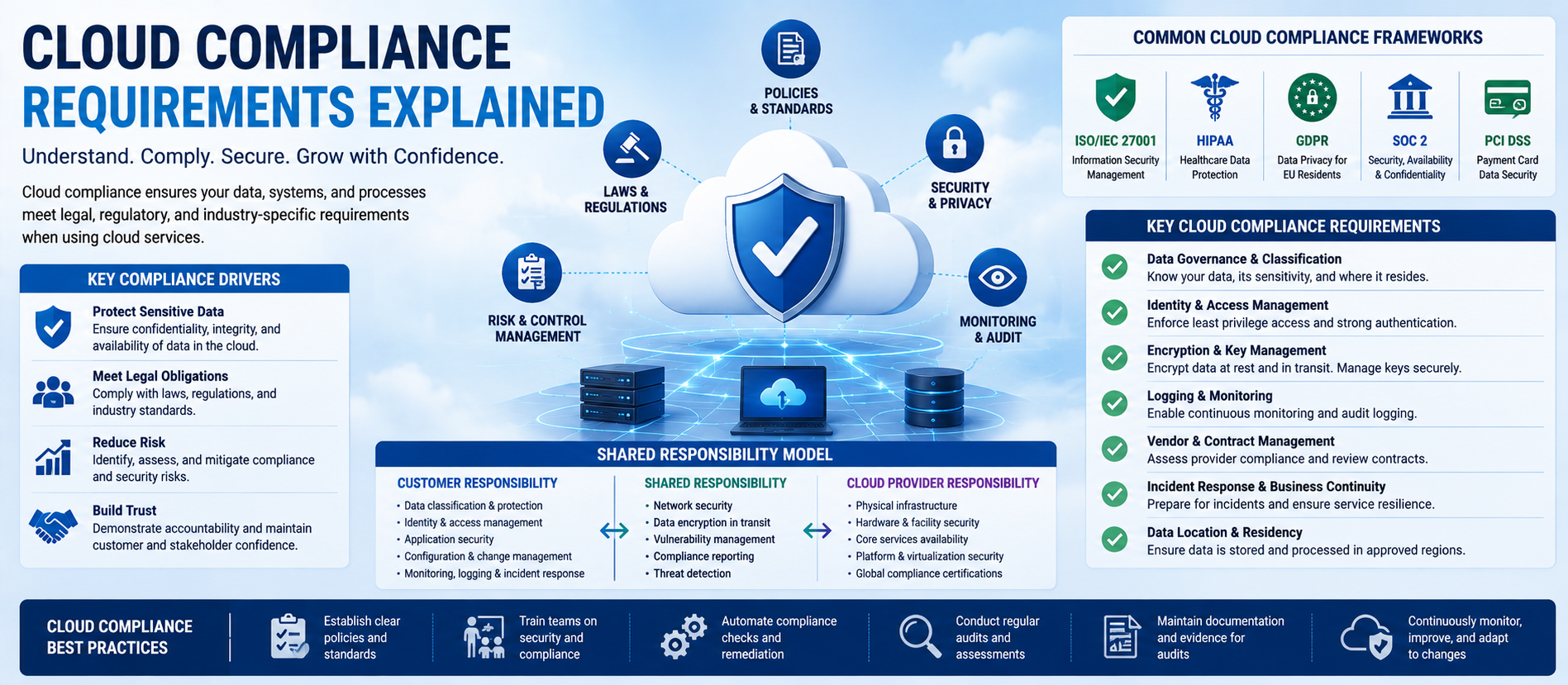
2. Understand the Shared Responsibility Model
Moving data to a cloud provider does not automatically transfer all security and compliance responsibilities to that provider. The provider may secure physical infrastructure and parts of the cloud platform, while the customer remains responsible for areas such as identities, configurations, applications, data, and access policies depending on the service model.
NIST's cloud guidance emphasizes understanding provider offerings, contractual requirements, visibility into security and privacy controls, and ongoing risk management. citeturn0search34
3. Compliance Differs Across IaaS, PaaS, and SaaS
In IaaS, customers generally have more responsibility for operating systems, applications, network configuration, identities, and data. In PaaS, the provider manages more underlying infrastructure while customers remain responsible for applications, data, and configuration. In SaaS, the provider manages most of the technical stack, but customers still have responsibilities around users, permissions, data handling, and configuration.
NIST SP 800-210 specifically addresses access-control considerations across IaaS, PaaS, and SaaS because different service models require different approaches. citeturn0search5turn0search11
4. Data Classification and Inventory
Compliance begins with knowing what data exists. Organizations should identify sensitive, confidential, regulated, and public information and understand where each category is stored or processed.
A useful cloud data inventory can record the data owner, classification, application, cloud provider, geographic location, retention requirement, authorized users, and deletion process.
5. Identity and Access Management
💡 Key Insight
Strong identity controls are essential to cloud compliance. Organizations should use least privilege, role-based access, strong authentication, multi-factor authentication, privileged-access controls, and timely removal of inactive accounts.
Cloud access should be reviewed regularly because excessive permissions can expose sensitive resources and create both security and compliance problems. NIST recommends access-control guidance tailored to cloud service models and their characteristics. citeturn0search5
6. Encryption and Key Management
Encryption can help protect sensitive information while it is stored and transmitted. Compliance requirements may also affect how encryption keys are generated, stored, rotated, accessed, and separated from protected data.
Businesses should document which data requires encryption, which services perform encryption, who controls the keys, and how key-management events are monitored.
7. Logging, Monitoring, and Audit Trails
Cloud compliance often requires evidence that security controls are operating effectively. Logging can provide records of authentication, administrative changes, access to sensitive resources, configuration changes, and security events.
Logs should be protected against unauthorized modification, retained according to business and regulatory requirements, and monitored for meaningful events. Centralized security monitoring can make investigation and evidence collection more efficient.
8. Data Privacy Requirements
Cloud services may process personal information belonging to customers, employees, partners, or other individuals. Privacy requirements can affect lawful processing, transparency, data minimization, retention, individual rights, security, and third-party processing.
The European Commission explains that organizations using personal data must address GDPR principles and obligations, including data security and breach notification. citeturn0search13 The EDPB has also highlighted the importance of carefully evaluating cloud-based services when public-sector organizations process personal data. citeturn0search12
9. Data Location and International Transfers
Some compliance programs require organizations to understand where data is stored and processed. Cloud architectures can distribute information across regions, providers, backups, support systems, and subprocessors.
Organizations should document geographic locations, applicable transfer mechanisms, contractual requirements, and provider commitments. NIST specifically recommends understanding laws and regulations that may affect cloud initiatives, including data-location, privacy, security, records-management, and discovery requirements. citeturn0search34
10. Vendor and Cloud Provider Due Diligence
Before selecting a cloud provider, evaluate its security architecture, compliance reports, certifications, incident processes, subcontractors, data locations, service commitments, access controls, and contract terms.
Do not rely only on a provider's “compliant” marketing claim; determine which controls the provider covers and which remain the customer's responsibility.
12. Secure Configuration and Change Management
Cloud resources can be created rapidly, which makes configuration management critical. Misconfigured storage, exposed management interfaces, excessive permissions, and insecure network rules can create serious risk.
Organizations should use secure configuration baselines, infrastructure-as-code where appropriate, change approval processes, automated checks, and continuous monitoring. NIST's checklist guidance emphasizes secure configuration and identifying unauthorized configuration changes as ways to reduce attack surface and vulnerabilities. citeturn0search4
13. Incident Response and Breach Management
A compliant cloud environment needs a documented process for detecting, investigating, containing, and recovering from security incidents. The organization should understand which logs and forensic information the provider can supply and how quickly evidence can be obtained.
Privacy or sector-specific breach notification requirements may apply when regulated data is affected. Response plans should therefore include security, legal, privacy, communications, and business stakeholders.
16. Common Cloud Compliance Mistakes
- Assuming the cloud provider handles all compliance responsibilities.
- Using one generic compliance checklist for every jurisdiction.
- Failing to inventory sensitive cloud data.
- Granting excessive user permissions.
- Ignoring data location and transfer requirements.
- Failing to review cloud vendors and subprocessors.
- Not monitoring configuration changes.
- Keeping insufficient audit logs.
- Failing to test backup restoration.
- Collecting compliance evidence only immediately before an audit.
17. Practical Cloud Compliance Checklist
- Identify applicable laws, standards, contracts, and industry requirements.
- Map cloud services and data flows.
- Define the provider/customer responsibility split.
- Classify sensitive and regulated data.
- Implement least privilege and strong authentication.
- Encrypt appropriate data and manage keys securely.
- Enable and protect audit logging.
- Review cloud configurations continuously.
- Evaluate providers and subprocessors.
- Document data locations and transfers.
- Test incident response and disaster recovery.
- Maintain evidence for audits and internal reviews.
SEO, AEO, GEO and AI Search Optimization
SEO content about cloud compliance should target searches such as “cloud compliance requirements,” “cloud compliance checklist,” “cloud security compliance,” “cloud compliance standards,” and “cloud regulatory requirements.”
AEO should directly answer questions such as “What are cloud compliance requirements?”, “Who is responsible for cloud compliance?”, and “How do businesses prepare for a cloud compliance audit?”
GEO and AI Search optimization can be strengthened with jurisdiction-specific considerations, recognized frameworks, clear definitions, structured headings, actionable checklists, authoritative references, and concise FAQ answers.
Frequently Asked Questions About Cloud Compliance
What are cloud compliance requirements?
Cloud compliance requirements are the legal, regulatory, contractual, industry, and internal controls an organization must meet when using cloud services. They can cover security, privacy, access control, data location, monitoring, incident response, retention, and audit evidence.
Is cloud compliance the cloud provider's responsibility?
Not entirely. Cloud security and compliance are commonly shared responsibilities. The exact division depends on the provider, service model, contract, and customer configuration. NIST recommends understanding provider controls and ensuring contractual arrangements meet organizational requirements. citeturn0search34
What is the most important cloud compliance control?
There is no single control that fits every organization. Strong identity and access management, data protection, secure configuration, logging, monitoring, vendor management, and documented governance are common foundations.
How can a company prepare for a cloud compliance audit?
Map requirements to controls, maintain an accurate cloud inventory, document responsibilities, review access and configurations, collect audit evidence continuously, test security processes, and address gaps before the formal audit.
Does using a certified cloud provider guarantee compliance?
No. A provider's certification or assurance report can support a compliance program, but the customer's own configuration, data handling, access controls, processes, and contractual responsibilities still need to meet applicable requirements.
Conclusion
Cloud compliance requirements are best understood as an ongoing risk-management and governance process rather than a one-time certification exercise. Organizations need to identify applicable requirements, understand shared responsibilities, protect data, control access, monitor cloud environments, evaluate vendors, manage configurations, prepare for incidents, and maintain evidence.
NIST guidance emphasizes governance, contractual clarity, visibility into provider security and privacy controls, and continuous risk management for cloud environments. citeturn0search34turn0search0
As cloud architectures become more distributed, organizations should build compliance into cloud design and daily operations. A strong compliance program can improve security, reduce audit surprises, strengthen trust, and support responsible cloud adoption.
For businesses seeking modern websites, cybersecurity content, cloud-focused content, automation, SEO, AEO, GEO, and AI Search optimization, Digiifrog can help. Visit www.digiifrog.com.
Quick Answer: What Are the Main Cloud Compliance Requirements?
The main cloud compliance requirements typically include identifying applicable regulations and standards, understanding the shared-responsibility model, protecting sensitive data, managing identities and access, using appropriate encryption, maintaining audit logs, controlling cloud configurations, reviewing providers and subprocessors, managing data location and transfers, preparing incident response and disaster recovery, and maintaining evidence that controls are working.
Important Note
This article is general educational content, not legal, audit, or compliance advice. Requirements vary by jurisdiction, industry, contract, cloud architecture, and data type. Organizations should consult qualified legal, privacy, cybersecurity, or compliance professionals and verify current official requirements before making compliance decisions.
Ready to Grow?
Talk to us about a strategy tailored to your brand — we will help you stand out in search, AI discovery and social.

Comments (0)
Log in to leave a comment.