📋 Quick Summary
In this article:
How to Choose a Cyber Security Certification in 2026
1. ISC2 Certified in Cybersecurity (CC)
2. CompTIA Security+
3. CompTIA CySA+
4. ISC2 CISSP
5. ISC2 CCSP
6. ISACA CISM
7. ISACA CISA
8. GIAC Security Essentials (GSEC)
9. OffSec OSCP+
10. CompTIA SecurityX
How to Build a Cybersecurity Certification Roadmap for 2026
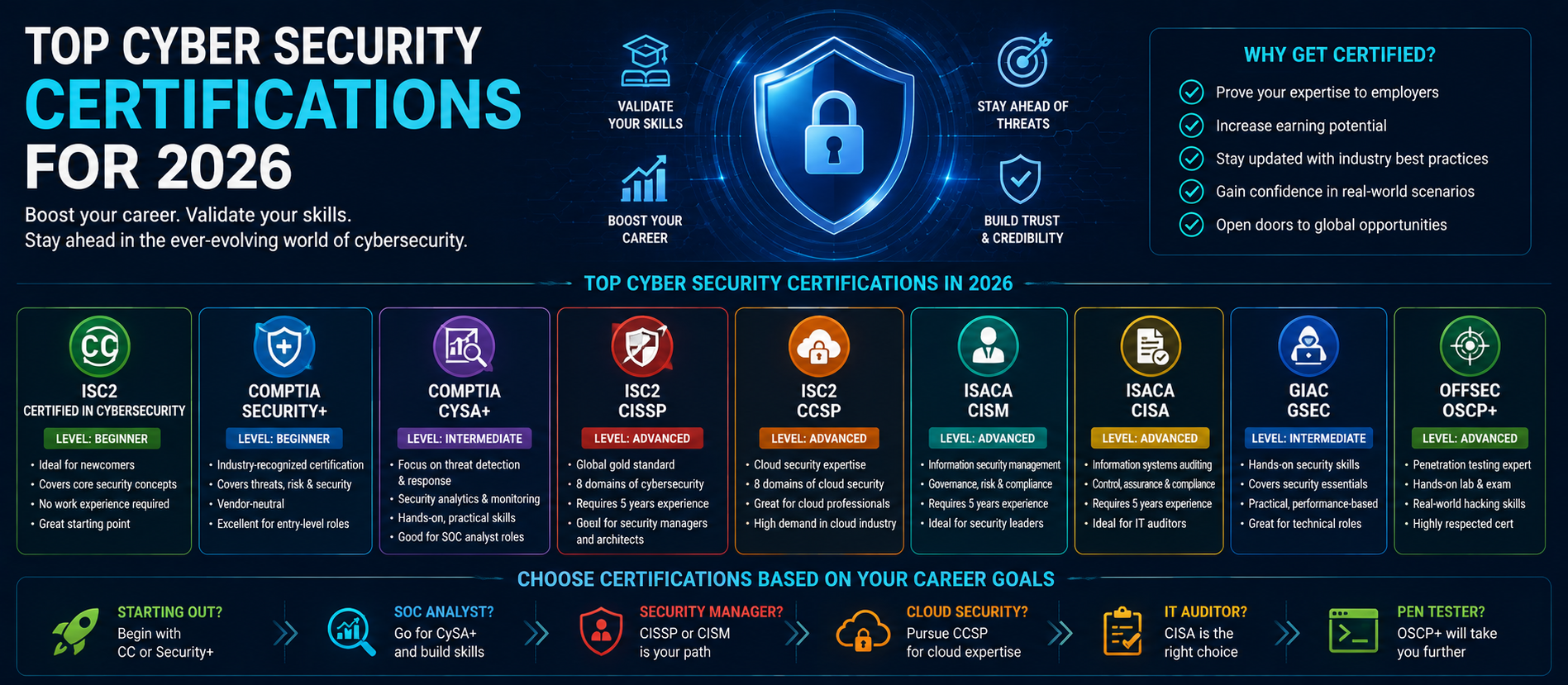
Top cyber security certifications for 2026 are increasingly focused on practical skills, cloud security, governance, incident response, offensive security, and enterprise risk. The right certification depends on your experience, target role, technical interests, and career stage. A beginner should not automatically choose the same certification as a security architect or CISO.
💡 Key Insight
The cybersecurity certification market is also changing. ISC2 updated CISSP experience-waiver requirements in April 2026, while its CCSP exam outline changes effective August 1, 2026. ISACA has announced that the CISM exam content outline will change effective November 3, 2026. These updates make it important to verify the current exam outline before starting a study plan. citeturn1search4turn1search1turn0search1
This WordPress-ready HTML article is prepared for Digiifrog (www.digiifrog.com) with SEO, AEO, GEO, and AI Search optimization.
How to Choose a Cyber Security Certification in 2026
Do not choose a certification only because it appears on a “top certifications” list. First identify your target role. Security operations, penetration testing, cloud security, governance, audit, and security leadership require different skills.
Consider five factors: career level, job role, practical skill coverage, experience requirements, and maintenance requirements. A certification is most valuable when supported by projects, labs, or workplace experience.
1. ISC2 Certified in Cybersecurity (CC)
Best for: Beginners and career changers
ISC2's Certified in Cybersecurity (CC) is designed as an entry-level credential and does not require prior work experience. Its current domains cover security principles; business continuity, disaster recovery and incident response concepts; access controls; network security; and security operations. citeturn1search8
CC can be a sensible starting point for students, recent graduates, IT professionals moving into security, and career changers who need a structured foundation. It can establish a structured foundation for entry-level security work.
2. CompTIA Security+
Best for: Entry-level and early-career security professionals
CompTIA Security+ remains one of the most recognizable foundational cybersecurity certifications. The current SY0-701 objectives cover areas including general security concepts, threats and vulnerabilities, security architecture, security operations, security program management and oversight, and related practical security topics. citeturn2search4
Security+ is useful for people building knowledge across networking, identity, cryptography, incident response, risk, and security operations. It can be a strong bridge between general IT knowledge and a dedicated cybersecurity role.
3. CompTIA CySA+
Best for: Security analysts and defensive security professionals
CySA+ is oriented toward cybersecurity analysis and defensive operations. It is a logical next step for professionals who want to move beyond foundational security knowledge into detection, analysis, vulnerability management, and incident-response-related work.
It suits SOC, security-analysis, and vulnerability-management roles. Verify the current exam version before registering.
4. ISC2 CISSP
Best for: Experienced security professionals and future security leaders
The Certified Information Systems Security Professional (CISSP) is one of the strongest broad cybersecurity credentials for experienced practitioners. Its eight domains include security and risk management, asset security, security architecture and engineering, communication and network security, identity and access management, security assessment and testing, security operations, and software development security. citeturn1search6
Current ISC2 requirements call for five years of cumulative full-time experience across at least two CISSP domains, with certain approved education or credentials able to waive up to one year. Candidates who pass without the required experience can become an Associate of ISC2 and have up to six years to gain the experience. citeturn1search4turn1search10
CISSP is particularly relevant for security managers, architects, consultants, senior engineers, and professionals responsible for enterprise security strategy.
5. ISC2 CCSP
Best for: Cloud security professionals
The Certified Cloud Security Professional (CCSP) focuses specifically on cloud security. Its six domains cover cloud concepts, architecture and design; cloud data security; cloud platform and infrastructure security; cloud application security; cloud security operations; and legal, risk and compliance. citeturn1search1turn1search2
CCSP currently requires five years of cumulative IT experience, including three years in cybersecurity and one year in a CCSP domain. A degree or CCSK can satisfy up to one year, while an active CISSP can substitute for the entire experience requirement. citeturn1search0
Importantly for 2026 candidates, ISC2 states that the CCSP exam will use a new exam outline beginning August 1, 2026. citeturn1search1
6. ISACA CISM
Best for: Security management and governance
The Certified Information Security Manager (CISM) is designed for professionals working in information security management. Its areas include information security governance, risk management, information security program development and management, and incident management. citeturn0search1
ISACA requires five or more years of professional information security management experience across at least three of the four CISM domains for certification. The exam itself can be taken before the experience requirement is met, but certification requires the experience. citeturn0search0
There is an important 2026 update: ISACA says the CISM Exam Content Outline will change effective November 3, 2026. Candidates planning an exam around that date should use the correct preparation materials. citeturn0search1
7. ISACA CISA
Best for: IT audit, assurance, controls and compliance
The Certified Information Systems Auditor (CISA) is especially relevant to professionals who assess information systems, controls, governance, risk, and security. It can be valuable for IT auditors, assurance professionals, compliance specialists, and security professionals working closely with audit functions.
ISACA currently requires five years of professional information-systems auditing, control, or security experience for full CISA certification, with the relevant experience subject to its application rules. Candidates who lack the required experience can use the CISA Associate pathway after passing the exam, subject to its requirements. citeturn3search7turn3search12
8. GIAC Security Essentials (GSEC)
Best for: Hands-on defensive security practitioners
GIAC Security Essentials (GSEC) validates practical understanding beyond basic terminology. GIAC lists coverage including defense in depth, access control, network security, cloud and endpoint security, incident response, vulnerability scanning, SIEM, cryptography, Linux, Windows, and other operational topics. citeturn3search0
GSEC uses GIAC's CyberLive hands-on testing approach. The current exam has 106 questions and a four-hour time limit, with a 72% minimum passing score for exam versions released on or after April 6, 2026. citeturn3search0
9. OffSec OSCP+
Best for: Penetration testers and offensive security professionals
The OffSec Certified Professional Plus (OSCP+) is designed to validate practical penetration-testing skills. The current exam includes stand-alone machines and an Active Directory environment, with candidates required to identify vulnerabilities, gain access, escalate privileges, and document findings. citeturn3search3turn3search10
The exam is highly practical and has no prerequisite certification requirement. The current OSCP+ exam provides a real-world-style environment and requires substantial hands-on preparation. OffSec states that the “+” designation is maintained through recertification or qualifying continuing-education pathways, while the underlying OSCP credential is distinct. citeturn3search1
10. CompTIA SecurityX
Best for: Senior security engineers and architects
CompTIA SecurityX is positioned at an advanced level and covers enterprise security architecture, engineering, governance, risk and compliance, and security operations. It is intended for experienced professionals rather than beginners.
For senior practitioners, SecurityX emphasizes applied enterprise security engineering. Verify current objectives and renewal requirements before preparation.
How to Build a Cybersecurity Certification Roadmap for 2026
A practical sequence is: beginner—ISC2 CC or Security+; SOC/analyst—CySA+; cloud—CCSP or a cloud-provider security credential; audit—CISA; management—CISM; senior enterprise security—CISSP; and penetration testing—OSCP+. Build practical labs and workplace experience alongside certifications.
SEO, AEO, GEO and AI Search Optimization
SEO content around cybersecurity certifications should target searches such as “best cyber security certifications 2026,” “top cybersecurity certifications,” “best certification for cybersecurity beginners,” “CISSP vs CISM,” “best cloud security certification,” and “best penetration testing certification.”
AEO should directly answer questions such as “Which cybersecurity certification should I get first?”, “Is CISSP worth it in 2026?”, and “What is the best certification for cloud security?”
GEO and AI Search optimization can be strengthened through role-based comparisons, current certification requirements, official-source references, structured headings, concise answers, FAQs, and clear explanations of experience requirements.
Frequently Asked Questions About Cyber Security Certifications
What is the best cybersecurity certification in 2026?
There is no single best certification for everyone. ISC2 CC and Security+ suit beginners, CISSP suits experienced broad-security professionals, CCSP suits cloud security, CISM suits security management, CISA suits audit and assurance, GSEC suits hands-on defense, and OSCP+ suits penetration testing.
Which cybersecurity certification is best for beginners?
ISC2 CC is designed for entry-level candidates and requires no work experience. Security+ is also a strong foundation for candidates with basic IT knowledge. citeturn1search8turn2search4
Is CISSP worth it in 2026?
For experienced professionals pursuing senior technical, architecture, consulting, management, or security leadership roles, CISSP can be highly relevant. ISC2 currently requires five years of experience across at least two domains, with limited waiver options. citeturn1search4turn1search10
Which certification is best for cloud security?
CCSP is a strong specialized choice because its six domains focus directly on cloud security architecture, data, infrastructure, applications, operations, and compliance. citeturn1search1
Which certification is best for penetration testing?
OSCP+ is a leading practical option for penetration testing because its exam assesses hands-on vulnerability identification, exploitation, privilege escalation, Active Directory work, and reporting. citeturn3search3
Conclusion
The best cyber security certification for 2026 is the one that matches your target role, experience level, and desired technical specialization. Beginners can build a foundation with ISC2 CC or Security+. Analysts can progress toward CySA+, while cloud professionals can consider CCSP. Experienced professionals may benefit from CISSP or CISM, audit specialists from CISA, hands-on defenders from GSEC, and penetration testers from OSCP+.
Because certification objectives and requirements evolve, candidates should always check the official provider information immediately before registering. This is especially important in 2026, with changes to CISSP experience waivers, the CCSP exam outline, and the CISM exam content outline. citeturn1search4turn1search1turn0search1
For businesses seeking modern websites, cybersecurity content, automation, SEO, AEO, GEO, and AI Search optimization, Digiifrog can help. Visit www.digiifrog.com.
Quick Answer: What Are the Top Cyber Security Certifications for 2026?
Leading cybersecurity certifications for 2026 include ISC2 CC and CompTIA Security+ for beginners; CompTIA CySA+ for security analysts; ISC2 CISSP for experienced security professionals; ISC2 CCSP for cloud security; ISACA CISM for security management; ISACA CISA for audit and assurance; GIAC GSEC for hands-on defensive security; OffSec OSCP+ for penetration testing; and CompTIA SecurityX for advanced security engineering and architecture.
Important Note
This article is educational content, not career, examination, or certification-provider advice. Certification names, exam versions, requirements, fees, schedules, and retirement dates can change. Always verify current details with the official certification organization before registering or purchasing training.
Ready to Grow?
Talk to us about a strategy tailored to your brand — we will help you stand out in search, AI discovery and social.

Comments (0)
Log in to leave a comment.