📋 Quick Summary
In this article:
Quick Answer: What Are the Biggest Cloud Software Trends in 2026?
Why Cloud Software Is Changing in 2026
1. AI-Native Cloud Platforms
2. Agentic AI Will Become a Cloud Workload
3. AI Inference Will Drive Cloud Spending
4. Multicloud and Hybrid Cloud Will Become More Strategic
5. Sovereign Cloud Will Grow
6. Cloud-Native Software Will Mature Further
7. Platform Engineering Will Become More Important
8. FinOps Will Shift From Cost Control to Technology Value
9. AI Security Will Become a Core Cloud Capability
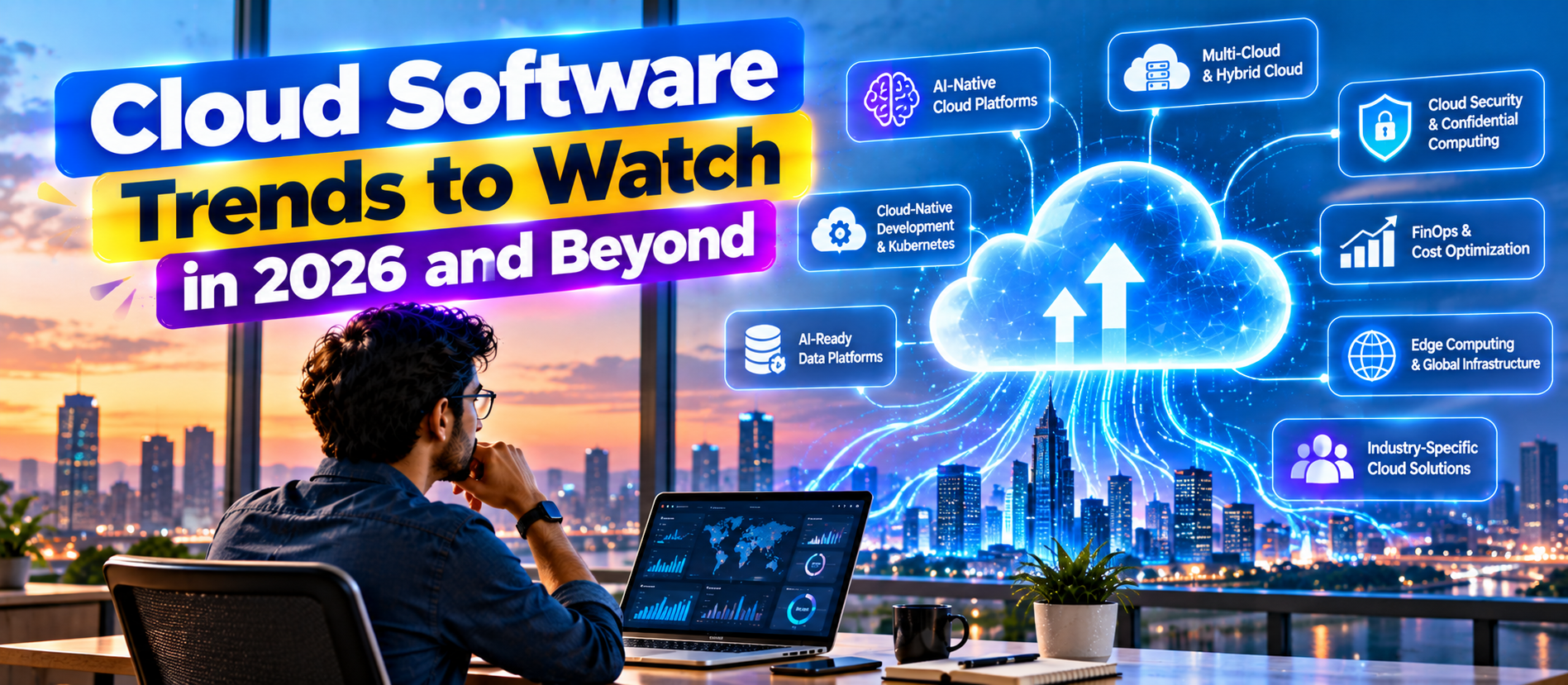
Cloud Software Trends to Watch in 2026 and Beyond Cloud software is entering a new phase. For years, businesses moved applications, storage, databases, and infrastructure to the cloud. In 2026, the focus is shifting from simple cloud adoption to AI-ready infrastructure, intelligent software platforms, automation, cost control, security, sovereignty, and business value.
Cloud platforms are becoming more than places to run applications. They are becoming operating environments for AI agents, data products, modern applications, automated workflows, and increasingly autonomous business processes.
Gartner says public cloud spending in India is forecast to reach $17.5 billion in 2026, up 28.1% from 2025. Gartner attributes this growth partly to demand for AI-ready infrastructure, application modernization, digital sovereignty, and scalable consumption-based IT.
Globally, Gartner also forecasts AI-optimized IaaS spending to reach about $42 billion in 2026, with inference spending surpassing training spending.
These changes affect both large enterprises and small businesses. The cloud is becoming more intelligent, more distributed, and more tightly connected to business strategy.
Quick Answer: What Are the Biggest Cloud Software Trends in 2026?
The most important cloud software trends for 2026 and beyond include AI-native cloud platforms, agentic AI, AI-optimized infrastructure, multi cloud and hybrid cloud, sovereign cloud, cloud-native application development, platform engineering, Fin Ops, confidential computing, stronger cloud security, edge computing, cross-cloud infrastructure, and more intelligent data platforms.
AI is the biggest force behind many of these trends. Cloud providers are redesigning compute, storage, networking, databases, developer platforms, security, and management tools around AI workloads.
At the same time, businesses are becoming more disciplined about cloud cost, data location, compliance, resilience, and vendor dependency. The future of cloud software is therefore not simply “more cloud.” It is smarter, governed, AI-ready, and business-focused cloud.
What Is Cloud Software?
Cloud software refers to applications, platforms, development environments, infrastructure services, databases, security tools, and other software capabilities delivered through cloud infrastructure.
It can include:
- Software as a Service (SaaS)
- Platform as a Service (PaaS)
- Infrastructure as a Service (IaaS)
- Cloud databases
- Cloud-native applications
- AI and machine learning platforms
- Cloud security software
- Developer platforms
- Data analytics platforms
- Cloud automation tools
- Observability platforms
- Server less services
- Edge computing platforms
Cloud software is increasingly connected. An application may use several cloud services, multiple AI models, distributed databases, APIs, containers, and external SaaS products.
That flexibility creates new opportunities. It also creates new management challenges.
Why Cloud Software Is Changing in 2026
The first phase of cloud adoption focused on migration. Businesses wanted to reduce data-center dependence, increase scalability, and make infrastructure easier to provision.
💡 Key Insight
The second phase focused on cloud-native development. Containers, Kubernetes, microservices, server less platforms, APIs, and managed databases became important building blocks.
The next phase is being driven by AI.
AI workloads need large amounts of compute, fast networking, scalable storage, specialized accelerators, reliable data pipelines, and continuous inference. Agentic applications add another challenge because they can create dynamic, unpredictable workloads.
Forrester's 2026 cloud trends report describes agentic AI as a major force reshaping cloud platforms and highlights multi cloud complexity, AI cloud cost increases, and the need to balance AI enablement with cost management.
1. AI-Native Cloud Platforms
AI-native cloud platforms are becoming one of the defining cloud trends of 2026.
Traditional cloud platforms were designed mainly to help developers deploy applications. AI-native platforms go further. They provide the infrastructure, models, data services, agent frameworks, evaluation tools, security controls, and orchestration capabilities needed to build intelligent applications.
Gartner lists AI-Native Development Platforms among its top strategic technology trends for 2026. Gartner describes them as platforms that help teams build software using generative AI and increasingly support enterprise-ready development.
This means developers may increasingly start with a business requirement instead of a blank code editor.
For example, a developer might describe an application that:
- Collects customer requests
- Classifies them using an AI model
- Stores information in a cloud database
- Creates a support ticket
- Notifies an employee
- Generates a customer response
The cloud platform can increasingly provide the building blocks for this entire workflow.
2. Agentic AI Will Become a Cloud Workload
AI agents are different from traditional chatbots. An agent can receive a goal, plan multiple steps, use tools, access data, and take actions under defined permissions.
Google Cloud's 2026 AI Agent Trends report predicts that agentic workflows will become a core part of business processes, with multiple agents potentially coordinating to automate complex tasks.
This changes cloud infrastructure requirements.
An AI agent may generate many internal requests. It may call APIs, retrieve documents, query databases, invoke models, create tasks, and interact with other agents.
Google Cloud notes that agentic workloads can generate large numbers of messages and complex queries, creating new requirements for networking, databases, security, and infrastructure.
As a result, cloud platforms will need to support machine-speed workflows while keeping humans in control of sensitive actions.
3. AI Inference Will Drive Cloud Spending
AI training gets a lot of attention, but production inference is becoming equally important.
Inference is the process of using a trained model to generate outputs. Every customer request, recommendation, classification, agent action, or AI-powered workflow can create inference demand.
Gartner forecasts that AI-optimized IaaS spending will reach about $42.3 billion in 2026. It also forecasts that inference spending will exceed training spending in 2026.
This has an important business implication. Companies will need to optimize not only model training but also the ongoing cost of running AI in production.
That means cloud architecture will increasingly consider:
- Model size
- Inference latency
- GPU and accelerator usage
- CPU utilization
- Token consumption
- Caching
- Model routing
- Workload placement
- Data transfer
- Availability requirements
4. Multi cloud and Hybrid Cloud Will Become More Strategic
Many organizations already use more than one cloud. But multi cloud is becoming less about having multiple vendors and more about placing each workload where it creates the best combination of cost, performance, security, data access, and regulatory fit.
Gartner says organizations are moving toward more disciplined workload placement across hybrid and multi cloud environments, particularly as AI workloads create new infrastructure requirements. Gartner also predicts that by 2030, more than 60% of enterprises will perform intensive AI model activity in one cloud while using data in another.
This could make cloud architecture more flexible.
A business might use:
- One provider for general application hosting
- Another provider for specialized AI infrastructure
- A private environment for sensitive data
- An edge platform for low-latency workloads
- A SaaS platform for business operations
The challenge will be managing this environment without creating unnecessary complexity.
5. Sovereign Cloud Will Grow
Sovereign cloud is becoming a major consideration for governments, regulated industries, and organizations with strict data-location or operational-control requirements.
Gartner forecasts worldwide sovereign cloud IaaS spending of about $80 billion in 2026, up 35.6% from 2025. Gartner says sovereignty requirements are driving organizations toward local and regional cloud providers and influencing workload placement.
Sovereignty can involve more than where data is physically stored. Organizations may also care about:
- Who controls the infrastructure
- Which laws apply
- Where encryption keys are managed
- Who can access operational systems
- Where support personnel are located
- How data can cross borders
- How geopolitical risks affect availability
This trend will be particularly important for government, financial services, healthcare, telecommunications, and critical infrastructure.
6. Cloud-Native Software Will Mature Further
Cloud-native development is no longer an experimental approach. It is becoming a standard way to build and operate modern software.
The CNCF's 2026 Annual Cloud Native Survey reports that 82% of container users are running Kubernetes in production and describes Kubernetes as a common operating layer for cloud-native applications and AI workloads.
Cloud-native architecture will continue to evolve through:
- Containers
- Kubernetes
- Server less computing
- Managed databases
- Event-driven architecture
- APIs
- Infrastructure as code
- Service meshes
- Observability
- Automated deployment
The next challenge is not simply adopting these technologies. It is reducing the complexity they create.
7. Platform Engineering Will Become More Important
Developers do not want to spend their time learning every detail of cloud infrastructure.
Platform engineering addresses this problem by creating internal developer platforms that provide reusable, approved, self-service building blocks.
A developer might be able to create a new application environment through a simple interface instead of manually configuring networks, permissions, databases, deployment pipelines, logging, and monitoring.
This approach can improve developer productivity and governance at the same time.
AI will strengthen platform engineering. Developers may increasingly interact with internal platforms using natural language, while the platform handles infrastructure configuration behind the scenes.
8. Fin Ops Will Shift From Cost Control to Technology Value
Cloud costs are becoming harder to manage because AI adds new and unpredictable spending patterns.
The Fin Ops Foundation's 2026 report says 98% of respondents now manage AI spend, up from 63% in 2025. It also reports that Fin Ops teams are expanding their scope into SaaS, licensing, private cloud, data centers, and other technology costs.
This means Fin Ops is evolving.
The question is no longer only:
“How much did our cloud cost?”
The better question is:
“What business value did our technology spending create?”
For AI workloads, companies may need to measure cost per customer interaction, cost per workflow, cost per AI task, or cost per business outcome.
9. AI Security Will Become a Core Cloud Capability
AI creates new security risks.
AI agents can access tools and data. AI applications can process sensitive information. Developers can create AI-powered workflows quickly. Employees can also adopt unsanctioned AI applications.
Gartner lists AI Security Platforms and preemptive cybersecurity among its 2026 strategic trends. Gartner also warns that agentic AI creates new attack surfaces and increases the need for governance.
Cloud security will therefore need to protect:
- Models
- AI agents
- Prompts
- Data
- APIs
- Agent identities
- Tool permissions
- AI-generated code
- Cloud infrastructure
- Human users
Identity and access management will become especially important because machines will increasingly act as digital identities.
10. Confidential Computing Will Gain Importance
Traditional security protects data while it is stored and while it moves across networks. Confidential computing focuses on protecting sensitive data while it is being processed.
This matters for cloud environments because businesses may want to use shared infrastructure without exposing sensitive information to unauthorized parties.
Gartner includes confidential computing among its top strategic technology trends for 2026 and connects it to protecting sensitive data while in use.
Confidential computing can become more important as businesses use cloud AI for sensitive data, regulated workloads, and cross-organization collaboration.
11. Edge Computing Will Work With Cloud AI
The cloud will not eliminate the need for local computing.
Some workloads need extremely low latency. Others cannot send all data to a distant cloud because of connectivity, cost, privacy, or operational requirements.
Edge computing allows processing closer to where data is created.
Examples include:
- Factories
- Retail locations
- Healthcare equipment
- Vehicles
- Telecommunications networks
- Smart buildings
- Security cameras
- Industrial sensors
The future will often be a combination of cloud and edge rather than cloud versus edge.
12. Cross-Cloud Infrastructure Will Become a Design Priority
AI workloads are making cross-cloud infrastructure more important.
Google Cloud's 2026 infrastructure announcements describe a cross-cloud approach involving compute, Kubernetes, secure connectivity, unified data layers, observability, and digital sovereignty.
The underlying idea is simple: businesses should be able to connect workloads and data across different environments without creating disconnected islands.
Cross-cloud architecture will require:
- Consistent identity
- Secure networking
- Portable data access
- Observability
- Policy management
- Workload orchestration
- Cost visibility
13. Data Platforms Will Become AI Context Platforms
AI applications are only as useful as the information they can access.
This makes data architecture a central part of cloud software strategy.
Businesses will increasingly need data platforms that can provide AI systems with:
- Reliable business data
- Real-time information
- Historical context
- Documents
- Metadata
- Permissions
- Knowledge relationships
- Data lineage
Cloud data platforms are therefore becoming more than analytics systems. They are becoming context layers for AI applications and agents.
14. Observability Will Expand to AI and Agents
Traditional observability monitors applications, infrastructure, logs, traces, and metrics.
AI applications require additional visibility.
Businesses may need to understand:
- Which model was used
- How many tokens were consumed
- How long inference took
- Which tools an agent called
- Which data sources were accessed
- What an agent decided to do
- Where a workflow failed
- How much an AI task cost
This is sometimes described as AI observability or agent observability.
Without this visibility, organizations may struggle to debug AI applications or explain unexpected costs and behaviors.
15. Server less and Managed Services Will Continue to Grow
Developers want to spend less time managing infrastructure.
Server less platforms and managed services allow businesses to consume databases, queues, storage, APIs, AI models, analytics, and application components without managing every underlying server.
This trend will continue because AI-native development increases the number of services developers need to connect.
However, managed services can increase vendor dependency. Businesses should balance developer productivity with portability and long-term architecture.
16. Digital Provenance Will Matter More
AI-generated content creates a trust problem.
Businesses need to know where data, software, models, and generated content came from.
Gartner lists digital provenance among its 2026 strategic technology trends. The goal is to verify the origin and integrity of software, data, and AI-generated content.
Cloud software will increasingly need mechanisms for tracking:
- Data sources
- Software components
- Model versions
- AI-generated content
- Deployment history
- Configuration changes
This can support security, compliance, debugging, and trust.
17. Cloud Security Will Become More Proactive
Reactive security waits for an alert. Modern cloud security is moving toward prevention and prediction.
Gartner describes preemptive cybersecurity as a 2026 trend and emphasizes the need to address threats before they cause damage.
Cloud security will increasingly combine:
- Identity security
- Endpoint security
- Application security
- Cloud posture management
- Data security
- AI security
- Threat intelligence
- Automated response
The objective is to reduce the time between detecting risk and correcting it.
18. Cloud Software Will Become More Industry-Specific
Generic cloud software is useful, but organizations often need domain-specific capabilities.
Gartner lists domain-specific language models among its 2026 strategic trends.
This points toward more specialized cloud applications for industries such as:
- Healthcare
- Finance
- Insurance
- Manufacturing
- Retail
- Education
- Legal services
- Logistics
Industry-specific software can combine specialized data, terminology, workflows, compliance rules, and AI models.
19. Cloud Sustainability Will Remain Important
Cloud computing requires significant energy and infrastructure resources. AI increases this demand.
Businesses will therefore pay more attention to efficient compute, workload scheduling, resource utilization, and infrastructure choices.
Sustainability may increasingly become part of cloud architecture decisions alongside cost, security, and performance.
20. The Cloud Operating Model Will Become More Automated
The biggest long-term change may be the way cloud environments are operated.
Today, many cloud tasks still require human configuration. In the future, AI agents may handle more routine operations under defined policies.
Examples include:
- Scaling resources
- Identifying idle infrastructure
- Optimizing workloads
- Investigating alerts
- Generating infrastructure configurations
- Preparing incident summaries
- Recommending cost reductions
- Testing deployment changes
Gartner's 2026 cloud strategy guidance says cloud operating models should increasingly support self-service for both humans and AI agents.
This will make cloud operations faster, but it also increases the importance of governance.
Cloud Software Trends: What Businesses Should Do Now
Businesses do not need to adopt every cloud trend immediately.
A better strategy is to prepare the foundation.
1. Audit your current cloud environment
Identify applications, providers, data stores, SaaS tools, workloads, and dependencies.
2. Improve cloud cost visibility
Use Fin Ops practices to understand which teams, applications, customers, and workloads generate cloud spending.
3. Prepare data for AI
Improve data quality, permissions, metadata, governance, and accessibility before deploying large numbers of AI applications.
4. Strengthen identity security
Use least privilege, strong authentication, centralized identity, and clear access policies for humans and machines.
5. Start with practical AI workloads
Choose AI use cases that solve measurable business problems instead of adopting AI simply because it is fashionable.
6. Build for observability
Make applications measurable from the beginning. Include logs, metrics, traces, AI usage, cost signals, and security events.
7. Plan for hybrid and multi cloud reality
Even if your company uses one primary provider today, understand which workloads may need another environment in the future.
8. Review data sovereignty
Know where important data is stored, processed, and accessed.
Cloud Software Trends for Small Businesses
Small businesses can benefit from these trends without building complicated infrastructure.
Many cloud providers already offer managed services. A small company can use SaaS applications, managed databases, server less platforms, AI APIs, cloud security, and automated backups without operating a large infrastructure team.
The key is avoiding unnecessary complexity.
For a small business, the most useful cloud priorities may be:
- Reliable SaaS tools
- Secure cloud storage
- Strong identity protection
- Automated backups
- AI productivity tools
- Cloud cost controls
- Simple monitoring
- Business continuity
Cloud Software Trends in India
India is becoming an important cloud and AI market.
Gartner forecasts public cloud spending in India at $17.5 billion in 2026, representing 28.1% growth from 2025. Gartner identifies AI-ready infrastructure, platform modernization, digital sovereignty, and scalable IT consumption as important growth drivers.
For Indian businesses, cloud strategy should therefore consider:
- AI infrastructure availability
- Data location
- Regulatory requirements
- Cloud cost in Indian operations
- Application modernization
- Local skills
- Multi cloud requirements
- Security and resilience
Businesses should avoid copying a cloud strategy designed for another market without considering India's regulatory, infrastructure, talent, and cost environment.
How Cloud Software Trends Support SEO, AEO, GEO and AI Search
Cloud software trends are also relevant to SEO, AEO, GEO, and AI Search Optimization.
AI search systems need clear, structured, trustworthy information. Cloud technology content can be difficult to understand when providers use different names for similar concepts.
Content about cloud software should therefore:
- Define technical terms clearly.
- Answer questions directly.
- Explain why a trend matters.
- Connect technologies to business outcomes.
- Use comparison tables where appropriate.
- Separate predictions from current facts.
- Use clear entity relationships.
- Include current sources for time-sensitive claims.
This approach helps human readers and makes content easier for search engines and generative AI systems to understand.
Frequently Asked Questions
What are the biggest cloud software trends in 2026?
The biggest trends include AI-native cloud platforms, agentic AI, AI-optimized infrastructure, multi cloud, sovereign cloud, cloud-native development, platform engineering, Fin Ops, cloud security, confidential computing, edge computing, and AI-focused data platforms.
How is AI changing cloud computing?
AI is increasing demand for compute, accelerators, high-speed networking, scalable storage, data platforms, model-serving infrastructure, security, observability, and automated cloud operations.
Will multi cloud become more important?
Yes. Organizations are increasingly considering workload placement based on performance, cost, data location, AI capabilities, security, and regulatory requirements rather than simply choosing one cloud provider.
What is sovereign cloud?
Sovereign cloud refers to cloud environments designed to meet requirements around data residency, operational control, jurisdiction, security, and digital sovereignty.
Why is Fin Ops important for AI cloud spending?
AI workloads can create unpredictable and rapidly growing infrastructure costs. Fin Ops helps organizations understand usage, allocate costs, optimize resources, and evaluate technology value.
Will Kubernetes remain important?
Kubernetes is expected to remain important for cloud-native and AI workloads. CNCF's 2026 survey reports that 82% of container users are running Kubernetes in production.
What is an AI-native cloud platform?
An AI-native cloud platform is designed to support AI application development and operation through integrated models, data services, compute, orchestration, security, evaluation, and developer tools.
What should small businesses do about these trends?
Small businesses should focus on practical foundations: secure SaaS, strong identity, reliable backups, cloud cost visibility, good data management, useful AI applications, and scalable cloud services. They do not need to adopt every emerging technology.
Final Verdict
The future of cloud software is not simply about moving more applications to the cloud. It is about creating intelligent, distributed, secure, cost-aware, and AI-ready digital systems.
AI-native platforms and agentic AI will change how applications are built and operated. AI inference will increase demand for specialized infrastructure. Multi cloud and cross-cloud architectures will become more strategic. Sovereign cloud will grow as governments and regulated organizations demand greater control. Kubernetes and cloud-native architecture will remain important. Fin Ops will expand from cloud cost management into broader technology value management.
Security, observability, data governance, and identity will become even more important as AI agents gain access to business systems.
For businesses, the winning cloud strategy will not be the one that adopts the most technologies. It will be the one that connects technology choices to measurable business outcomes.
The next generation of cloud software will be more automated, more intelligent, and more distributed. Businesses that build strong foundations today will be better positioned to take advantage of that future.
Primary SEO Keywords
cloud software trends 2026, cloud computing trends 2026, cloud software trends, future of cloud computing, cloud technology trends
Secondary SEO Keywords
AI cloud software, AI-native cloud platforms, agentic AI cloud, cloud native software, multi cloud strategy, hybrid cloud trends, sovereign cloud, cloud Fin Ops, AI infrastructure, cloud security trends, edge computing, Kubernetes trends, platform engineering, cloud automation, AI inference infrastructure
SEO, AEO, GEO and AI Search Optimization Summary
- SEO: Primary and secondary cloud keywords are used naturally in the title, headings, body, FAQs, and keyword sections.
- AEO: The article provides direct answers, definitions, question-based headings, structured lists, and concise FAQ responses.
- GEO: Major cloud concepts are connected to specific business outcomes, technologies, risks, and use cases.
- AI Search: Current statistics and predictions are clearly attributed, while concepts are defined with explicit relationships and structured sections.
- Readability: Sentences are intentionally short and direct. Technical cloud concepts are explained in plain language.
About Digiifrog
Digiifrog publishes practical content about digital marketing, SEO, AI Search, software, cloud technology, automation, cybersecurity, web development, and business growth. Visit www.digiifrog.com for more information.
Sources and Further Reading
- Gartner – Top Strategic Technology Trends for 2026
- Gartner – Public Cloud Spending in India 2026
- Gartner – AI-Optimized IaaS Spending
- Gartner – Sovereign Cloud IaaS Spending
- CNCF – Annual Cloud Native Survey 2026
- Fin Ops Foundation – State of Fin Ops 2026
- Forrester – Top 10 Trends in Cloud 2026
Ready to Grow?
Talk to us about a strategy tailored to your brand — we will help you stand out in search, AI discovery and social.
Comments (0)
Log in to leave a comment.