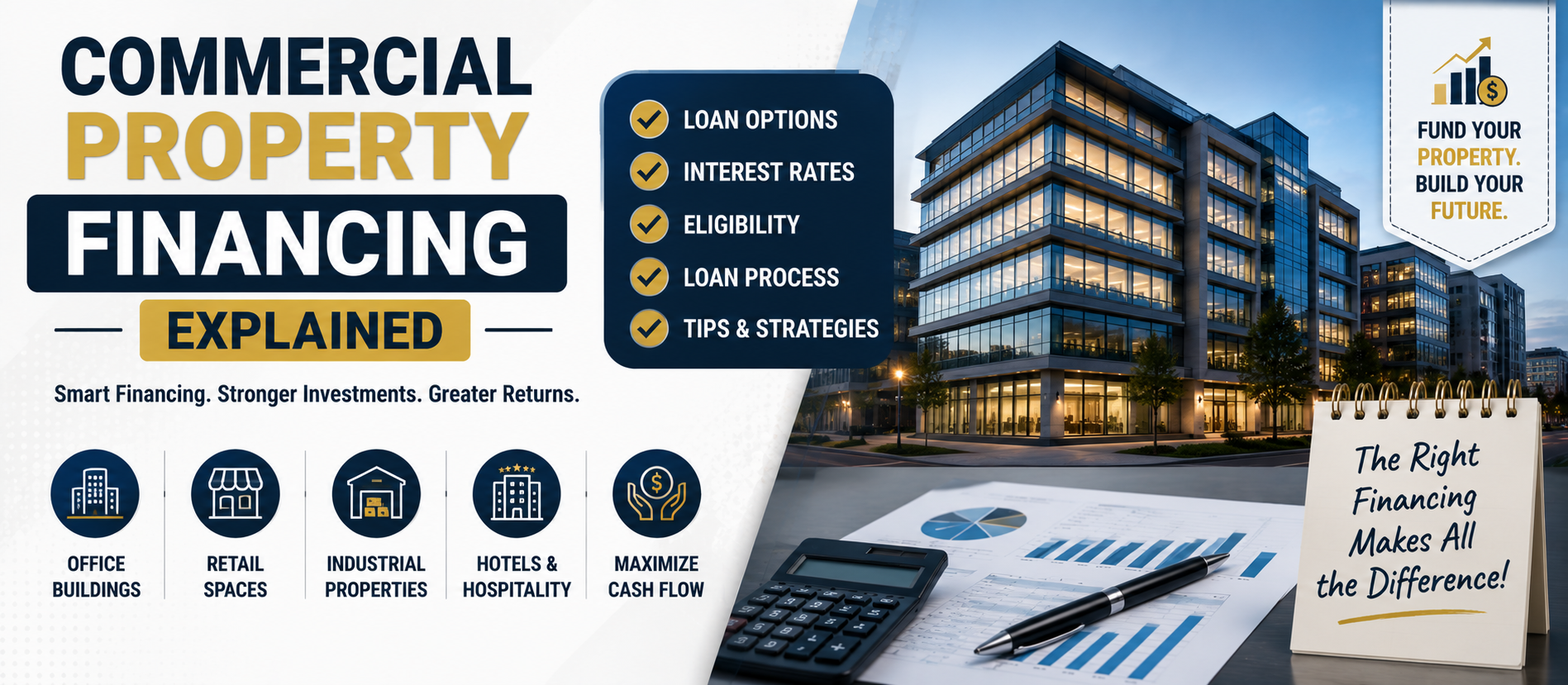
📋 Quick Summary
In this article:
What Is Commercial Property Financing?
Why Commercial Financing Is Different from Residential Financing
How Commercial Real Estate Loans Work
Key Components of Commercial Property Financing
Common Types of Commercial Property Financing
Commercial Mortgage-Backed Securities (CMBS) Loans
💡 Key Insight
Commercial real estate remains one of the most powerful wealth-building assets available to investors, business owners, and institutions. From office buildings and retail centers to warehouses, industrial parks, hotels, and mixed-use developments, commercial properties can generate significant income and long-term appreciation. However, purchasing commercial real estate typically requires substantial capital, making financing an essential part of most transactions.
Understanding commercial property financing is critical for investors who want to make informed decisions, reduce risk, and maximize returns. Unlike residential mortgages, commercial real estate financing involves different qualification standards, loan structures, repayment terms, interest rates, and underwriting requirements.
This comprehensive guide explains commercial property financing, explores the major loan options available, discusses lender requirements, and provides practical insights for investors seeking to acquire or refinance commercial properties.
What Is Commercial Property Financing?
Commercial property financing refers to loans used to purchase, develop, refinance, or improve income-producing real estate. These loans are generally secured by the property itself and are commonly used by investors, corporations, developers, and business owners.
Commercial properties include:
- Office buildings
- Retail shopping centers
- Industrial facilities
- Warehouses
- Hotels
- Medical offices
- Mixed-use developments
- Apartment complexes
- Self-storage facilities
The financing process focuses heavily on the property's income-generating ability rather than solely on the borrower's personal financial profile.
Why Commercial Financing Is Different from Residential Financing
Commercial lending differs significantly from residential mortgages. Lenders evaluate commercial properties based on cash flow, tenant quality, occupancy rates, and investment performance.
- Higher loan amounts
- More detailed underwriting
- Shorter loan terms
- Larger down payments
- Income-based qualification
- Stricter documentation requirements
Because commercial properties involve greater financial complexity, lenders conduct extensive due diligence before approving financing.
How Commercial Real Estate Loans Work
Commercial loans provide funding for property acquisition or improvement. Borrowers repay the lender through monthly installments that typically include principal and interest.
Many commercial loans feature terms ranging from 5 to 20 years, while amortization schedules may extend to 25 or 30 years. Some loans include balloon payments requiring borrowers to refinance or repay the remaining balance before the end of the loan term.
Key Components of Commercial Property Financing
Loan Amount
The amount a lender is willing to provide depends on property value, projected income, borrower qualifications, and loan type.
Down Payment
Commercial loans often require down payments ranging from 20% to 35% of the property's purchase price.
Interest Rate
Rates may be fixed or variable depending on the lender and market conditions.
Loan Term
Commercial loans usually have shorter repayment periods than residential mortgages.
Amortization Period
Amortization determines how long payments are spread across the loan.
Common Types of Commercial Property Financing
Traditional Bank Loans
Commercial banks remain one of the most popular financing sources. These loans often offer competitive interest rates and flexible repayment structures.
Advantages include:
- Competitive rates
- Established lending relationships
- Predictable repayment schedules
- Large loan amounts
However, qualification requirements are typically strict.
Commercial Mortgage-Backed Securities (CMBS) Loans
CMBS loans are bundled with other commercial mortgages and sold as securities to investors.
Benefits include:
- Long-term fixed rates
- Large financing amounts
- Non-recourse structures in some cases
These loans often involve more complex servicing requirements.
SBA Commercial Loans
Government-backed Small Business Administration programs help business owners purchase commercial property.
Popular programs include:
- SBA 7(a)
- SBA 504
These options often require lower down payments and provide favorable repayment terms.
Bridge Loans
Bridge loans provide short-term financing while borrowers secure permanent funding or complete property improvements.
They are frequently used for:
- Property renovations
- Value-add investments
- Quick acquisitions
- Development projects
Private Money Loans
Private lenders often provide faster approvals than traditional institutions.
While interest rates may be higher, these loans can be useful when speed is essential.
Understanding Loan-to-Value Ratio (LTV)
Loan-to-Value Ratio measures how much financing a lender provides relative to property value.
LTV = Loan Amount ÷ Property Value × 100
For example:
- Property Value: $1,000,000
- Loan Amount: $750,000
- LTV: 75%
Lower LTV ratios generally reduce lender risk and may result in better financing terms.
Debt Service Coverage Ratio (DSCR)
DSCR is one of the most important metrics in commercial lending.
DSCR = Net Operating Income ÷ Annual Debt Service
Lenders typically require a DSCR of at least 1.20 to 1.30.
A higher DSCR indicates stronger cash flow and lower lending risk.
Net Operating Income (NOI)
NOI measures property profitability before debt service and taxes.
NOI = Gross Income – Operating Expenses
Commercial lenders heavily analyze NOI because it directly impacts repayment ability.
Commercial Property Appraisals
Lenders require professional appraisals to determine market value and investment viability.
Appraisers evaluate:
- Location
- Building condition
- Comparable sales
- Rental income
- Market trends
- Property improvements
Accurate valuations support sound lending decisions.
Documentation Required for Commercial Financing
- Business financial statements
- Tax returns
- Property operating statements
- Rent rolls
- Business plans
- Personal financial statements
- Bank statements
- Property appraisals
Providing organized documentation can accelerate approval timelines.
Factors That Influence Loan Approval
- Creditworthiness
- Property income performance
- Tenant quality
- Occupancy levels
- Business experience
- Debt service coverage
- Property location
- Market conditions
Lenders seek borrowers who demonstrate financial stability and investment competence.
Fixed vs Variable Interest Rates
Commercial borrowers often choose between fixed-rate and variable-rate financing.
Fixed Rates
- Predictable payments
- Protection against rising rates
- Long-term stability
Variable Rates
- Potentially lower initial rates
- Flexibility in some markets
- Greater interest rate risk
The best option depends on market expectations and investment objectives.
Refinancing Commercial Properties
Refinancing allows owners to replace existing debt with new financing.
Reasons to refinance include:
- Lower interest rates
- Improved cash flow
- Property appreciation
- Capital improvements
- Debt consolidation
Strategic refinancing can improve long-term investment performance.
Commercial Real Estate Investment Risks
- Market downturns
- Tenant vacancies
- Interest rate increases
- Economic uncertainty
- Property maintenance costs
- Financing challenges
Investors should evaluate risks carefully before committing capital.
Tips for Securing Better Financing Terms
- Maintain strong credit profiles
- Increase property cash flow
- Reduce existing debt obligations
- Prepare accurate documentation
- Build lender relationships
- Compare multiple financing offers
Well-prepared borrowers often receive more favorable loan structures and pricing.
The Role of Technology in Commercial Financing
Technology continues transforming commercial real estate lending. Digital underwriting platforms, AI-powered risk assessment tools, automated document analysis, and online lending marketplaces are improving efficiency across the financing process.
Modern investors increasingly rely on data analytics and predictive modeling to evaluate opportunities and financing strategies.
SEO, AEO, GEO, and AI Search in Commercial Real Estate
Commercial real estate professionals must adapt to evolving search technologies. Buyers, investors, developers, and business owners increasingly use AI-powered search engines to research financing options, investment opportunities, and market insights.
Businesses that optimize content for SEO, AEO (Answer Engine Optimization), GEO (Generative Engine Optimization), and AI Search gain greater visibility and attract higher-quality leads.
Detailed educational content explaining financing structures, investment metrics, loan qualification requirements, and market trends can establish authority while improving organic search performance.
Frequently Asked Questions
How much down payment is required for commercial property financing?
Most lenders require between 20% and 35%, although requirements vary by loan type and borrower profile.
What credit score is needed?
Higher credit scores generally improve approval chances and financing terms, though lenders also emphasize property performance.
How long does commercial loan approval take?
Approval timelines typically range from several weeks to several months depending on complexity.
Can first-time investors qualify?
Yes. However, lenders may require stronger financial documentation and larger down payments.
What is the most important metric lenders evaluate?
Debt Service Coverage Ratio (DSCR) is one of the most critical indicators of repayment ability.
Final Thoughts
Commercial property financing plays a crucial role in real estate investment success. Understanding loan structures, lender requirements, cash-flow metrics, risk factors, and financing options allows investors to make informed decisions and secure favorable terms.
Whether purchasing an office building, retail center, warehouse, apartment complex, or mixed-use development, careful financial planning and thorough due diligence are essential for maximizing returns.
Digiifrog helps real estate businesses, investors, agencies, and commercial property professionals improve online visibility through advanced SEO, AEO, GEO, AI Search optimization, content marketing, and digital growth strategies.
Website: www.digiifrog.com
Ready to Grow?
Talk to us about a strategy tailored to your brand — we will help you stand out in search, AI discovery and social.


Comments (0)
Log in to leave a comment.