📋 Quick Summary
In this article:
Why Facebook Advertising Mistakes Can Become Expensive
1. Choosing the Wrong Campaign Objective
2. Optimizing for Clicks Instead of Business Results
3. Poor or Incomplete Conversion Tracking
4. Creating Too Many Ad Sets
5. Making Too Many Changes During Learning
6. Using Weak or Repetitive Ad Creative
7. Ignoring Mobile-First Creative
8. Writing Generic Ad Copy
💡 Key Insight
Facebook Advertising remains an important paid marketing channel for businesses of many sizes. With Meta's advertising ecosystem spanning Facebook, Instagram, Messenger, WhatsApp, Reels, and other placements, businesses can reach people at different stages of the customer journey. But access to a large audience does not automatically produce profitable campaigns.
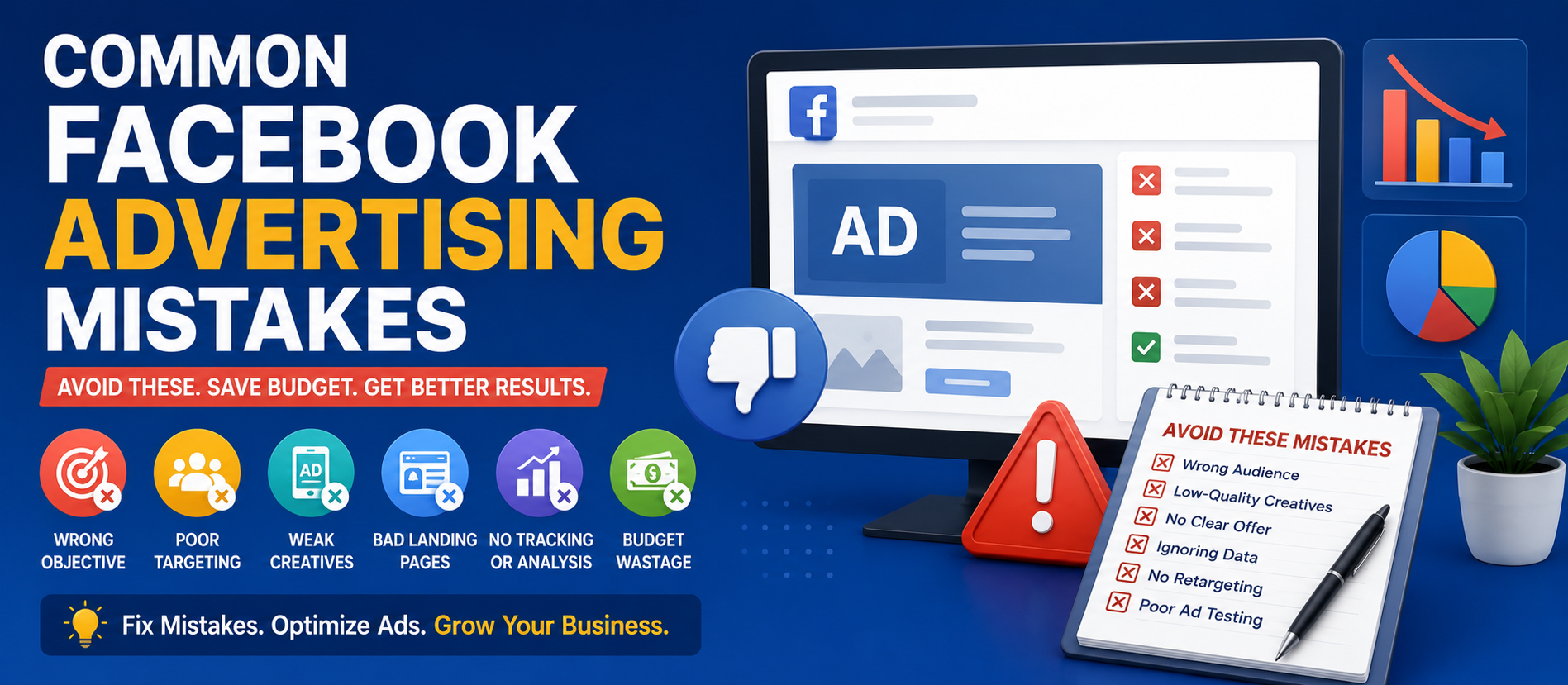
Many advertisers struggle because they focus on clicks, create too many ad sets, use weak creative, choose the wrong campaign objective, send traffic to poor landing pages, or make changes before the system has enough data to learn. Meta's current performance guidance emphasizes simplified account structures, creative diversification, high-quality data, automation, and testing. citeturn1search3turn1search13
⚠ Watch Out
This guide explains the most common Facebook Advertising mistakes, why they happen, how to avoid them, and how businesses can build a more reliable Meta Ads strategy. It also covers conversion tracking, audience targeting, creative testing, landing pages, budget management, retargeting, analytics, SEO, AEO, GEO, and AI Search Optimization.
Company: Designfo
Website: www.designfo.in
Contact: +91 9831037463
Why Facebook Advertising Mistakes Can Become Expensive
Paid advertising is different from organic marketing because every strategic mistake can consume budget. A weak offer, inaccurate conversion signal, poor creative, or badly structured campaign can reduce efficiency before you understand what went wrong.
The solution is not to avoid experimentation. Successful advertising requires testing. The key is to make controlled decisions based on business goals and reliable data.
Meta's advertising system is designed around campaign objectives. Advertisers tell the system what they want to accomplish, and the auction looks for people across Meta platforms who are more likely to take the action associated with that objective. citeturn1search1
1. Choosing the Wrong Campaign Objective
One of the most common Facebook Ads mistakes is selecting an objective that does not match the desired business result.
For example, a company that needs sales may choose a traffic-focused approach simply because clicks are cheaper. But inexpensive clicks do not necessarily produce customers. Meta recommends choosing the objective that most closely matches the larger business goal. citeturn1search1
How to Avoid This Mistake
- Define the business outcome before creating the campaign.
- Choose an objective aligned with that outcome.
- Track the actual customer action.
- Evaluate cost per meaningful result rather than cheap clicks.
2. Optimizing for Clicks Instead of Business Results
A campaign can generate thousands of clicks and still lose money. Clicks are an activity metric, not necessarily a revenue metric.
If your goal is lead generation, evaluate qualified leads. If your goal is eCommerce, evaluate purchases and revenue. If your goal is bookings, measure completed bookings.
Meta's Traffic objective is specifically designed to send people to a destination, while businesses seeking leads, messages, or sales may need objectives more closely aligned with those outcomes. citeturn1search10
3. Poor or Incomplete Conversion Tracking
Conversion tracking tells your advertising system which actions matter. Without reliable data, optimization becomes much harder.
Common tracking problems include duplicate events, missing purchase values, incorrect lead events, broken pixels, and failure to connect meaningful offline outcomes.
Meta's Conversions API is designed to create a more direct connection between business data and Meta's optimization systems. It can connect website, app, offline, CRM, and messaging data where supported. citeturn1search6
Tracking Checklist
- Verify key conversion events.
- Check event parameters.
- Remove duplicate tracking where applicable.
- Track meaningful revenue or lead outcomes.
- Connect CRM or offline data when appropriate.
- Review reporting regularly.
4. Creating Too Many Ad Sets
Another common mistake is excessive campaign fragmentation. Advertisers sometimes create separate ad sets for every small audience variation, interest, age group, or placement.
This can spread the budget too thin and give each ad set fewer opportunities to generate useful learning data.
Meta recommends simplifying account structures and combining similar ad sets when appropriate. Its current guidance explains that consolidation can help reduce audience fragmentation and improve opportunities for the system to learn. citeturn1search3turn1search13
5. Making Too Many Changes During Learning
Advertising systems need time to gather signals. Constantly changing budgets, audiences, creatives, objectives, or optimization settings can make performance difficult to interpret.
This does not mean you should ignore a serious tracking or policy problem. It means normal optimization should be disciplined. Make meaningful changes, observe the results, and avoid changing five variables simultaneously.
6. Using Weak or Repetitive Ad Creative
Creative is one of the most visible components of an advertisement. If every ad uses the same image, headline, angle, and offer, the campaign has limited opportunities to discover what resonates with different people.
Meta currently recommends creative diversification, encouraging advertisers to develop a variety of creative so its AI systems can deliver relevant messages to people more effectively. citeturn1search3turn1search5
Creative Variations to Test
- Different hooks
- Different visual concepts
- Customer problem vs. product benefit
- Educational vs. promotional messaging
- Testimonials and social proof
- Short-form video
- Demonstration content
- Different calls to action
7. Ignoring Mobile-First Creative
A large amount of social media consumption happens on mobile devices. Ads should therefore be designed for small screens rather than simply shrinking desktop creative.
For vertical video placements such as Reels, Meta recommends creative designed specifically for the format, including 9:16 video, audio, and keeping important messages within the safe zone. citeturn1search0
Make your main message understandable quickly, use readable text, and avoid placing critical information where platform controls may cover it.
8. Writing Generic Ad Copy
Statements such as "We provide the best quality service" rarely communicate a compelling reason to act. Strong advertising copy identifies a problem, benefit, differentiator, or outcome.
A Simple Copy Framework
- Identify the customer's problem.
- Introduce the desired outcome.
- Explain your solution.
- Add a credibility element.
- Give the customer a clear next step.
Keep the message aligned with the landing page so the customer experiences a consistent journey from advertisement to conversion.
9. Sending Every Ad to the Homepage
A homepage is designed to serve many audiences. A paid advertisement often has a much narrower promise.
If an ad promotes a specific service, send users to a relevant service page. If it promotes a product, send users to the appropriate product page. If it offers a guide, send users directly to the guide or registration page.
A Strong Landing Page Should
- Match the ad's promise.
- Load quickly.
- Work well on mobile.
- Explain the offer clearly.
- Provide trust signals.
- Answer common objections.
- Make the next action obvious.
10. Targeting Too Narrowly
Advertisers sometimes assume that extremely detailed targeting always produces better results. But excessive restrictions can reduce the number of people available to the delivery system and make it harder to find additional qualified customers.
Meta's Advantage+ audience combines advertiser-provided audience information with AI-based expansion. Businesses can provide audience suggestions while retaining important controls such as location, minimum age, language, and exclusions where available. citeturn1search9
The right balance depends on the campaign, market, objective, and data quality. Test audience approaches rather than assuming one targeting method is universally superior.
11. Ignoring Audience Exclusions
While targeting new prospects, you may not want to spend acquisition budget repeatedly showing the same offer to existing customers. Similarly, you may want to exclude people who already converted from a prospecting campaign.
Use appropriate exclusions for customers, existing leads, employees, or other groups when they conflict with the campaign objective.
12. Forgetting Retargeting
Not every visitor converts on the first interaction. Facebook retargeting can help businesses reconnect with people who previously interacted with the website, content, products, or brand, where the relevant audience and privacy setup permit it.
Retargeting messages should be different from cold-audience messages. Someone who already visited a product page may need an objection-handling message, review, demonstration, reminder, or offer rather than another introduction to the company.
13. Focusing Only on CPM or CPC
CPM and CPC can be useful diagnostic metrics, but they should not be treated as the final measure of campaign success.
Consider:
- Cost per qualified lead
- Cost per purchase
- Conversion rate
- Revenue
- Return on ad spend
- Customer acquisition cost
- Customer lifetime value
A higher CPC can still be acceptable if it produces significantly more profitable customers.
14. Ignoring Creative Fatigue
When the same audience repeatedly sees the same creative, performance may decline. Monitor frequency, engagement, conversion rate, and creative-level results together.
Instead of changing everything at once, introduce new creative concepts while keeping the campaign structure stable enough to evaluate the impact.
15. Testing Too Many Variables at Once
If you change the audience, creative, landing page, budget, offer, and objective simultaneously, you may not know which change caused the result.
For structured testing, isolate the main variable whenever practical. Meta provides A/B testing tools and recommends testing to understand which approaches perform better. citeturn1search4turn1search7
16. Ignoring the Offer
Sometimes the problem is not the advertisement. The offer itself may be weak.
Before blaming targeting or creative, ask:
- Is the offer relevant?
- Is the value clear?
- Is the price competitive for the market?
- Does the offer reduce perceived risk?
- Is there a reason to act now?
- Does the landing page explain the value?
Better advertising cannot always fix an unattractive proposition.
17. Ignoring Policy and User Experience
Advertising must provide a clear and trustworthy experience. Misleading creative, deceptive interactions, confusing calls to action, or problematic landing destinations can create policy and performance issues.
Meta's published Audience Network guidance specifically warns against misleading images, accidental clicks, unclear ad experiences, and unsafe or deceptive products. citeturn0search0
Although placement-specific rules can vary, the broader principle is useful: advertisements should be clear, honest, functional, and respectful of the user experience.
18. Not Using First-Party and High-Quality Data
Advertising performance increasingly depends on data quality. Businesses should maintain accurate customer records, conversion events, and consent-aware measurement practices.
High-quality data helps advertising systems understand which users and actions matter. Meta specifically positions Conversions API as a way to create a direct connection between marketing data and its optimization and measurement systems. citeturn1search6
19. Ignoring the Full Customer Journey
A Facebook ad is only one part of the customer journey. A user may see an advertisement, visit the website, compare competitors, read reviews, return through another channel, and finally purchase.
Evaluate advertising alongside:
- Website experience
- Organic search
- Email marketing
- Retargeting
- CRM follow-up
- Sales activity
- Customer retention
This broader view prevents marketers from judging campaigns solely by last-click or platform-level metrics.
20. Using AI Without Human Strategy
Meta's advertising products increasingly use AI and automation for audience selection, placements, creative optimization, and campaign delivery. citeturn1search15
Automation can improve efficiency, but it does not replace the need for a strong offer, accurate data, quality creative, clear positioning, and human business judgment.
Use AI to increase testing capacity and operational efficiency while keeping humans responsible for strategy, brand voice, compliance, and customer experience.
Facebook Advertising Mistakes Checklist
- Wrong campaign objective
- Unreliable conversion tracking
- Too many fragmented ad sets
- Frequent unnecessary changes
- Weak creative
- Generic copy
- Poor landing pages
- Overly narrow targeting
- Missing audience exclusions
- No retargeting strategy
- Focusing only on CPC or CPM
- Creative fatigue
- Poor testing methodology
- Weak offer
- Ignoring policy and user experience
- Poor data quality
- Ignoring the full customer journey
- Using AI without strategy
How Designfo Helps Businesses Improve Facebook Advertising
Designfo helps businesses build integrated paid and organic digital marketing strategies. Our approach can combine Facebook Advertising, Meta Ads, creative strategy, conversion tracking, landing-page optimization, marketing automation, SEO, AEO, GEO, and AI Search Optimization.
Designfo Digital Growth Services
- Facebook and Meta Ads Management
- Paid Social Advertising
- Conversion Tracking
- Creative Strategy
- Landing Page Optimization
- Marketing Automation
- SEO and Technical SEO
- AEO and GEO Strategy
- AI Search Optimization
- Conversion Rate Optimization
Frequently Asked Questions
What is the biggest Facebook Advertising mistake?
There is no single universal mistake, but choosing an objective that does not match the real business goal is a common problem. Meta recommends selecting the objective most closely aligned with the desired outcome. citeturn1search1
Why are my Facebook Ads getting clicks but no sales?
Possible causes include the wrong campaign objective, poor traffic quality, weak offer, landing-page problems, inaccurate tracking, or a mismatch between the ad promise and the destination.
Should I create many Facebook ad sets?
Not necessarily. Excessive fragmentation can reduce learning opportunities. Meta currently recommends simplifying similar ad sets when appropriate. citeturn1search13
How important is creative in Facebook Advertising?
Creative is extremely important because it determines how the offer is communicated and gives the delivery system different messages to match with potential customers. Meta recommends creative diversification. citeturn1search3turn1search5
Should businesses use Meta Advantage+?
Advantage+ can be useful when its automation aligns with your campaign goals and constraints. Meta positions Advantage+ as a suite of AI-powered tools that can automate aspects of audience, placement, budget, and creative optimization. citeturn1search15
How can I reduce wasted Facebook ad spend?
Start with accurate tracking, the correct objective, strong creative, appropriate audience strategy, relevant landing pages, meaningful exclusions, and disciplined testing. Measure cost per business outcome rather than only clicks.
Conclusion
Common Facebook Advertising mistakes are rarely caused by one isolated setting. Poor results usually come from a combination of unclear goals, weak data, fragmented campaign structures, generic creative, weak offers, poor landing pages, and insufficient testing.
The modern Meta Ads environment is increasingly automated. That makes strategy more important, not less. Advertisers need to give the system accurate conversion signals, strong creative options, meaningful business objectives, and enough room to learn. Meta's current performance guidance emphasizes account simplification, automation, creative diversification, data quality, and results validation. citeturn1search3
For sustainable growth, connect Facebook Advertising with your wider digital ecosystem. Combine paid social with SEO, AEO, GEO, AI Search Optimization, content marketing, CRM, and marketing automation. The goal is not simply to generate more clicks—it is to create a measurable customer journey that turns attention into qualified leads, sales, and long-term business value.
Company: Designfo
Website: www.designfo.in
Contact: +91 9831037463
Ready to Grow?
Talk to us about a strategy tailored to your brand — we will help you stand out in search, AI discovery and social.

Comments (0)
Log in to leave a comment.