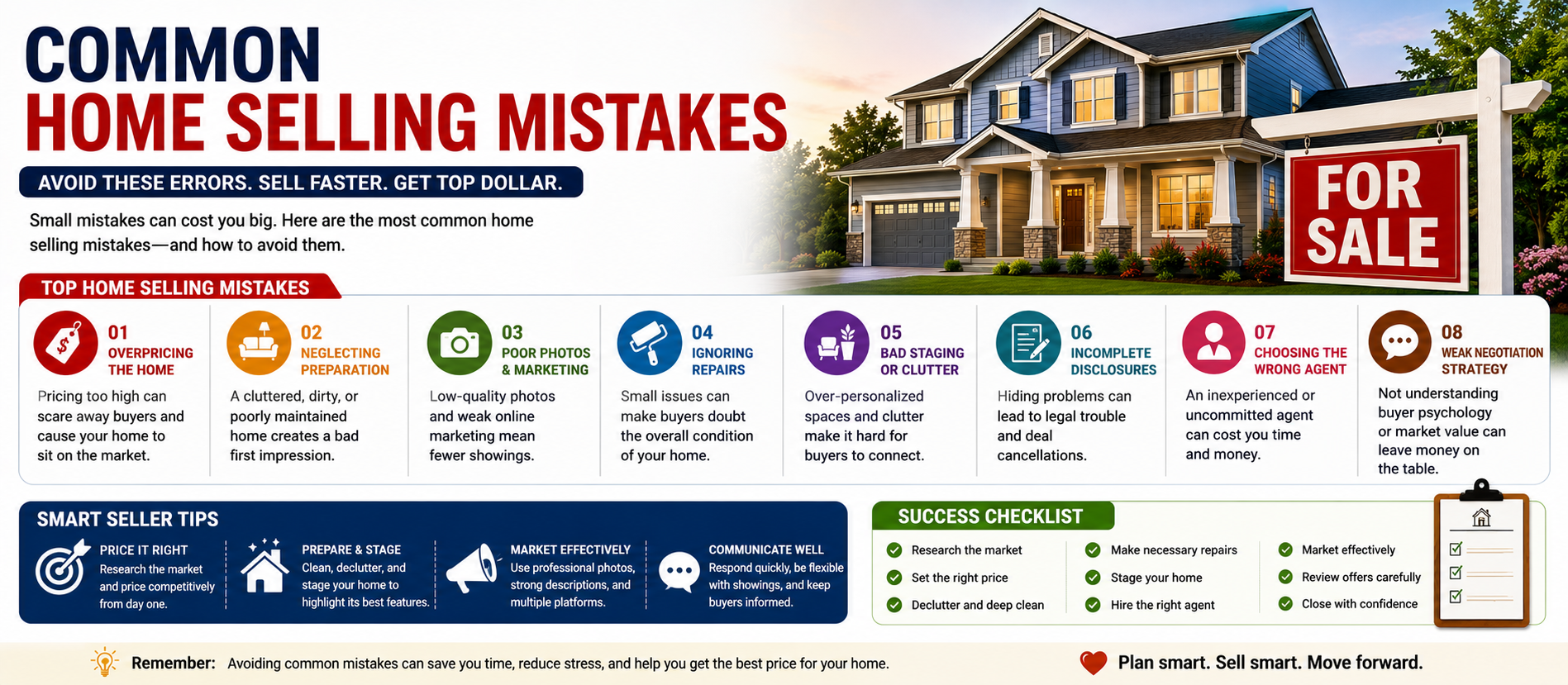
📋 Quick Summary
In this article:
Why Avoiding Home Selling Mistakes Matters
1. Overpricing the Home
2. Pricing Too Low Without a Strategy
3. Ignoring Comparable Sales
4. Waiting Too Long to Prepare the Home
5. Skipping Necessary Repairs
6. Spending Too Much on Renovations
7. Failing to Declutter
8. Keeping the Home Too Personalized
9. Ignoring Deep Cleaning
10. Neglecting Curb Appeal
11. Using Poor Listing Photos
Selling a home is a major financial decision, and small mistakes can affect the final sale price, time on the market, negotiation power, and overall selling experience. Many homeowners focus heavily on the listing price, but successful home selling involves much more: preparation, presentation, pricing, marketing, communication, negotiation, paperwork, and realistic expectations.
💡 Key Insight
Common home selling mistakes include overpricing the property, skipping essential repairs, failing to declutter, using poor-quality listing photos, ignoring curb appeal, being unavailable for showings, hiding material property problems, choosing an agent based only on commission, and failing to understand the complete cost of selling.
Current real estate guidance emphasizes that pricing should consider property characteristics and current market conditions, while preparation can include cleaning, decluttering, repairs, and improvements to curb appeal. The National Association of REALTORS® also reports that staging can help buyers visualize a property as their future home and may reduce time on the market. citeturn0search0turn0search25
This WordPress-ready HTML article is prepared for Digiifrog (www.digiifrog.com) with a strong focus on SEO, AEO, GEO, and AI Search optimization.
Why Avoiding Home Selling Mistakes Matters
A home sale combines emotional and financial decisions. Sellers naturally want the highest possible price, but an unrealistic strategy can produce the opposite result. A property that sits on the market for a long time may require price reductions, additional marketing, or a complete change in strategy.
The objective should be to create a strong combination of attractive presentation, competitive pricing, accurate information, effective marketing, and smooth transaction management.
1. Overpricing the Home
One of the most common mistakes is setting the asking price based on emotion rather than market evidence. Homeowners may think about how much they paid, how much they spent on renovations, or how much they need from the sale. Buyers, however, compare the property with competing homes and recent comparable sales.
Pricing should consider location, size, condition, features, recent comparable sales, competition, and current market conditions. NAR guidance specifically notes that current market conditions and comparable properties are important when determining a listing price. citeturn0search25
2. Pricing Too Low Without a Strategy
Underpricing can also be a mistake when it is done without understanding the market. A lower price may attract more attention, but sellers should understand the strategy and likely buyer response before listing.
Instead of choosing an arbitrary low number, discuss pricing strategy with a qualified local real estate professional and review recent comparable sales.
3. Ignoring Comparable Sales
Comparable sales, often called “comps,” are recently sold properties that are similar enough to help estimate market value. Looking only at active listings can be misleading because an asking price does not prove what buyers are actually willing to pay.
Consider recent sales, property condition, location, size, upgrades, lot characteristics, and differences between the properties.
4. Waiting Too Long to Prepare the Home
Preparation should begin before the listing goes live. Last-minute cleaning, repairs, photography, paperwork, and staging can create unnecessary pressure.
Walk through the property as if you were a buyer. Identify visible defects, clutter, odors, poor lighting, damaged surfaces, and exterior issues that could negatively affect the first impression.
5. Skipping Necessary Repairs
Sellers do not necessarily need to renovate everything. However, obvious maintenance problems can make buyers question the condition of the entire property.
Fixing leaking faucets, damaged doors, broken fixtures, peeling paint, loose hardware, damaged flooring, or other relatively manageable issues may improve presentation. For larger defects, get professional advice before deciding whether to repair, disclose, price accordingly, or sell as-is.
6. Spending Too Much on Renovations
The opposite mistake is renovating far beyond what the local market supports. A seller may spend heavily on a kitchen or bathroom expecting to recover every dollar, but renovation costs do not automatically translate into equal increases in sale price.
Prioritize improvements that address obvious problems, improve presentation, or help the property compete with comparable homes.
7. Failing to Declutter
Clutter can make rooms appear smaller and prevent buyers from imagining how they would use the space. NAR's current seller guidance recommends decluttering and creating a clean presentation before showings. citeturn0search0turn0search3
Remove unnecessary furniture, excess decorations, piles of paperwork, unused appliances, and personal items. Consider temporary storage if necessary.
8. Keeping the Home Too Personalized
Family photographs, highly specific décor, unusual color schemes, and excessive personal belongings can make it harder for some buyers to imagine themselves living in the property.
The goal is not to remove all personality. It is to create a welcoming, relatively neutral environment that allows buyers to focus on the home's space and features.
9. Ignoring Deep Cleaning
A clean home communicates care. Pay particular attention to kitchens, bathrooms, windows, floors, appliances, entryways, and high-touch surfaces.
Professional cleaning may be worthwhile before photography and showings, especially if the property has accumulated years of dirt, dust, stains, or odors.
10. Neglecting Curb Appeal
The exterior is often the first physical impression buyers receive. Overgrown landscaping, dirty walkways, damaged doors, poor lighting, or neglected exterior surfaces can reduce perceived value before a buyer enters the home.
NAR seller guidance identifies curb appeal as an important preparation area, including landscaping, the front entrance, and exterior presentation. citeturn0search24
11. Using Poor Listing Photos
Many buyers begin their home search online. Poor lighting, cluttered rooms, tilted images, dark spaces, and low-resolution photographs can reduce interest before buyers ever schedule a showing.
Use bright, accurate, high-quality images that represent the property honestly. Important rooms should be photographed from useful angles that communicate layout and scale.
12. Using Misleading Photos or AI Edits
Modern AI tools can improve lighting, remove temporary clutter, and support virtual staging. However, sellers should not use technology to create a misleading representation of the property.
⚠ Watch Out
NAR's 2026 guidance notes that AI-powered marketing tools can enhance listing presentation but cautions professionals against misleading edits. citeturn0search6
13. Skipping Staging Completely
Staging is not mandatory, and not every property requires professional staging. However, presentation can make it easier for buyers to visualize living in the home.
NAR's 2025 staging report found that 83% of buyers' agents said staging made it easier for buyers to visualize the property as their future home. The report also found that many seller agents observed faster sales or higher offers for staged properties. citeturn0search0turn0search2
14. Over-Staging the Property
Too much furniture, decoration, or artificial styling can make a property feel crowded. The goal is to emphasize space, flow, light, and useful features.
Keep rooms functional and comfortable. Remove oversized furniture and unnecessary decorations that make spaces difficult to navigate.
15. Ignoring Odors
Strong odors can immediately affect buyer perception. Common sources include cooking, pets, smoke, dampness, trash, drains, and moisture.
Do not simply cover odors with heavy fragrances. Identify and address the source whenever possible.
16. Hiding Property Problems
Attempting to hide a material defect can create serious problems. Disclosure requirements vary by jurisdiction, but sellers should understand what they are legally required to disclose.
NAR's seller disclosure guidance explains that state and local requirements differ and that material property defects may need to be disclosed. It also notes that knowingly withholding required information can create legal consequences. citeturn0search5
When in doubt, consult the appropriate real estate professional and, where necessary, a qualified attorney familiar with local law.
17. Assuming “As-Is” Means No Disclosure
Selling a property as-is does not automatically mean that every disclosure obligation disappears. The meaning and legal effect of “as-is” can vary by jurisdiction and contract.
Understand local requirements before using as-is language in your marketing or contract.
18. Choosing an Agent Based Only on Commission
A low commission can be attractive, but it should not be the only selection criterion. Evaluate an agent's local market knowledge, pricing strategy, communication, marketing plan, negotiation experience, and transaction management.
Ask exactly what services are included and what marketing costs, photography, staging support, advertising, and other services may cost separately.
19. Hiring the Agent Who Promises the Highest Price
An agent who gives the highest suggested listing price may sound attractive, but a high estimate without strong market evidence can create unrealistic expectations.
Ask each candidate to explain the comparable sales and pricing strategy behind the recommendation.
20. Failing to Understand Selling Costs
The sale price is not the same as the amount you receive. Sellers may have costs related to agent compensation, repairs, concessions, taxes, legal services, title or settlement services, mortgage payoff, moving, and other transaction expenses depending on location and contract terms.
Prepare a realistic seller net estimate before making major financial decisions.
21. Forgetting the Existing Mortgage
If the property has an outstanding mortgage, the remaining balance and payoff amount affect the seller's net proceeds.
Request an up-to-date payoff estimate and account for any applicable fees or adjustments. Do not assume that the mortgage balance shown on an old statement is the exact amount needed at closing.
22. Ignoring Taxes and Local Transaction Rules
Tax implications can vary significantly by country, state, province, city, ownership structure, and individual circumstances. Sellers should understand potential capital gains, transfer taxes, withholding requirements, and other applicable costs.
When the financial consequences are significant, consult a qualified tax professional.
23. Making Showings Difficult
If buyers cannot easily schedule a showing, they may move on to another property. Sellers should work with their agent to create reasonable showing availability.
Some flexibility can increase the number of serious buyers who see the home.
24. Staying Home During Every Showing
Sellers naturally want to hear what buyers think, but remaining present can make buyers uncomfortable and limit their ability to discuss the property openly.
When practical, leave the home during showings and allow the agent to manage the buyer interaction.
25. Refusing to Accommodate Buyer Feedback
Not every buyer comment is useful, but repeated feedback can reveal patterns. If several buyers independently mention clutter, price, odors, dated finishes, or poor presentation, consider whether the feedback points to a real issue.
Use feedback as information rather than taking every comment personally.
26. Ignoring the First Weeks on the Market
The early marketing period is important because initial interest can influence how quickly offers appear. If a property receives little activity, do not simply wait indefinitely.
Review pricing, photos, listing description, showing availability, condition, and marketing reach with your agent.
27. Refusing to Adjust an Unrealistic Price
If the property is receiving views but no serious offers, or if comparable properties are selling while yours remains inactive, the original strategy may need adjustment.
NAR's current pricing guidance notes that market conditions can influence the recommended asking price, including situations where higher interest rates reduce buyer demand. citeturn0search25
28. Writing a Weak Listing Description
A listing description should communicate the home's most useful and relevant features. Include accurate information about layout, improvements, location advantages, outdoor areas, storage, parking, appliances, and other meaningful features.
Avoid excessive hype and unsupported claims such as “best home in the city.” Clear, specific information is more useful to buyers and search systems.
29. Forgetting Local SEO and Online Visibility
Homebuyers increasingly discover properties online. Sellers should work with their agent to ensure that the listing has accurate location information, searchable property details, strong photographs, and a complete online presentation.
For real estate businesses, SEO, AEO, GEO, and AI Search optimization can help educational content and property information become more discoverable.
30. Overlooking the Importance of the First Listing Image
The first image often determines whether a potential buyer stops scrolling to learn more. Choose an accurate image that highlights the property's strongest feature while representing the home honestly.
NAR's 2026 guidance on relisting homes notes that refreshing photography, staging, and marketing can help reset buyer interest when a property has previously failed to sell. citeturn0search9
31. Being Unprepared for Negotiation
Before offers arrive, decide which terms matter most. Price is important, but closing date, contingencies, financing strength, repairs, included items, and concessions can also affect the value of an offer.
Evaluate the complete offer rather than automatically accepting the highest headline price.
32. Rejecting Reasonable Offers Emotionally
Sellers may feel disappointed when an initial offer is below the asking price. However, an offer is an opportunity to negotiate.
Analyze the buyer's financing, contingencies, requested credits, closing timeline, and probability of completing the transaction.
33. Accepting an Offer Without Reviewing the Details
A high offer with weak financing or extensive contingencies may create more risk than a slightly lower but stronger offer.
Review the complete contract with your real estate professional and legal adviser where appropriate.
34. Ignoring Inspection Issues
Buyer inspections can reveal problems that may lead to repair requests or renegotiation. Sellers can reduce surprises by addressing obvious problems before listing and, where appropriate, considering a presale inspection.
NAR guidance identifies presale inspection as one possible way for sellers to identify issues before listing and prepare for buyer negotiations. citeturn0search11
35. Delaying Required Paperwork
Gather documents early, including warranties, permits, invoices for major improvements, appliance manuals, service records, property information, and disclosure forms required in your area.
NAR's preparation guide recommends locating warranties, guarantees, and user manuals for appliances and systems that will remain with the property before closing. citeturn0search24
36. Making Last-Minute Changes Without Advice
Once the property is under contract, avoid major changes, new debt, or other decisions that could complicate the transaction without consulting the appropriate professionals.
Keep communication clear between the seller, agent, buyer, lender, title or settlement professionals, and attorneys where applicable.
37. Forgetting to Plan the Move
Selling a home requires more than finding a buyer. Plan moving dates, storage, utilities, insurance, school arrangements, temporary accommodation if needed, and the purchase or rental of your next property.
A rushed move can create unnecessary costs and stress.
38. Leaving the Home in Poor Condition at Closing
The property should generally be delivered according to the contract. Remove agreed personal belongings, complete negotiated repairs, clean the property as required, and leave included appliances and fixtures as specified.
Do not assume that small changes are acceptable after the buyer has agreed to the transaction.
39. Not Reviewing the Final Closing Numbers
Sellers should understand the final financial statement and expected proceeds before closing. Review the sale price, mortgage payoff, commissions or compensation, taxes, credits, repairs, fees, and other adjustments.
Settlement documents are designed to show the financial components of the transaction. In the United States, closing documentation can include detailed disclosures of amounts due to and from parties. citeturn0search4turn0search8
40. Treating Home Selling as a One-Size-Fits-All Process
Every property and market is different. A downtown condominium, suburban family home, luxury property, rural house, investment property, and newly renovated home may require different pricing and marketing strategies.
The strongest strategy considers the specific property, likely buyer pool, competition, market conditions, seller goals, and transaction requirements.
Home Selling Checklist
- Research local market conditions.
- Review comparable sales.
- Set a realistic asking price.
- Complete important repairs.
- Declutter and depersonalize.
- Deep clean the property.
- Improve curb appeal.
- Use high-quality photography.
- Consider appropriate staging.
- Prepare accurate disclosures.
- Gather warranties and property documents.
- Make showings convenient.
- Review every offer carefully.
- Prepare for inspection negotiations.
- Understand selling costs and expected net proceeds.
- Review final closing documents.
Frequently Asked Questions About Common Home Selling Mistakes
What is the biggest mistake when selling a home?
Overpricing is one of the most common mistakes because it can reduce buyer interest and lead to longer market time or later price reductions. Pricing should be based on comparable sales, property condition, competition, and current market conditions.
Should I renovate before selling?
Not necessarily. Focus first on important repairs, cleanliness, decluttering, curb appeal, and presentation. Major renovations should be evaluated based on local buyer expectations and likely return.
Does staging really help sell a home?
Staging can help buyers visualize the property as their future home. NAR's 2025 staging report found strong support among buyer agents for staging and reported that many seller agents observed faster sales or higher offers for staged homes. citeturn0search0turn0search2
Should sellers disclose defects?
Disclosure requirements depend on state and local law. Sellers should understand what material conditions must be disclosed and provide accurate information. When uncertain, consult a qualified real estate professional or attorney.
Should I accept the highest offer?
Not automatically. Compare the complete offer, including financing, contingencies, closing date, requested credits, and likelihood of successfully closing.
How important are listing photos?
Very important. Buyers often discover properties online, so accurate, bright, professional-looking photographs can make a major difference in attracting attention.
What should I do if my home is not getting offers?
Review pricing, condition, photography, listing description, showing availability, and marketing reach. If several buyers are showing interest but no offers are appearing, ask your agent to analyze the feedback and comparable properties.
Can AI improve real estate listing photos?
AI can assist with presentation, virtual staging, lighting, and temporary clutter removal, but edits should not materially misrepresent the actual property. NAR's 2026 guidance specifically cautions against misleading AI-enhanced listing images. citeturn0search6
Conclusion
A successful home sale depends on preparation, realistic pricing, accurate information, strong presentation, effective marketing, and thoughtful negotiation. Avoiding common mistakes can help sellers reduce unnecessary delays, attract more qualified buyers, and make better decisions throughout the transaction.
Start by understanding the local market and setting a realistic price. Prepare the property through cleaning, decluttering, necessary repairs, and curb-appeal improvements. Use accurate, high-quality photography and consider staging where it makes sense. Make showings convenient, respond thoughtfully to offers, and keep all disclosures and documents accurate.
Most importantly, avoid making decisions based solely on emotion. A home is often both a personal space and a major financial asset. Treat the sale as a structured financial transaction while working with qualified local professionals who understand the applicable rules and market.
For businesses looking to improve their real estate digital presence, build AI-powered websites, automate lead generation, implement SEO, AEO, GEO, and AI Search optimization, Digiifrog can help. Visit www.digiifrog.com to learn more.
Quick Answer: What Are the Most Common Home Selling Mistakes?
The most common home selling mistakes include overpricing the property, skipping necessary repairs, failing to declutter and clean, using poor listing photos, neglecting curb appeal, making showings difficult, hiding required disclosures, choosing an agent only because of commission, ignoring buyer feedback, rejecting reasonable offers emotionally, and failing to understand selling costs. Sellers can reduce these risks by researching comparable sales, preparing the property, using accurate marketing, understanding local disclosure rules, and reviewing offers and closing documents carefully.
Research Notes
This article incorporates current seller guidance from the National Association of REALTORS® and U.S. consumer-finance resources. Real estate disclosure rules, taxes, contracts, transaction costs, agency relationships, and closing procedures vary by country, state, and local jurisdiction. Sellers should obtain location-specific legal, tax, and real estate advice where appropriate.
Ready to Grow?
Talk to us about a strategy tailored to your brand — we will help you stand out in search, AI discovery and social.

Comments (0)
Log in to leave a comment.