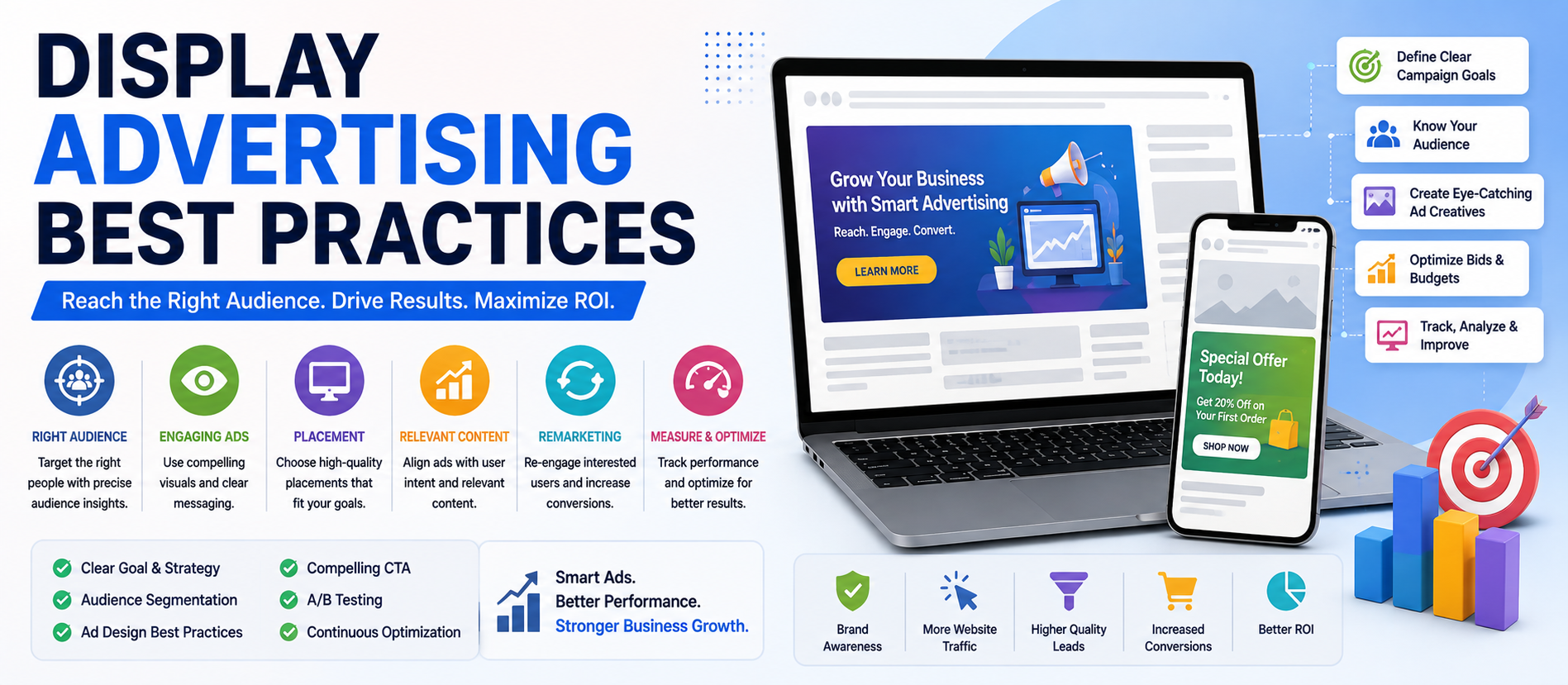
📋 Quick Summary
In this article:
1. Start With a Clear Campaign Goal
2. Set Up Accurate Conversion Tracking
3. Choose the Right Audience
4. Use High-Quality Creative Assets
5. Design Ads for Fast Understanding
6. Write Multiple Headlines and Descriptions
Display advertising helps businesses reach potential customers while they browse websites, use apps, watch videos, check email, and explore digital content. Unlike search advertising, where people actively type a query, display campaigns can introduce a brand, product, service, or offer while customers are still discovering their needs.
Successful display advertising is not simply about buying impressions. Strong campaigns combine a clear objective, accurate conversion tracking, relevant audiences, high-quality creative, compelling messaging, appropriate landing pages, disciplined testing, and meaningful measurement. Google currently recommends defining goals first, selecting suitable bidding and audience strategies, using responsive creative assets, and measuring the full value of Display campaigns. citeturn0search3turn0search4
This Display Advertising Best Practices guide explains how businesses can build campaigns that are more relevant, measurable, and conversion-focused while also supporting broader SEO, AEO, GEO, and AI Search Optimization strategies.
Company: Designfo
Website: www.designfo.in
Contact: +91 9831037463
What Is Display Advertising?
Display advertising uses visual or responsive ad formats to reach audiences across digital properties such as websites, apps, YouTube, Gmail, and other eligible inventory. Google describes Display campaigns as a way to connect businesses with audiences across millions of websites, apps, and video content. citeturn0search2turn0search6
Display ads can support several marketing goals:
- Brand awareness
- Product discovery
- Website traffic
- Lead generation
- Sales and conversions
- Remarketing and customer re-engagement
1. Start With a Clear Campaign Goal
The first display advertising best practice is to define what success means before creating the campaign. Your objective influences the audience, creative, budget, bidding approach, landing page, and metrics you should monitor.
Common Goals
- Awareness: Reach relevant audiences and build recognition.
- Traffic: Bring qualified visitors to a useful destination.
- Leads: Generate enquiries, registrations, or other valuable actions.
- Sales: Drive purchases or revenue.
- Remarketing: Re-engage previous visitors or customers.
⚠ Watch Out
Avoid optimizing for cheap clicks when the real business goal is qualified leads or revenue.
2. Set Up Accurate Conversion Tracking
💡 Key Insight
Conversion tracking is essential because advertising platforms need reliable signals to understand which outcomes matter. Google recommends setting up and regularly checking conversion tracking for Display campaigns. citeturn0search4
Depending on your business, useful conversions may include:
- Purchases
- Qualified lead submissions
- Phone calls
- Bookings
- Demo requests
- Account registrations
- Important downloads
Do not treat every page view or minor interaction as a primary conversion. The more closely your conversion data reflects real business value, the more useful your optimization becomes.
3. Choose the Right Audience
Display campaigns can reach people based on audience segments, contextual signals, your own customer data, demographics, geography, and other available targeting options. Google also offers optimized targeting, which uses AI to discover additional people who may be likely to convert. citeturn0search3turn0search10
Audience Strategy
- Define your ideal customer.
- Use relevant audience segments.
- Use your own data for appropriate remarketing.
- Consider contextual relevance.
- Use geographic targeting when location matters.
- Review exclusions to reduce wasted exposure.
Do not assume that the narrowest possible audience is always the best audience. Test controlled targeting strategies and evaluate business outcomes.
4. Use High-Quality Creative Assets
Creative is one of the most important elements of display advertising. A person may see your ad while focused on another activity, so the message must communicate value quickly.
For responsive display ads, Google recommends providing multiple assets so its systems can create combinations suited to different available placements. Its current guidance includes multiple image ratios, headlines, descriptions, logos, and video where available. citeturn0search0turn0search12
Useful Creative Assets
- Horizontal images
- Square images
- Vertical images where appropriate
- Multiple headlines
- Multiple descriptions
- High-quality logos
- Video assets
5. Design Ads for Fast Understanding
A strong display ad should communicate its core message quickly. Avoid crowded layouts, tiny text, unclear calls to action, and visual elements that distract from the product or service.
Google's responsive display guidance recommends making the product or service the focus of the image, using high-quality images, and avoiding excessive blank space, collages, and distracting composite backgrounds. citeturn0search0
Creative Principles
- One primary message per creative.
- Strong visual hierarchy.
- Readable typography.
- Clear value proposition.
- Visible brand identity.
- Relevant call to action.
- Mobile-friendly composition.
6. Write Multiple Headlines and Descriptions
Responsive display advertising can combine different assets automatically. Instead of creating several versions that say exactly the same thing, write distinct messages that communicate different benefits or customer motivations.
Test Messaging Angles
- Problem-focused message
- Benefit-focused message
- Product feature
- Customer outcome
- Trust or credibility
- Offer or promotion
- Urgency when genuine
Google's Ad Strength system evaluates the quality and diversity of responsive display assets, and its guidance recommends adding more unique creative assets to create more opportunities for optimization. citeturn0search9
7. Create Landing Pages That Match the Ad
Even an excellent advertisement can fail if the landing page does not deliver on its promise. The message, offer, audience, and next step should remain consistent from ad to page.
A Strong Landing Page Should
- Match the ad message.
- Load quickly.
- Work well on mobile.
- Explain the value clearly.
- Provide trust signals.
- Answer important objections.
- Make the desired action obvious.
For example, an ad promoting a specific service should normally lead to a relevant service page rather than a generic homepage.
8. Use Remarketing Strategically
Display remarketing can help reconnect with people who previously visited your website or interacted with your business. Google now commonly refers to remarketing audiences as your data or data segments in its audience terminology. citeturn0search11
Different audiences may need different messages. A first-time visitor may need education, while someone who viewed a product repeatedly may be ready for a comparison, review, reminder, or offer.
9. Control Frequency and Avoid Ad Fatigue
Repeated exposure can help build recognition, but excessive repetition can annoy users and reduce creative effectiveness. Monitor frequency and engagement, particularly for remarketing campaigns.
If performance declines, test new creative concepts, adjust audience strategy, or review frequency controls instead of immediately increasing budget.
10. Use Smart Bidding When the Data Supports It
Google supports automated bidding for Display campaigns, including conversion- and value-focused strategies. Smart Bidding can use auction-level signals to adjust bids toward campaign goals. citeturn0search3turn0search4 Use it when conversion tracking is reliable and the campaign has a clear objective.
11. Test One Major Variable at a Time
Testing is essential, but changing everything simultaneously makes results difficult to interpret.
- Define the hypothesis.
- Choose one primary variable.
- Keep other important conditions reasonably stable.
- Collect enough data to evaluate the change.
- Document the result.
- Apply the learning to the next test.
Test creative, landing pages, audiences, offers, and bidding approaches in a structured way rather than making random changes.
12. Measure Business Outcomes, Not Vanity Metrics
Impressions and clicks can show activity, but they do not necessarily show profitability.
Important Display Advertising Metrics
- Conversions
- Conversion rate
- Cost per conversion
- Conversion value
- Return on ad spend
- Qualified lead rate
- Revenue
- Customer acquisition cost
Google recommends considering the full value of Display, including relevant view-through and engaged-view conversions where appropriate, rather than evaluating performance only from direct clicks. citeturn0search4
13. Use Fresh Creative Regularly
Creative fatigue can reduce campaign performance over time. Develop a library of different visual concepts and messages rather than relying on one banner for months.
For seasonal promotions, update the offer and imagery. For evergreen campaigns, introduce new creative angles based on performance data and customer feedback.
14. Use Content Exclusions and Brand Safety Controls
Not every available placement is suitable for every brand. Review content exclusions, geographic settings, language settings, and other available controls when your business requires greater placement control. Google identifies these as ways advertisers can manage where and how Display ads appear. citeturn0search3
Brand safety should be considered alongside reach. The objective is not simply to maximize impressions, but to reach relevant audiences in environments appropriate for the brand.
18. Use AI Without Losing Human Strategy
Modern Google Ads campaigns increasingly use AI for targeting, bidding, and creative combinations. Responsive display ads allow Google AI to assemble uploaded assets into different combinations across eligible placements. citeturn0search7
Automation can improve efficiency, but humans still need to define the offer, brand positioning, audience priorities, creative direction, conversion goals, and business constraints.
19. Support SEO, AEO, GEO, and AI Search Optimization
Display advertising and organic search are different channels, but they can support the same digital visibility strategy. Advertising can generate awareness and reveal which messages resonate with audiences, while website content can capture informational and commercial search demand.
For SEO, create useful website content around customer needs. For AEO, answer important questions clearly. For GEO and AI Search Optimization, build original, trustworthy content and consistent brand information that clearly explains what the business does.
Google's current guidance for AI search emphasizes unique, valuable, people-first content and says established SEO fundamentals continue to apply to AI-powered search experiences. citeturn0search1turn0search13
Display Advertising Best Practices Checklist
- Define the business objective.
- Verify conversion tracking.
- Choose relevant audiences.
- Prepare diverse creative assets.
- Write clear messaging.
- Use relevant landing pages.
- Choose suitable bidding.
- Use remarketing where appropriate.
- Test systematically.
- Measure conversions and revenue.
How Designfo Helps Businesses With Display Advertising
Designfo helps businesses build integrated digital marketing strategies that connect Display Advertising with Google Ads, conversion tracking, landing-page optimization, SEO, AEO, GEO, AI Search Optimization, content marketing, and marketing automation.
Designfo Digital Growth Services
- Google Display Advertising
- Google Ads Management
- Remarketing Campaigns
- Creative Strategy
- Landing Page Optimization
- Conversion Tracking
- SEO and Technical SEO
- AEO, GEO and AI Search Optimization
- Marketing Automation
- Conversion Rate Optimization
Frequently Asked Questions
What is display advertising?
Display advertising uses visual and responsive ad formats to reach audiences across websites, apps, video content, Gmail, YouTube, and other eligible digital inventory.
What is the most important display advertising best practice?
Start with a clear business objective and accurate conversion tracking. Without knowing what outcome matters and measuring it correctly, creative, targeting, and bidding decisions become much harder to evaluate.
What makes a good display ad?
A good display ad has a clear message, relevant visual, strong value proposition, readable design, recognizable branding, and an appropriate call to action. Responsive campaigns also benefit from diverse, high-quality assets.
Should I use responsive display ads?
Responsive display ads can be useful because Google can combine your headlines, descriptions, images, logos, and other assets into formats that fit available placements. Google recommends providing multiple high-quality assets to give its systems more options. citeturn0search0turn0search7
How do I measure Display advertising success?
Measure conversions, qualified leads, revenue, conversion value, cost per acquisition, and return on ad spend. Impressions and clicks are useful diagnostic metrics but should not be the only business measures.
Is display advertising good for small businesses?
It can be effective when the campaign has a clear audience, suitable budget, compelling offer, accurate tracking, and a realistic objective. Small businesses can begin with focused campaigns and expand based on measurable results.
Conclusion
Display Advertising Best Practices are ultimately about relevance, clarity, measurement, and continuous improvement. The strongest campaigns do not simply maximize impressions. They connect the right message with the right audience, send users to a useful destination, measure meaningful outcomes, and use data to improve future decisions.
Start with a clear goal. Build reliable conversion tracking. Use high-quality and diverse creative assets. Test audience strategies without unnecessary fragmentation. Match landing pages to ad promises. Use automated bidding when your data supports it, and monitor the full customer journey rather than focusing only on clicks.
As Google's advertising ecosystem evolves, including the 2026 transition of Display campaigns toward Demand Gen, advertisers should stay aware of current campaign options and plan their account structure accordingly. Google announced a phased migration beginning in June 2026 for eligible existing Display campaigns. citeturn0search0turn0search8
Finally, connect paid advertising with SEO, AEO, GEO, AI Search Optimization, content marketing, CRM, and marketing automation. This creates a more complete digital growth system where paid campaigns generate attention, organic content builds authority, and conversion workflows turn interest into measurable business value.
Company: Designfo
Website: www.designfo.in
Contact: +91 9831037463
Ready to Grow?
Talk to us about a strategy tailored to your brand — we will help you stand out in search, AI discovery and social.
Comments (0)
Log in to leave a comment.