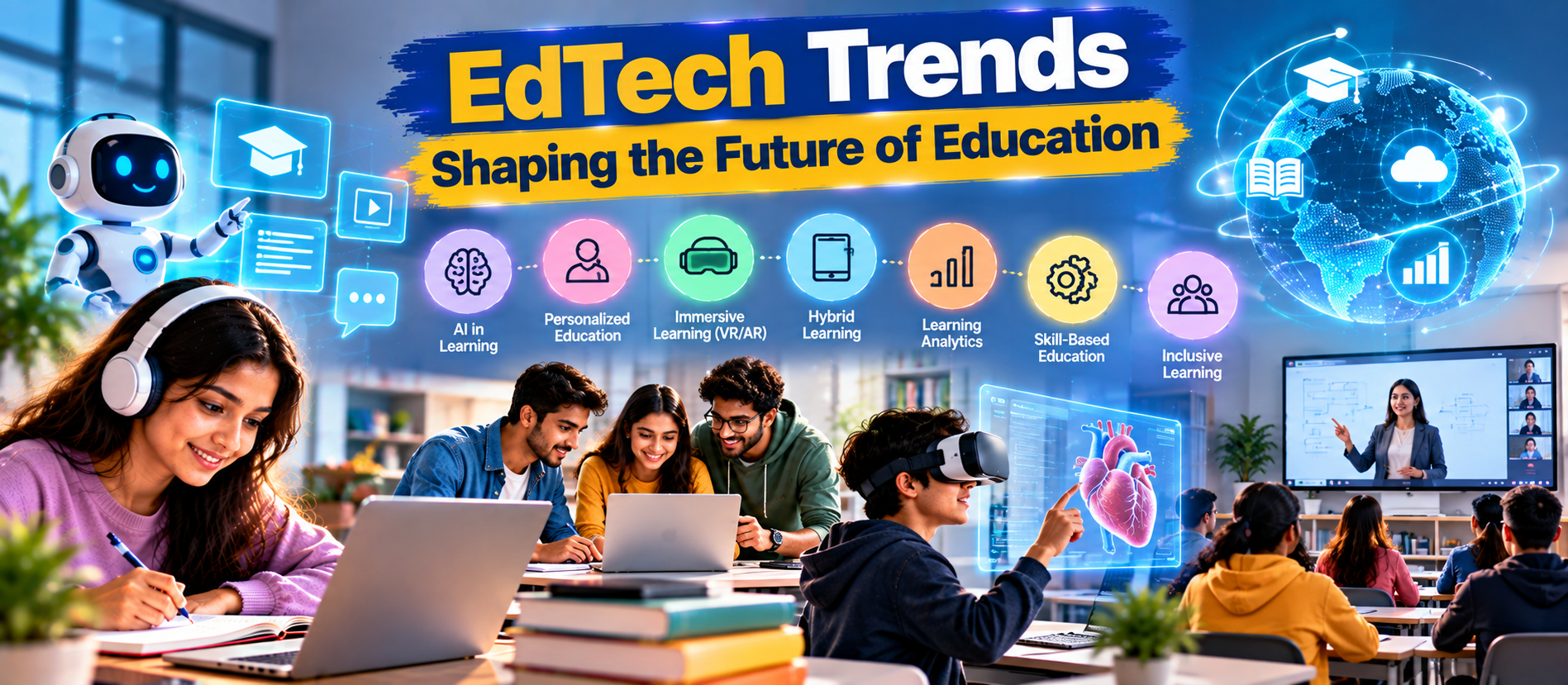
📋 Quick Summary
In this article:
Why EdTech Is Becoming More Important
1. Artificial Intelligence in Education
2. AI-Powered Personalized Learning
3. Adaptive Learning Platforms
4. Learning Analytics and Data-Driven Education
5. Generative AI and AI Study Assistants
6. Smart Classrooms and Connected Learning Spaces
7. Hybrid and Blended Learning
8. Immersive Learning With VR and AR
9. Gamification and Game-Based Learning
10. Microlearning
Education is changing quickly. Technology is changing how students learn, how teachers prepare lessons, how institutions manage information, and how learners access support.
But the future of education is not simply about putting more devices into classrooms. The real change is about using technology to solve meaningful learning problems. A good EdTech system should help students understand concepts, practice skills, receive useful feedback, collaborate with others, and become more independent learners.
Educational technology, or EdTech, now includes much more than learning management systems and online classes. Artificial intelligence, adaptive learning, learning analytics, immersive technologies, digital assessments, educational apps, collaborative platforms, accessibility tools, cybersecurity systems, and smart-campus technologies are becoming part of the broader education ecosystem.
The OECD's Digital Education Outlook 2026 says generative AI can support learning when it is guided by clear teaching principles, but simply outsourcing tasks to AI does not automatically create learning gains. UNESCO similarly emphasizes human agency, critical thinking, ethics, equity, and inclusive technology use as education systems adapt to AI.
This means the next phase of EdTech will not be defined only by the newest tool. It will be defined by how well technology supports learning, teaching, inclusion, safety, and human development.
This article explores the major EdTech trends shaping the future of education and explains what they mean for students, teachers, schools, colleges, universities, and education leaders.
What Is EdTech?
EdTech is short for educational technology. It refers to digital tools, platforms, systems, and technologies designed to support teaching, learning, assessment, administration, communication, or educational access.
Examples include:
- Learning management systems
- Online course platforms
- AI tutoring tools
- Adaptive learning systems
- Digital textbooks
- Online assessment platforms
- Learning analytics dashboards
- Virtual and augmented reality
- Educational mobile apps
- Digital collaboration tools
- Accessibility technologies
- School and university management systems
The purpose is not technology for its own sake. The purpose is better education.
Why EdTech Is Becoming More Important
Several forces are pushing education toward greater use of technology.
- Students expect flexible access to learning resources.
- Teachers need tools that reduce repetitive administrative work.
- Institutions need better data to identify learning gaps.
- AI is changing how students search for and interact with information.
- Employers increasingly expect digital and human skills together.
- Remote and hybrid learning have expanded expectations around flexibility.
- Accessibility technologies can help more learners participate.
The World Economic Forum reports that AI and big data, networks and cybersecurity, and technological literacy are among the fastest-growing skill areas, while creative thinking, resilience, flexibility, curiosity, and lifelong learning are also rising in importance.
Education therefore has to prepare learners for both a digital environment and a changing labor market.
1. Artificial Intelligence in Education
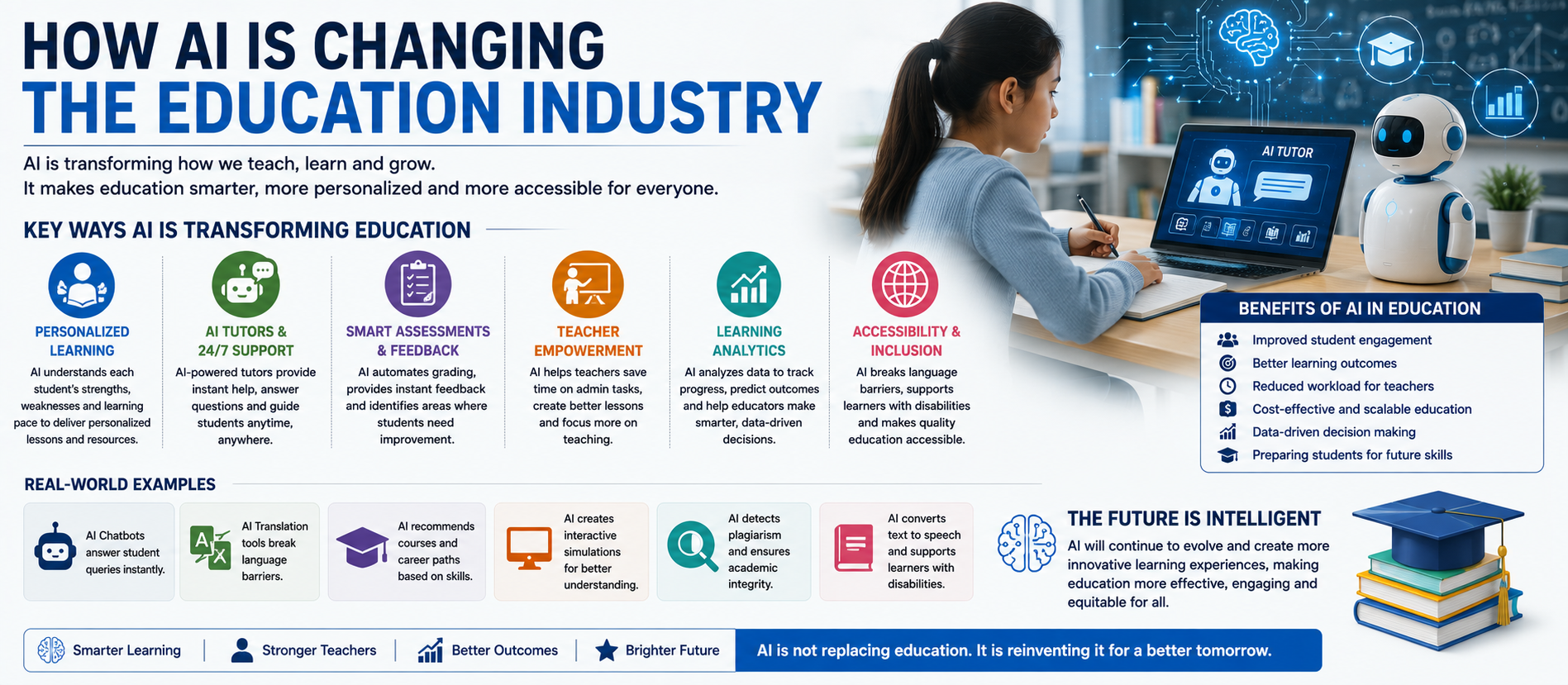
Artificial intelligence is one of the biggest EdTech trends. AI can support students, teachers, administrators, and education providers in many different ways.
Students can use AI systems to ask questions, receive explanations, generate practice questions, summarize provided material, brainstorm ideas, and get feedback. Teachers can use AI to draft lesson materials, create differentiated activities, organize information, and support planning.
However, responsible use matters. The OECD's 2026 Digital Education Outlook highlights a critical distinction: AI can improve task performance without necessarily improving learning. When students simply ask AI to complete work for them, the visible result may improve while the underlying learning does not.
The strongest use of AI is therefore as a tutor, learning partner, feedback assistant, or planning tool rather than a replacement for thinking.
2. AI-Powered Personalized Learning
Traditional classrooms often provide the same lesson to many students at the same time. AI and learning analytics can make it easier to personalize parts of the learning experience.
An intelligent platform may identify that a student is struggling with fractions, vocabulary, or a particular concept. It can then recommend additional practice or explain the concept differently.
UNESCO IITE's recent work on digital learning platforms highlights AI-powered tutoring, learning analytics, adaptive learning, student support systems, and personalized education as major areas of development.
Personalization should not mean putting every student into a separate digital bubble. Teachers still play an important role in understanding motivation, context, emotions, social development, and learning needs.
3. Adaptive Learning Platforms
Adaptive learning changes the learning path according to a learner's performance.
If a student answers several questions correctly, the system may increase difficulty. If the student struggles, it may provide additional examples or practice.
This can be useful in mathematics, language learning, science, exam preparation, and skills training.
The major benefit is efficient practice. A student does not necessarily have to spend equal time on every topic. More time can be directed toward areas that need attention.
But adaptive systems depend on good instructional design. A sophisticated algorithm cannot compensate for poor content or unclear learning objectives.
4. Learning Analytics and Data-Driven Education
Schools and universities generate large amounts of educational data. This may include assessment results, attendance, course activity, assignment submissions, and engagement patterns.
Learning analytics uses data to identify patterns that can support educational decisions.
For example, an institution may identify that students are consistently struggling with a particular module. A teacher may notice that many students stop engaging with an online lesson after a certain point. Advisors may use data to identify students who could benefit from additional support.
UNESCO IITE notes that learning analytics and AI-powered platforms can help institutions analyze student behavior, predict performance, provide tailored interventions, and support personalized education.
Data should support human decisions, not replace them. Predictions can be wrong, and students should not be reduced to a dashboard score.
5. Generative AI and AI Study Assistants
Generative AI has created a new category of learning tools. Instead of navigating only fixed menus, students can interact with systems using natural language.
A student might ask:
- “Explain this concept in simple language.”
- “Give me five practice questions.”
- “Test me without showing the answers immediately.”
- “Compare these two theories.”
- “Help me identify the gap in my reasoning.”
This creates a more conversational learning experience.
However, AI-generated explanations can contain errors. Students should verify important information and use their own reasoning. Schools also need clear policies for academic integrity, privacy, and responsible AI use.
6. Smart Classrooms and Connected Learning Spaces
A smart classroom combines physical teaching spaces with digital systems.
Examples include interactive displays, wireless presentation systems, classroom response tools, digital attendance, connected devices, and learning platforms that connect classroom and home learning.
The goal should be seamless learning rather than technology overload.
A smart classroom is valuable when technology makes an activity easier, more interactive, more accessible, or more informative. If a digital device adds complexity without improving learning, it may not be worth using.
7. Hybrid and Blended Learning
Blended learning combines face-to-face teaching with digital learning activities. Hybrid models may also give learners greater flexibility about where or how some learning takes place.
A strong blended model might use classroom time for discussion, experiments, collaboration, and problem-solving while students use digital resources for preparation, review, practice, or independent learning.
This can make classroom time more valuable because students arrive with basic background knowledge and can spend more time applying it.
8. Immersive Learning With VR and AR
Virtual reality and augmented reality can create learning experiences that are difficult to reproduce with textbooks alone.
Students may explore a virtual historical environment, examine a three-dimensional scientific model, practice procedures in a simulated environment, or visualize complex systems.
Virtual reality creates a simulated environment. Augmented reality adds digital information to the physical environment.
Immersive learning can be especially useful when direct access to expensive equipment, distant locations, hazardous environments, or rare experiences is limited.
But immersive technology should be selected because it improves a learning objective, not because it looks impressive.
9. Gamification and Game-Based Learning
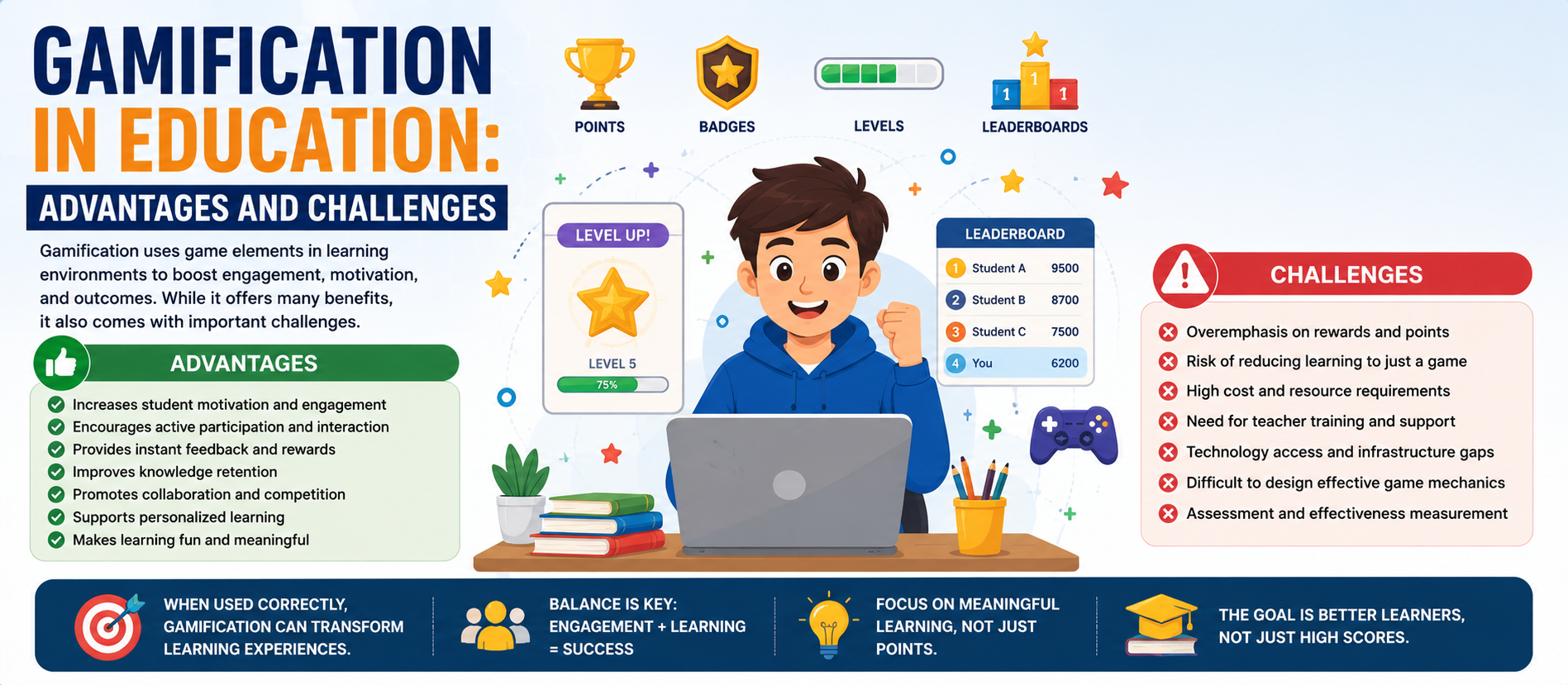
Gamification uses selected game elements, such as points, challenges, progress indicators, levels, or badges, in non-game learning environments.
Game-based learning goes further by using games as the learning environment itself.
These approaches can increase engagement when they are designed around meaningful learning goals.
A leaderboard, for example, may motivate some students but discourage others. Good educational game design should consider different learner preferences and avoid making competition the only source of motivation.
10. Microlearning
Microlearning delivers learning in small, focused units.
A microlearning activity might take five to fifteen minutes and focus on one concept, skill, or task.
This format works well for:
- Vocabulary
- Quick revision
- Professional skills
- Software tutorials
- Safety procedures
- Exam review
- Daily practice
Microlearning should not replace deeper learning when a subject requires extended reasoning. It works best as one part of a larger learning system.
11. Mobile Learning
Smartphones and tablets allow learners to access educational content almost anywhere.
Mobile learning can support short lessons, flashcards, language practice, videos, quizzes, reminders, reading, and communication.
Its major advantage is accessibility. A student may have a few minutes while commuting or waiting and use that time for review.
But mobile learning also creates distractions. Educational apps should be designed to keep learners focused rather than competing constantly for attention.
12. Open Educational Resources
Open Educational Resources, or OER, can reduce barriers to accessing educational materials.
OER may include open textbooks, lessons, multimedia resources, course materials, and other openly licensed educational content.
UNESCO promotes open educational resources as part of wider digital learning and education transformation efforts.
For students and teachers, open resources can make it easier to find alternative explanations and supplementary learning materials.
13. Digital Assessment and Continuous Feedback
Traditional exams often provide feedback after a significant delay. Digital assessment platforms can make some forms of feedback much faster.
Online quizzes can provide immediate explanations. Automated systems can identify common mistakes. Digital portfolios can show progress across a longer period.
The future of assessment is likely to include more frequent, lower-stakes checks of understanding alongside formal examinations.
AI may also support feedback, but human review remains important for complex writing, creative work, reasoning, and high-stakes decisions.
14. Learning Management Systems Are Becoming More Intelligent
Learning management systems, or LMS platforms, have traditionally been used to organize courses, assignments, grades, and communication.
Modern systems increasingly connect with analytics, AI, content libraries, assessment tools, video platforms, collaboration systems, and student-support services.
The LMS is moving from a digital filing cabinet toward a more connected learning environment.
The important question for institutions is not simply which LMS has the most features. It is whether the system is easy for teachers and students to use and whether it supports the institution's teaching model.
15. Digital Credentials and Skills-Based Learning
Education is gradually becoming more focused on specific skills and demonstrable capabilities.
Digital badges, certificates, micro-credentials, portfolios, and project evidence can complement traditional degrees.
This is particularly relevant to professional learning, where a learner may need to demonstrate a specific skill without completing a multi-year program.
However, credentials are valuable only when they represent meaningful learning. Students should check who issued the credential, what was assessed, and whether employers or educational institutions recognize it.
16. AI Literacy Becomes a Core Educational Skill
Students will increasingly need to understand how AI works, what it can do, what it cannot do, and how to use it responsibly.
AI literacy includes:
- Understanding basic AI concepts
- Writing clear prompts
- Checking AI-generated information
- Recognizing bias and limitations
- Protecting private information
- Understanding academic integrity
- Knowing when human judgment is necessary
OECD research emphasizes that education systems need to rethink which skills should be prioritized as AI capabilities advance.
AI literacy therefore belongs across the curriculum, not only inside computer science courses.
17. Accessibility and Inclusive EdTech
One of the most important EdTech opportunities is improving access for learners with different needs.
Technology can support accessibility through:
- Text-to-speech
- Speech-to-text
- Captions and transcripts
- Screen-reader compatibility
- Adjustable text size
- Alternative input methods
- Translation and language support
- Accessible digital documents
UNESCO emphasizes that digital and AI transformation should be inclusive and should not leave learners behind. It also highlights equity, safety, privacy, and human rights as important considerations.
18. Cybersecurity and Student Data Protection
As education becomes more digital, cybersecurity becomes an essential part of EdTech.
Schools and universities may hold sensitive student information, academic records, payment information, identity data, and communications.
Institutions need strong security practices, clear access controls, secure authentication, staff training, backup systems, and responsible data policies.
Students also need basic digital safety skills. They should use strong passwords, protect accounts, recognize phishing attempts, and think carefully before sharing personal information with online tools.
19. Digital Well-Being and Healthy Technology Use
More technology does not automatically mean better learning.
Students can experience distraction, notification overload, screen fatigue, and reduced concentration when digital tools are poorly managed.
Future EdTech should therefore consider digital well-being.
Useful practices include:
- Reducing unnecessary notifications
- Creating focused study periods
- Taking regular breaks
- Balancing screen-based work with offline activities
- Using technology only when it serves a clear learning purpose
Good EdTech should support attention, not constantly compete for it.
20. Smart Education and Connected Ecosystems
The future is moving toward more connected education ecosystems rather than isolated tools.
A student may use one identity to access courses, assessments, digital libraries, tutoring, career services, and support resources. Teachers may see relevant information across multiple platforms instead of manually combining spreadsheets.
UNESCO IITE's 2026 Smart Education work describes smart education as more than adopting technology. It connects pedagogy, governance, teacher development, learner well-being, and AI so that technology serves educational purpose.
This is an important shift. The future of EdTech is not a collection of disconnected apps. It is a more coordinated learning ecosystem.
21. Teacher Technology Skills Will Become More Important
Technology cannot transform education if teachers are not supported.
Teachers need time, training, practical guidance, and professional autonomy to use new tools effectively.
The OECD's 2026 report on teaching highlights the need to reimagine teaching in a rapidly changing environment and explores AI as an ally for teaching and learning.
Teacher training should cover more than button-clicking. Teachers need to understand when a technology improves learning, when it creates risks, how to evaluate outputs, and how to maintain meaningful human interaction.
22. Human Skills Will Become More Valuable, Not Less
One common misconception is that technology will make human skills less important.
The evidence points in the opposite direction.
The World Economic Forum's Future of Jobs Report 2025 identifies analytical thinking as the top core skill and also highlights resilience, leadership, creative thinking, motivation and self-awareness, technological literacy, empathy and active listening, and curiosity and lifelong learning.
This means future education needs a balance. Students should learn how to use technology while also developing judgment, communication, creativity, collaboration, critical thinking, and adaptability.
23. Career-Focused and Skills-Based EdTech
Education technology is increasingly connecting learning with employment.
Career platforms can help students identify skills, explore occupations, build portfolios, practice interviews, learn job-specific tools, and discover learning pathways.
This matters because technology is changing the skills employers need. The World Economic Forum reports that technological skills are expected to grow rapidly through 2030, alongside creative thinking, resilience, flexibility, curiosity, and lifelong learning.
EdTech can help students move from “What course should I take?” toward a more useful question: “What capabilities do I need for the work I want to do?”
24. The Rise of Human-Centered EdTech
The next stage of education technology should be more human-centered.
That means technology should be evaluated by questions such as:
- Does it improve learning?
- Does it help teachers?
- Does it improve access?
- Is it safe?
- Does it protect privacy?
- Is it affordable?
- Can students understand how it works?
- Does it support human relationships?
- Does it reduce or increase inequality?
UNESCO's current digital education work stresses human agency, critical thinking, ethics, equity, and inclusive technology. citeturn0search15
This approach is important because a technically impressive product can still be educationally weak.
Key EdTech Trends to Watch in the Coming Years
| Trend Likely Impact | |
| Generative AI | More conversational tutoring, content support, feedback, and teacher assistance |
| Adaptive learning | More personalized practice and learning pathways |
| Learning analytics | Earlier identification of learning gaps and targeted support |
| Immersive learning | More simulations and experiential learning |
| Microlearning | Short, flexible learning experiences |
| Open educational resources | Greater access to learning materials |
| Digital credentials | More emphasis on demonstrable skills |
| Accessibility technology | More inclusive learning environments |
| Cybersecurity | Greater focus on protecting educational data |
| Smart education ecosystems | Better integration between learning, support, administration, and career services |
Challenges That Could Slow EdTech Adoption
Technology creates opportunities, but it also creates risks.
Digital Divide
Not every student has reliable internet, modern devices, electricity, or a suitable place to study. UNESCO continues to emphasize equity and inclusive access as technology expands in education.
Privacy
Learning platforms can collect large amounts of information. Institutions must understand what data is collected, why it is collected, who can access it, and how long it is retained.
AI Accuracy
Generative AI can produce incorrect or misleading information. Students and teachers need verification habits.
Academic Integrity
Schools and universities need clear rules for acceptable AI use. The goal should be to protect learning while teaching students responsible use of modern tools.
Teacher Workload
Introducing a new platform can create extra work if teachers receive little training or if systems do not integrate well.
Technology Fatigue
Students and teachers can become overwhelmed when too many platforms are introduced. Simplicity matters.
How Schools and Colleges Can Prepare for the Future of EdTech
- Start with learning goals: Identify the problem before selecting a tool.
- Train teachers: Provide practical professional development.
- Build AI literacy: Teach responsible use, verification, privacy, and ethics.
- Protect data: Establish strong cybersecurity and data governance.
- Design for accessibility: Make digital resources usable by diverse learners.
- Measure outcomes: Evaluate whether technology actually improves learning.
- Reduce platform overload: Integrate systems where possible.
- Keep human relationships central: Technology should support teachers and learners, not remove meaningful interaction.
How Students Can Benefit From EdTech
Students do not need to use every new tool. They should build a small, purposeful technology toolkit.
A practical student EdTech stack might include:
- One reliable learning platform
- One note-taking system
- One calendar or planning tool
- A trusted practice or assessment tool
- An AI assistant used responsibly
- Accessibility tools when needed
- Secure cloud storage for academic work
The best tool is the one that helps you learn better, not the one with the longest feature list.
Frequently Asked Questions About EdTech Trends
What is the biggest EdTech trend right now?
Artificial intelligence is one of the most significant trends, especially generative AI, AI tutoring, personalization, and learning analytics. But the larger trend is the integration of technology with evidence-based teaching and learning.
How will AI change education?
AI can support tutoring, practice, feedback, content preparation, personalization, and administrative work. Its educational value depends on how it is designed and used. Simply letting AI complete tasks does not guarantee learning.
Will AI replace teachers?
AI can automate or assist with some tasks, but education involves relationships, judgment, motivation, classroom management, mentoring, ethics, and social development. Current education research increasingly frames AI as a tool that should support teachers and learning rather than simply replace them.
What is adaptive learning?
Adaptive learning uses learner performance or other information to adjust content, difficulty, sequence, or practice. The goal is to provide more targeted learning support.
What is learning analytics?
Learning analytics involves collecting and analyzing educational data to understand learning behavior, progress, engagement, and support needs.
Why is cybersecurity important in EdTech?
Education platforms can store personal, academic, and financial information. Strong cybersecurity helps protect students, teachers, institutions, and their data.
What skills should students develop for the EdTech future?
Students need digital literacy as well as analytical thinking, communication, creativity, problem-solving, adaptability, collaboration, and lifelong learning. Employers increasingly value a combination of technical and human capabilities.
Is more technology always better for education?
No. Technology should be used when it improves a clear learning goal. A simple offline activity can be better than an expensive digital tool if it produces better learning.
Conclusion
The future of education will not be defined by one device, one app, or one AI model. It will be shaped by how effectively technology works with teachers, students, curriculum, assessment, and educational policy.
AI, adaptive learning, learning analytics, immersive technology, mobile learning, microlearning, digital credentials, accessibility tools, smart classrooms, and connected education platforms are all changing the EdTech landscape.
But technology must remain connected to purpose. Students need more than faster answers. They need understanding, judgment, creativity, communication, problem-solving, and the ability to keep learning.
Teachers need more than new software. They need useful tools, training, time, autonomy, and strong support.
Schools and universities need more than digital platforms. They need strategies that protect equity, privacy, safety, accessibility, and human connection.
The strongest future for EdTech is therefore not technology replacing education. It is technology helping education become more personalized, accessible, effective, flexible, and human-centered.
For students, the message is simple: learn how to use technology, but do not let technology do all your thinking. For educators, use digital tools where they solve real problems. For institutions, measure educational outcomes rather than counting devices or subscriptions.
That is how EdTech can help shape a stronger future of education.
Digiifrog
Education, technology, digital learning, AI, and career insights.
www.digiifrog.com
Research Notes
This article is informed by recent OECD, UNESCO, UNESCO IITE, and World Economic Forum research on digital education, generative AI, smart education, learning analytics, technology adoption, and future skills. The OECD Digital Education Outlook 2026 emphasizes pedagogically guided use of generative AI; UNESCO emphasizes human-centered, ethical, equitable technology; UNESCO IITE highlights AI-powered learning platforms and smart education; and the World Economic Forum identifies technology and human skills as important to the future of work.
Ready to Grow?
Talk to us about a strategy tailored to your brand — we will help you stand out in search, AI discovery and social.
Comments (0)
Log in to leave a comment.