📋 Quick Summary
In this article:
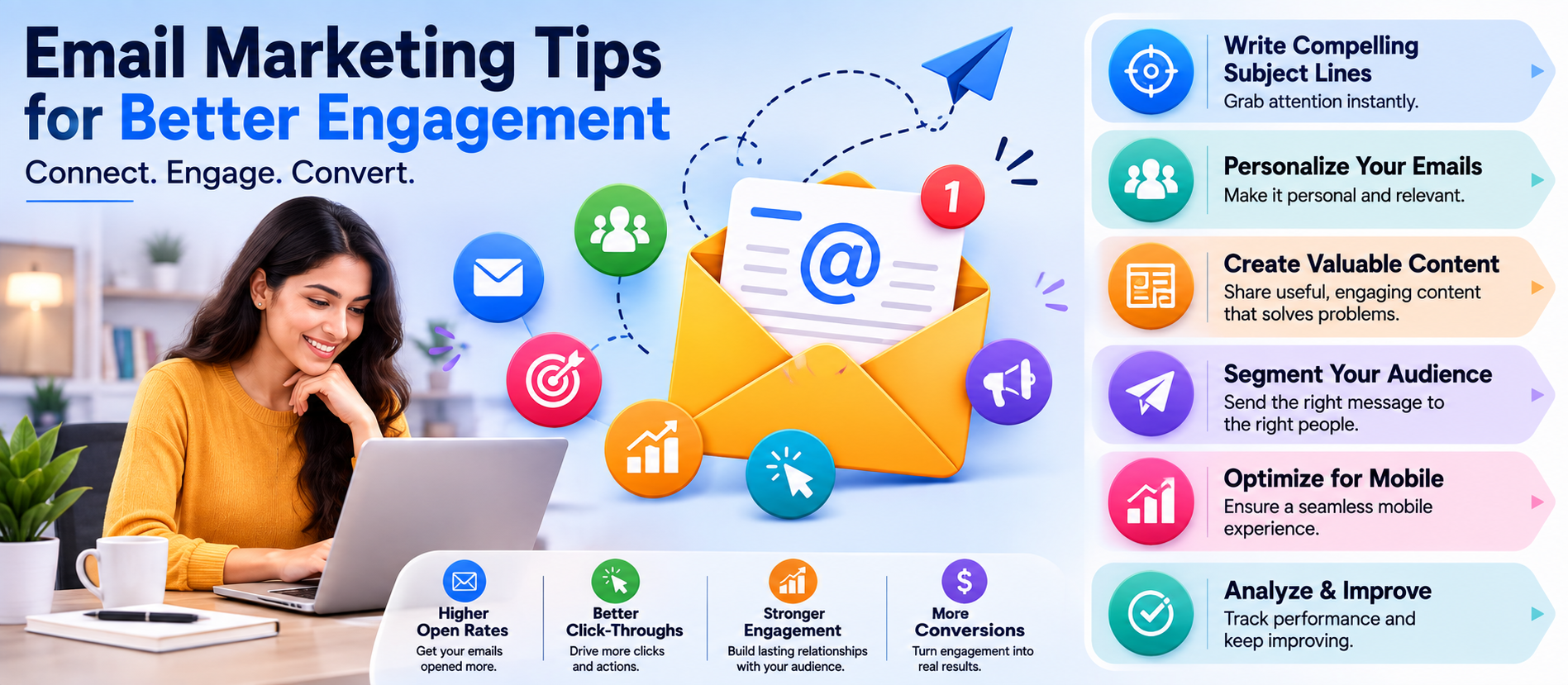
1. Build a Permission-Based Email List
2. Segment Your Audience
3. Personalize Beyond the First Name
4. Write Better Subject Lines
5. Make the First Few Lines Valuable
6. Focus Each Email on One Primary Goal
7. Optimize Emails for Mobile
Focus Keyword: Email Marketing Tips for Better Engagement
💡 Key Insight
Email marketing tips for better engagement are increasingly important for businesses that want to build direct relationships with subscribers instead of depending entirely on social media algorithms or paid advertising. However, sending more emails does not automatically create better results. Engagement improves when the right message reaches the right person at an appropriate time and provides clear value.
In 2026, successful email marketing combines audience segmentation, personalization, useful content, strong deliverability practices, mobile-friendly design, automation, and continuous testing. Businesses also need to protect sender reputation by following modern authentication and unsubscribe requirements.
Designfo helps businesses create connected digital growth strategies through email marketing, marketing automation, content marketing, SEO, AEO, GEO, AI Search Optimization, website optimization, and conversion-focused campaigns.
What Is Email Engagement?
Email engagement describes how subscribers interact with your messages. Depending on the campaign and platform, useful signals may include opens, clicks, replies, conversions, website activity, and long-term subscriber activity.
The goal is not to maximize a single metric in isolation. A high open rate means little if recipients do not find the message useful. Strong engagement should ultimately support meaningful business outcomes such as leads, sales, bookings, customer education, or retention.
1. Build a Permission-Based Email List
Better engagement begins before the first campaign is sent. Subscribers should understand what they are signing up for and have a genuine reason to receive your messages.
- Use clear opt-in forms.
- Explain what subscribers will receive.
- Confirm email addresses when appropriate.
- Avoid purchasing unrelated email lists.
- Keep subscription records organized.
- Give people an easy way to unsubscribe.
Google's sender guidelines recommend making sure recipients opt in, confirming addresses, periodically checking continued interest, and considering the removal of persistently unengaged recipients.
2. Segment Your Audience
One of the most effective ways to improve email engagement is to stop treating every subscriber as identical. Segmentation allows businesses to group subscribers based on relevant characteristics and behavior.
Useful Segmentation Options
- New subscribers
- Existing customers
- Past customers
- Industry or business type
- Location
- Purchase history
- Product interest
- Website behavior
- High-engagement and low-engagement groups
Mailchimp's engagement guidance highlights demographic, geographic, and behavioral segmentation as practical ways to tailor messages and make content more relevant.
3. Personalize Beyond the First Name
Using a subscriber's first name can be useful, but meaningful personalization goes further. The strongest personalization changes the message based on context, needs, interests, or previous actions.
Examples
- Recommend products based on previous purchases.
- Send onboarding content based on the service selected.
- Share local information when location is relevant.
- Follow up after a visitor downloads a specific resource.
- Provide content based on a customer's stage in the journey.
Personalization should feel helpful rather than intrusive. Only use data in ways that support a better customer experience and align with applicable privacy requirements.
4. Write Better Subject Lines
The subject line is often the first decision point. It should accurately represent the email and give the recipient a reason to open it.
Good Subject Line Principles
- Be specific.
- Communicate a clear benefit or topic.
- Keep the promise consistent with the email content.
- Use urgency only when it is genuine.
- Test different approaches over time.
⚠ Watch Out
Avoid deceptive tactics. Google's sender guidelines state that subject lines, headers, display names, and other message elements should accurately represent the sender and content.
5. Make the First Few Lines Valuable
Do not spend the beginning of every email on a long introduction. Help the reader understand why the message matters quickly.
A practical structure is:
- Start with the main problem, opportunity, or benefit.
- Explain why it matters.
- Provide useful information or evidence.
- Present one clear next step.
This structure makes emails easier to scan on both desktop and mobile devices.
6. Focus Each Email on One Primary Goal
An email with too many competing links and calls to action can create decision fatigue. Before writing, decide what you want the recipient to do.
Possible primary goals include:
- Read an article
- Download a guide
- Book a consultation
- Watch a demonstration
- Explore a product
- Reply with a question
- Complete an account action
Supporting links are fine, but the main action should remain clear.
7. Optimize Emails for Mobile
Many subscribers read email on smartphones, so mobile usability should be part of the design process. Use readable text, concise paragraphs, touch-friendly buttons, and layouts that adapt to smaller screens.
Mobile Email Checklist
- Use a clear single-column layout where appropriate.
- Keep paragraphs short.
- Use readable font sizes.
- Make buttons easy to tap.
- Do not rely on tiny text inside images.
- Test the email in multiple clients and devices.
8. Use Automation to Respond at the Right Moment
Email marketing automation can improve relevance by sending messages based on subscriber actions instead of using only large one-time broadcasts.
High-Value Automated Workflows
- Welcome sequences
- Lead magnet follow-up
- Product onboarding
- Abandoned inquiry or cart reminders where appropriate
- Educational nurture sequences
- Re-engagement campaigns
- Post-purchase follow-up
- Renewal or milestone reminders
Automation works best when each workflow has a clear trigger, audience, purpose, and measurement plan.
9. Improve Deliverability Before Increasing Volume
Even excellent content cannot generate engagement if it does not reach the inbox. Modern email programs should treat authentication and sender reputation as core operational requirements.
Google requires authentication measures for senders to Gmail and applies additional requirements to high-volume senders, including SPF, DKIM, DMARC, low spam rates, and one-click unsubscribe for qualifying marketing and subscribed messages.
Deliverability Priorities
- Configure SPF.
- Enable DKIM.
- Implement DMARC as appropriate.
- Use secure and consistent sending practices.
- Monitor spam complaints and sender reputation.
- Separate important message categories when useful.
- Avoid sudden, unexplained volume spikes.
- Remove or re-engage inactive subscribers.
Yahoo also recommends sending timely and relevant email to an active, engaged audience and following authentication and responsible sending practices.
10. Make Unsubscribing Easy
Trying to trap subscribers can damage trust and sender reputation. A visible unsubscribe process helps people who are no longer interested leave instead of marking messages as spam.
Google specifically requires qualifying bulk marketing senders to support one-click unsubscribe and also recommends a clear unsubscribe option in the message body.
11. Create Content People Actually Want to Receive
Promotions can be effective, but an entire email program should not consist only of sales messages. Give subscribers a reason to continue opening your emails.
Engaging Content Ideas
- Industry insights
- How-to tips
- Practical checklists
- Customer success stories
- Product education
- Original research
- Common mistakes to avoid
- Relevant company updates
- Exclusive resources
A useful question to ask before sending is: “Would this message still be valuable if the reader does not buy anything today?”
12. Test Send Times and Frequency
There is no universal best day or time to send email. Audience behavior differs by industry, geography, role, and customer journey.
Test timing systematically. Compare meaningful groups, avoid changing too many variables at once, and measure downstream engagement rather than only opens.
Frequency should also be based on value and expectations. Sending more often can increase opportunities for engagement, but excessive frequency may increase unsubscribes or complaints.
13. Use A/B Testing Strategically
A/B testing can help businesses learn what their audience responds to. Test one major variable at a time.
Elements Worth Testing
- Subject lines
- Preview text
- Email opening
- Call-to-action wording
- Button placement
- Content length
- Visual format
- Send timing
- Audience segments
Do not assume that a result from one campaign applies permanently. Continue testing as the audience, offer, and market change.
14. Use AI to Improve Workflow, Not to Remove Human Judgment
AI can assist email teams with topic ideas, outlines, subject line variations, content repurposing, segmentation analysis, and workflow automation. The final message should still be reviewed for accuracy, relevance, brand voice, and customer context.
The strongest approach combines automation with human strategy. AI can speed up production, but it cannot automatically understand every customer relationship or business priority.
Email Marketing and SEO, AEO, GEO, and AI Search
Email marketing does not directly replace search optimization, but the channels can support each other. Useful website articles can be distributed to subscribers, while recurring subscriber questions can become new content ideas.
For SEO, use email to distribute useful resources and encourage the right audiences to discover your website. For AEO, turn recurring questions into direct, well-structured answers. For GEO and AI Search Optimization, focus on original expertise, accurate information, clear brand positioning, and useful content that can exist across your website and digital ecosystem.
The goal should be a connected content system rather than isolated marketing channels.
How Designfo Supports Better Email Engagement
Designfo helps businesses build practical digital marketing systems focused on visibility, engagement, automation, and conversion.
Designfo Services
- Email Marketing Strategy
- Email Campaign Design
- Marketing Automation
- Lead Nurturing Workflows
- Content Marketing
- SEO and Technical SEO
- Website and Landing Page Optimization
- Conversion Rate Optimization
- AEO, GEO, and AI Search Optimization
Frequently Asked Questions
How can I improve email engagement?
Improve relevance through permission-based list building, segmentation, useful content, clear subject lines, strong calls to action, mobile-friendly design, automation, testing, and good deliverability practices.
What is the most important email engagement metric?
No single metric is enough. Opens, clicks, replies, conversions, and long-term subscriber activity can all provide useful information depending on the campaign goal.
How often should a business send marketing emails?
The right frequency depends on audience expectations and the value of each message. Test a sustainable schedule and monitor engagement, unsubscribes, complaints, and conversions.
Why are SPF, DKIM, and DMARC important?
They help authenticate sending domains and support email security and deliverability. Google applies authentication requirements to senders and additional requirements to qualifying bulk senders.
Can AI improve email marketing?
Yes. AI can support ideation, drafting, analysis, personalization workflows, and automation. Human review remains important for quality, accuracy, and brand consistency.
Conclusion
Email marketing tips for better engagement begin with a simple principle: send messages that people genuinely want to receive. Build a permission-based audience, segment subscribers, personalize based on useful context, make every email easy to understand, and give the reader a clear reason to take the next step.
In 2026, engagement and deliverability are closely connected. Strong authentication, responsible list management, relevant content, transparent unsubscribe options, and consistent sending practices help create a healthier long-term email program.
By connecting email marketing with SEO, AEO, GEO, AI Search Optimization, content marketing, and automation, businesses can create a more complete digital growth system.
Designfo
Website: www.designfo.in
Ready to Grow?
Talk to us about a strategy tailored to your brand — we will help you stand out in search, AI discovery and social.

Comments (0)
Log in to leave a comment.