📋 Quick Summary
In this article:
What Are Emerging Technologies in B2B Services?
Why Technology Matters in B2B Services
1. Generative AI Is Transforming B2B Service Delivery
2. AI Agents Are Creating Intelligent B2B Workflows
3. Cloud Computing Enables Scalable B2B Services
4. SaaS Is Changing How B2B Services Are Purchased
5. Automation Reduces Repetitive B2B Work
6. Advanced Analytics Improves B2B Decision-Making
7. Predictive Analytics Supports Business Forecasting
8. Natural-Language Interfaces Make Business Data More Accessible
9. Cybersecurity Is Becoming a Strategic B2B Technology
10. Zero-Trust Architecture Is Reshaping Business Security
The B2B services industry is entering a period of rapid technological change. Businesses that once relied primarily on traditional consulting, outsourcing, professional expertise, telephone communication, spreadsheets, and manual workflows are increasingly adopting artificial intelligence, automation, cloud computing, advanced analytics, cybersecurity technologies, intelligent software, and connected digital platforms. These technologies are changing not only how B2B services are delivered, but also how providers create value, communicate with clients, measure performance, and compete in global markets.
Emerging technologies reshaping B2B services are creating opportunities for companies to operate faster, personalize services, reduce repetitive work, improve decision-making, and develop new business models. At the same time, these technologies introduce challenges involving cybersecurity, data privacy, integration, skills, governance, cost management, and organizational change.
In 2026, the most successful B2B service providers are unlikely to be those that simply adopt the largest number of new technologies. Instead, competitive advantage will increasingly come from selecting technologies that solve real customer problems and integrating them into practical business processes. Artificial intelligence may improve research and customer support, cloud platforms may improve scalability, automation may reduce administrative work, and advanced analytics may help clients make better decisions.
This WordPress-ready HTML article is prepared for Digiifrog (www.digiifrog.com) with a strong focus on SEO, AEO, GEO, and AI Search optimization.
What Are Emerging Technologies in B2B Services?
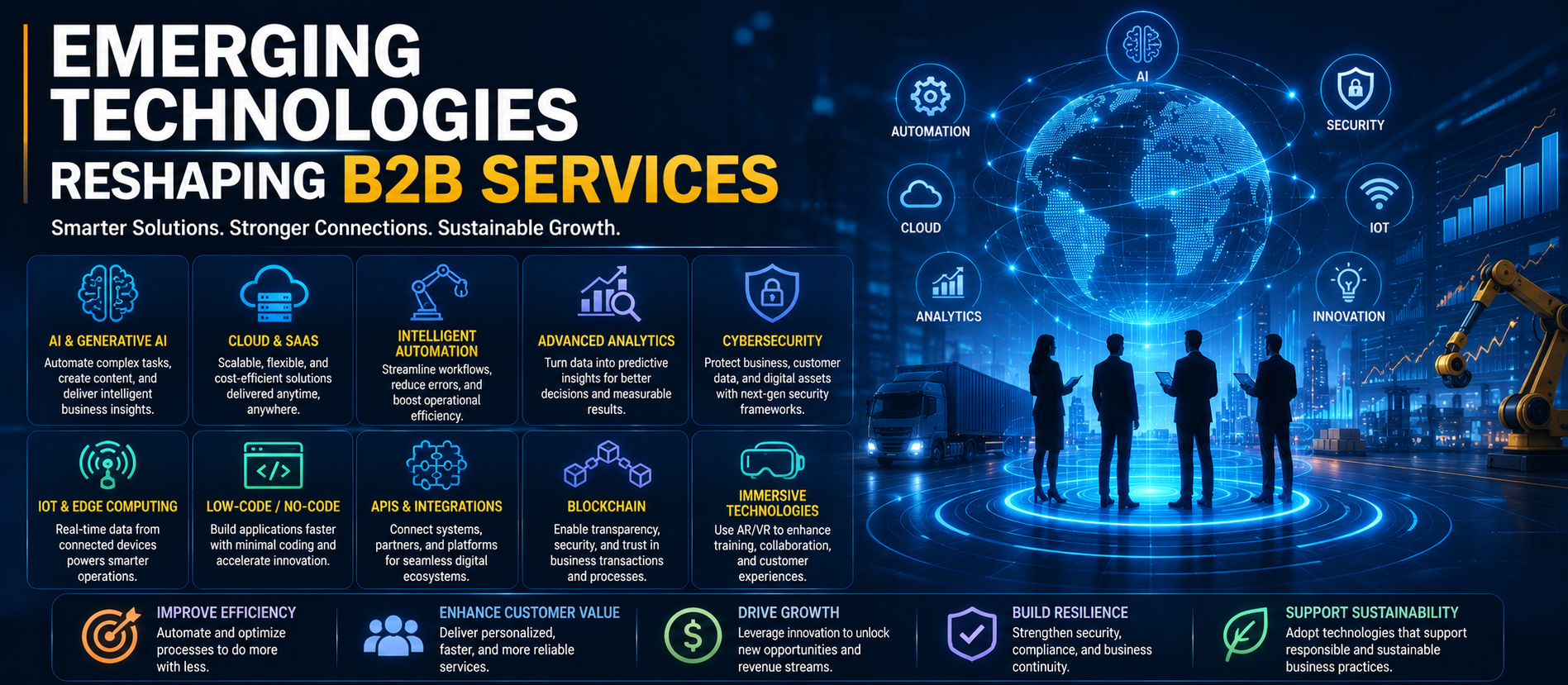
Emerging technologies are new or rapidly developing digital capabilities that can significantly influence how businesses operate. In B2B services, these technologies can improve service delivery, communication, analytics, automation, security, customer experience, and product development.
Important technologies include:
- Artificial intelligence and generative AI
- AI agents and agentic automation
- Cloud computing
- Advanced business analytics
- Machine learning
- Robotic process automation
- Cybersecurity and zero-trust technologies
- Internet of Things
- Digital twins
- Blockchain and distributed ledgers
- Low-code and no-code platforms
- Edge computing
- Immersive technologies
- API-driven business platforms
Why Technology Matters in B2B Services
B2B services often involve complex workflows, large amounts of information, specialized expertise, and long-term customer relationships. Technology can help service providers coordinate these activities more efficiently.
- Faster service delivery
- Lower administrative workload
- Better customer communication
- Improved data visibility
- Greater operational scalability
- More personalized services
- Better decision support
- Improved risk management
- New revenue opportunities
1. Generative AI Is Transforming B2B Service Delivery
Generative AI can create text, summaries, reports, proposals, code, documentation, marketing material, research drafts, and other forms of business content. B2B service providers can use these capabilities to accelerate routine knowledge work.
Consultants can use AI to organize research. Marketing teams can generate content drafts. Customer-support teams can summarize conversations. Software companies can use AI-assisted development tools. Professional service firms can automate portions of documentation and reporting.
💡 Key Insight
Human review remains important because AI-generated output can contain errors, omissions, or inappropriate assumptions.
2. AI Agents Are Creating Intelligent B2B Workflows
AI agents represent an emerging category of software that can interpret goals, use approved tools, retrieve information, perform multiple steps, and escalate issues when necessary.
A B2B service provider could use an AI agent to monitor incoming requests, classify them, retrieve relevant information, prepare a response, update a CRM, and create a task for a human employee.
Agentic systems should operate within clearly defined permissions and should maintain appropriate logging, security, and human oversight.
3. Cloud Computing Enables Scalable B2B Services
Cloud computing has become a foundation for modern B2B operations. Service providers can use cloud infrastructure for applications, databases, analytics, collaboration, storage, AI workloads, and customer portals.
Cloud platforms allow businesses to scale resources according to demand and provide services to geographically distributed customers without maintaining all infrastructure locally.
4. SaaS Is Changing How B2B Services Are Purchased
Software as a Service allows businesses to access applications through subscription models rather than purchasing and maintaining traditional software installations.
CRM, accounting, project management, HR, marketing, cybersecurity, analytics, communication, and customer-support software are increasingly delivered through cloud-based models.
This subscription approach can reduce upfront infrastructure requirements while creating ongoing vendor-management and cost-optimization responsibilities.
5. Automation Reduces Repetitive B2B Work
Business process automation can connect applications and trigger actions based on defined events. A new lead can automatically enter a CRM, receive an appropriate communication, create a sales task, and appear in a reporting dashboard.
Automation can support:
- Lead management
- Invoice processing
- Customer onboarding
- Employee administration
- Reporting
- Document workflows
- Appointment scheduling
- Service notifications
6. Advanced Analytics Improves B2B Decision-Making
Modern B2B organizations generate data from sales, marketing, finance, operations, websites, customer support, and software systems. Advanced analytics can turn this information into insights that support better decisions.
Businesses can analyze revenue trends, customer behavior, service performance, conversion rates, operational costs, and other important indicators.
7. Predictive Analytics Supports Business Forecasting
Predictive analytics uses historical and current information to estimate future outcomes. B2B organizations can use it for sales forecasting, customer retention, demand planning, workforce requirements, financial analysis, and risk management.
Predictions should be treated as decision-support tools rather than guaranteed outcomes, particularly when market conditions change.
8. Natural-Language Interfaces Make Business Data More Accessible
Natural-language interfaces allow users to interact with software using ordinary questions instead of complex technical queries.
A manager may be able to ask which customers generated the highest revenue last quarter or which sales region experienced the largest decline. The system can then provide an answer based on connected business data.
Organizations should validate AI-generated responses against authoritative data before using them for important decisions.
9. Cybersecurity Is Becoming a Strategic B2B Technology
As businesses become more digitally connected, cybersecurity becomes increasingly important. B2B service providers may have access to customer systems, confidential documents, financial information, employee data, or operational platforms.
- Identity and access management
- Multi-factor authentication
- Encryption
- Security monitoring
- Endpoint protection
- Vulnerability management
- Incident response
- Zero-trust security
10. Zero-Trust Architecture Is Reshaping Business Security
Zero-trust security is based on the principle that access should be continuously verified rather than automatically trusted because a user or device is inside a corporate network.
For B2B service providers, zero-trust principles can help protect distributed teams, cloud applications, customer portals, APIs, and sensitive data.
11. Low-Code and No-Code Platforms Accelerate Innovation
Low-code and no-code platforms allow businesses to create applications and workflows with less traditional programming. These tools can help departments build internal solutions, automate processes, and prototype digital services.
They do not eliminate the need for professional developers. Complex integrations, security, architecture, performance, and mission-critical applications may still require specialized engineering.
12. API-Driven Architecture Connects B2B Systems
Application programming interfaces allow different systems to exchange information and functionality. APIs are essential for connecting CRM, ERP, marketing, finance, analytics, websites, customer portals, and automation platforms.
Connected systems reduce manual data transfer and create more integrated business workflows.
13. Robotic Process Automation Supports Administrative Work
Robotic process automation can perform repetitive, rule-based digital tasks. Examples include copying information between systems, processing standardized documents, generating routine reports, and updating records.
RPA can be especially useful where legacy applications do not have modern integration capabilities.
14. Intelligent Document Processing
Many B2B organizations process invoices, contracts, purchase orders, applications, forms, and other documents. AI-powered document processing can extract information from suitable documents and transfer it into business systems.
This can reduce manual data entry and accelerate administrative workflows, while sensitive or high-impact documents may still require human verification.
15. Digital Twins Are Expanding Beyond Manufacturing
A digital twin is a digital representation of a physical object, process, or environment. Although widely associated with industrial applications, digital-twin concepts can also support logistics, facilities, infrastructure, energy, and service operations.
Organizations can use simulations and operational data to explore scenarios and identify potential improvements.
16. Internet of Things Is Creating New B2B Data Sources
IoT devices generate information from equipment, vehicles, facilities, warehouses, and other physical assets. B2B service providers can analyze this data to support monitoring, maintenance, optimization, and customer services.
For example, connected equipment can provide information that helps service teams identify potential maintenance needs.
17. Edge Computing Supports Real-Time Operations
Edge computing processes data closer to where it is generated instead of sending every transaction to a centralized cloud environment. This can be useful when low latency, local processing, or connectivity limitations are important.
Edge computing can support industrial monitoring, connected devices, logistics, security systems, and other real-time applications.
18. Blockchain Has Specialized B2B Applications
Blockchain and distributed ledger technologies can provide shared records across participating organizations. Potential B2B applications include supply-chain traceability, digital records, asset tracking, and selected transaction workflows.
Blockchain is not appropriate for every business problem. Organizations should evaluate whether its specific characteristics provide meaningful advantages over conventional databases.
19. Immersive Technologies Are Changing B2B Training
Virtual and augmented reality can create immersive training, visualization, remote assistance, product demonstrations, and simulation experiences.
These technologies can be particularly useful when physical equipment, complex environments, or safety procedures are difficult to reproduce through traditional training.
20. AI-Powered Customer Service Is Becoming Standard
B2B customers increasingly expect fast responses. AI-powered support systems can answer routine questions, retrieve information, summarize tickets, and route complex requests to human representatives.
The best customer-service models combine automation for simple requests with human support for complex or sensitive situations.
21. Personalization Is Becoming More Sophisticated
AI and analytics allow B2B providers to personalize communication based on customer needs, account history, service usage, and engagement patterns.
⚠ Watch Out
Personalization can improve relevance, but businesses should use customer information responsibly and avoid intrusive practices.
22. Digital Platforms Are Creating B2B Ecosystems
B2B platforms increasingly connect buyers, sellers, service providers, partners, software systems, and data. Platform models can create network effects and make it easier for businesses to access specialized services.
Strong platforms typically depend on reliable APIs, security, identity management, analytics, and scalable cloud infrastructure.
23. Remote Collaboration Technology Is Reshaping Services
Video conferencing, cloud documents, project management platforms, digital whiteboards, and virtual workspaces allow B2B teams to deliver services across geographic boundaries.
Remote collaboration expands access to specialized talent and can help service providers serve international clients without maintaining physical offices in every market.
24. Digital Payments Are Improving B2B Transactions
Digital payment platforms can simplify invoicing, collections, subscriptions, international transactions, and reconciliation. Automated payment workflows can reduce administrative work and improve cash-flow visibility.
Businesses should select payment systems based on security, regulatory requirements, transaction costs, integration capabilities, and customer needs.
25. Cloud-Based ERP Is Connecting Business Functions
Enterprise resource planning systems can connect finance, procurement, inventory, human resources, supply chains, and other business functions. Cloud-based ERP can make shared information accessible across locations.
Integrated systems can reduce duplicate data entry and provide management with more consistent operational information.
26. Industry-Specific Technology Is Growing
Instead of using generic software for every business problem, organizations increasingly use industry-specific platforms designed around particular workflows.
Examples include healthcare technology, legal technology, financial technology, logistics platforms, construction software, property management systems, and professional-service platforms.
27. Technology Is Changing Outsourcing Services
Outsourcing providers are using AI, automation, cloud platforms, analytics, and workflow systems to deliver services more efficiently. This is shifting outsourcing from labor-based models toward technology-enabled and outcome-oriented services.
Clients increasingly expect outsourcing partners to provide measurable business outcomes rather than simply additional manpower.
28. Technology Is Reshaping Consulting Services
Consultants can use AI and analytics to accelerate research, scenario analysis, documentation, and reporting. This allows consultants to spend more time on strategic interpretation, client communication, and implementation.
Human expertise remains essential because business strategy requires context, judgment, and understanding of organizational realities.
29. Technology Is Transforming Professional Services
Legal, accounting, financial, HR, marketing, engineering, and other professional services are increasingly adopting digital workflows.
Automated document processing, analytics, AI assistants, scheduling systems, client portals, and cloud collaboration can improve productivity while allowing professionals to focus on higher-value work.
30. Emerging Technologies Improve B2B Scalability
Technology allows service providers to deliver more work without increasing every operational cost at the same rate. Cloud infrastructure can scale computing resources, automation can reduce repetitive work, and AI can assist knowledge workers.
Scalability does not mean removing human expertise. It means using technology to increase the capacity and consistency of human teams.
31. Data Governance Becomes More Important
As organizations use more AI and analytics, data governance becomes essential. Businesses need clear policies for data ownership, access, quality, retention, security, and usage.
Strong governance improves trust and reduces the risk of inaccurate or inappropriate use of business information.
32. AI Governance Is Essential for B2B Services
Organizations using AI should define acceptable use, data handling, human oversight, model monitoring, and accountability. AI-generated content and recommendations should be reviewed according to their potential impact.
Governance becomes particularly important when AI affects customers, employees, financial decisions, security, or regulated processes.
33. Technology Skills Are Becoming a Competitive Advantage
New technology requires new skills. B2B service providers increasingly need professionals who understand AI, cloud architecture, cybersecurity, data analytics, automation, APIs, and digital product development.
Continuous training can help organizations adapt without relying entirely on external expertise.
34. How B2B Companies Should Adopt Emerging Technologies
- Identify a measurable business problem.
- Assess existing processes and systems.
- Determine whether technology can improve the outcome.
- Evaluate data availability and quality.
- Select a focused use case.
- Run a controlled pilot.
- Measure business results.
- Address security and governance requirements.
- Train employees.
- Scale successful solutions gradually.
35. Common Technology Adoption Mistakes
Adopting Technology Without a Business Goal
New technology should solve a meaningful business problem rather than being adopted simply because it is fashionable.
Ignoring Integration
A new platform may create additional complexity if it cannot connect effectively with existing systems.
Underestimating Security
Connected systems can create new attack surfaces and third-party risks.
Over-Automating Processes
Some decisions require human judgment and should not be completely automated.
Ignoring Employees
Technology adoption requires training, communication, and change management.
36. Measuring Technology ROI in B2B Services
Technology investments should be evaluated using measurable outcomes rather than technology adoption alone.
- Revenue growth
- Reduced operating costs
- Faster service delivery
- Improved customer retention
- Higher employee productivity
- Reduced processing time
- Improved forecast accuracy
- Lower error rates
- Better customer satisfaction
37. Emerging Technologies and B2B SEO, AEO, GEO and AI Search
Technology is also changing how B2B companies attract customers through search. SEO helps businesses improve visibility in traditional search engines. AEO focuses on providing direct answers to user questions. GEO helps content become useful in generative search experiences, while AI Search optimization emphasizes structured, authoritative, context-rich information.
B2B technology providers should publish useful content around AI automation, cloud computing, cybersecurity, analytics, digital transformation, industry-specific applications, implementation challenges, and customer questions.
Clear definitions, practical examples, structured headings, FAQs, trustworthy information, and concise answers can make business content more useful for both human readers and modern search systems.
38. Future of Emerging Technologies in B2B Services
The future of B2B services will likely involve increasingly integrated technology ecosystems. AI agents may coordinate workflows, cloud platforms may provide scalable infrastructure, analytics may deliver proactive insights, and automation may handle more routine operations.
The distinction between software and services may also become less clear. Service companies may package technology, human expertise, data, and automation together as complete business solutions.
39. Key Technology Trends to Watch in 2026
- Generative AI for business operations
- AI agents and agentic workflows
- Cloud-native business platforms
- AI-powered analytics
- Zero-trust cybersecurity
- Intelligent automation
- Industry-specific SaaS
- Low-code and no-code development
- Digital twins
- Edge computing
- Connected IoT ecosystems
- AI-powered customer service
- Automated document intelligence
- Digital procurement platforms
Frequently Asked Questions About Emerging B2B Technologies
What technologies are reshaping B2B services?
Major technologies include artificial intelligence, generative AI, AI agents, cloud computing, automation, advanced analytics, cybersecurity, IoT, digital twins, low-code platforms, APIs, edge computing, and industry-specific SaaS.
How is AI changing B2B services?
AI can automate repetitive work, analyze data, support customer service, generate content, assist research, improve forecasting, personalize services, and coordinate selected business workflows.
Why is cloud computing important for B2B services?
Cloud computing provides scalable infrastructure for applications, data, collaboration, analytics, AI, and customer-facing platforms while supporting distributed operations.
What are AI agents in B2B services?
AI agents are software systems designed to interpret goals, use approved tools, complete multiple workflow steps, and escalate tasks when human intervention is required.
Can emerging technologies reduce B2B operating costs?
They can reduce certain costs by automating repetitive processes, improving resource utilization, reducing errors, and increasing productivity. Actual savings depend on implementation, process design, and ongoing management.
What is the biggest challenge when adopting emerging technologies?
Common challenges include integration, data quality, cybersecurity, skills gaps, cost management, governance, employee adoption, and selecting technologies that genuinely solve business problems.
How should a small B2B business adopt new technology?
A small business should start with one measurable problem, choose a practical technology solution, run a focused pilot, measure results, train employees, and expand gradually after demonstrating value.
Will emerging technologies replace B2B service professionals?
Technology will automate some repetitive activities, but professional judgment, strategy, relationship management, creativity, accountability, and specialized expertise will remain important. Many B2B services will increasingly use a human-plus-technology model.
Conclusion
Emerging technologies are reshaping B2B services by changing how companies deliver expertise, manage operations, communicate with customers, analyze information, and create value. Artificial intelligence, cloud computing, automation, advanced analytics, cybersecurity, IoT, and digital platforms are becoming important components of modern B2B strategies.
The strongest technology strategies will focus on business outcomes rather than technology adoption for its own sake. Organizations should identify meaningful problems, evaluate data and integration requirements, test focused solutions, measure results, and establish appropriate security and governance.
AI and automation will increasingly augment professional teams, allowing employees to spend less time on repetitive tasks and more time on strategic, creative, analytical, and relationship-driven work. At the same time, cybersecurity, data governance, and responsible AI practices will become essential for maintaining trust.
The future of B2B services will therefore be shaped by a combination of technology and human expertise. Businesses that can integrate emerging technologies thoughtfully into practical workflows will be better positioned to improve efficiency, deliver better customer experiences, scale services, and create sustainable competitive advantages.
For businesses looking to implement AI automation, emerging technology solutions, digital transformation, intelligent websites, analytics, cybersecurity strategies, and modern B2B technology systems, Digiifrog can help develop practical strategies. Visit www.digiifrog.com to learn more.
Quick Answer: Which Emerging Technologies Are Reshaping B2B Services?
The key emerging technologies reshaping B2B services include generative AI, AI agents, cloud computing, SaaS, intelligent automation, advanced analytics, cybersecurity, zero-trust architecture, IoT, digital twins, low-code platforms, APIs, edge computing, and industry-specific software. These technologies can help B2B companies improve productivity, scalability, customer experience, decision-making, security, and service delivery when implemented around clear business objectives.
Ready to Grow?
Talk to us about a strategy tailored to your brand — we will help you stand out in search, AI discovery and social.
Comments (0)
Log in to leave a comment.