📋 Quick Summary
In this article:
Facebook Ads vs Meta Ads: The Short Answer
Are Facebook Ads and Meta Ads the Same?
Meta Ads Manager Is the Important Difference
Facebook Ads vs Meta Ads: Placement Difference
Does a Meta Ad Always Appear on Facebook?
Facebook Ads vs Meta Ads: Campaign Objectives
Facebook Ads vs Meta Ads: Targeting
Broad Targeting vs Narrow Targeting
Facebook Ads vs Meta Ads: Creative
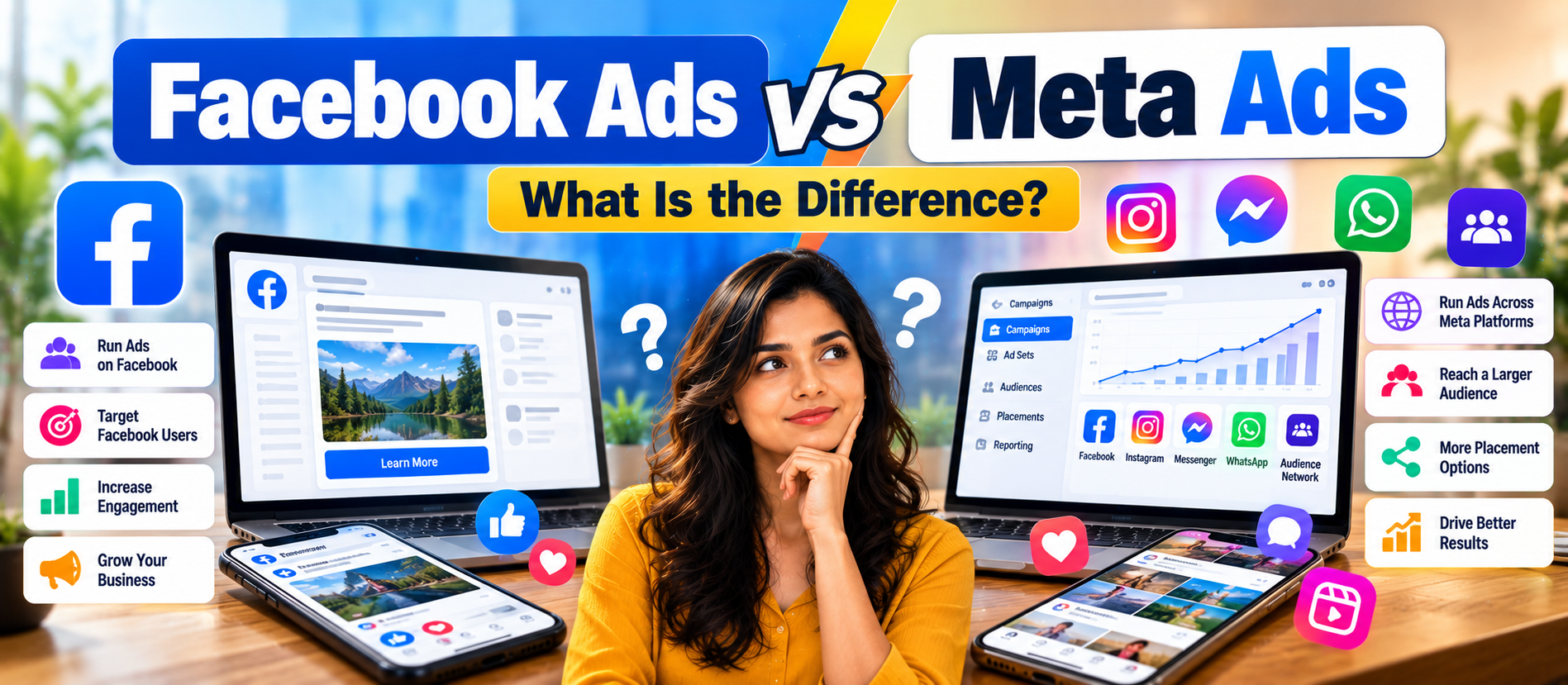
In simple terms, Facebook Ads usually refers to paid advertising that appears on Facebook. Meta Ads is the broader term used for advertising across Meta's advertising ecosystem. Depending on the campaign, placements can include Facebook, Instagram, Messenger, and other eligible Meta technologies and placements.
Meta's own advertising documentation shows that Ads Manager can use placement options across Facebook, Instagram, Messenger, and Audience Network. Its Reels advertising guidance, for example, describes Advantage+ placements that can distribute ads across Facebook, Messenger, Instagram, and Audience Network.
That means the difference is mainly about scope and terminology, not two completely separate advertising systems.
This article explains the difference in clear language. It covers campaign setup, placements, targeting, objectives, creative, measurement, budgeting, remarketing, local advertising, eCommerce, AI-powered advertising, and practical strategies for businesses.
Facebook Ads vs Meta Ads: The Short Answer
Here is the simplest way to understand the terms:
| Term Common Meaning | |
| Facebook Ads | Paid ads associated specifically with Facebook placements. |
| Meta Ads | The broader advertising ecosystem managed through Meta's advertising tools, with eligible placements across Meta technologies. |
| Meta Ads Manager | The central advertising interface used to create, manage, measure, and optimize campaigns. |
So, when someone says “Facebook Ads,” they may be talking about a specific platform placement. When someone says “Meta Ads,” they usually mean the wider paid advertising system.
What Are Facebook Ads?
Facebook Ads are paid advertisements delivered through Facebook. Businesses can use them to promote products, services, content, offers, events, apps, or other business goals.
Facebook has several advertising environments and formats. Depending on eligibility and campaign configuration, ads can appear in places such as feeds, Stories, Reels, Marketplace, and other Facebook surfaces.
Facebook advertising has been widely used by businesses because it can combine visual creative with audience targeting and measurable campaign objectives.
For example, a local restaurant could create an ad for a new menu. An online store could promote a product. A service company could generate consultation requests. A content publisher could promote an article.
The important point is that the ad should be connected to a clear business objective.
What Are Meta Ads?
Meta Ads refers to advertising through Meta's advertising ecosystem. The system is broader than Facebook alone.
Meta's current advertising documentation describes placements across Facebook, Instagram, Messenger, and Audience Network for eligible campaigns. Meta's Ads Manager also supports campaign creation, placement selection, creative configuration, and measurement.
Meta's advertising ecosystem has therefore made it possible for businesses to manage campaigns that can reach people across more than one Meta property.
For advertisers, this means a campaign does not always have to be designed around Facebook alone.
A campaign can be built around a business goal and then delivered through eligible placements based on the selected campaign settings, audience, creative, and delivery system.
Why Did the Name Change?
Facebook, the social networking platform, remains a major product. The parent company changed its corporate name from Facebook, Inc. to Meta Platforms, Inc. in 2021.
The change reflected the company's broader focus on multiple products and technologies rather than only the Facebook platform.
As a result, the advertising terminology also became broader. Today, “Meta Ads” is commonly used when discussing advertising across the company's wider ecosystem.
This does not mean Facebook advertising disappeared. Facebook remains one of the potential advertising placements within the broader Meta advertising system.
Are Facebook Ads and Meta Ads the Same?
They can refer to the same campaign in casual conversation, but the terms have different levels of scope.
Think of it this way:
Facebook Ads → one important advertising environment.
Meta Ads → the broader advertising ecosystem.
A campaign created in Meta Ads Manager may deliver an ad on Facebook, Instagram, or other eligible placements. Therefore, calling every Meta campaign a “Facebook Ad” can be too narrow.
Meta Ads Manager Is the Important Difference
For advertisers, the more useful concept is Meta Ads Manager.
Ads Manager is the environment where advertisers can build and manage campaigns. It allows businesses to define objectives, audiences, budgets, placements, creative, and other campaign settings.
Meta's own documentation shows that advertisers can select placements at the ad set level. It also describes Advantage+ placements, which can make an ad eligible for multiple placements such as Facebook, Instagram, Messenger, and Audience Network.
This is why the term “Meta Ads” is more accurate when discussing a modern multi-placement campaign.
Facebook Ads vs Meta Ads: Placement Difference
Placement is one of the clearest ways to understand the difference.
A Facebook-focused campaign may use Facebook placements such as:
- Facebook Feed
- Facebook Stories
- Facebook Reels
- Other eligible Facebook surfaces
A broader Meta campaign may be eligible for additional placements such as:
- Instagram Feed
- Instagram Stories
- Instagram Reels
- Facebook Feed
- Facebook Stories
- Facebook Reels
- Messenger placements
- Audience Network placements
Exact placement availability depends on the campaign, objective, creative format, account setup, and current Meta advertising options.
Meta's Reels guidance specifically describes Advantage+ placements as an option that can include Facebook, Messenger, Instagram, and Audience Network.
Does a Meta Ad Always Appear on Facebook?
No.
A Meta campaign can use placements outside Facebook. If the campaign is configured to include Instagram or other eligible placements, the ad may be delivered there instead of, or in addition to, Facebook.
This is one reason advertisers should stop thinking of Meta advertising as only Facebook advertising.
The campaign is broader than a single social network.
Facebook Ads vs Meta Ads: Campaign Objectives
Modern social advertising is usually built around a business objective rather than simply choosing a platform.
Depending on the current Ads Manager interface and campaign options, businesses may create campaigns around goals such as:
- Awareness
- Traffic
- Engagement
- Leads
- App promotion
- Sales
The exact objective structure and available settings can change as Meta updates its advertising products.
The important principle is simple: choose a campaign goal that reflects the business outcome you want to measure.
Facebook Ads vs Meta Ads: Targeting
Audience targeting is another important part of Meta advertising.
Depending on the campaign and current platform features, businesses may use information such as location, age, interests, behaviors, customer lists, website activity, and other eligible signals.
However, advertisers should not assume that every targeting option is available for every objective, region, audience, or category.
Meta also applies special rules to certain advertising categories and audiences.
The better approach is to start with the customer and business objective. Do not create complicated targeting simply because the platform offers many settings.
Broad Targeting vs Narrow Targeting
One common question is whether businesses should target very specific audiences.
There is no universal answer.
A local business may need geographic limits. A specialized B2B service may need a more focused audience. A consumer product with broad appeal may benefit from a wider audience.
Modern advertising systems also use machine learning and delivery signals. Overly restrictive targeting can sometimes reduce the system's available audience.
The practical approach is to test a sensible audience structure and measure the quality of the results.
Facebook Ads vs Meta Ads: Creative
Creative is important in both Facebook and Meta advertising.
However, creative should account for different placements.
A landscape image designed for a desktop feed may not work well as a vertical Story or Reels asset.
Meta's Reels guidance recommends creative designed for the Reels environment, including vertical 9:16 video, clear safe-zone placement for key messages, and suitable audio.
💡 Key Insight
This creates an important distinction between old-style Facebook advertising and modern multi-placement Meta advertising.
A business may need several creative variations for one campaign.
Useful Creative Formats
- Square images
- Vertical images
- Vertical video
- Short-form video
- Carousel ads
- Product-focused creative
- Customer testimonials
- Demonstration videos
- Educational content
Creative should match the placement and the customer's stage in the buying journey.
Why Reels Matter in Meta Advertising
Reels have become an important advertising placement across Facebook and Instagram.
Meta's current Reels advertising documentation describes Reels as part of its broader advertising system and explains how advertisers can include Reels through placement settings in Ads Manager.
For businesses, this means short-form video can be used as part of a wider campaign instead of being treated as a completely separate advertising system.
Businesses should create vertical video when Reels are an important part of the strategy.
Facebook Ads vs Meta Ads: Measurement
Measurement is critical for both.
Businesses can review campaign metrics such as:
- Reach
- Impressions
- Clicks
- Click-through rate
- Cost per click
- Video views
- Engagement
- Leads
- Purchases
- Cost per result
- Conversion value
The most useful metric depends on the campaign goal.
An awareness campaign should not be judged only by sales. A lead-generation campaign should not be judged only by impressions.
Measurement should follow the business objective.
Meta Pixel and Conversions API
Website tracking is another important part of Meta advertising.
Businesses can use Meta's measurement technologies to connect advertising activity with website actions. Meta's tools have included the Meta Pixel and Conversions API for eligible use cases.
The exact implementation should be handled with attention to privacy, consent, data protection laws, platform requirements, and the business's analytics setup.
Good tracking helps answer questions such as:
- Which campaigns generated leads?
- Which ads generated purchases?
- Which audiences produced valuable actions?
- Which landing pages converted?
- What is the cost per customer?
Without reliable measurement, optimization becomes much harder.
Facebook Ads vs Meta Ads: Budgeting
Both Facebook and broader Meta campaigns use advertising budgets within the Meta advertising system.
Businesses can choose budget approaches based on the campaign setup. Common concepts include daily budgets and lifetime budgets.
The correct budget depends on:
- Business goal
- Audience size
- Market competition
- Customer value
- Conversion rate
- Sales cycle
- Creative quality
- Geographic coverage
There is no universal “correct” budget.
A better method is to define the desired business outcome and understand the economics behind customer acquisition.
Cost Per Click Is Not the Whole Story
A low cost per click can look attractive. But cheap clicks are not automatically valuable clicks.
Suppose Campaign A generates inexpensive traffic but few qualified leads. Campaign B costs more per click but produces customers with higher value.
Looking only at CPC would miss the larger business picture.
Businesses should connect:
Spend → Clicks → Leads → Qualified Leads → Customers → Revenue
This approach makes paid social measurement more useful.
Facebook Ads vs Meta Ads for Small Businesses
Small businesses often have limited budgets and limited creative resources.
That makes simplicity important.
A small business can begin with a clear objective and one or two core offers. It can then test creative and audience strategies before expanding.
Examples include:
- A local salon promoting appointments
- A restaurant promoting a seasonal menu
- A B2B company generating consultation leads
- An online store promoting a product collection
- A real estate company generating property inquiries
- A training company promoting course registrations
The campaign should match the actual customer journey.
Local Business Advertising With Meta Ads
Local businesses can use geographic targeting to reach audiences within their service areas, subject to available platform settings.
Local campaigns should use clear messaging.
For example:
- Service area
- Location
- Offer
- Opening hours
- Appointment option
- Phone number or contact method
The landing page should also confirm the same location and service information.
Consistency reduces confusion.
Meta Ads for E-commerce
E-commerce businesses can use Meta advertising to promote products, collections, offers, and other shopping-related actions.
Strong e-commerce campaigns depend on more than ad creative.
Businesses should also review:
- Product photography
- Product titles
- Pricing
- Offers
- Landing pages
- Mobile experience
- Checkout process
- Product availability
- Tracking
If the ad is strong but the product page is weak, advertising performance can suffer.
Meta Ads for Lead Generation
Lead generation is another common use case.
A business can promote:
- Free consultations
- Product demonstrations
- Price quotes
- Service inquiries
- Webinars
- Downloads
- Appointment requests
The quality of the offer matters.
“Contact us” may work for an established brand, but a useful lead magnet or specific consultation offer can give the customer a clearer reason to respond.
Meta Ads for Remarketing
Not every visitor buys or submits a form on the first visit.
Remarketing can help businesses reconnect with eligible audiences who have already interacted with a business, website, product, or content.
Possible remarketing groups can include people who:
- Visited a website
- Viewed a product
- Engaged with content
- Started a conversion process
- Previously purchased
Audience eligibility and privacy requirements vary. Businesses should use current platform documentation and comply with applicable privacy and consent requirements.
Meta Ads and AI-Powered Advertising
AI and machine learning are increasingly involved in digital advertising.
Meta's current advertising materials describe Advantage+ tools and AI-enabled creative and placement features. Its Reels guidance, for example, describes Advantage+ creative features that can help automate certain creative adjustments and music selection.
For advertisers, this means the workflow is becoming more automated.
But automation does not eliminate strategy.
Businesses still need:
- A clear offer
- Accurate conversion tracking
- Good creative
- Useful landing pages
- Correct business goals
- Quality customer data
- Regular performance review
AI can optimize delivery. It cannot fix an unclear business proposition.
Facebook Ads vs Meta Ads: Common Misunderstandings
Misunderstanding 1: Meta Ads Are Completely Different From Facebook Ads
They are not separate systems in the way many people assume. Facebook advertising is part of the broader Meta advertising ecosystem.
Misunderstanding 2: Every Meta Ad Appears on Facebook
Not necessarily. Depending on the campaign and placement settings, ads can appear on Instagram, Messenger, Audience Network, and other eligible placements.
Misunderstanding 3: Instagram Ads Require a Completely Separate Advertising System
Instagram advertising can be managed through Meta's advertising tools. Meta's own documentation describes Instagram and Facebook placements within the same broader campaign environment.
Misunderstanding 4: More Targeting Always Means Better Results
More targeting is not automatically better. The right audience structure depends on the product, market, objective, budget, and available data.
Misunderstanding 5: More Clicks Mean More Sales
Clicks are only one part of the customer journey. A campaign should be evaluated using the business outcomes that matter.
Facebook Ads vs Meta Ads: Which Term Should Businesses Use?
If you are talking specifically about advertising on Facebook, “Facebook Ads” is clear.
If you are discussing campaigns across Facebook, Instagram, Messenger, and other Meta placements, “Meta Ads” is more precise.
For agencies and professional marketing teams, using the broader term can make campaign discussions clearer.
How to Build a Strong Meta Ads Campaign
Step 1: Define the Goal
Decide whether the campaign is intended to generate awareness, traffic, engagement, leads, app activity, sales, or another measurable outcome.
Step 2: Define the Customer
Identify who is most likely to need the product or service.
Step 3: Create the Offer
Give people a clear reason to respond. The offer could be a product, consultation, discount, demonstration, download, booking, or useful resource.
Step 4: Prepare Creative
Create multiple versions where appropriate. Consider square, landscape, and vertical formats.
Step 5: Build the Campaign
Configure the campaign objective, audience, budget, placements, creative, and tracking.
Step 6: Verify Tracking
Make sure important conversion actions are measured correctly before spending heavily.
Step 7: Launch
Start with a controlled budget and a clear measurement plan.
Step 8: Analyze
Review performance at campaign, ad set, ad, placement, and conversion levels where the available reporting supports it.
Step 9: Improve
Test creative, messaging, audiences, landing pages, and campaign settings based on evidence.
How to Make Meta Ads More Readable and Effective
Good advertising does not need complicated language.
Use:
- Short sentences
- Clear benefits
- One main message
- Readable headlines
- Strong visual hierarchy
- Specific calls to action
- Accurate claims
Avoid putting too much information into one image.
The ad should attract attention. The landing page can provide more detail.
Meta Ads and AI Search Optimization
Paid advertising and AI Search are different channels, but they can support the same customer journey.
Users may discover a business through a social ad, visit its website, search for the company later, read an article, ask an AI-powered search engine a question, and then return to the website.
That means businesses should maintain consistent information across their website, social profiles, landing pages, and other digital properties.
For AEO, GEO, and AI Search optimization, businesses should create clear answers to real customer questions. Service pages should explain what the business offers, who it serves, where it operates, and what customers can expect.
This broader approach helps create a stronger digital presence beyond the advertising campaign itself.
Facebook Ads vs Meta Ads: Key Differences at a Glance
| Area Facebook Ads Meta Ads | ||
| Scope | Usually refers to Facebook advertising | Broader Meta advertising ecosystem |
| Facebook placements | Yes | Yes, when eligible |
| Instagram placements | Not implied by the narrow term | Yes, when eligible |
| Messenger placements | Not implied by the narrow term | Yes, when eligible |
| Audience Network | Not implied by the narrow term | Available for eligible campaigns |
| Management | Can be managed through Meta advertising tools | Managed through Meta advertising tools |
| Creative strategy | Can focus on Facebook formats | May require multi-placement creative |
How Digiifrog Can Help With Meta Advertising
Digiifrog approaches paid social advertising as part of a wider digital marketing system.
Meta advertising can work alongside:
- Facebook and Instagram marketing
- SEO
- Content marketing
- Website development
- Landing page optimization
- Lead generation
- Conversion optimization
- Branding
- Google Ads
- AI Search optimization
- GEO and AEO
The goal is to connect advertising with the rest of the customer journey.
A good campaign should bring the right audience to a useful destination. The website should then make the next action clear.
Digiifrog can help businesses plan this connected approach through digital marketing, paid advertising, SEO, web development, branding, and AI-focused search strategies.
Frequently Asked Questions
What is the difference between Facebook Ads and Meta Ads?
Facebook Ads usually refers to advertising on Facebook. Meta Ads is the broader term for advertising through Meta's advertising ecosystem, which can include Facebook, Instagram, Messenger, Audience Network, and other eligible placements.
Are Facebook Ads now called Meta Ads?
“Meta Ads” is the broader terminology commonly used for Meta's advertising ecosystem. Facebook Ads remains a useful term when specifically referring to ads shown on Facebook.
Do Meta Ads include Instagram Ads?
Yes. Instagram can be an eligible placement within Meta advertising campaigns. Meta's advertising documentation describes Facebook and Instagram placements within its broader Ads Manager workflow.
Can I run Facebook and Instagram Ads together?
Yes. Depending on the campaign and placement settings, advertisers can make campaigns eligible for both Facebook and Instagram placements.
Is Meta Ads Manager the same as Facebook Ads Manager?
The terminology has evolved. Many people still use “Facebook Ads Manager” informally, but the broader advertising environment is now generally referred to as Meta Ads Manager.
Are Meta Ads more expensive than Facebook Ads?
There is no universal price difference because Meta Ads can include Facebook placements. Advertising costs vary based on factors such as audience, competition, objective, creative, placement, market, and campaign performance.
Should a small business use Facebook Ads or Meta Ads?
The better starting point is the business objective and customer audience. If Facebook is important to the audience, Facebook placements may be useful. If Instagram or other eligible Meta placements are also relevant, a broader Meta campaign may make sense.
Can Meta Ads generate leads?
Yes. Lead generation is a common advertising use case. Businesses can promote consultations, forms, calls, registrations, demonstrations, or other lead actions depending on the available campaign options.
Can Meta Ads drive website sales?
Yes. Businesses can use eligible campaigns to promote products and drive website or other purchase actions. Results depend on factors such as product-market fit, creative, audience, landing page quality, pricing, tracking, and checkout experience.
Final Thoughts
The difference between Facebook Ads and Meta Ads is mainly about scope.
Facebook Ads usually means advertising on Facebook. Meta Ads refers to the broader advertising ecosystem that can include Facebook, Instagram, Messenger, Audience Network, and other eligible placements.
For modern advertisers, the more useful question is not “Facebook Ads or Meta Ads?” The better questions are:
- What business goal are we trying to achieve?
- Who is the right audience?
- Which placements are relevant?
- What creative will communicate the offer clearly?
- Which conversion actions should be measured?
- How will advertising connect with the website and sales process?
When these questions are answered clearly, Meta advertising becomes easier to plan and measure.
Use the platform as a tool. Start with the customer, define the business goal, measure the outcome, and improve the campaign using real data.
Official Resources
- Meta for Business — Ads
- Meta for Business — Facebook and Instagram Reels Ads
- Meta Business Help Center
- Meta Audience Network
- Meta Ad Library
Brand: Digiifrog | www.digiifrog.com
Ready to Grow?
Talk to us about a strategy tailored to your brand — we will help you stand out in search, AI discovery and social.

Comments (0)
Log in to leave a comment.