📋 Quick Summary
In this article:
What Does AI Mean for Real Estate?
Why AI Is Becoming Important in Real Estate
1. AI-Powered Property Search Will Change the Buyer Journey
2. AI Will Improve Property Recommendations
3. Automated Property Valuation Will Become More Sophisticated
4. AI Will Transform Land Acquisition and Feasibility Analysis
5. AI Will Make Market Research Faster
6. Generative AI Will Change Real Estate Design
7. Construction Will Become More Data-Driven
8. Predictive Maintenance Will Improve Property Operations
9. Smart Buildings Will Become More Intelligent
10. AI Will Change Property Management
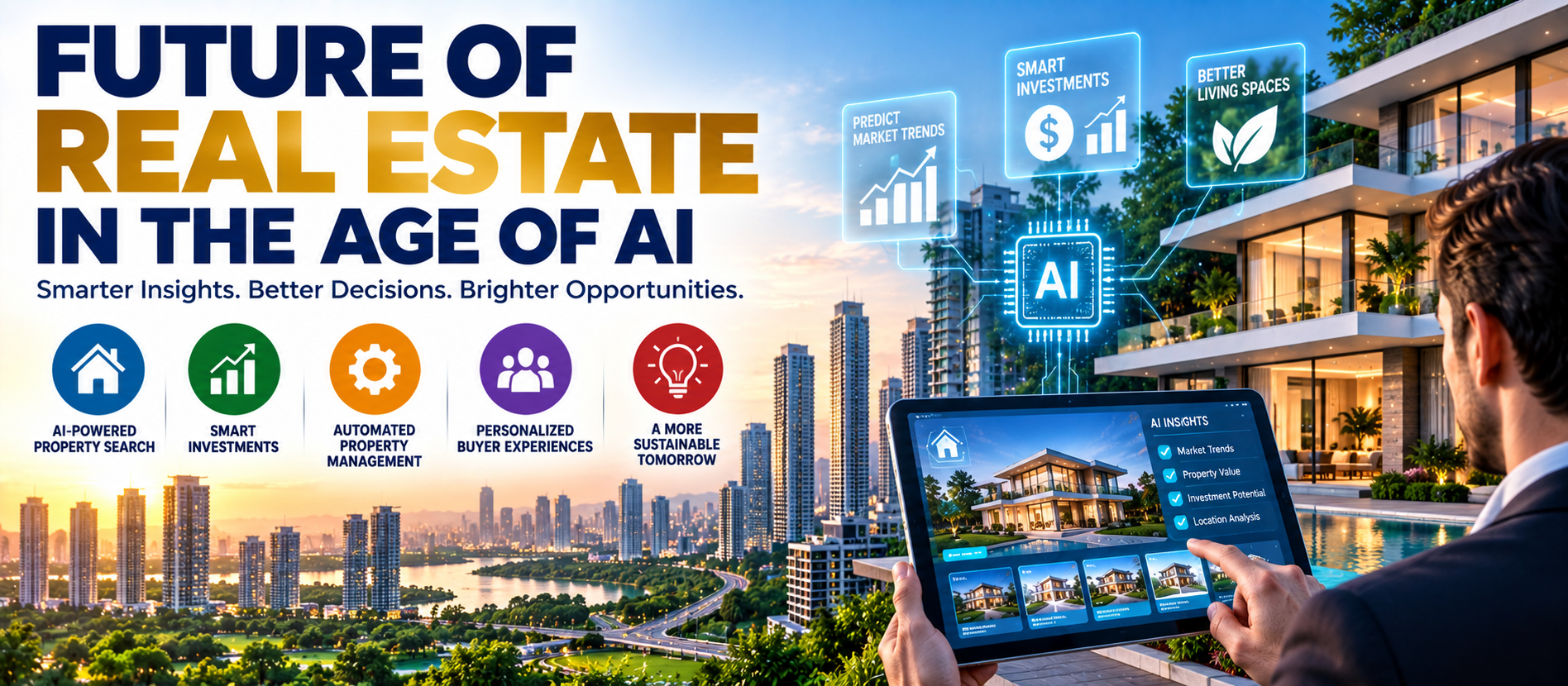
The future of real estate in the age of AI is not simply about adding chatbots to property websites. Artificial intelligence is beginning to change how real estate companies research markets, evaluate land, design projects, manage construction, attract buyers, operate buildings, and make investment decisions.
Real estate has always depended on information. Developers need to understand land, demand, pricing, infrastructure, regulations, construction costs, and buyer preferences. Investors need to compare opportunities and risks. Property managers need to maintain buildings and respond to tenants. Buyers need clear information before making one of the largest financial decisions of their lives.
💡 Key Insight
AI can process large amounts of information quickly. It can identify patterns, generate scenarios, summarize documents, automate repetitive work, and support decision-making. But AI does not remove the need for human judgment. The most important change is the combination of human expertise, reliable data, automation, and intelligent software.
In 2026, this transition is becoming more visible. EY-Parthenon and CREDAI reported that generative AI could potentially improve sales velocity by 30% to 50% and accelerate product launches by about 30% in Indian real estate, while identifying use cases across land evaluation, design, construction, sales, and post-sales service. These are reported potential impacts, not guaranteed results for every company.
What Does AI Mean for Real Estate?
AI in real estate refers to software systems that can analyze data, recognize patterns, generate content, make predictions, support decisions, or automate tasks.
Common technologies include:
- Machine learning
- Generative AI
- Large language models
- Computer vision
- Predictive analytics
- Natural language processing
- AI agents
- Recommendation systems
- Automated valuation models
- Digital twins
- Robotic process automation
These technologies can be used at different stages of the property lifecycle. The major shift is from isolated tools to connected workflows.
Why AI Is Becoming Important in Real Estate
Real estate generates large volumes of structured and unstructured information. A single project may involve property documents, land records, architectural drawings, financial models, construction schedules, customer inquiries, contracts, market reports, images, videos, and maintenance records.
Traditional software can store this information. AI can help people interpret it.
McKinsey's 2026 research describes a move from individual AI experiments toward end-to-end workflow redesign in areas such as leasing, operations, and asset management. BCG similarly identifies AI, smart facility management, industrialized construction, and property ecosystems as major forces changing the sector.
This means the future question is not simply, “Which AI tool should a real estate company buy?” A better question is, “Which real estate workflow should be redesigned with AI?”
1. AI-Powered Property Search Will Change the Buyer Journey
Property search has traditionally required buyers to browse many listings, compare specifications, contact agents, schedule visits, and repeat the process several times.
AI can make the search more conversational.
A buyer could describe a need in natural language:
“Find a three-bedroom home near a metro station, with good natural light, a quiet neighborhood, parking, and a monthly budget within my range.”
An AI system can interpret these requirements and combine them with listing data, location information, property features, and user preferences.
The result can be a more personalized shortlist instead of a long list of unrelated properties.
2. AI Will Improve Property Recommendations
Recommendation engines already exist in many digital industries. Real estate can use similar systems to identify properties that match a person's behavior and preferences.
For example, an AI platform may learn that a buyer repeatedly views properties with large balconies, home offices, specific school zones, or certain commute times.
Instead of showing every new listing, the system can prioritize properties that are more relevant.
This can reduce search time. It can also help agents focus on conversations that are more likely to be useful.
3. Automated Property Valuation Will Become More Sophisticated
Property valuation has always involved data and professional judgment.
AI can analyze comparable transactions, location characteristics, property attributes, rental trends, supply, demand, infrastructure changes, and other market signals.
Automated valuation models can then estimate a property's value or identify a reasonable valuation range.
These models should support professional valuation rather than blindly replace it. Data quality, unusual properties, incomplete records, rapidly changing markets, and local knowledge can affect model accuracy.
Grant Thornton Bharat's 2025-26 India real estate report identifies AI, machine learning, and big data analytics as technologies that can transform property valuations, market predictions, and personalized property offerings.
4. AI Will Transform Land Acquisition and Feasibility Analysis
Land acquisition is one of the most important decisions for developers.
A poor site decision can affect a project for years. Developers need to evaluate location, zoning, access, infrastructure, demand, competition, pricing, construction costs, development restrictions, and potential returns.
AI can bring these signals together.
A developer could use an AI-supported feasibility system to compare multiple sites and generate different development scenarios.
EY-Parthenon and CREDAI reported that Gen AI could reduce deal evaluation time by around 50% and support more automated feasibility analysis, including ROI and IRR scenarios. Again, these figures represent the report's potential impact estimates, not universal outcomes.
5. AI Will Make Market Research Faster
Real estate market research often involves collecting information from many sources.
AI can help organize information about:
- Property prices
- Rental levels
- Absorption
- New supply
- Infrastructure projects
- Population changes
- Employment trends
- Consumer preferences
- Competitor projects
- Economic indicators
An analyst can then spend more time interpreting the information instead of manually collecting it.
However, AI-generated market research still requires source validation. A fast answer is not automatically a reliable answer.
6. Generative AI Will Change Real Estate Design
Generative AI can support architects and design teams during early-stage planning.
Designers can explore multiple layouts, massing concepts, interior ideas, landscape concepts, and visual directions more quickly.
AI can also help compare design options against constraints such as area requirements, daylight, circulation, parking, energy performance, or development rules.
The role of the architect remains important. AI can generate possibilities, but professionals must evaluate safety, usability, regulations, context, cost, and human experience.
7. Construction Will Become More Data-Driven
Construction involves thousands of activities and many potential sources of delay.
AI can help monitor progress using project data, drones, site images, schedules, procurement information, and cost records.
Computer vision can compare site conditions with planned designs. Predictive systems can identify patterns that may indicate schedule or quality problems.
EY's 2026 India research specifically identifies drone-based monitoring, deviation detection, predictive schedule control, and automated project workflows as potential Gen AI-enabled use cases.
8. Predictive Maintenance Will Improve Property Operations
Property management is another major area of opportunity.
Traditional maintenance often follows a fixed schedule or responds after something breaks. AI can support predictive maintenance by analyzing equipment data.
For example, a building management system may detect unusual changes in an HVAC unit's energy consumption or operating pattern.
The system can alert the maintenance team before the problem becomes a major failure.
This can reduce downtime and improve building performance when the underlying data and maintenance processes are reliable.
9. Smart Buildings Will Become More Intelligent
Future buildings will increasingly use connected sensors and automated systems.
AI can help manage:
- Heating and cooling
- Lighting
- Energy consumption
- Indoor air quality
- Security
- Elevator operations
- Water systems
- Occupancy patterns
- Maintenance
The objective is not simply to automate everything. It is to operate buildings more efficiently while improving comfort, safety, and reliability.
BCG's 2026 real estate research highlights smart facility management and AI as important parts of a shift toward continuously optimized buildings.
10. AI Will Change Property Management
Property managers handle a wide range of repetitive tasks.
AI assistants can help answer routine tenant questions, classify maintenance requests, summarize communications, prepare reports, and route issues to the right team.
More advanced AI agents may be able to coordinate several steps in a workflow while keeping humans responsible for important decisions.
McKinsey describes this shift as moving from AI helper tools toward systems that can execute parts of complete workflows, with humans retaining authority and oversight.
11. AI Will Personalize Real Estate Marketing
Real estate marketing has traditionally relied on broad campaigns.
AI allows marketing teams to create more personalized communication.
Different buyers may respond to different messages. A first-time buyer may need financing information. An investor may want rental yield and market data. A luxury buyer may care more about privacy, design, services, and location.
AI can help segment audiences and create relevant content for each group.
EY-Parthenon and CREDAI report that Gen AI could improve sales velocity through customer intelligence, hyper-personalized campaigns, lead qualification, and other sales processes.
12. AI Chatbots Will Become Real Estate Assistants
Basic chatbots answer predefined questions. AI assistants can handle more natural conversations.
A real estate AI assistant can help users understand project features, compare floor plans, explain amenities, schedule visits, answer common questions, and provide follow-up information.
However, customer-facing AI should clearly distinguish verified facts from generated suggestions. It should not invent property specifications, pricing, availability, legal claims, or financial information.
13. AI Will Support Real Estate Investment Analysis
Investors need to evaluate risk and return.
AI can help analyze large datasets and generate scenarios for different assumptions.
For example, an investment model could examine changes in:
- Purchase price
- Rental income
- Vacancy
- Interest rates
- Operating expenses
- Capital expenditure
- Exit value
- Market growth
AI can make scenario analysis faster. It cannot guarantee investment performance.
14. Real Estate Risk Management Will Become More Predictive
AI can identify patterns that may indicate emerging risks.
Examples include unusual maintenance costs, declining occupancy, changing tenant behavior, construction delays, cost overruns, or shifts in local market demand.
Investors can use these signals to investigate potential problems earlier.
The important principle is simple: AI should identify signals. People should investigate and decide what those signals mean.
15. AI Will Change Commercial Real Estate Demand
AI can affect the demand for physical space in different ways.
Some organizations may need less traditional office space if AI changes workforce structures. Other businesses may require more specialized environments for collaboration, research, technology, or AI-enabled operations.
JLL's September 2026 research emphasizes that AI does not affect every market or industry in the same way. Labor-market changes interact with supply conditions, asset quality, and broader economic factors.
This means investors should avoid simple assumptions such as “AI means fewer offices.” The actual effect depends on industry, location, building quality, workplace strategy, and the way organizations adopt AI.
16. Data Centers Will Become More Important to Real Estate
AI requires computing infrastructure.
Data centers need land, power, cooling, connectivity, security, and reliable infrastructure.
As AI adoption grows, these physical requirements can influence real estate markets.
Knight Frank's 2026 technology research notes that AI depends on physical infrastructure, including power, connectivity, and buildings capable of supporting higher digital demands.
This creates new questions for developers and investors about energy availability, grid capacity, water use, connectivity, and suitable locations.
17. AI Will Make Buildings More Like Platforms
The future building may be viewed less as a static asset and more as an operating platform.
Its performance can be measured continuously. Systems can be updated. Tenant needs can be analyzed. Maintenance can become predictive. Energy systems can be optimized.
BCG argues that real estate companies are moving toward more active ownership, where teams continuously manage building performance instead of treating ownership as passive asset holding.
18. Digital Twins Will Connect the Physical and Digital Property
A digital twin is a digital model of a physical building, development, or infrastructure system.
It can combine information from building plans, sensors, maintenance systems, energy data, and operational records.
Developers can use digital twins during planning. Operators can use them after completion.
Over time, the digital representation can become a valuable operational record of the property.
19. AI Will Improve Customer Experience After the Sale
Real estate customer experience should not end when a sale is completed.
Homeowners and tenants need support with maintenance, payments, documents, community services, and property information.
AI can provide always-available assistance for routine questions and route complex problems to human teams.
EY's 2026 research identifies predictive maintenance, automated customer responses, sentiment analysis, and post-sales automation as potential areas of impact.
20. AI Will Change the Role of Real Estate Professionals
AI is likely to automate some repetitive tasks, but that does not mean every real estate role will disappear.
Instead, many roles may change.
Analysts may spend less time collecting data and more time interpreting it. Sales professionals may spend less time answering routine questions and more time building relationships. Property managers may spend less time processing requests and more time improving asset performance.
PwC and ULI's Emerging Trends in Real Estate 2026 report describes job transformation and AI use-case exploration as more common than broad job replacement in the sector at this stage.
21. Human Judgment Will Remain Essential
Real estate decisions involve uncertainty.
AI can process data, but important decisions often require context, negotiation, local knowledge, ethics, relationships, and accountability.
A model may identify a financially attractive property. A professional still needs to verify the title, regulations, physical condition, market assumptions, financing terms, and exit strategy.
Human oversight is especially important for high-value decisions.
22. Data Quality Will Become a Competitive Advantage
AI is only as useful as the information it can access.
Many real estate companies still have fragmented data across spreadsheets, emails, PDFs, CRM systems, property management platforms, accounting software, and project systems.
If these systems do not communicate, AI may produce incomplete or inconsistent results.
Knight Frank's 2026 technology research identifies weak data, fragmented processes, and skills gaps as important barriers to AI adoption.
Companies therefore need a strong data foundation before expecting advanced AI to deliver major value.
23. AI Governance Will Become Essential
Real estate companies should create rules for how AI is used.
Governance should address:
- Data privacy
- Access control
- Confidential documents
- Model accuracy
- Human approval
- Audit trails
- Bias and fairness
- Cybersecurity
- Third-party AI providers
- Regulatory compliance
AI should not be allowed to make sensitive decisions without appropriate review.
24. AI and Real Estate Cybersecurity
More connected buildings and digital workflows create new security requirements.
Property companies may hold financial data, tenant information, access records, building system data, contracts, and identity documents.
AI can help detect unusual behavior, but it can also introduce new risks if sensitive data is sent to poorly controlled systems.
Security should therefore be included in AI strategy from the beginning.
25. AI Will Change Real Estate Content and Search
Buyers and investors increasingly ask search engines and AI assistants direct questions.
They may search for:
- Best neighborhoods for families
- Property investment opportunities
- Commercial real estate trends
- Home-buying costs
- Rental market information
- Property management solutions
- Sustainable buildings
- AI-powered real estate services
This creates an opportunity for real estate brands to publish clear, authoritative content.
Content should answer specific questions directly. It should use logical headings, short paragraphs, useful lists, definitions, examples, and trustworthy sources.
26. Why AEO and GEO Matter for Real Estate Brands
Answer Engine Optimization (AEO) focuses on making content easy for systems to use when answering direct questions.
Generative Engine Optimization (GEO) focuses on improving the chance that a brand's information is understood and represented accurately in generative AI experiences.
For real estate companies, this means creating content that clearly explains services, locations, property types, processes, expertise, market knowledge, and customer questions.
A page that clearly answers “How does AI property valuation work?” may be more useful to both people and AI systems than a page filled with generic promotional language.
27. The Future Real Estate Website Will Be More Interactive
Traditional websites mainly display information.
Future real estate websites may behave more like intelligent assistants.
Visitors could ask questions, compare properties, estimate costs, explore neighborhoods, understand floor plans, schedule appointments, and receive personalized recommendations.
Voice interfaces may also become more common.
The website can become part of the sales and service workflow rather than simply an online brochure.
28. AI Will Support Sustainable Real Estate
AI can help improve energy efficiency and resource management.
Buildings can use occupancy and weather data to adjust cooling and lighting. Property managers can identify unusual energy consumption. Developers can compare design scenarios.
AI can also help forecast demand and optimize maintenance.
These applications can support sustainability, but the actual environmental benefit depends on how systems are designed and operated.
29. India Is Moving Toward AI-Enabled Real Estate
India is becoming an important market for real estate technology.
KPMG's 2026 research describes technology as an increasingly foundational layer across planning, development, transactions, and asset management in India's real estate sector.
EY-Parthenon and CREDAI have also identified AI opportunities across the full development lifecycle, from land evaluation to customer engagement.
India's large urban population, expanding digital infrastructure, growing technology ecosystem, and diverse property market create opportunities for AI adoption.
30. What Real Estate Companies Should Do Now
Companies do not need to transform everything at once.
A practical approach is to begin with high-volume workflows where data is available and results can be measured.
Examples include:
- Lead qualification
- Customer support
- Document summarization
- Market research
- Property listing content
- Maintenance classification
- Sales reporting
- Lease analysis
- Financial scenario preparation
- Project reporting
Once these workflows are stable, companies can move toward more advanced AI agents and connected systems.
31. A Simple AI Roadmap for Real Estate Businesses
Step 1: Identify the workflow
Choose one process that consumes significant time or creates repeated manual work.
Step 2: Audit the data
Check where the required information exists and whether it is accurate.
Step 3: Define the human role
Decide what AI can automate and where human approval is required.
Step 4: Start with a controlled pilot
Test the workflow on a limited scope before expanding it.
Step 5: Measure the result
Track time saved, error rates, customer response, cost, revenue, or another relevant business metric.
Step 6: Improve the process
Use feedback to improve data, prompts, rules, integrations, and human workflows.
Step 7: Scale carefully
Expand only after the system is reliable, secure, and useful.
32. Common Mistakes in AI Adoption
Some companies may buy AI tools without redesigning the underlying workflow.
Other common mistakes include:
- Using poor-quality data
- Expecting AI to be accurate without verification
- Automating sensitive decisions without human review
- Ignoring cybersecurity
- Creating too many disconnected AI tools
- Failing to measure business impact
- Training employees too little
- Using AI-generated content without fact-checking
McKinsey's 2026 analysis warns that many organizations see AI activity without clear bottom-line impact. The shift toward workflow redesign is intended to connect AI use with measurable performance.
33. What the Future Real Estate Company May Look Like
The real estate company of the future may operate with a smaller number of manual processes and a stronger digital operating layer.
AI systems may continuously monitor markets, identify opportunities, summarize documents, support feasibility analysis, generate reports, qualify leads, assist customers, monitor construction, and manage building operations.
People will remain responsible for strategy, relationships, negotiation, design judgment, legal accountability, risk decisions, and complex problem-solving.
The organization will be less dependent on isolated spreadsheets and manual coordination.
34. AI Will Not Make Location Irrelevant
Technology may change real estate, but location will remain important.
People still care about transport, schools, jobs, healthcare, safety, amenities, environment, infrastructure, and community.
AI may help measure these factors more accurately. It does not remove their importance.
35. The Future Will Be AI-Assisted, Not AI-Only
The strongest model for real estate is likely to combine AI with experienced professionals.
AI can handle large amounts of information and repetitive workflows. Humans can provide context, judgment, creativity, empathy, negotiation, and accountability.
This partnership can create a more responsive real estate industry.
Frequently Asked Questions
What is the future of real estate in the age of AI?
The future involves greater use of AI across property search, valuation, land acquisition, design, construction, marketing, investment analysis, property management, building operations, and customer service.
Will AI replace real estate agents?
AI can automate some repetitive tasks performed by agents, but relationship management, negotiation, local knowledge, property tours, and complex customer decisions still require human involvement. The likely impact will vary by market and role.
How is AI used in real estate today?
Current applications include property recommendations, automated valuation, market research, lead qualification, customer chatbots, document analysis, predictive maintenance, construction monitoring, personalized marketing, and investment analysis.
Can AI predict property prices?
AI can analyze market data and generate price estimates or scenarios. It cannot guarantee future prices because real estate markets are affected by economic conditions, supply, demand, policy, financing, infrastructure, and unexpected events.
How can real estate developers use generative AI?
Developers can use generative AI for land feasibility, market intelligence, financial scenarios, design exploration, project reporting, sales content, customer engagement, and post-sales service.
What is agentic AI in real estate?
Agentic AI refers to systems that can plan and execute multiple steps in a workflow rather than only generating a response. In real estate, this can support processes such as research, lead handling, reporting, leasing, operations, and maintenance, with appropriate human controls.
Why is data important for AI in real estate?
AI depends on reliable information. Poor, incomplete, outdated, or fragmented data can produce unreliable results. A strong data foundation is therefore essential.
How should a small real estate company start using AI?
Start with one measurable workflow such as lead qualification, customer support, content production, market research, or reporting. Test the system, measure results, improve it, and then expand.
Conclusion
The future of real estate in the age of AI will be defined by better information, faster workflows, smarter buildings, personalized customer experiences, and more connected decision-making.
AI is moving beyond simple content generation. It is beginning to influence the complete real estate lifecycle, from land and development to sales, operations, investment, and customer service.
Current 2026 research from EY-Parthenon, BCG, McKinsey, KPMG, JLL, Knight Frank, PwC/ULI, and other industry organizations points to a common direction: AI is becoming part of real estate operations, but its value depends on data quality, workflow design, infrastructure, skills, governance, and human oversight.
The companies that prepare successfully will not simply collect AI tools. They will redesign how work gets done.
For real estate professionals, developers, investors, brokers, property managers, and technology companies, the opportunity is practical: use AI where it can improve speed, accuracy, service, and decision quality while keeping humans responsible for important choices.
The future of real estate will not be built by AI alone. It will be built by people who know how to combine AI, data, property expertise, technology, and human judgment.
Digiifrog: Digital Growth in the AI Era
Digiifrog helps businesses strengthen their digital presence through SEO, AEO, GEO, AI Search optimization, content strategy, and modern digital marketing.
For real estate brands, the rise of AI Search creates a major opportunity to publish clear, trustworthy, answer-focused content that helps customers and AI systems understand the business.
Learn more at www.digiifrog.com.
Sources and Further Reading
- EY-Parthenon and CREDAI, Gen AI in Indian Real Estate, 2026.
- McKinsey, Is 2026 the year AI changes real estate?, 2026.
- McKinsey, Where AI is creating real value in real estate, 2026.
- Boston Consulting Group, The Future of Real Estate: Ecosystems and Active Ownership, 2026.
- JLL, Where AI is changing jobs and what it means for real estate, 2026.
- Knight Frank, Quantifying Technology in Real Estate, 2026.
- KPMG India, Reimagining India's real estate landscape, 2026.
- CBRE India, India Residential Market Outlook 2026.
- PwC and ULI, Emerging Trends in Real Estate 2026.
Disclaimer: This article is for general educational and informational purposes. AI-generated analysis should be verified before being used for legal, financial, investment, valuation, property, construction, or regulatory decisions.
Ready to Grow?
Talk to us about a strategy tailored to your brand — we will help you stand out in search, AI discovery and social.

Comments (0)
Log in to leave a comment.