📋 Quick Summary
In this article:
What Is a Sustainable Community?
Why Sustainable Communities Matter More Than Ever
1. Green Buildings Will Become the Community Standard
2. Renewable Energy Will Move Closer to the Neighborhood
3. Smart Mobility Will Reduce Car Dependence
4. Walkable Neighborhoods Will Gain Importance
5. Water Management Will Become a Core Planning Priority
6. Climate Resilience Will Be Designed Into Communities
7. Green Spaces Will Become Infrastructure
8. Biodiversity Will Become Part of Community Design
9. Circular Waste Systems Will Replace the Linear Model
10. Affordable Housing Will Be Central to Sustainability
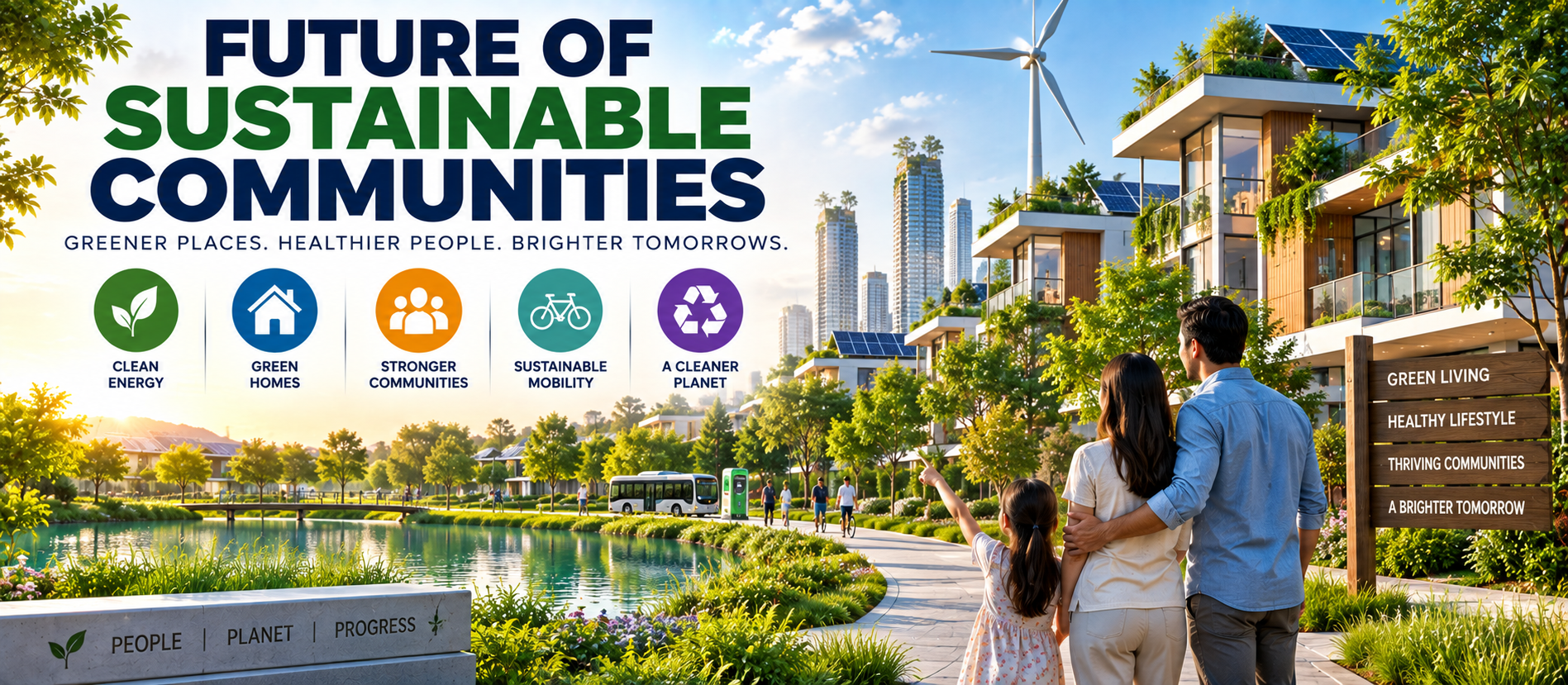
The future of sustainable communities is moving beyond green buildings and energy-efficient homes. A sustainable community must also be affordable, connected, safe, resilient, healthy, inclusive, and easy to live in.
Cities and neighborhoods are changing quickly. Climate risks are increasing. Urban populations are growing. Energy systems are becoming cleaner. Digital technology is changing how people travel, work, shop, communicate, and use public services.
These changes are creating a new model of community development. The goal is not simply to build modern buildings. The goal is to create places where people can live well while using fewer resources and preparing for future risks.
Recent research shows why this shift matters. UN-Habitat's 2026 SDG 11 report places housing at the center of sustainable cities because housing is closely connected with transport, public space, environmental quality, disaster risk reduction, and urban planning. In India, WRI India's 2026 urbanization research also highlights the need to connect housing, infrastructure, economic development, environmental sustainability, climate resilience, governance, and finance.
What Is a Sustainable Community?
A sustainable community is a neighborhood, town, city district, or wider urban area designed to support people and the environment over the long term.
It usually combines several elements:
- Energy-efficient buildings
- Clean and reliable energy
- Efficient public transport
- Walking and cycling infrastructure
- Affordable and diverse housing
- Reliable water and sanitation systems
- Waste reduction and recycling
- Green spaces and biodiversity
- Climate-resilient infrastructure
- Digital public services
- Local employment and economic opportunity
- Inclusive public spaces and community facilities
The important point is integration. A community cannot become truly sustainable by installing solar panels while ignoring poor public transport, water shortages, unsafe streets, or unaffordable housing.
Why Sustainable Communities Matter More Than Ever
Urban development decisions can influence energy use, emissions, mobility, housing costs, public health, and climate resilience for decades.
The World Bank has noted that India's urban population could rise from about 480 million in 2020 to 951 million by 2050. It also estimates that more than half of the infrastructure, buildings, and urban services needed for future urban growth are still to be created. This creates a major opportunity to design new development for resilience rather than retrofit everything later.
India's current urban transition also extends beyond large metropolitan areas. WRI India reports that urbanization is spreading across small towns, census towns, and peri-urban areas. Its 2026 research calls for better coordination between spatial planning, infrastructure, housing, economic development, environmental sustainability, climate resilience, governance, and finance.
1. Green Buildings Will Become the Community Standard
Buildings are one of the most important parts of sustainable communities. Future buildings will focus on lower energy demand, efficient water use, better indoor comfort, lower operating costs, and improved resilience.
Design features may include better insulation, natural ventilation, efficient lighting, high-performance glazing, smart energy controls, rooftop solar, rainwater harvesting, efficient cooling systems, and low-impact materials.
💡 Key Insight
Green building standards are also becoming more important. A 2026 review of Indian green building and regulatory frameworks found that green codes can reduce energy use significantly, while also noting challenges such as uneven enforcement and regional differences.
The future will therefore focus not only on certification at the time of construction. Building owners and managers will increasingly need to measure actual performance during operation.
2. Renewable Energy Will Move Closer to the Neighborhood
Sustainable communities will increasingly produce some of their own energy.
Rooftop solar is one example. Community solar systems, battery storage, microgrids, smart meters, and energy management platforms can also support local energy resilience.
A neighborhood energy system can help balance demand and supply. During normal conditions, it can reduce pressure on the wider grid. During outages or extreme weather events, local storage and distributed generation can support essential services.
Future communities may therefore think of energy as a local network rather than a service that only comes from a distant power plant.
3. Smart Mobility Will Reduce Car Dependence
Transportation is another major part of sustainable community design.
Future neighborhoods are likely to provide more choices. Residents may be able to walk to local shops, cycle to nearby destinations, use buses or rail for longer journeys, and access shared electric mobility when needed.
Transit-oriented development can place homes, workplaces, shops, schools, and services closer to major public transport routes. This can reduce unnecessary travel and make communities more convenient.
Electric vehicles will also become more common. However, sustainable mobility is not only about replacing petrol cars with electric cars. A community can become more efficient when fewer people need to use private cars for every trip.
India is already planning around this transition. For example, recent policy activity in Delhi has focused on wider EV adoption and charging infrastructure as part of urban sustainability efforts.
4. Walkable Neighborhoods Will Gain Importance
A sustainable community should work at human speed.
Safe sidewalks, shaded streets, connected footpaths, cycle lanes, crossings, public seating, and accessible public spaces can make daily life easier.
Walkability can also support local businesses. When residents spend more time walking through their neighborhood, nearby shops, cafés, services, and community spaces can become more active.
Good street design should consider children, older adults, people with disabilities, cyclists, pedestrians, delivery workers, and public transport users.
5. Water Management Will Become a Core Planning Priority
Water security is central to sustainable communities.
Future developments will need to manage both water supply and extreme rainfall. Useful strategies include rainwater harvesting, wastewater treatment, greywater reuse, permeable surfaces, restored ponds, urban wetlands, efficient irrigation, and leak detection.
Natural drainage should also be protected. Building over wetlands, floodplains, and natural drainage channels can increase future risk.
India's sustainable habitat framework includes measures such as protecting wetlands and water bodies, conserving urban water assets, improving drainage planning, and integrating climate action into city plans.
6. Climate Resilience Will Be Designed Into Communities
Sustainability is not only about reducing environmental impact. It is also about surviving shocks.
Future communities will need to prepare for heatwaves, flooding, storms, water shortages, power disruptions, and other climate-related risks.
⚠ Watch Out
Resilient design can include shaded public spaces, cool roofs, tree cover, flood-resistant infrastructure, emergency shelters, backup power, better drainage, water storage, and early-warning systems.
India's Ministry of Housing and Urban Affairs reported in 2026 that heat action plans had been prepared by 23 states, 195 districts, and 64 cities. This reflects the growing importance of heat resilience in urban planning.
7. Green Spaces Will Become Infrastructure
Trees and parks should not be treated only as decoration.
Urban greenery can provide shade, improve the public realm, support biodiversity, and help manage heat and storm water. Connected green spaces can also create ecological corridors.
Future communities may combine parks with rain gardens, bios wales, urban forests, ponds, community gardens, and shaded walking routes.
This approach is often called green and blue infrastructure. It treats natural systems as part of the city's infrastructure network.
8. Biodiversity Will Become Part of Community Design
Sustainable development must consider more than human needs.
Native plants, pollinator-friendly landscapes, bird habitats, restored water bodies, and connected green corridors can support urban biodiversity.
Future developments can reduce ecological damage by protecting existing trees and natural features before construction begins.
Good planning starts with understanding the site. It asks what natural systems already exist and how development can work with them rather than simply replacing them.
9. Circular Waste Systems Will Replace the Linear Model
The traditional model is simple: take resources, make products, use them, and throw them away.
Sustainable communities need a different model.
Buildings and neighborhoods can support waste separation, composting, recycling, repair, reuse, and material recovery. Construction projects can also reduce waste through better material planning and reuse of existing structures.
Future communities may increasingly track material flows just as they track energy and water.
10. Affordable Housing Will Be Central to Sustainability
A community cannot be called sustainable if only high-income residents can afford to live there.
Housing affordability should therefore be treated as part of sustainability.
Mixed-income neighborhoods can include different housing types, including apartments, smaller homes, rental housing, family housing, and accessible units.
Affordable housing near jobs and public transport can also reduce commuting costs and improve access to opportunity.
UN-Habitat's 2026 SDG 11 report emphasizes that housing affects progress across many areas of sustainable urban development.
11. Mixed-Use Development Will Make Communities More Efficient
Single-purpose districts can create long journeys. Mixed-use communities bring different activities closer together.
A well-planned neighborhood may include homes, offices, schools, healthcare, shops, parks, restaurants, and community facilities within a connected area.
This can make daily life more convenient and support local economic activity.
Mixed-use planning does not mean every building needs every function. It means the wider neighborhood should offer a useful combination of destinations.
12. Smart Technology Will Support Better Decisions
Technology will play an important role in sustainable communities, but it should solve real problems.
Sensors can measure energy use, air quality, water consumption, traffic, waste collection, and infrastructure performance.
Digital platforms can help residents report problems, access services, find transport options, manage utilities, or participate in local decisions.
Artificial intelligence can help planners analyze large datasets and identify patterns. It can support traffic planning, energy forecasting, maintenance scheduling, climate-risk analysis, and development scenarios.
However, technology should remain transparent and human-centered. A smart community is not simply a community filled with sensors. It is a place where information helps people make better decisions.
13. Digital Twins Will Improve Urban Planning
A digital twin is a digital representation of a physical place or system.
Future cities can use digital twins to test development scenarios before construction. Planners can examine how a new road, building, park, drainage system, or transit route might affect the wider area.
Digital models can also help manage existing infrastructure. Instead of waiting for a system to fail, operators can use performance data to identify maintenance needs earlier.
14. Community Health Will Become a Planning Metric
Sustainable communities should support physical and mental well-being.
Clean air, safe streets, access to nature, comfortable homes, healthy food options, public recreation spaces, and reliable healthcare all influence quality of life.
Future planning will increasingly consider whether a neighborhood helps people live healthier daily lives.
15. Local Jobs Will Strengthen Sustainable Communities
Economic sustainability is just as important as environmental sustainability.
Communities need jobs, businesses, skills, and investment.
Mixed-use development, local entrepreneurship, green construction, renewable energy, repair services, sustainable transport, recycling, and urban agriculture can all create economic opportunities.
WRI India has also highlighted the importance of green jobs and fair urban transitions, including work related to the buildings sector.
16. Sustainable Communities Will Need Better Governance
Good design cannot compensate for poor governance.
Local governments, developers, infrastructure providers, residents, businesses, and community organizations need clear responsibilities.
Planning should also use reliable data and measurable targets.
India's 2026 urbanization policy research from WRI India recommends stronger integration across planning, infrastructure, housing, environmental sustainability, resilience, governance, and finance.
Future communities will benefit when these areas are planned together instead of through isolated projects.
17. Community Participation Will Become More Important
People who live in a neighborhood understand local problems that may not appear in a technical report.
Residents can identify unsafe crossings, drainage problems, missing services, traffic conflicts, public-space needs, and accessibility barriers.
Digital consultation tools can make participation easier, but in-person engagement remains important. Sustainable development should be designed with communities, not only for communities.
18. Existing Neighborhoods Will Need to Be Upgraded
The future of sustainable communities is not only about new construction.
Most cities already contain large numbers of existing homes, roads, offices, schools, and public facilities. Improving these places can often be more practical than replacing them.
Retrofits can improve insulation, lighting, cooling, water efficiency, accessibility, safety, and energy performance.
Creative redevelopment can also reuse underutilized buildings and land. The Asian Development Bank has highlighted redevelopment and repurposing as tools for more inclusive, resilient, and sustainable urban growth.
19. Sustainable Communities Will Measure Performance
Future developers and local authorities will increasingly need measurable results.
Useful indicators can include:
- Energy consumption per building or household
- Renewable energy generation
- Water consumption and reuse
- Waste diversion from landfill
- Tree canopy and green-space access
- Public transport usage
- Walking and cycling rates
- Housing affordability
- Indoor comfort
- Air quality
- Climate-risk exposure
- Community satisfaction
Measurement turns sustainability from a marketing claim into a management process.
20. The Role of Developers and Real Estate Companies
Real estate developers have a major role in shaping future communities.
They can improve outcomes by considering sustainability from the earliest planning stage.
Important actions include:
- Selecting sites with access to transport and services
- Protecting natural features
- Reducing construction waste
- Designing efficient buildings
- Providing useful green spaces
- Supporting water conservation
- Planning for extreme weather
- Using durable materials
- Providing diverse housing options
- Measuring operational performance after completion
The best projects will increasingly combine environmental performance with practical value for residents.
21. Why Sustainable Communities Can Create Long-Term Value
Sustainability can support value in several ways.
Efficient buildings may reduce operating expenses. Good public transport can improve accessibility. Attractive green spaces can improve the quality of a neighborhood. Climate-resilient infrastructure can reduce disruption. Well-designed public spaces can support local economic activity.
However, sustainability should not be treated as a guarantee of property appreciation. Market value depends on location, demand, supply, financing, regulations, infrastructure, and many other factors.
The stronger approach is to view sustainability as one part of long-term asset quality and community performance.
22. Future Sustainable Communities Will Be More Connected
The community of the future will not operate as a collection of separate systems.
Energy will connect with buildings. Buildings will connect with transport. Transport will connect with land use. Water systems will connect with landscape design. Digital platforms will connect residents with public services.
This systems approach can reduce duplication and improve resource efficiency.
23. Challenges That Could Slow Sustainable Development
The transition will not be easy.
Common barriers include high upfront costs, fragmented governance, limited technical capacity, outdated infrastructure, weak enforcement, lack of reliable data, financing constraints, and resistance to change.
There can also be a gap between sustainable design on paper and actual performance after construction.
Policies therefore need to support implementation, maintenance, monitoring, and long-term accountability.
24. What the Future May Look Like
Imagine a neighborhood where most daily needs are within a short walk or public transport trip.
Buildings use less energy because they are designed for the local climate. Rooftop solar supports local power demand. Battery storage helps during outages. Streets have shade and safe walking routes. Rainwater is captured. Waste is separated at source. Parks support both people and biodiversity.
Residents use a digital platform to access transport, public services, local events, and community information. Sensors provide data about energy, water, air quality, and infrastructure. Planners use that information to improve the neighborhood.
This vision is not one single technology. It is the result of many practical decisions working together.
25. How Businesses Can Prepare for the Future of Sustainable Communities
Businesses connected to real estate, construction, architecture, infrastructure, technology, mobility, energy, and property management can prepare now.
Start by identifying the sustainability problems that customers actually face. Then develop solutions that are measurable and easy to understand.
For example, a property company can publish energy and water performance. A construction company can track material waste. A technology provider can create simple dashboards. A property manager can optimize building operations.
Clear communication is important. Customers increasingly need practical information, not vague sustainability claims.
26. How AI Search Is Changing Sustainable Community Research
People researching real estate and urban development increasingly use AI-powered search tools to ask direct questions.
They may ask:
- What makes a community sustainable?
- Which features reduce long-term living costs?
- How can a neighborhood prepare for heatwaves?
- What are the benefits of transit-oriented development?
- How can developers reduce water consumption?
- What technologies support smart communities?
For organizations, this creates a new content opportunity. Sustainable development information should be written in clear language with direct answers, structured headings, definitions, lists, examples, and credible evidence.
This is useful for SEO, Answer Engine Optimization (AEO), Generative Engine Optimization (GEO), and AI Search optimization. Search engines and AI systems can more easily understand content when the main question and answer are clearly stated.
27. Future Content Strategy for Sustainable Real Estate Brands
Real estate and urban development brands should publish useful educational content rather than relying only on promotional pages.
Strong content topics include green building features, energy savings, water management, sustainable materials, climate resilience, walkability, smart home systems, community design, public transport access, and long-term maintenance.
Each article should answer a specific user question. Facts should be supported by credible sources. Technical concepts should be explained simply.
This approach can help a brand become easier for both people and AI-powered search systems to understand.
28. A Practical Checklist for Sustainable Community Development
Before developing or evaluating a sustainable community, ask:
- Is the location connected to jobs and essential services?
- Can residents walk safely?
- Is public transport accessible?
- Are buildings designed for local climate conditions?
- Can renewable energy be used?
- How will water be collected, treated, and reused?
- How will storm water be managed?
- Are natural drainage systems protected?
- Is there enough shade and green space?
- Are biodiversity and native plants considered?
- Is housing accessible to different income groups?
- Can residents access healthcare, education, and community services?
- How will waste be reduced and recovered?
- How will extreme heat and flooding be managed?
- Are digital systems secure and useful?
- Will sustainability performance be measured after completion?
Frequently Asked Questions
What is the future of sustainable communities?
The future of sustainable communities combines efficient buildings, clean energy, smart mobility, water conservation, green infrastructure, climate resilience, affordable housing, digital services, and strong community participation.
Why are sustainable communities important?
They can help cities manage resource use, climate risks, infrastructure demand, housing needs, mobility challenges, and quality-of-life goals while supporting long-term economic development.
What technologies will support sustainable communities?
Important technologies include renewable energy, battery storage, smart meters, IoT sensors, digital twins, AI analytics, intelligent transport systems, building management systems, water monitoring, and digital public-service platforms.
Are sustainable communities only for large cities?
No. Sustainable planning can be applied to large cities, suburbs, small towns, peri-urban areas, villages, and new development projects. The right solution depends on local needs and resources.
How can real estate developers support sustainability?
Developers can select connected locations, protect natural assets, design efficient buildings, reduce construction waste, provide green and public spaces, improve water management, plan for climate risks, and measure operational performance.
What is the role of housing in sustainable communities?
Housing is a central part of sustainable development because its location, affordability, quality, energy performance, access to transport, and connection to services affect many other parts of urban life.
Can AI help create sustainable cities?
Yes. AI can help analyze urban data, forecast energy demand, optimize traffic, identify infrastructure problems, model climate risks, and support planning. Human oversight and responsible data governance remain important.
Conclusion: Building Communities for the Next Generation
The future of sustainable communities is not about creating perfect cities. It is about making better decisions today that reduce future risks and improve everyday life.
The strongest communities will combine environmental responsibility with affordability, accessibility, resilience, economic opportunity, and human well-being.
India's urban transition makes this especially important. Current research points toward more integrated planning, stronger climate resilience, better housing, greener infrastructure, improved mobility, and more coordinated urban governance.
For developers, investors, planners, businesses, and residents, the message is practical: sustainability should be built into the way communities are planned, constructed, operated, and measured.
The communities that succeed in the future will not simply use more technology. They will use technology, design, policy, finance, and community participation together to create places that are efficient, resilient, inclusive, and enjoyable to live in.
Digiifrog: Digital Growth for a Changing World
Digiifrog helps businesses build stronger digital visibility through content, SEO, AI Search optimization, GEO, and modern digital marketing strategies.
As sustainable communities become a major topic in real estate, construction, infrastructure, architecture, and urban development, clear digital communication will become increasingly important.
Learn more at www.digiifrog.com.
Sources and Further Reading
- UN-Habitat, SDG 11 Global Report 2026: Housing at the Centre of Sustainable Cities and Communities.
- WRI India, Equitable, Productive, Low-Carbon and Resilient System of Cities in India: National Urbanization Policy Recommendations, 2026.
- World Bank, Towards Resilient and Prosperous Cities in India.
- Asian Development Bank, Creative Redevelopment of Cities in India.
- Ministry of Housing and Urban Affairs, climate-resilient cities and urban heatwave initiatives.
- NITI Aayog, Scenarios Towards Vik sit Bharat and Net Zero: Sectoral Insights—Buildings, 2026.
Note: This article is for general educational and informational purposes. Specific development, investment, planning, legal, environmental, or construction decisions should be evaluated using current local regulations, professional advice, and project-specific data.
Ready to Grow?
Talk to us about a strategy tailored to your brand — we will help you stand out in search, AI discovery and social.

Comments (0)
Log in to leave a comment.