📋 Quick Summary
In this article:
What Does Investing With Limited Capital Mean?
1. Start With Your Financial Foundation
2. Pay Attention to High-Interest Debt
3. Define Your Investment Goal
4. Understand Your Time Horizon
5. Understand Risk Before You Invest
6. Begin With an Amount You Can Repeat
7. Use Automatic Contributions
8. Consider Dollar-Cost Averaging
9. Choose an Appropriate Investment Account
10. Understand Stocks, Bonds, and Funds
💡 Key Insight
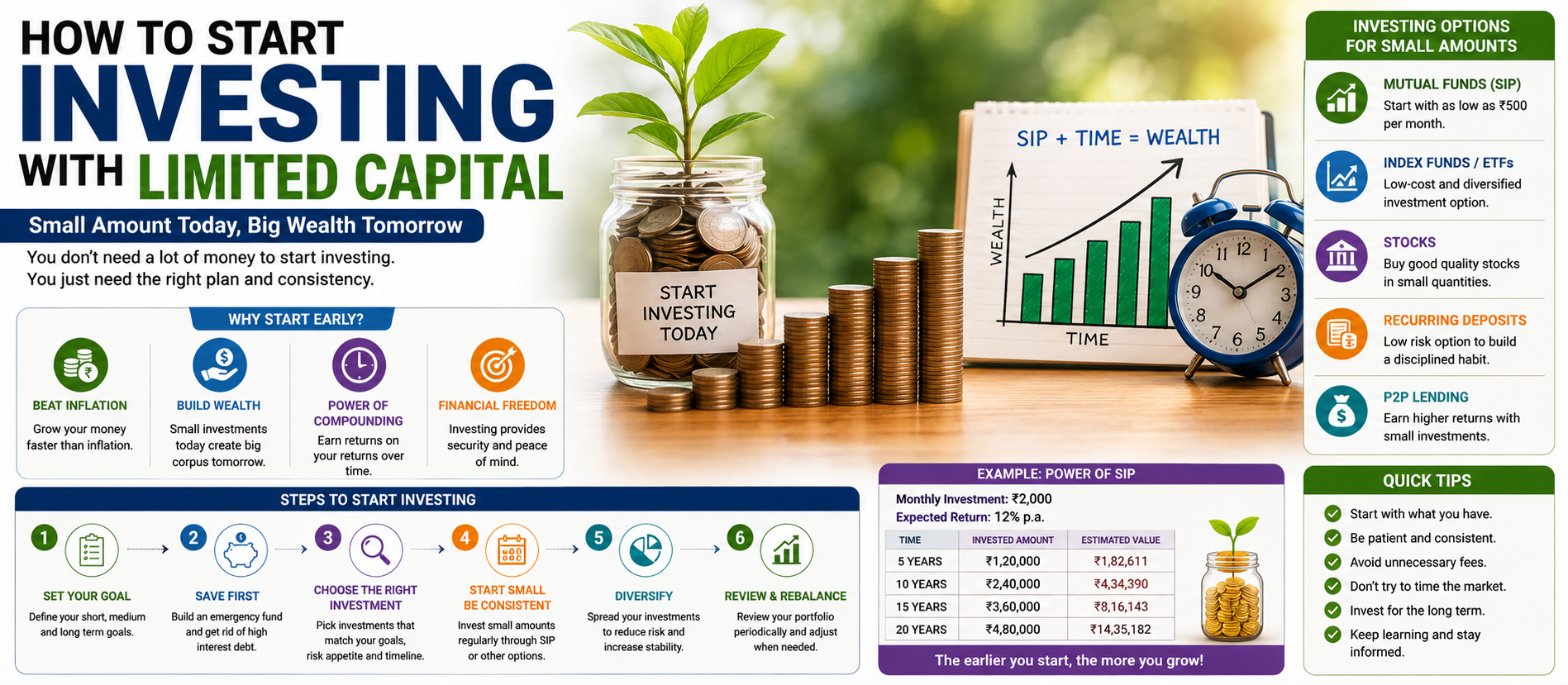
Investing is often associated with large amounts of money, expensive financial products, and complicated strategies. In reality, many people can begin investing with relatively small amounts if they have a clear goal, understand the risks, control costs, and contribute consistently over time. The most important factor for a new investor is not starting with a huge portfolio. It is building a sustainable investing habit.
How to start investing with limited capital begins with understanding your financial foundation, deciding what you are investing for, choosing an appropriate account and investment type, diversifying where practical, keeping fees under control, and investing regularly. Investor.gov explains that regular investing combined with time can support long-term wealth building through compound growth, while also emphasizing that all investments involve risk. citeturn0search2turn0search0
Someone may begin with $25, $50, $100, or another amount that fits their budget. The exact amount matters less than whether the contribution is affordable and repeatable. A small monthly investment can become meaningful when it continues for many years and the returns remain invested.
This WordPress-ready HTML article is prepared for Digiifrog (www.digiifrog.com) with a strong focus on SEO, AEO, GEO, and AI Search optimization.
What Does Investing With Limited Capital Mean?
Investing with limited capital means putting a manageable portion of your available money into assets intended to produce a return over time. These assets can include stocks, bonds, mutual funds, exchange-traded funds, and other investment products.
The objective is not to become rich quickly. A sensible beginner strategy focuses on building financial knowledge, developing discipline, managing risk, and allowing time and compounding to work.
Investor.gov describes investing as putting money into assets with the expectation of receiving a return through potential price appreciation, interest, dividends, or other forms of income. It also stresses that investments can lose value and that investors should understand risk before investing. citeturn0search2
1. Start With Your Financial Foundation
Before investing, make sure your basic financial needs are reasonably organized. You should know how much you earn, how much you spend, what debts you have, and how much cash you need for unexpected expenses.
FINRA recommends taking care of basic financial needs before investing, including maintaining money for emergencies and addressing high-interest debt. It notes that investors may need an emergency fund so unexpected expenses do not force them to sell investments at an unfavorable time. citeturn0search5
⚠ Watch Out
The exact size of an emergency fund depends on income stability, household expenses, dependents, insurance, and personal circumstances. The important principle is to avoid investing money that you may need immediately for essential expenses.
2. Pay Attention to High-Interest Debt
If you have expensive credit-card or other high-interest debt, paying it down may deserve priority over investing additional money in risky assets. High borrowing costs can work against your wealth-building efforts.
Compare the guaranteed cost of the debt with the uncertain return of an investment. There is no investment return that is guaranteed simply because historical markets have performed well.
3. Define Your Investment Goal
Do not begin by asking, “Which stock should I buy?” Start by asking, “What am I investing for?”
- Retirement
- Buying a home
- Education
- Long-term wealth building
- Starting a business
- A future major purchase
- Building an additional financial cushion
Your goal influences your time horizon, risk tolerance, asset allocation, and the type of account that may be appropriate.
4. Understand Your Time Horizon
Time horizon means how long you expect the money to remain invested before you need it. A goal that is decades away can generally tolerate more market fluctuation than money needed within a few months.
Investor.gov explains that knowing your time horizon and risk tolerance helps determine the types of investments that may be appropriate. citeturn0search2
Do not automatically put short-term savings into volatile investments simply because you want a higher return. Money needed soon has less time to recover from a market decline.
5. Understand Risk Before You Invest
Every investment carries some level of risk. A stock can decline, a bond can lose value, a fund can fall during a market downturn, and an investment product can perform differently from expectations.
Risk tolerance is partly financial and partly emotional. If you would panic and sell after a large market decline, a highly aggressive portfolio may not be appropriate for you.
The goal is not to eliminate all risk. The goal is to choose a level of risk that is consistent with your time horizon, financial situation, and ability to stay invested.
6. Begin With an Amount You Can Repeat
A common mistake is trying to invest too much at the beginning and then stopping because the contribution is uncomfortable.
Instead, choose an amount that can realistically fit into your monthly budget. It could be $25, $50, $100, or another amount. Increase the contribution later when income rises or expenses fall.
Consistency can be more useful than trying to make a large one-time investment that creates financial stress.
7. Use Automatic Contributions
Automation can make investing easier because money is transferred on a regular schedule instead of depending on willpower every month.
For example, an investor might schedule a recurring contribution shortly after receiving income. Over time, this creates a systematic process and reduces the temptation to spend money that was intended for long-term goals.
8. Consider Dollar-Cost Averaging
Dollar-cost averaging involves investing equal amounts at regular intervals regardless of market ups and downs. Investor.gov explains that this approach results in buying more shares when prices are lower and fewer when prices are higher, assuming the same investment amount is used each time. citeturn0search1
Dollar-cost averaging does not guarantee a profit or eliminate investment losses. Its main advantage for many beginners is that it creates a disciplined contribution process and reduces the need to make repeated decisions about when to invest.
9. Choose an Appropriate Investment Account
The right account depends on your country, goal, tax situation, employment benefits, and investment needs. Examples can include taxable brokerage accounts, retirement accounts, employer-sponsored plans, individual retirement arrangements, or other locally available investment accounts.
Tax treatment varies significantly by country. Before choosing an account, understand contribution limits, withdrawal rules, tax benefits, fees, and investment choices.
10. Understand Stocks, Bonds, and Funds
Stocks
Stocks represent ownership in companies. They can offer significant long-term growth potential but can also experience substantial price declines.
Bonds
Bonds generally represent loans made to governments, companies, or other issuers. They can provide interest income, but bond investments still carry risks such as interest-rate risk and credit risk.
Mutual Funds
Mutual funds pool money from investors and invest according to a stated strategy. They can provide diversification, but fees and investment objectives vary.
Exchange-Traded Funds
ETFs are pooled investment products that trade on exchanges. Many ETFs provide exposure to a broad market index or a particular asset category, although some are highly specialized.
11. Why Diversification Matters
Diversification means spreading investments across different assets rather than concentrating all your money in one investment. Investor.gov and FINRA both identify diversification and asset allocation as important tools for managing investment risk. citeturn0search6turn0search4
For example, owning one company's stock creates company-specific risk. A diversified fund holding many companies can reduce the impact that one company's poor performance has on the overall portfolio.
Diversification does not guarantee that a portfolio will not lose money. A broad market decline can affect many investments at the same time.
12. Consider Broad, Low-Cost Funds
For many beginners, broad-market funds can be easier to understand than selecting individual stocks. A single fund may provide exposure to many securities, which can simplify diversification.
Cost matters. Investor.gov notes that investment fees and expenses can have a major impact on a portfolio over time, even when individual fees appear small. citeturn0search0
When comparing funds, look at expense ratios, trading costs, account fees, and other charges. A lower-cost product is not automatically better, but unnecessary costs can reduce long-term returns.
13. Be Careful With Individual Stocks
Buying a small amount of an individual company can be an educational experience, but concentrating your portfolio in one or two companies can create substantial risk.
If you choose individual stocks, research the company, understand its business, consider valuation and financial condition, and recognize that even excellent companies can experience significant price declines.
Investor.gov recommends researching investments rather than purchasing solely because of tips from other people. citeturn0search3
14. Avoid Chasing Fast Profits
Limited capital can make quick-profit promises particularly tempting. Advertisements may claim that a small investment can become a huge amount in a short period.
High potential returns usually come with high risk, and some offers may be fraudulent. Be skeptical of guaranteed returns, urgent investment opportunities, secret strategies, and requests to transfer money quickly.
Investor.gov specifically recommends learning to recognize investment-fraud red flags and protecting your money before investing. citeturn0search0
15. Understand Investment Fees
Fees can include fund expenses, brokerage commissions, account fees, advisory fees, transaction costs, spreads, and other charges depending on the product.
For someone investing a small amount, fees can be particularly important. A flat fee that looks small in dollars can represent a large percentage of a small contribution.
Always ask how much you pay to open an account, buy or sell an investment, maintain the account, and hold the investment.
16. Start With Simple Investments
Beginners do not need a portfolio containing dozens of complicated products. A simple strategy can be easier to maintain and understand.
The more complex an investment becomes, the more important it is to understand how it works, what can cause losses, what fees apply, and how easily you can exit the position.
17. Avoid Frequent Trading
Frequent trading can increase transaction costs, taxes, emotional stress, and the risk of making poor decisions based on short-term market movements.
Long-term investing is different from short-term speculation. If your goal is long-term wealth building, consider whether every trade actually supports that objective.
18. Do Not Try to Predict Every Market Move
Markets move because of many factors, including company performance, economic conditions, interest rates, investor expectations, geopolitical developments, and changing sentiment.
Trying to predict every short-term movement can encourage emotional decisions. A rules-based contribution plan can be easier to follow.
19. Increase Contributions Gradually
You do not need to start with a large monthly contribution. Begin with a sustainable amount and increase it when your income grows.
For example, an investor contributing $50 per month could increase the contribution to $60 or $75 after a salary increase. Small increases can become meaningful over long periods.
20. Let Compound Growth Work Over Time
Compound growth occurs when investment returns remain invested and can themselves generate future returns. The effect becomes stronger as the investment period grows.
Investor.gov illustrates the potential power of regular contributions and long-term compounding using hypothetical return assumptions. These examples are not guarantees; actual investment returns vary. citeturn0search2
The key lesson is that starting early can give your money more time to compound. You do not need a large initial investment to benefit from the principle.
21. A Simple Example of Small Monthly Investing
Suppose an investor contributes $100 per month for 20 years. The investor contributes $24,000 in total. If the investment earns a hypothetical average annual return of 7%, compounded monthly, the ending value could be around $52,000 before taxes and fees.
This is only an illustration. Markets do not deliver a fixed 7% every year, and actual results can be substantially higher or lower. The example demonstrates how regular contributions and time can work together.
22. Investing With Limited Capital in India
Indian investors have access to several investment routes, including mutual funds, exchange-traded funds, direct equities, government securities, fixed-income products, retirement-oriented accounts, and other regulated options. The appropriate choice depends on the investor's goals, risk tolerance, time horizon, taxation, and eligibility.
Before investing, verify that the platform, intermediary, and investment product are appropriately regulated for the service being offered. Do not invest solely because a social-media personality or online group recommends a product.
23. Investing With Limited Capital in the United States
U.S. investors may use brokerage accounts and tax-advantaged retirement accounts such as employer-sponsored plans or IRAs, depending on eligibility. The tax advantages, contribution limits, withdrawal rules, and investment options differ between account types.
Investors should review official account rules and consider professional tax or financial guidance when their situation is complex.
24. Build a Basic Investment Plan
A beginner investment plan can be simple:
- Define the goal.
- Choose the time horizon.
- Assess risk tolerance.
- Build appropriate emergency savings.
- Address expensive debt.
- Choose an investment account.
- Select diversified investments that fit the goal.
- Automate contributions.
- Review fees.
- Review the plan periodically rather than reacting to every market move.
25. Review Your Portfolio Periodically
Checking your portfolio every hour can encourage emotional decisions. Instead, review it at a reasonable interval to make sure your investments still match your goals and risk tolerance.
FINRA explains that rebalancing can help investors return a portfolio toward its intended asset allocation when market movements change the portfolio's mix. citeturn0search4
26. Rebalance When Appropriate
Suppose your target allocation is divided between stocks and bonds. If stocks rise significantly, the portfolio may become more heavily weighted toward stocks than originally intended.
Rebalancing can restore the target allocation, but the appropriate frequency and method depend on the investor's situation. Taxes and transaction costs should also be considered.
27. Keep Investment Money Separate From Emergency Savings
An emergency fund is designed for unexpected expenses and should generally be held in a form that is accessible and relatively stable. Investments are intended for goals that can tolerate market fluctuations.
Keeping these purposes separate can reduce the chance that you will have to sell a volatile investment during a market decline to pay an unexpected bill.
28. Be Careful With Investment Apps
Modern investing apps can make investing accessible with small amounts. However, convenience can also encourage frequent trading.
Before using an app, understand its fees, investment products, account protections, withdrawal process, customer support, and regulatory status. Easy access should not replace careful decision-making.
29. Fractional Shares Can Lower Entry Barriers
Some investment platforms allow fractional ownership of securities, meaning an investor can purchase a portion of a share rather than needing enough money to buy one whole share.
This can make diversification more accessible to investors with limited capital. Availability, fees, voting rights, transfer rules, and eligible securities vary by platform.
30. Use Investment Education Before Increasing Risk
Limited capital can actually be an advantage for learning because mistakes may have smaller financial consequences when the portfolio is small. Use the early stage to understand diversification, fees, risk, taxes, account types, and market behavior.
As your knowledge grows, you can decide whether you need a more sophisticated investment strategy.
31. Common Mistakes New Investors Should Avoid
- Investing emergency savings
- Ignoring high-interest debt
- Putting everything into one stock
- Chasing social-media tips
- Ignoring fees
- Trading too frequently
- Using borrowed money without understanding the risks
- Expecting guaranteed returns
- Panic-selling during market declines
- Investing without a goal
32. How to Stay Consistent During Market Declines
Market declines are a normal feature of investing. A portfolio can temporarily lose value even when the long-term plan remains sound.
If your investment goal is long term, review whether the decline changes your underlying plan or simply reflects normal market volatility. Avoid making major decisions solely because of fear.
However, staying invested does not mean ignoring new information. If your financial situation, time horizon, or risk tolerance changes, your investment plan may need to change as well.
33. How to Increase Your Investment Capital
One of the most effective ways to increase investing capacity is to improve the gap between income and expenses.
- Automate savings after receiving income.
- Reduce unnecessary subscriptions.
- Control recurring expenses.
- Increase income through skills or additional work.
- Direct part of salary increases toward investing.
- Use windfalls thoughtfully instead of spending everything.
The goal is not extreme frugality. It is creating a sustainable amount of money that can be invested without harming essential financial needs.
34. How Technology Is Changing Small-Scale Investing
Technology has lowered some barriers to investing. Digital account opening, automated contributions, fractional investing, portfolio tracking, educational tools, and low-cost fund access can make investing easier for beginners.
Artificial intelligence is also increasingly used for financial education, research assistance, portfolio analysis, and personalized explanations. However, AI-generated information should be verified, especially when it involves specific investments, tax rules, or individualized financial recommendations.
35. SEO, AEO, GEO and AI Search for Financial Businesses
Financial companies can use SEO to improve traditional search visibility, AEO to answer specific investor questions, and GEO and AI Search optimization to improve visibility in generative search experiences.
Useful financial content should explain concepts clearly, disclose risks, avoid unrealistic promises, answer frequently asked questions, and use structured information that search systems can understand.
Topics such as “how to start investing with $100,” “best investments for beginners,” “how diversification works,” “what are investment fees,” and “how compound growth works” can be addressed through educational, evidence-based content.
36. A Beginner's Monthly Investing Routine
A simple monthly routine can include reviewing your budget, transferring your planned contribution, checking whether your investments remain aligned with your target allocation, and recording your progress.
There is no need to constantly trade. The purpose of the routine is to maintain discipline and ensure that investing remains connected to your financial goals.
37. How to Start With $25, $50, or $100
With $25: Focus on building the habit and learning how your chosen account works. Consider a diversified investment if available and appropriate.
With $50: Automate the contribution and prioritize low-cost, diversified options where they fit your goal.
With $100: You may have more flexibility to diversify, but simplicity is still valuable. Avoid adding unnecessary products just because you have a larger monthly contribution.
The exact investment depends on your country, account, taxes, time horizon, and risk tolerance.
38. When Should You Increase Your Investment?
Consider increasing contributions when your income rises, debts decrease, expenses fall, or you receive a recurring financial benefit such as a salary increase.
Increasing contributions gradually can be easier than attempting a major increase all at once.
39. When Should You Consider Professional Advice?
Professional financial or tax advice may be useful when your situation involves complex taxes, multiple income sources, inheritance, business ownership, retirement planning, concentrated investments, or significant assets.
Even when working with an adviser, understand the fees, services, conflicts of interest, and qualifications. Do not assume that professional advice automatically means better investment performance.
40. Final Checklist for Starting With Limited Capital
- Know your monthly budget.
- Maintain appropriate emergency savings.
- Address high-interest debt.
- Define a clear investment goal.
- Choose a realistic time horizon.
- Understand your risk tolerance.
- Choose a suitable account.
- Compare investment fees.
- Prefer understandable investments.
- Diversify where appropriate.
- Automate regular contributions.
- Review the portfolio periodically.
- Ignore unrealistic guaranteed-return promises.
- Keep learning.
Frequently Asked Questions About Investing With Limited Capital
Can I start investing with only $50?
Yes, depending on the investment platform and product available in your country. The more important question is whether the investment is affordable, diversified where appropriate, and suitable for your goal and risk level.
What is the best investment for a beginner with little money?
There is no single best investment for everyone. A diversified, low-cost fund may be suitable for some long-term investors, while other goals may require different assets. Your time horizon, risk tolerance, taxes, and account type matter.
Should I invest before building an emergency fund?
For many people, building appropriate emergency savings first is sensible. FINRA recommends having funds available for emergencies so unexpected expenses do not force you to sell investments at an unfavorable time. citeturn0search5
Is dollar-cost averaging a safe strategy?
Dollar-cost averaging is a contribution method, not a guarantee against losses. It can provide a consistent investing schedule, but the underlying investment can still rise or fall in value. citeturn0search1
Should beginners buy individual stocks?
Individual stocks can be risky because the portfolio may become concentrated in a small number of companies. Beginners should understand diversification and the risks of concentration before selecting individual securities.
How important are investment fees?
Fees are important because even relatively small ongoing costs can reduce portfolio growth over time. Compare fund expenses, account fees, commissions, spreads, and advisory charges before investing. citeturn0search0
Can small investments really grow?
Small regular investments can potentially grow over long periods through contributions and compound growth. Actual results depend on investment performance, fees, taxes, and the length of time invested. No return is guaranteed. citeturn0search2
Is investing better than keeping money in savings?
They serve different purposes. Savings can be appropriate for short-term needs and emergency funds, while investing is generally intended for longer-term goals where market fluctuations can be tolerated.
How often should I check my investments?
There is no universal schedule. For long-term investors, periodic reviews are generally more useful than reacting to daily market movements. Review when your goals, financial situation, or risk tolerance changes as well.
Conclusion
Starting to invest with limited capital is possible when you focus on consistency, diversification, reasonable costs, risk management, and time. You do not need a large portfolio to begin learning how investing works. Starting with a manageable amount can help you develop a long-term habit without putting essential finances at risk.
Build your financial foundation first, define your goal, understand your time horizon, choose investments that match your risk tolerance, and automate contributions when practical. Avoid guaranteed-return promises, excessive trading, unnecessary fees, and concentrated bets that you do not fully understand.
Most importantly, remember that investing is a long-term process rather than a race. Small contributions made consistently can become meaningful over time, especially when investment returns remain invested and compound. Investor.gov emphasizes the relationship between regular investing, time, and compound growth while also warning that investment values can fluctuate and losses are possible. citeturn0search2
For businesses looking to improve their digital presence, build AI-powered websites, automate customer interactions, implement SEO, AEO, GEO, AI Search optimization, and develop modern technology solutions for financial and investment businesses, Digiifrog can help. Visit www.digiifrog.com to learn more.
Quick Answer: How Can You Start Investing With Limited Capital?
Start by building appropriate emergency savings, addressing high-interest debt, setting a clear financial goal, choosing a realistic time horizon, selecting a suitable investment account, and investing a small amount regularly into diversified and understandable investments. Automate contributions where possible, compare fees, avoid concentrated bets and unrealistic promises, and increase your contributions gradually as your income and financial situation improve. Investing involves risk, so never invest money you cannot afford to lose or money you may need for immediate essential expenses.
Ready to Grow?
Talk to us about a strategy tailored to your brand — we will help you stand out in search, AI discovery and social.


Comments (0)
Log in to leave a comment.