📋 Quick Summary
In this article:
1. Who Can Be Affected by GDPR?
2. The Seven Core GDPR Principles
3. Lawful Bases for Processing
4. Data Minimization and Purpose Limitation
5. Important GDPR Rights for Individuals
6. Privacy Notices and Transparency
7. Data Security and Privacy by Design
11. California CCPA and CPRA
12. UK GDPR and the UK Privacy Framework
13. Brazil's LGPD
14. India's Digital Personal Data Protection Framework
GDPR and global privacy regulations have changed the way organizations collect, use, store, share, and protect personal information. Businesses that operate websites, mobile applications, e-commerce stores, SaaS platforms, marketing systems, or customer databases may have privacy obligations in more than one country.
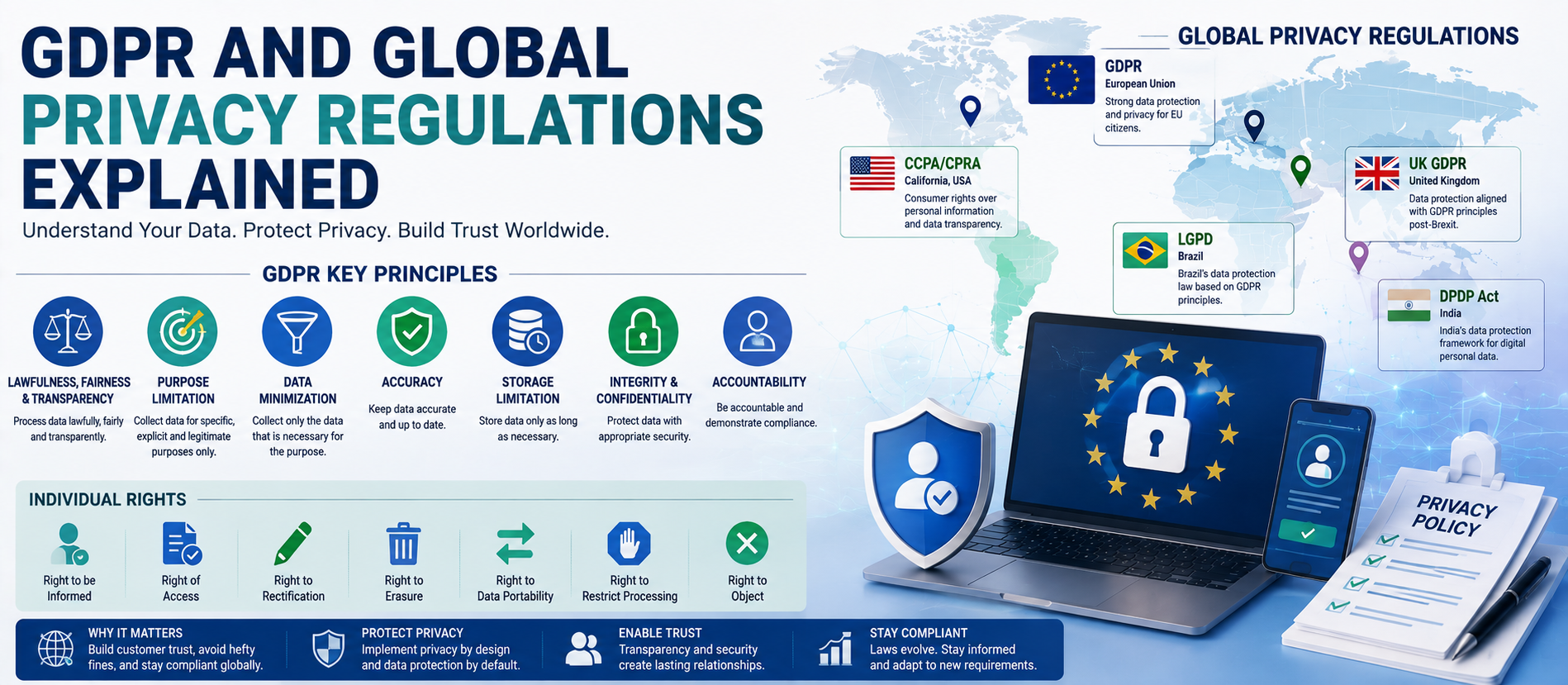
The European Union's General Data Protection Regulation (GDPR) is one of the most influential privacy laws in the world. It established a strong framework around lawful processing, transparency, data minimization, individual rights, security, accountability, and international data transfers. Other jurisdictions have developed their own privacy regimes, including the California Consumer Privacy Act (CCPA), Brazil's LGPD, India's Digital Personal Data Protection framework, and the UK's post-Brexit UK GDPR regime.
These laws are not identical. GDPR compliance does not automatically mean compliance everywhere. Organizations should identify applicable laws, map data flows, understand local requirements, and build controls that can accommodate different obligations.
This WordPress-ready HTML article is prepared for Digiifrog (www.digiifrog.com) with SEO, AEO, GEO, and AI Search optimization.
What Is the GDPR?
The General Data Protection Regulation (GDPR) is the European Union's major personal-data protection framework. It governs how organizations process personal data and gives individuals significant rights over information relating to them.
GDPR is technology-neutral. Personal data can include information such as names, identification numbers, location information, online identifiers, and combinations of information that can identify a living person. Pseudonymized information can still remain personal data when re-identification is possible. citeturn0search6
1. Who Can Be Affected by GDPR?
GDPR is not limited to companies physically located in the EU. Its reach can extend to organizations outside the EU when they offer goods or services to people in the EU or monitor their behavior in circumstances covered by the regulation.
A business outside Europe should evaluate its customers, services, and processing activities.
2. The Seven Core GDPR Principles
The European Commission identifies seven central GDPR principles: lawfulness, fairness and transparency; purpose limitation; data minimization; accuracy; storage limitation; integrity and confidentiality; and accountability. citeturn0search1
- Lawfulness, fairness and transparency: Process data legally, fairly, and openly.
- Purpose limitation: Collect data for specific, legitimate purposes.
- Data minimization: Collect only what is necessary.
- Accuracy: Keep personal information accurate and updated.
- Storage limitation: Do not retain personal data longer than necessary.
- Integrity and confidentiality: Protect information with appropriate security measures.
- Accountability: Be able to demonstrate compliance.
3. Lawful Bases for Processing
GDPR does not require consent for every use of personal data. Organizations need an appropriate legal basis for each processing activity. Depending on the circumstances, these can include consent, contract, legal obligation, vital interests, public task, or legitimate interests.
Identify and document the lawful basis that actually applies.
4. Data Minimization and Purpose Limitation
Privacy compliance begins with asking a simple question: Do we really need this data? If a business needs only a customer's name and email address to deliver a service, collecting additional sensitive information without a valid purpose increases privacy and security risk.
The European Commission explains that personal data should be adequate, relevant, and limited to what is necessary for the stated purpose. citeturn0search11
5. Important GDPR Rights for Individuals
GDPR gives individuals a range of rights, including the right to be informed, access personal data, correct inaccurate information, request erasure in applicable circumstances, restrict processing, obtain data portability, object to certain processing, and receive protections concerning certain automated decision-making and profiling. citeturn0search0
Organizations need processes for receiving, verifying, tracking, and responding to requests. GDPR generally requires a response without undue delay and at the latest within one month, subject to its rules and exceptions. citeturn0search0
6. Privacy Notices and Transparency
A privacy notice should explain what personal data is collected, why it is used, the relevant legal basis, retention information, recipients or categories of recipients, international transfers where applicable, and individual rights.
Privacy information should be concise, transparent, intelligible, and written in clear language. citeturn0search3turn0search10
7. Data Security and Privacy by Design
Privacy compliance is closely connected with cybersecurity. Organizations should use appropriate technical and organizational measures to protect personal data against unauthorized access, unlawful processing, accidental loss, destruction, or damage.
GDPR also promotes data protection by design and by default. Privacy should therefore be considered during product design, software development, system configuration, and business-process planning rather than added only after launch. citeturn0search1
11. California CCPA and CPRA
💡 Key Insight
The California Consumer Privacy Act (CCPA), as amended by the California Privacy Rights Act (CPRA), gives eligible California consumers important rights concerning personal information. These include rights to know, delete, correct, opt out of sale or sharing, and limit certain uses of sensitive personal information, subject to applicable rules and exceptions. citeturn0search2
The California framework demonstrates an important difference from GDPR: terminology, thresholds, exemptions, consumer rights, notices, and business obligations are not identical. A global company should maintain a jurisdiction-specific privacy matrix rather than copying one policy everywhere.
12. UK GDPR and the UK Privacy Framework
The United Kingdom maintains the UK GDPR alongside its domestic data-protection legislation. The UK's Information Commissioner's Office identifies seven key principles broadly aligned with GDPR: lawfulness, fairness and transparency; purpose limitation; data minimization; accuracy; storage limitation; integrity and confidentiality; and accountability. citeturn1search0
The UK framework also provides individual rights such as access, rectification, erasure, restriction, portability, objection, and protections relating to certain automated decision-making. citeturn1search6
UK privacy requirements continue to evolve. The Data (Use and Access) Act 2025 has introduced changes affecting UK data-protection law, so businesses should use current ICO guidance rather than relying on old GDPR checklists. citeturn1search0turn1search5
13. Brazil's LGPD
Brazil's Lei Geral de Proteção de Dados (LGPD) is a major privacy framework governing the processing of personal data in Brazil. Brazil's National Data Protection Authority (ANPD) describes individual rights that include information about processing, confirmation of processing, access to personal data, and correction of inaccurate data. citeturn1search12
Brazilian businesses should evaluate LGPD separately from GDPR because terminology, legal bases, procedures, and implementation requirements can differ.
14. India's Digital Personal Data Protection Framework
India has developed its Digital Personal Data Protection framework, including the Digital Personal Data Protection Act and the Digital Personal Data Protection Rules, 2025. India's Ministry of Electronics and Information Technology published the 2025 Rules and related enforcement information in November 2025. citeturn0search9
Businesses serving Indian users should follow the official implementation timeline and assess obligations under India's current law, rules, notifications, and applicable roles.
15. Why Global Privacy Laws Look Similar but Are Not the Same
Many privacy laws share common themes: transparency, data minimization, security, individual rights, accountability, and restrictions on certain uses of personal information. However, the details differ.
Differences can include who is covered, which data is regulated, thresholds for applicability, legal bases, consumer rights, response deadlines, breach notification rules, children's data requirements, cross-border transfer mechanisms, regulator powers, and penalties.
16. Building a Global Privacy Compliance Program
A practical global privacy program starts with a data inventory: identify what personal data is collected, why it is used, where it is stored, who can access it, which vendors receive it, and when it should be deleted.
Then document processing activities and legal bases, review privacy notices and retention rules, implement security controls, and establish procedures for individual-rights requests.
SEO, AEO, GEO and AI Search Optimization
SEO content on privacy regulations should target searches such as “GDPR explained,” “global privacy regulations,” “GDPR vs CCPA,” “GDPR compliance checklist,” and “data privacy laws around the world.”
AEO should provide direct answers to questions such as “What is GDPR?”, “Does GDPR apply outside Europe?”, “What are the seven GDPR principles?”, and “How is GDPR different from CCPA?”
⚠ Watch Out
GEO and AI Search optimization can be improved with jurisdiction-specific information, official regulatory sources, structured headings, concise definitions, comparison-focused explanations, FAQs, and clear warnings that privacy requirements change by country.
Frequently Asked Questions About GDPR and Global Privacy Regulations
What is GDPR in simple terms?
GDPR is a European Union data-protection framework that regulates personal-data processing and gives individuals significant rights over their information. It emphasizes lawful processing, transparency, data minimization, security, accountability, and individual rights. citeturn0search1turn0search0
Does GDPR apply to companies outside Europe?
It can. GDPR may apply to organizations outside the EU when their activities fall within the regulation's territorial scope, including certain offerings of goods or services to people in the EU or monitoring of their behavior. citeturn0search6
Is CCPA the same as GDPR?
No. They share privacy concepts but have different scope, terminology, rights, exemptions, obligations, and enforcement structures. California's official guidance lists rights including knowing, deleting, correcting, opting out of sale or sharing, and limiting certain uses of sensitive personal information. citeturn0search2
Why do businesses need a global privacy strategy?
Because a company may serve people in multiple jurisdictions, and privacy laws can differ in scope, rights, deadlines, transfer requirements, and enforcement. A global strategy can provide common controls while allowing jurisdiction-specific requirements to be implemented where necessary.
Conclusion
GDPR and global privacy regulations are not simply legal documents; they are frameworks for responsible data management. Businesses need to know what information they collect, why they collect it, how long they keep it, who receives it, where it moves, and how individuals can exercise their rights.
The GDPR provides an influential model based on seven core principles and strong individual rights. California's CCPA, the UK's evolving privacy framework, Brazil's LGPD, and India's Digital Personal Data Protection framework demonstrate how privacy regulation is developing across major markets. citeturn0search1turn0search2turn1search0turn1search12turn0search9
The best approach is to combine legal review, data mapping, privacy-by-design, cybersecurity, vendor management, clear notices, rights-request processes, and ongoing regulatory monitoring.
For businesses seeking modern websites, privacy-focused content, automation, SEO, AEO, GEO, and AI Search optimization, Digiifrog can help. Visit www.digiifrog.com.
Quick Answer: What Are GDPR and Global Privacy Regulations?
GDPR is the European Union's major personal-data protection framework. Global privacy regulations include other regional and national laws such as California's CCPA, the UK's GDPR framework, Brazil's LGPD, and India's Digital Personal Data Protection framework. Although these laws share principles such as transparency, data minimization, security, and individual rights, their scope and detailed requirements differ.
Important Note
This article is general educational content, not legal advice. Privacy requirements depend on jurisdiction, business model, data types, processing activities, contracts, and regulatory developments. Organizations should obtain qualified legal or privacy-professional advice for compliance decisions and verify current official requirements before acting.
Ready to Grow?
Talk to us about a strategy tailored to your brand — we will help you stand out in search, AI discovery and social.


Comments (0)
Log in to leave a comment.