📋 Quick Summary
In this article:
1. How Firewalls Control Network Traffic
2. Firewalls Create Security Boundaries
3. Perimeter Protection
4. Internal Segmentation and Lateral Movement
5. Stateful Firewall Inspection
6. Next-Generation Firewall Capabilities
8. Protecting Public-Facing Services
9. Controlling Outbound Traffic
11. Firewalls in Cloud Environments
12. Firewalls and Zero Trust
14. Why Firewall Rules Matter
💡 Key Insight
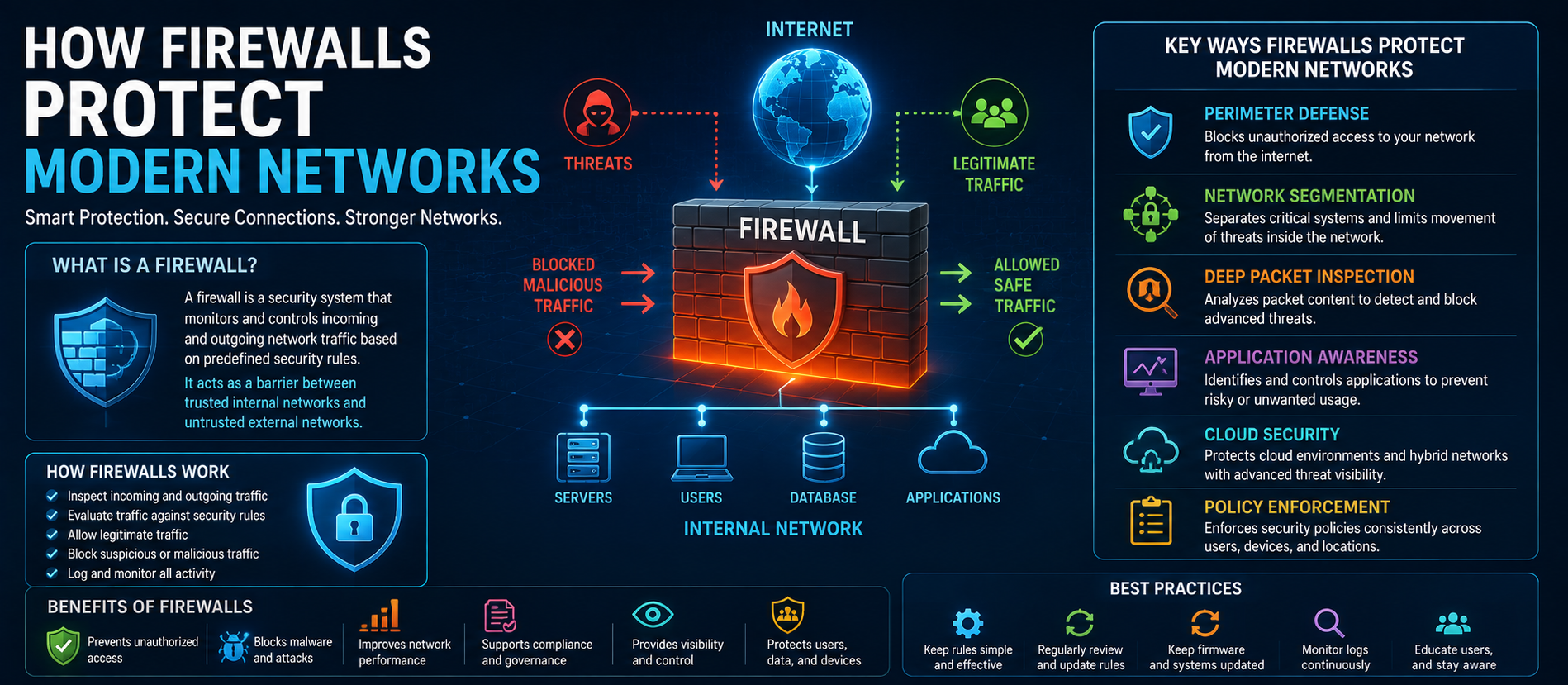
How firewalls protect modern networks is an important question for businesses, schools, healthcare organizations, financial institutions, and home users. A firewall acts as a traffic-control point that can allow, block, or inspect network connections according to defined security policies. Modern networks are more complex than the traditional office network connected to one internet gateway, so firewall protection has evolved as well.
Organizations now operate cloud workloads, remote offices, mobile devices, SaaS applications, IoT devices, and hybrid infrastructure. NIST notes that this changing landscape requires security approaches beyond a simple perimeter. citeturn0search2turn0search22
Firewalls remain an important security layer, but they are not a complete cybersecurity solution. Their effectiveness depends on sound architecture, carefully designed rules, secure administration, patching, monitoring, and integration with other controls.
This WordPress-ready HTML article is prepared for Digiifrog (www.digiifrog.com) with SEO, AEO, GEO, and AI Search optimization.
What Is a Firewall?
A firewall is hardware, software, or a combination of both that controls network traffic between networks or hosts with different security requirements. NIST describes firewalls as mechanisms that control the flow of traffic between networks or hosts employing different security postures. citeturn0search1turn0search3
A firewall works like a security checkpoint: it evaluates connections against rules and permits or blocks them according to policy.
1. How Firewalls Control Network Traffic
Firewall rules can evaluate information such as source and destination addresses, ports, protocols, connection state, applications, users, and other security signals depending on the firewall technology.
For example, a company may allow web traffic to a public website while blocking direct internet access to an internal database. It may allow employees to reach approved business applications while preventing guest Wi-Fi devices from accessing internal systems.
CISA describes firewalls as devices that can block unauthorized connections or allow limited communication between networks and devices. citeturn0search21
2. Firewalls Create Security Boundaries
One of the most important firewall functions is establishing boundaries between areas with different trust or security requirements. A network may contain public-facing services, employee devices, servers, management systems, guest devices, and sensitive databases.
Separating these areas can reduce the opportunity for an attacker who compromises one system to move freely into another part of the environment.
NIST recommends considering firewall placement where networks with different security requirements interface, including internal network segments as well as external boundaries. citeturn0search24
3. Perimeter Protection
Traditional firewalls were often deployed at the network perimeter between an organization's internal network and the public internet. They remain useful at these boundaries because they can restrict unwanted inbound and outbound connections.
However, modern security architecture should not assume that everything inside the network is automatically trusted. Cloud applications, remote employees, contractors, mobile devices, and third-party services have changed where security boundaries exist.
4. Internal Segmentation and Lateral Movement
Firewalls can also be placed inside an organization's network to separate sensitive systems. This is known as internal segmentation. For example, a company could separate its finance systems from general employee devices and isolate production technology from office IT.
If an attacker compromises a workstation, segmentation can make it harder to reach unrelated systems. CISA describes firewalls as gatekeepers between network zones and emphasizes that segmentation can protect assets at multiple levels. citeturn0search25
5. Stateful Firewall Inspection
Stateful firewalls track the state of network connections. Instead of examining each packet in complete isolation, they can determine whether traffic belongs to an established and permitted connection.
NIST describes stateful inspection as dynamic packet filtering that monitors connection state and determines which packets belong to known active connections. citeturn0search22
6. Next-Generation Firewall Capabilities
Modern next-generation firewalls can combine traditional traffic filtering with capabilities such as application awareness, deeper inspection, intrusion-prevention functions, malware-related controls, user or identity context, and security intelligence.
These features provide more context than rules based only on IP addresses and ports, but they can also increase configuration complexity and administrative requirements.
8. Protecting Public-Facing Services
Web servers, APIs, remote-access services, and other internet-facing systems are exposed to a larger attack surface. Firewalls can restrict which connections are allowed to these services and can help separate public-facing systems from sensitive internal resources.
Public-facing services can be placed in controlled zones while databases and administrative systems remain more restricted.
9. Controlling Outbound Traffic
Firewalls can control not only incoming connections but also outbound traffic. Egress filtering can limit where internal systems are permitted to communicate.
This can be useful during malware incidents. If a compromised workstation attempts to contact an unauthorized external service, an outbound firewall policy may block or restrict the connection.
11. Firewalls in Cloud Environments
Cloud environments use different mechanisms for controlling network access, including cloud-native firewall services, security groups, network access controls, virtual appliances, and application-level controls.
NIST's secure enterprise network guidance recognizes that modern environments require security capabilities across cloud services, applications, devices, and network configurations rather than a single perimeter appliance. citeturn0search2
12. Firewalls and Zero Trust
Firewalls can support Zero Trust architectures by enforcing segmentation and access policies, but a firewall alone does not create Zero Trust. Zero Trust also considers identity, device state, authorization, application access, continuous evaluation, and least privilege.
In modern environments, firewall capabilities may be integrated with broader secure-access architectures such as Zero Trust Network Access and SASE. citeturn0search2
14. Why Firewall Rules Matter
A firewall is only as effective as the policy it enforces. Overly broad rules can expose systems, while excessively restrictive rules can disrupt legitimate business operations.
CISA guidance warns that overly permissive, nonexistent, or unpatched firewalls can create vulnerabilities. citeturn0search21 Organizations should use a documented rule-management process, review unnecessary rules, and remove obsolete access.
15. The Principle of Least Privilege
Firewall policies should generally allow only the communication that is required for a legitimate business purpose. A rule that permits every source to reach every destination creates a much larger attack surface than a narrowly scoped rule.
CISA's defense-in-depth guidance emphasizes the principle that traffic should be explicitly permitted when required and otherwise denied, rather than relying on broad “allow all” policies. citeturn0search25
17. Common Firewall Mistakes
- Leaving unnecessary ports or services exposed.
- Using overly broad “allow” rules.
- Failing to review old firewall rules.
- Ignoring outbound traffic controls.
- Allowing unrestricted administrative access.
- Failing to patch firewall software or firmware.
- Not monitoring firewall logs.
- Relying on a firewall as the only security control.
- Ignoring internal network segmentation.
- Failing to document configuration changes.
Practical Firewall Security Checklist
- Document network zones and their security requirements.
- Define exactly which traffic each zone needs.
- Block unnecessary inbound connections.
- Control outbound traffic where appropriate.
- Use internal segmentation for sensitive systems.
- Review and remove obsolete firewall rules.
- Protect firewall administration with strong authentication.
- Keep firewall software and firmware supported and patched.
- Enable appropriate logging and monitoring.
- Test rules after major network or application changes.
- Maintain secure configuration backups.
- Integrate firewall controls with the broader security architecture.
SEO, AEO, GEO and AI Search Optimization
SEO content about firewalls should target searches such as “how firewalls protect networks,” “what is a firewall,” “firewall security benefits,” “next-generation firewall,” and “network firewall protection.”
AEO should directly answer questions such as “How does a firewall protect a network?”, “Can a firewall stop hackers?”, and “What is the difference between a traditional and next-generation firewall?”
GEO and AI Search optimization can be strengthened with clear definitions, practical examples, structured headings, recognized security guidance, concise answers, checklists, and FAQs.
Frequently Asked Questions About Firewalls
How does a firewall protect a network?
A firewall protects a network by controlling traffic between networks or systems according to security rules. It can block unauthorized connections, restrict access to sensitive zones, and allow required communication. citeturn0search1turn0search21
Can a firewall stop all cyber attacks?
No. A firewall is an important security layer, but it cannot prevent every threat. Organizations also need identity security, endpoint protection, secure applications, patching, monitoring, backups, and security awareness.
Why is network segmentation important?
Segmentation separates systems with different security requirements. If one device is compromised, segmentation can make lateral movement toward sensitive systems more difficult. citeturn0search25
What is a next-generation firewall?
A next-generation firewall extends traditional traffic filtering with additional capabilities such as application awareness, deeper inspection, and other integrated security functions. The exact features vary by product and deployment.
Should businesses review firewall rules regularly?
Yes. Rules should be reviewed as applications, users, networks, and business requirements change. Removing obsolete or unnecessarily broad rules helps reduce exposure.
Conclusion
Firewalls protect modern networks by controlling traffic, enforcing security boundaries, supporting segmentation, restricting unnecessary connections, and providing valuable visibility into network activity. Their role has expanded beyond the traditional internet perimeter as organizations adopt cloud services, remote work, distributed applications, and hybrid infrastructure.
Modern firewalls can provide stateful inspection, application-aware controls, deeper traffic inspection, and integration with broader security architectures. However, technology alone is not enough. Effective protection depends on secure configuration, least-privilege rules, regular reviews, patching, monitoring, and integration with other cybersecurity controls.
NIST recommends selecting, configuring, testing, deploying, and managing firewall technologies as part of an overall firewall policy, while its modern enterprise network guidance recognizes the need for security across cloud, application, device, and network environments. citeturn0search3turn0search2
For businesses seeking modern websites, cybersecurity content, automation, SEO, AEO, GEO, and AI Search optimization, Digiifrog can help. Visit www.digiifrog.com.
Quick Answer: How Do Firewalls Protect Modern Networks?
Firewalls protect modern networks by inspecting and controlling network traffic according to security policies. They can block unauthorized connections, restrict access between network zones, support internal segmentation, control outbound traffic, protect public-facing services, and generate security logs. Modern firewall capabilities can also include stateful inspection, application awareness, and deeper traffic inspection. Firewalls are most effective when combined with identity security, endpoint protection, secure applications, monitoring, patching, and other layered defenses.
Important Note
This article is educational content and is not a substitute for a professional network-security assessment. Firewall architecture and rules should be designed according to an organization's systems, applications, data sensitivity, threat environment, compliance requirements, and business needs.
Ready to Grow?
Talk to us about a strategy tailored to your brand — we will help you stand out in search, AI discovery and social.

Comments (0)
Log in to leave a comment.