📋 Quick Summary
In this article:
What Is Google Cloud Security?
Why Google Cloud Security Matters
The Shared Responsibility Model
Identity and Access Management (IAM)
Common Google Cloud Security Risks
AI-Powered Cloud Security
💡 Key Insight
This WordPress-ready guide explains the essential components of Google Cloud Security, common threats, recommended controls, and practical implementation strategies. The article is optimized for SEO, AEO, GEO, and AI Search optimization.
What Is Google Cloud Security?
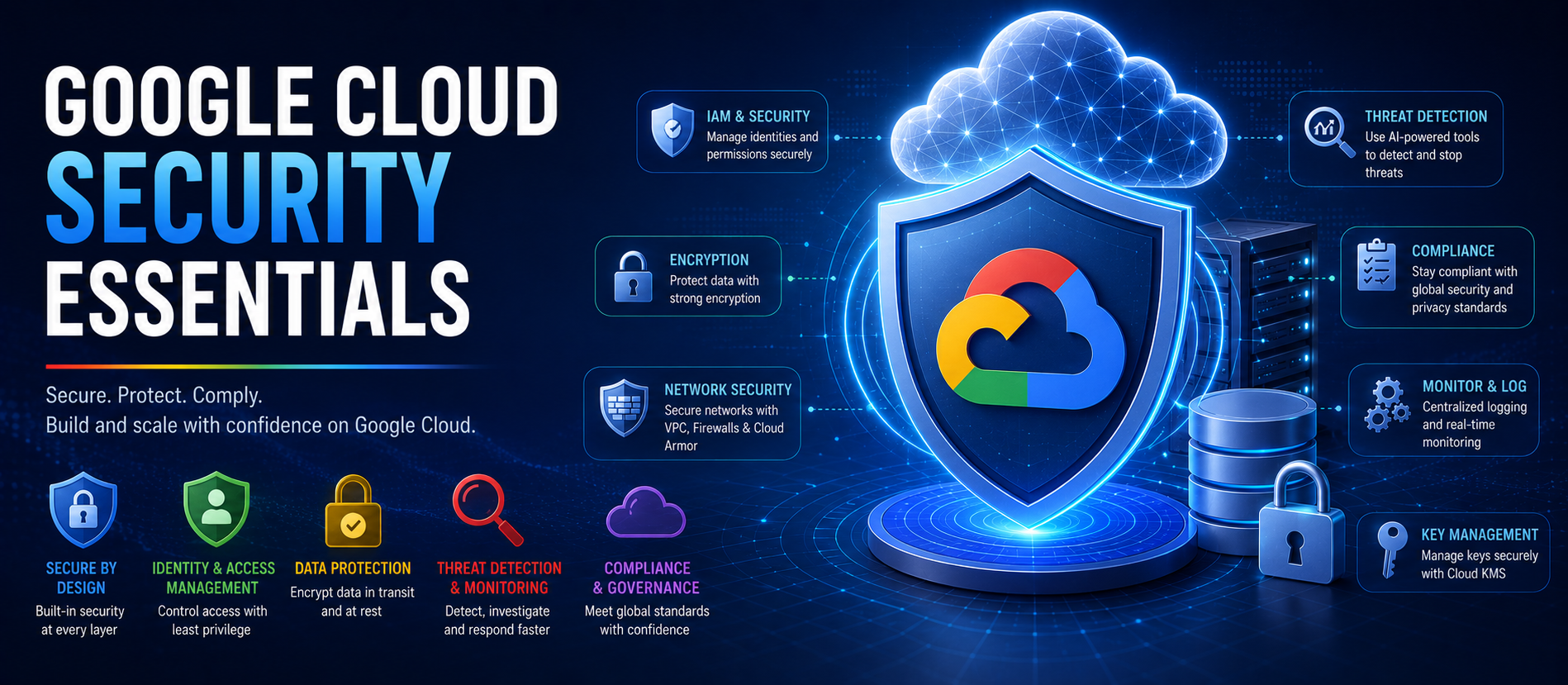
Google Cloud Security is the collection of technologies, policies, and operational practices used to protect Google Cloud resources, applications, storage, virtual machines, Kubernetes clusters, APIs, and sensitive business information.
Why Google Cloud Security Matters
- Protects sensitive business and customer data.
- Supports regulatory compliance.
- Reduces the risk of ransomware and data breaches.
- Secures remote and hybrid work environments.
- Maintains business continuity.
The Shared Responsibility Model
Google secures the underlying cloud infrastructure, while customers remain responsible for securing identities, applications, workloads, configurations, data, and access permissions.
Essential Security Controls
Identity and Access Management (IAM)
Use least-privilege access, custom roles, service accounts, and Multi-Factor Authentication (MFA).
Encryption
Protect data at rest and in transit using strong encryption and Cloud Key Management.
Network Security
Implement VPC firewalls, private networking, Cloud Armor, VPNs, and network segmentation.
Logging and Monitoring
Enable Cloud Logging, Cloud Monitoring, Security Command Center, and audit logs to detect suspicious activity.
Backup and Disaster Recovery
Maintain secure backups and regularly test recovery procedures to improve resilience.
Common Google Cloud Security Risks
- Misconfigured storage buckets
- Excessive IAM permissions
- Weak authentication
- Unpatched virtual machines
- Insecure APIs
- Compromised service accounts
Zero Trust in Google Cloud
Adopt Zero Trust by continuously verifying users, devices, workloads, and access requests instead of relying on network location alone.
AI-Powered Cloud Security
Artificial Intelligence helps identify anomalies, prioritize threats, detect suspicious identities, automate investigations, and accelerate incident response across cloud environments.
Best Practices
- Enable MFA for all privileged users.
- Review IAM permissions regularly.
- Apply security patches promptly.
- Encrypt sensitive data.
- Monitor logs continuously.
- Perform vulnerability assessments and penetration testing.
- Protect APIs and Kubernetes workloads.
- Train employees on cloud security awareness.
SEO, AEO & GEO Optimization
Create authoritative cloud security content with structured headings, semantic keywords, direct answers, practical examples, and FAQ sections to improve visibility across Google Search and AI-powered answer engines.
AEO & GEO Optimized FAQs
What is Google Cloud Security?
It is the combination of technologies, services, and best practices used to protect Google Cloud workloads, identities, applications, and data.
Who is responsible for security in Google Cloud?
Google secures the cloud infrastructure, while customers secure their data, identities, applications, and configurations under the shared responsibility model.
What is the most important Google Cloud security practice?
Strong identity management using IAM, MFA, least privilege, encryption, continuous monitoring, and regular security reviews.
How does AI improve cloud security?
AI detects anomalies, identifies suspicious behavior, prioritizes alerts, and automates threat detection and response.
Conclusion
Google Cloud provides a secure foundation for modern businesses, but strong protection depends on proper configuration, identity security, monitoring, encryption, Zero Trust, and continuous improvement. Organizations that implement these best practices can reduce cyber risk, strengthen compliance, and confidently scale cloud operations in 2026 and beyond.
For more expert insights on Cyber Security, Cloud Security, SEO, AEO, GEO, AI Search Optimization, and Digital Transformation, visit Digiifrog at www.digiifrog.com.
Ready to Grow?
Talk to us about a strategy tailored to your brand — we will help you stand out in search, AI discovery and social.


Comments (0)
Log in to leave a comment.