📋 Quick Summary
In this article:
What Are Holistic Rehab Programs?
How Is Holistic Rehabilitation Different?
Key Components of a Holistic Rehab Program
1. Physical Rehabilitation
2. Occupational Therapy
3. Psychological Support
4. Speech and Cognitive Rehabilitation
5. Nutrition and Healthy Habits
6. Social and Family Support
7. Return to Work and Community Life
Who May Benefit From Holistic Rehabilitation?
Introduction
Holistic rehab programs take a broad view of recovery. They do not focus only on pain, movement, or one medical condition. They consider the whole person and the factors that affect daily life. These may include physical health, mental well-being, emotions, sleep, habits, family support, work, and the home environment.
Rehabilitation aims to improve functioning and reduce disability. WHO describes it as a person-centered process that helps people optimize function and participate in everyday life. Depending on need, it may involve physical therapists, occupational therapists, speech therapists, psychologists, rehabilitation doctors, nurses, social workers, and other professionals.
A holistic approach can be useful when a person's challenges are complex. However, “holistic” does not automatically mean better. A good program should use appropriate clinical methods, measurable goals, qualified professionals, and regular progress reviews.
What Are Holistic Rehab Programs?
Holistic rehabilitation combines different areas of care around the person's needs. The exact mix varies by condition. One person may need physical therapy and occupational therapy. Another may need pain management, psychological support, speech therapy, and vocational planning.
The central idea is simple: health problems can affect more than the body. A physical limitation may affect work. Chronic pain may affect sleep and mood. A brain injury may affect memory, communication, relationships, and independence. A serious illness may change a person's confidence and daily routine.
A holistic rehab program looks at these connections instead of treating each problem as completely separate.
How Is Holistic Rehabilitation Different?
Traditional rehabilitation can also be comprehensive. The difference is usually the emphasis on the person's complete situation and meaningful life goals.
For example, a treatment plan may not stop at improving leg strength. It may also ask whether the person can safely climb the stairs at home, return to work, shop independently, or participate in family activities.
WHO emphasizes that rehabilitation should be person-centered and targeted to individual goals and preferences. It can take place in hospitals, outpatient clinics, homes, schools, workplaces, and community settings.
Key Components of a Holistic Rehab Program
1. Physical Rehabilitation
Physical rehabilitation may address strength, mobility, balance, flexibility, endurance, coordination, pain, and physical function. Exercises and movement training are selected according to the person's condition and goals.
2. Occupational Therapy
Occupational therapy focuses on meaningful daily activities. These may include dressing, bathing, cooking, writing, working, studying, using technology, or managing a home. Therapists may also recommend adaptive equipment or environmental changes.
3. Psychological Support
Recovery can be stressful. Anxiety, depression, fear, frustration, or low confidence may affect participation. Psychological support can help people develop coping strategies and manage emotional barriers.
4. Speech and Cognitive Rehabilitation
People recovering from stroke, brain injury, neurological disease, or other conditions may have communication, memory, attention, or swallowing difficulties. Speech-language professionals and other specialists can address these problems as part of a coordinated plan.
5. Nutrition and Healthy Habits
Nutrition may be relevant when recovery is affected by poor intake, weight changes, weakness, or other health concerns. A qualified professional can provide individualized advice. Healthy sleep, hydration, activity, and medication routines may also support recovery.
6. Social and Family Support
Recovery does not happen in isolation. Family members and caregivers may need education about safe assistance, communication, routines, and realistic expectations. Social workers may help with practical or community resources when appropriate.
7. Return to Work and Community Life
For many people, successful rehabilitation means returning to work, education, hobbies, or community activities. A holistic program may address workplace tasks, energy levels, transportation, communication, confidence, and gradual return plans.
Who May Benefit From Holistic Rehabilitation?
Holistic rehabilitation may be considered for people recovering from stroke, brain injury, spinal cord injury, orthopedic surgery, serious illness, chronic pain, neurological conditions, disability, major injury, or other health problems that affect daily function.
It may also help people who have several connected challenges. For example, someone with chronic pain may experience reduced activity, poor sleep, anxiety, loss of work capacity, and social isolation. Addressing only pain may not solve every problem.
The appropriate rehabilitation model should always be based on clinical assessment and individual needs.
Benefits of Holistic Rehab Programs
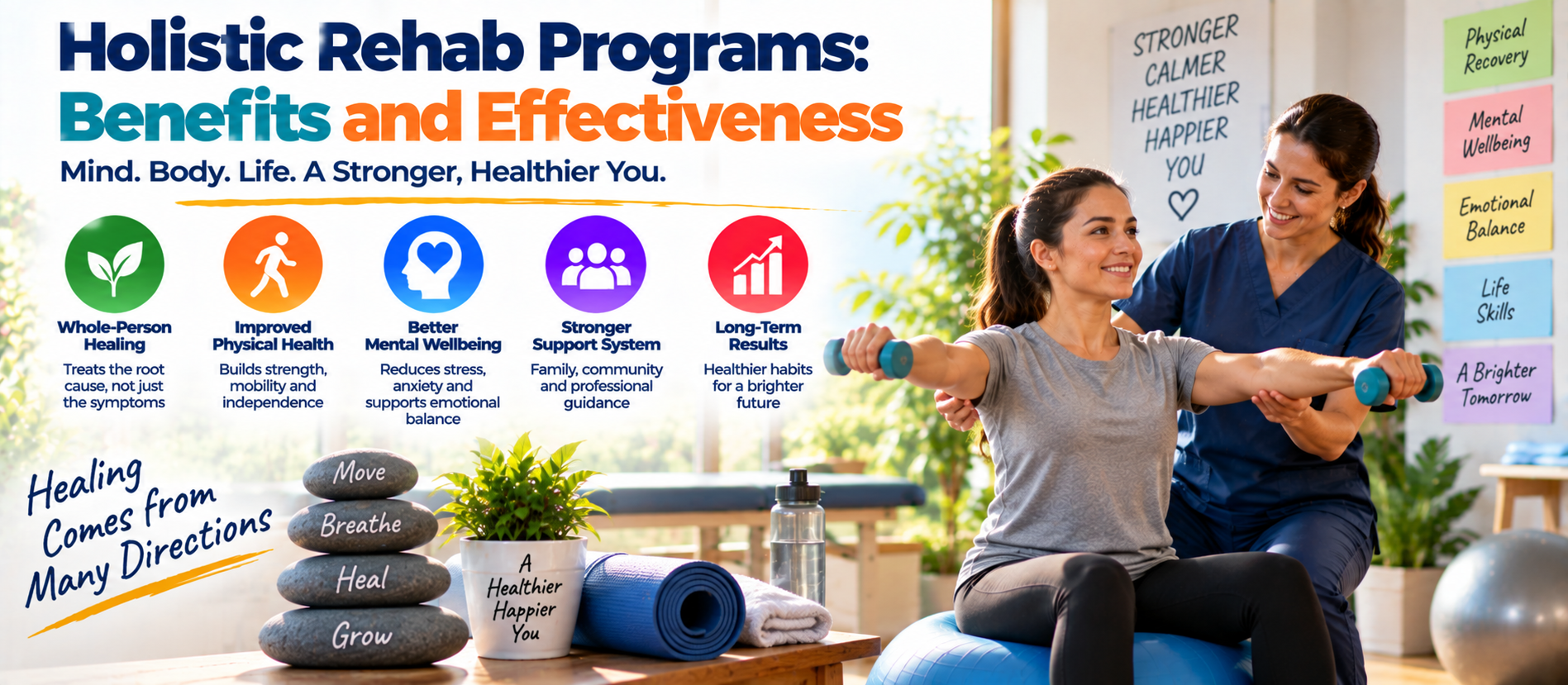
Potential benefits include improved function, greater independence, better participation in daily activities, stronger self-management skills, and improved quality of life. Rehabilitation can also help prevent, reduce, or manage complications associated with many health conditions.
- Whole-person care: Physical, psychological, social, and functional needs can be considered together.
- Personalized goals: Treatment can focus on activities that matter to the individual.
- Better coordination: Different professionals can share information and work toward common goals.
- Greater independence: Therapy can focus on practical daily skills.
- Improved self-management: People can learn strategies they can continue using at home.
- Support for long-term recovery: Plans can include follow-up and gradual progression.
Are Holistic Rehab Programs Effective?
The answer depends on the condition, program design, and individual. There is evidence supporting multidisciplinary rehabilitation for several conditions, but the results are not identical across every health problem.
A Cochrane review of multidisciplinary biopsychosocial rehabilitation for chronic low back pain found moderate-quality evidence that multidisciplinary rehabilitation reduced pain and disability compared with usual care. It also found evidence of better work outcomes compared with physical treatments, although results differed depending on the comparison.
At the same time, individual programs should not be assumed to be superior simply because they are described as “integrated” or “holistic.” For example, a randomized trial of an integrated multidisciplinary program for chronic low back pain found no statistically or clinically significant advantage over an existing rehabilitation program at 26 weeks. A one-year follow-up also found no significant difference in disability or secondary outcomes.
This is an important point. Effective rehabilitation is not about adding the largest possible number of therapies. It is about choosing the right interventions, delivering them well, and matching them to the person's needs.
Why a Multidisciplinary Team Can Help
Complex recovery often involves several areas of function. A single professional may not have the skills needed to address all of them.
For example, a person recovering from a stroke may need mobility training, daily activity training, communication therapy, cognitive strategies, psychological support, and family education. A coordinated team can divide responsibilities while working toward shared outcomes.
Research reviews have found evidence of improved functioning with multidisciplinary rehabilitation across several populations, including older adults, stroke, acquired brain injury, multiple sclerosis, chronic pain, and other conditions. However, evidence varies by condition, and further research is still needed.
What Happens During a Holistic Rehab Program?
The process usually begins with an assessment. The team reviews the person's medical history, symptoms, abilities, limitations, goals, medications, daily activities, support system, and environment.
The next step is goal setting. Goals should be specific and meaningful. Instead of “get stronger,” a functional goal might be “walk safely to the local shop” or “return to work with appropriate modifications.”
Treatment then begins. Sessions may include therapy, education, practical task training, exercise, psychological support, equipment training, or other appropriate interventions.
Progress is reviewed regularly. The program may become easier, harder, shorter, longer, or different as the person's needs change.
Home-Based Rehabilitation and Daily Practice
Rehabilitation should connect with real life. Skills learned in a clinic should be useful at home, work, school, or in the community.
Home-based activities can help people apply new skills in their normal environment. A patient may practice safe transfers, meal preparation, walking, communication strategies, energy management, or other tasks at home.
One qualitative study of an integrated multidisciplinary program for chronic low back pain found that patients valued the ability to transfer knowledge, skills, and behaviors into everyday life. The researchers reported perceived benefits related to body awareness, mental health, social interaction, and quality of life.
How Long Do Holistic Rehab Programs Last?
There is no standard duration. The timeline depends on the condition, severity, goals, progress, setting, and support available.
Some people need a short outpatient program. Others may require months of rehabilitation with reassessment. Long-term conditions may require self-management and occasional professional support rather than continuous intensive treatment.
A longer program is not automatically more effective. Treatment should be adjusted according to measurable progress and changing needs.
How Effectiveness Should Be Measured
Good rehabilitation uses meaningful outcomes. These can include:
- Ability to complete daily activities.
- Walking or movement ability.
- Strength, endurance, or coordination when relevant.
- Pain and symptom management.
- Communication or cognitive function.
- Return to work or education.
- Participation in family and community activities.
- Confidence and self-management.
- Quality of life.
Measures should match the person's goals. A change in a clinical test is useful, but it is also important to know whether the person can do more of what matters in daily life.
How to Choose a Quality Rehab Program
Look for qualified professionals, individualized assessment, clear goals, evidence-informed treatment, team communication, and regular progress reviews.
Ask what the program is designed to improve. Ask how progress will be measured. Ask who will be involved in care and how family members will be included when appropriate.
Be careful with programs that promise guaranteed results, claim to cure every condition, or rely heavily on unsupported treatments. “Holistic” should describe a broad and person-centered approach, not a promise of a particular outcome.
Common Challenges
Holistic rehabilitation can be demanding. Multiple appointments may be difficult to manage. Treatment may also require time, motivation, transportation, caregiver involvement, and financial resources.
Another challenge is coordination. If professionals do not communicate, the program can become confusing or repetitive. Clear goals can help.
Some programs may also include more interventions than a person can realistically follow. A smaller plan that the patient can maintain may be more useful than a complicated plan that is quickly abandoned.
Tips for Better Rehabilitation Results
- Set clear and realistic goals.
- Ask questions when instructions are unclear.
- Follow safety guidance from the care team.
- Practice appropriate skills between sessions.
- Track meaningful changes in daily function.
- Tell professionals about new symptoms or barriers.
- Include family or caregivers when helpful.
- Build routines that can continue after formal therapy ends.
- Review goals regularly instead of following an unchanged plan forever.
Frequently Asked Questions
What is a holistic rehab program?
It is a rehabilitation approach that considers physical, psychological, social, functional, and environmental needs rather than focusing on only one symptom or body part.
Is holistic rehabilitation the same as multidisciplinary rehabilitation?
They can overlap. Multidisciplinary rehabilitation involves professionals from different fields. A holistic approach emphasizes the person's whole situation and meaningful goals. A program can be both multidisciplinary and holistic.
Does holistic rehab always work better?
No. Effectiveness depends on the condition, interventions, quality of care, patient needs, and goals. Research supports multidisciplinary rehabilitation for some conditions, but not every integrated program has shown better results than standard rehabilitation.
Can holistic rehabilitation include mental health support?
Yes. When psychological factors affect recovery, appropriate counseling or psychological care may be included alongside physical and functional rehabilitation.
Can rehabilitation continue at home?
Yes. Depending on the condition, rehabilitation may include home-based exercises, daily activity practice, education, self-management, and follow-up support.
Final Thoughts
Holistic rehab programs can provide a useful framework for recovery because they recognize that health conditions affect more than physical function. The best programs connect treatment to real-life goals, involve appropriate professionals, and help people build skills they can use outside the clinic.
💡 Key Insight
Evidence shows that multidisciplinary rehabilitation can improve important outcomes in several conditions, but no single model works for everyone. A strong program should be individualized, evidence-informed, measurable, and practical.
For people considering rehabilitation, ask whether the program understands your needs, uses qualified professionals, sets meaningful goals, measures progress, and supports everyday participation.
Digiifrog creates clear, useful, and search-friendly health education content. Visit www.digiifrog.com for digital content and online solutions.
This article is for educational purposes only. Rehabilitation needs vary by person and condition. Consult qualified healthcare professionals for individualized assessment and treatment.
Ready to Grow?
Talk to us about a strategy tailored to your brand — we will help you stand out in search, AI discovery and social.

Comments (0)
Log in to leave a comment.