📋 Quick Summary
In this article:
Key Technologies Behind AI Chatbots
The Growing Importance of Customer Experience
24/7 Customer Support Availability
Benefits of 24/7 Support
Instant Response and Faster Resolution
Common Customer Requests Handled by Chatbots
Personalized Customer Interactions
Improving Customer Self-Service
Enhancing Omnichannel Experiences
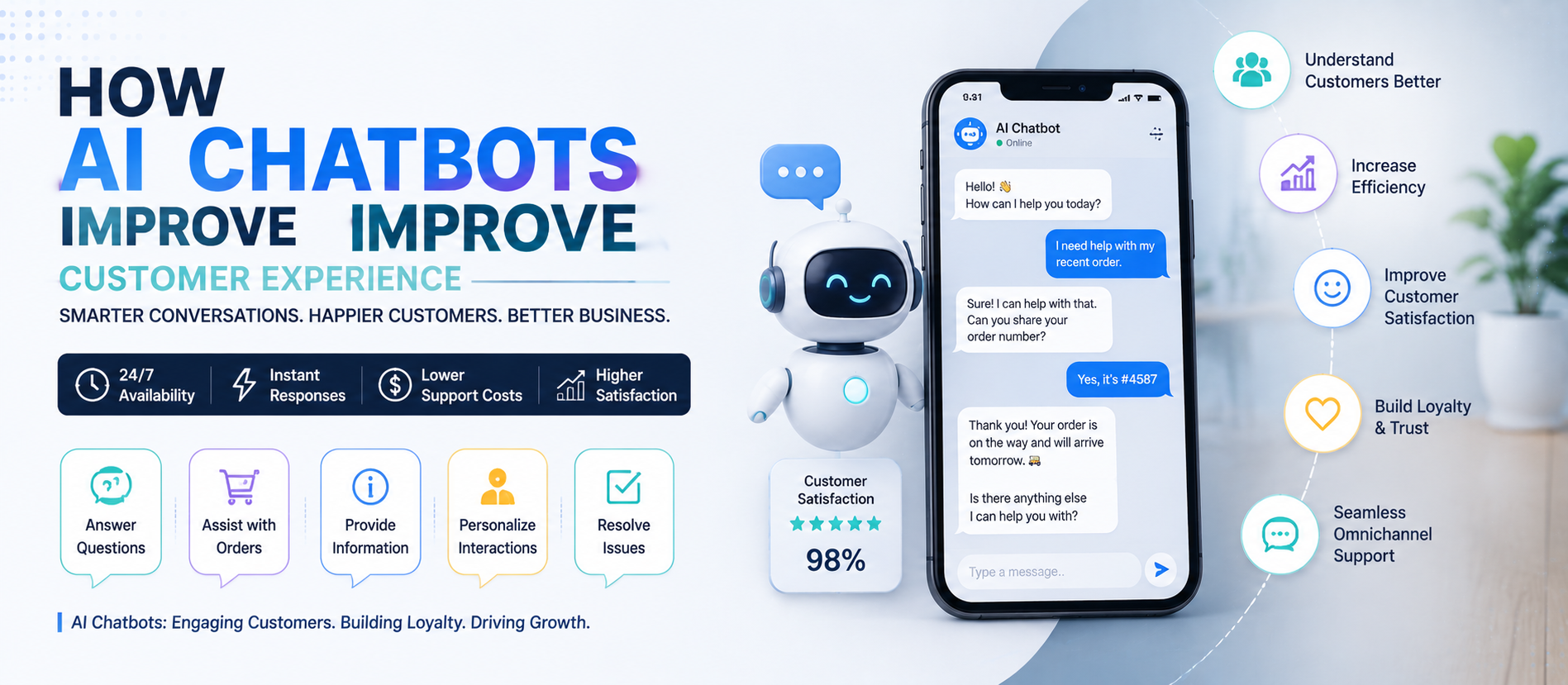
Artificial Intelligence (AI) is transforming the way businesses interact with customers. Among the most impactful innovations is the rise of AI-powered chatbots. These intelligent virtual assistants are revolutionizing customer service by providing instant responses, personalized experiences, and 24/7 support across multiple digital channels.
As customer expectations continue to evolve, businesses must deliver faster, smarter, and more convenient interactions. Modern consumers expect immediate answers, seamless experiences, and consistent support regardless of the time or platform. AI chatbots help organizations meet these demands while improving efficiency and reducing operational costs.
From e-commerce stores and SaaS platforms to healthcare providers and financial institutions, businesses across industries are leveraging AI chatbots to enhance customer experience, increase satisfaction, and drive growth.
This comprehensive guide explores how AI chatbots improve customer experience, the technologies behind them, business benefits, implementation strategies, and the role of SEO, AEO, GEO, and AI Search optimization in chatbot-driven customer engagement.
What Are AI Chatbots?
AI chatbots are software applications powered by Artificial Intelligence, Natural Language Processing (NLP), Machine Learning (ML), and conversational technologies. Unlike traditional rule-based chatbots that follow predefined scripts, AI chatbots can understand context, interpret user intent, learn from interactions, and provide more human-like responses.
Key Technologies Behind AI Chatbots
- Artificial Intelligence
- Natural Language Processing (NLP)
- Machine Learning (ML)
- Generative AI
- Speech Recognition
- Predictive Analytics
- Knowledge Graphs
These technologies enable chatbots to engage in meaningful conversations and continuously improve their performance.
The Growing Importance of Customer Experience
💡 Key Insight
Customer experience has become one of the most important competitive differentiators in modern business.
Today's customers evaluate brands based not only on products and pricing but also on the quality of interactions they receive throughout the customer journey.
Key Customer Expectations
- Fast responses
- Personalized interactions
- 24/7 availability
- Easy problem resolution
- Consistent communication
- Convenient self-service options
Organizations that deliver exceptional customer experiences often achieve higher customer retention, stronger loyalty, and increased revenue.
24/7 Customer Support Availability
One of the biggest advantages of AI chatbots is their ability to provide round-the-clock customer support.
Unlike human support teams that operate within limited business hours, AI chatbots remain available 24 hours a day, 7 days a week.
Benefits of 24/7 Support
- Immediate assistance
- Reduced waiting times
- Global customer coverage
- Improved customer satisfaction
- Enhanced brand reputation
⚠ Watch Out
Customers receive help whenever they need it, regardless of time zones or holidays.
Instant Response and Faster Resolution
Customers increasingly expect instant responses to their inquiries.
AI chatbots can process requests and provide answers within seconds, significantly reducing response times.
Common Customer Requests Handled by Chatbots
- Product information
- Order status updates
- Appointment scheduling
- Technical support
- Account management
- Frequently asked questions
Quick responses improve customer satisfaction and reduce frustration.
Personalized Customer Interactions
Modern AI chatbots can deliver highly personalized experiences by analyzing customer data, preferences, behavior, and interaction history.
Personalization Features
- Product recommendations
- Customized support
- Personalized offers
- Behavior-based messaging
- Relevant content suggestions
Personalization makes interactions more relevant and engaging.
Improving Customer Self-Service
Many customers prefer finding answers independently rather than contacting support representatives.
AI chatbots empower users with self-service capabilities.
- Knowledge base access
- Troubleshooting assistance
- Account management
- Service requests
- Order tracking
Self-service options improve convenience while reducing support workloads.
Enhancing Omnichannel Experiences
Customers interact with businesses across multiple channels, including websites, mobile apps, social media platforms, messaging apps, and email.
AI chatbots help create consistent omnichannel experiences.
Supported Channels
- Websites
- Mobile Applications
- Facebook Messenger
- Live Chat Platforms
Consistent experiences strengthen customer trust and satisfaction.
Reducing Customer Support Costs
AI chatbots automate routine interactions, allowing support teams to focus on more complex issues.
Cost Reduction Benefits
- Lower staffing costs
- Reduced support ticket volumes
- Improved operational efficiency
- Higher agent productivity
Businesses can scale support operations without proportionally increasing costs.
Increasing Customer Engagement
AI chatbots actively engage users throughout their customer journey.
Engagement Activities
- Personalized greetings
- Product recommendations
- Interactive conversations
- Lead qualification
- Survey collection
Higher engagement often translates into stronger customer relationships.
Lead Generation and Sales Support
AI chatbots not only improve customer service but also support sales and marketing efforts.
Sales Functions
- Lead capture
- Qualification surveys
- Product suggestions
- Demo scheduling
- Appointment booking
Chatbots help businesses convert visitors into qualified leads more efficiently.
Multilingual Customer Support
Global businesses often serve customers who speak different languages.
AI chatbots can support multilingual communication, making customer service more accessible and inclusive.
This capability enhances customer experiences while expanding market reach.
Using AI Chatbots for Customer Feedback Collection
Customer feedback provides valuable insights for continuous improvement.
Feedback Collection Methods
- Post-interaction surveys
- Satisfaction ratings
- Product feedback
- Service evaluations
Real-time feedback helps businesses identify opportunities for enhancement.
AI Chatbots and Data-Driven Decision Making
Every chatbot interaction generates valuable customer data.
Insights Generated
- Customer preferences
- Common questions
- Purchase behavior
- Support trends
- Service gaps
Businesses can use these insights to improve products, services, and customer experiences.
SEO, AEO, GEO and AI Search Integration
AI chatbots play an increasingly important role in modern digital marketing strategies.
SEO Benefits
Chatbots improve user engagement, reduce bounce rates, and help visitors find relevant content more quickly.
AEO Benefits
Answer Engine Optimization focuses on delivering direct answers to customer questions, which aligns perfectly with chatbot functionality.
GEO Benefits
Generative Engine Optimization helps businesses improve visibility within AI-generated search experiences.
AI Search Readiness
Chatbots help create structured conversational data that supports AI-powered search systems.
Challenges and Considerations
While AI chatbots offer significant advantages, businesses must address potential challenges.
- Data privacy concerns
- Training requirements
- Complex query handling
- Integration challenges
- Maintaining conversational quality
Careful planning ensures successful implementation.
Future Trends in AI Chatbots
The future of AI chatbots is highly promising. Advances in Generative AI, large language models, sentiment analysis, voice assistants, predictive analytics, and conversational intelligence will make chatbots even more powerful and human-like.
Organizations that adopt advanced chatbot technologies early will gain significant competitive advantages in customer experience management.
Best Practices for Implementing AI Chatbots
- Define clear objectives
- Focus on customer needs
- Train chatbots continuously
- Monitor performance metrics
- Provide seamless human escalation
- Protect customer data
- Optimize user experiences
Following these practices maximizes chatbot effectiveness and customer satisfaction.
Conclusion
AI chatbots are transforming customer experience by delivering instant support, personalized interactions, self-service capabilities, and seamless omnichannel engagement. They help businesses improve efficiency, reduce costs, increase customer satisfaction, and support long-term growth.
As AI technology continues evolving, chatbots will become even more sophisticated, enabling organizations to create exceptional customer experiences that drive loyalty and competitive advantage.
At Digiifrog, we help businesses leverage SEO, AEO, GEO, AI Search Optimization, conversational AI, digital marketing, and business automation to achieve sustainable growth and customer engagement.
Website: www.digiifrog.com
Contact: Connect with Digiifrog to accelerate your digital transformation journey.
Ready to Grow?
Talk to us about a strategy tailored to your brand — we will help you stand out in search, AI discovery and social.

Comments (0)
Log in to leave a comment.