📋 Quick Summary
In this article:
Quick Answer: How Is AI Transforming B2B Lead Generation?
What Is AI-Powered B2B Lead Generation?
Why Traditional B2B Lead Generation Is Changing
1. AI Helps Businesses Find Better Prospects
2. AI Improves Ideal Customer Profile Development
3. AI-Powered Lead Scoring Prioritizes Opportunities
4. AI Identifies Buyer Intent Signals
5. AI Makes B2B Outreach More Personalized
6. AI Chatbots Capture and Qualify Website Leads
7. AI Automates Lead Research
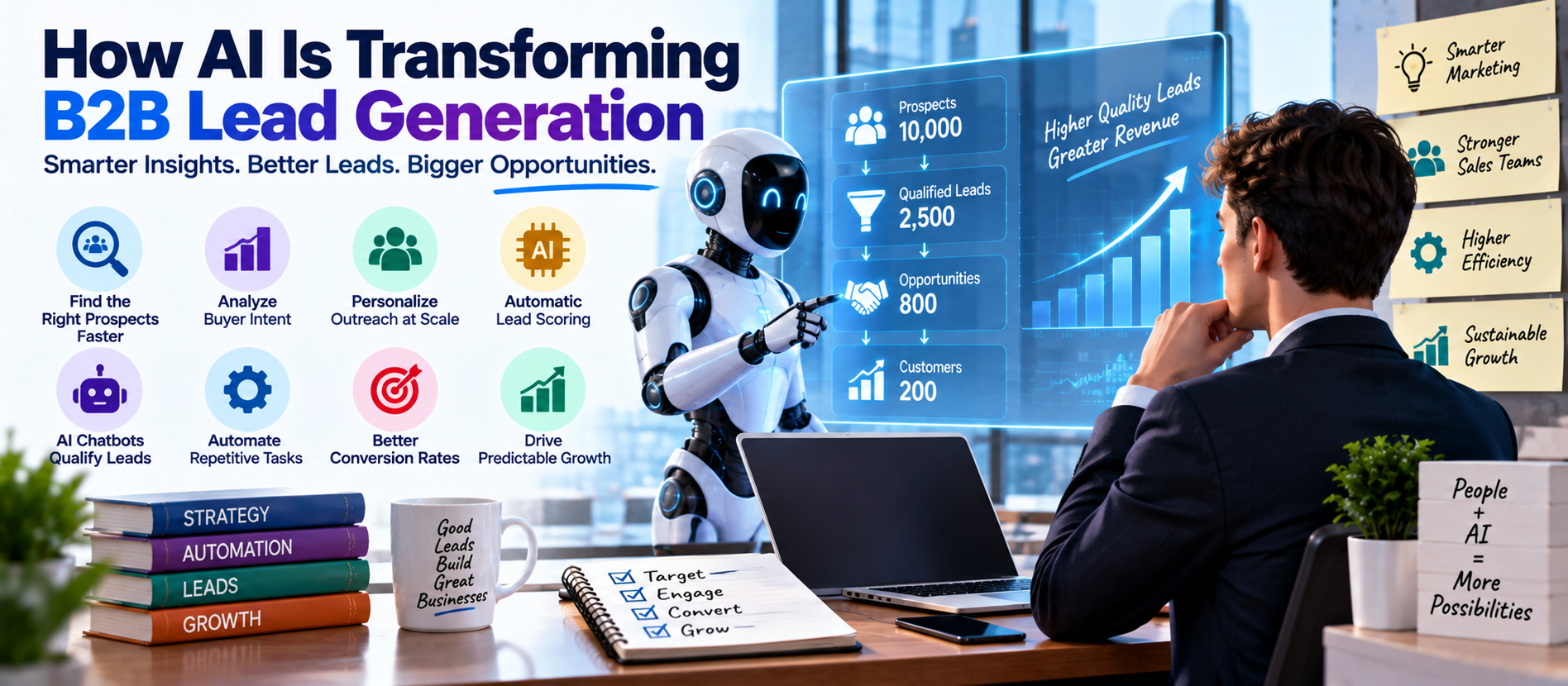
Artificial intelligence is transforming B2B lead generation by helping businesses find better prospects, understand buyer intent, personalize outreach, qualify leads faster, and improve sales efficiency. Traditional lead generation often depends on manual research, large contact lists, generic campaigns, and time-consuming follow-up. AI helps reduce much of this manual work.
However, AI does not magically create qualified customers. The best results come when businesses combine artificial intelligence with accurate data, clear targeting, strong content, and human sales expertise.
This guide explains how AI is transforming B2B lead generation, the most valuable applications, practical implementation strategies, common mistakes, and the future of AI-powered demand generation.
Quick Answer: How Is AI Transforming B2B Lead Generation?
AI transforms B2B lead generation by analyzing large amounts of data to identify promising prospects, predict buying intent, automate repetitive tasks, personalize communication, score leads, and help sales teams focus on opportunities with a higher likelihood of conversion.
Instead of treating every contact the same way, AI can help businesses understand which prospects are most relevant and what actions may move them closer to a conversation or purchase.
What Is AI-Powered B2B Lead Generation?
AI-powered B2B lead generation uses artificial intelligence, machine learning, natural language processing, automation, and data analysis to improve the process of finding and converting business prospects.
AI can support several stages of the B2B buyer journey:
- Finding potential accounts.
- Researching companies and decision-makers.
- Analyzing buyer behavior.
- Identifying intent signals.
- Qualifying leads.
- Personalizing outreach.
- Automating follow-up.
- Prioritizing sales opportunities.
The goal is not simply to generate more leads. The real goal is to improve the quality, relevance, speed, and efficiency of the lead generation process.
Why Traditional B2B Lead Generation Is Changing
Traditional B2B lead generation can be slow and labor-intensive.
Sales and marketing teams may spend hours:
- Searching for companies.
- Finding decision-makers.
- Checking contact information.
- Researching industries.
- Writing outreach messages.
- Following up with prospects.
- Updating CRM records.
💡 Key Insight
These activities are important, but many of them are repetitive.
AI helps teams automate parts of this work while providing more data-driven insights. A sales representative can spend less time copying information between tools and more time having meaningful conversations with qualified prospects.
1. AI Helps Businesses Find Better Prospects
One of the biggest challenges in B2B lead generation is identifying the right companies.
A large contact database is not automatically valuable. A business may have thousands of contacts but only a small percentage may match its ideal customer profile.
AI can analyze data points such as:
- Industry.
- Company size.
- Location.
- Technology usage.
- Business growth.
- Hiring activity.
- Online behavior.
- Previous engagement.
This information can help businesses identify accounts that are more likely to fit their target market.
Example
A company selling cybersecurity software may want to focus on medium-sized businesses that are expanding their technology teams, hiring security professionals, or showing signs of increasing digital infrastructure.
AI can help identify patterns and prioritize companies that match these characteristics.
2. AI Improves Ideal Customer Profile Development
An Ideal Customer Profile, or ICP, describes the type of company most likely to benefit from a product or service.
Traditional ICP development often depends on assumptions. AI can help businesses analyze actual customer data and identify common characteristics among successful customers.
For example, AI analysis may reveal that high-value customers share similarities in:
- Company size.
- Industry.
- Revenue range.
- Technology stack.
- Geographic market.
- Business maturity.
This can help marketing teams improve targeting and reduce wasted advertising and outreach efforts.
3. AI-Powered Lead Scoring Prioritizes Opportunities
Not every lead should receive the same level of attention.
Lead scoring helps businesses prioritize prospects based on factors that indicate potential value or buying readiness.
AI-powered lead scoring can consider multiple signals, including:
- Website visits.
- Content downloads.
- Email engagement.
- Product page activity.
- Company characteristics.
- Previous conversations.
- Campaign engagement.
Instead of relying only on simple rules, AI can help identify patterns across many data points.
The Main Benefit
Sales teams can focus more attention on leads that show stronger signals of relevance or interest.
This does not mean AI scores should replace human judgment. A lead score is a decision-support tool, not a guarantee that someone will buy.
4. AI Identifies Buyer Intent Signals
Buyer intent is one of the most valuable areas of modern B2B lead generation.
Intent signals can suggest that a company is researching a problem, evaluating a solution, or becoming more active in a relevant market.
AI can help organize and analyze signals from different sources, including:
- Website activity.
- Content engagement.
- Search behavior where legally and ethically available.
- Marketing interactions.
- CRM data.
- Public business information.
The purpose is to help sales teams understand when outreach may be more relevant.
Timing matters in B2B sales. Contacting a prospect when there is no immediate need can result in low engagement. Contacting a prospect when they are actively researching a problem may create a more relevant conversation.
5. AI Makes B2B Outreach More Personalized
Generic outreach is becoming less effective.
Business decision-makers receive many emails, messages, advertisements, and sales pitches every day. A message that looks automated or irrelevant is easy to ignore.
AI can help sales and marketing teams personalize outreach by using information such as:
- The prospect's industry.
- The company's business model.
- Relevant challenges.
- Previous interactions.
- Publicly available company information.
AI can assist with drafting:
- Personalized emails.
- LinkedIn messages.
- Follow-up sequences.
- Account-specific content ideas.
However, personalization should be reviewed by a human. Poor AI-generated outreach can sound generic, inaccurate, or overly familiar.
6. AI Chatbots Capture and Qualify Website Leads
Website visitors often have questions before they are ready to contact a sales representative.
AI-powered chat systems can help answer common questions and guide visitors toward useful information.
A B2B chatbot may:
- Answer product questions.
- Explain services.
- Recommend relevant resources.
- Collect qualification information.
- Route visitors to the correct team.
- Schedule a meeting.
This can provide faster responses and help businesses capture leads outside normal working hours.
Businesses should clearly define when a chatbot should transfer a conversation to a human representative. Complex sales questions, pricing discussions, technical requirements, and sensitive issues often require human expertise.
7. AI Automates Lead Research
Sales research is necessary for account-based marketing and high-quality B2B outreach.
AI can help summarize information about a company, such as:
- Its products and services.
- Target market.
- Recent public announcements.
- Business priorities.
- Technology-related information.
This can reduce research time and help representatives prepare for conversations.
Important: AI-generated research should be verified before use. Models can misunderstand information or generate incorrect summaries.
8. AI Supports Account-Based Marketing
Account-Based Marketing, or ABM, focuses marketing and sales efforts on selected high-value companies.
AI can strengthen ABM by helping teams:
- Identify target accounts.
- Analyze account characteristics.
- Prioritize accounts.
- Create personalized content ideas.
- Monitor engagement.
- Recommend next actions.
Instead of using one broad campaign for everyone, businesses can create more focused strategies for different account segments.
9. AI Improves Email Campaign Optimization
Email remains an important B2B communication channel, but successful email campaigns require relevance and good timing.
AI can assist with:
- Subject line ideas.
- Email structure.
- Audience segmentation.
- Content personalization.
- Follow-up suggestions.
- Engagement analysis.
AI should not be used to send large volumes of low-quality messages automatically.
More automation does not always mean better results. A smaller number of relevant and useful messages may perform better than thousands of generic emails.
10. AI Creates Better Sales and Marketing Alignment
B2B lead generation works best when marketing and sales teams share information.
AI can help connect data from different systems and identify patterns across the buyer journey.
For example, marketing may learn that prospects who read a specific guide and attend a webinar are more likely to request a consultation.
Sales teams can use this information to prioritize conversations.
Better alignment can help businesses answer important questions:
- Which campaigns generate qualified leads?
- Which industries convert best?
- Which content influences sales conversations?
- Which prospects need additional nurturing?
11. AI Improves Lead Nurturing
Most B2B prospects do not become customers immediately.
Lead nurturing helps businesses maintain a relationship with prospects over time.
AI can help recommend content and communication based on a prospect's stage in the buyer journey.
For example:
- An early-stage prospect may need educational content.
- A prospect comparing solutions may need case studies.
- A highly engaged prospect may be ready for a consultation.
This creates a more relevant experience than sending the same email sequence to every lead.
12. Predictive Analytics Helps Forecast Lead Quality
Predictive analytics uses historical data to identify patterns that may help estimate future outcomes.
In B2B lead generation, predictive models may help businesses understand which characteristics are associated with:
- Higher conversion rates.
- Longer customer relationships.
- Larger contract values.
- Faster sales cycles.
Predictions should be treated carefully. Business markets change, customer behavior changes, and historical data may contain bias.
Models should be reviewed and updated as business conditions change.
The Benefits of AI in B2B Lead Generation
Higher Efficiency
AI can automate repetitive research, data analysis, and content preparation tasks.
Better Targeting
Businesses can focus on accounts that more closely match their ideal customer profile.
Faster Response Times
Automation can help respond to website inquiries and lead interactions more quickly.
Improved Personalization
AI can help teams adapt messaging to industries, accounts, and buyer needs.
Better Use of Sales Time
Sales professionals can spend more time on conversations and less time on repetitive administrative work.
Data-Driven Decisions
AI can help organizations identify patterns that may be difficult to find manually.
Challenges and Risks of AI-Powered Lead Generation
AI creates opportunities, but it also introduces important risks.
Data Quality Problems
AI systems depend on data. Incorrect, outdated, or incomplete information can produce poor recommendations.
Privacy and Compliance
B2B businesses must handle personal and business data responsibly and follow applicable privacy and marketing laws.
Over-Automation
Too much automation can make outreach feel impersonal and damage brand reputation.
AI Hallucinations
Generative AI can produce incorrect information. Human review remains important.
Bias
Historical data can contain patterns or biases that influence AI recommendations.
How to Build an AI-Powered B2B Lead Generation Strategy
Step 1: Define Your Ideal Customer Profile
Start by clearly defining the companies and buyers you want to reach.
Step 2: Clean Your Data
Remove duplicate records and update inaccurate information.
Step 3: Identify Repetitive Tasks
Find activities that consume time but can be safely assisted by automation.
Step 4: Select the Right AI Use Cases
Start with one or two valuable use cases, such as lead scoring or research assistance.
Step 5: Connect Marketing and Sales Data
Create a clearer view of prospect activity across the buyer journey.
Step 6: Keep Humans in the Process
Review AI recommendations and allow experienced team members to make final decisions.
Step 7: Measure Results
Track metrics such as qualified leads, meeting rates, conversion rates, sales cycle length, and customer acquisition efficiency.
Common Mistakes Businesses Make with AI Lead Generation
- Using AI without a clear lead generation strategy.
- Buying large amounts of poor-quality data.
- Sending completely automated outreach without review.
- Trusting AI-generated research without verification.
- Ignoring privacy and compliance requirements.
- Measuring lead volume instead of lead quality.
- Installing too many disconnected AI tools.
The best AI strategy is usually focused. Businesses should solve specific problems rather than adding AI to every part of the sales process.
The Role of Human Sales Teams
AI is changing sales work, but human expertise remains essential.
Business buyers often make complex decisions involving:
- Budget.
- Risk.
- Technical requirements.
- Internal stakeholders.
- Long-term relationships.
AI can support research and decision-making, but human sales professionals provide trust, negotiation, strategic thinking, empathy, and relationship management.
The strongest approach is not AI versus humans. It is AI plus skilled people.
The Future of AI in B2B Lead Generation
AI-powered B2B lead generation is likely to become more integrated across marketing, sales, customer data, and automation systems.
Future systems may provide stronger capabilities for:
- Real-time buyer intent analysis.
- Account prioritization.
- AI sales agents.
- Personalized buyer journeys.
- Automated research workflows.
- Next-best-action recommendations.
- Predictive revenue insights.
At the same time, buyers will expect greater transparency and responsible data practices.
The companies that benefit most from AI will not necessarily be those using the largest number of AI tools. They will be the businesses that combine reliable data, useful automation, strong processes, and genuine human relationships.
SEO, AEO, GEO, and AI Search Optimization
Modern B2B content must be easy for people, search engines, answer engines, and AI systems to understand.
For SEO, relevant keywords should appear naturally, including AI B2B lead generation, AI lead generation tools, B2B sales automation, and AI-powered lead scoring.
For AEO, content should directly answer common questions such as:
- How does AI improve B2B lead generation?
- Can AI qualify B2B leads?
- What are the benefits of AI lead scoring?
For GEO and AI Search optimization, use clear definitions, logical headings, direct answers, and well-structured explanations. AI search systems can better interpret content when the relationship between problems, solutions, processes, and outcomes is clearly explained.
Frequently Asked Questions
How does AI help B2B lead generation?
AI helps identify potential prospects, analyze data, score leads, detect engagement patterns, personalize outreach, and automate repetitive tasks.
Can AI replace B2B salespeople?
No. AI can automate research and administrative tasks, but human professionals remain important for complex conversations, relationships, negotiation, and strategic sales decisions.
What is AI lead scoring?
AI lead scoring uses multiple data signals and patterns to help prioritize prospects based on potential relevance or likelihood of progressing through the sales process.
Is AI-generated outreach effective?
It can be effective when AI assists with personalization and research. However, generic automated messages should be reviewed and improved by humans.
What is the biggest challenge of AI lead generation?
Data quality is one of the biggest challenges. Poor data can lead to inaccurate targeting, weak recommendations, and irrelevant outreach.
Conclusion
AI is transforming B2B lead generation from a high-volume, manual process into a more intelligent and data-driven system.
Businesses can use AI to identify better prospects, understand intent, score leads, personalize communication, automate repetitive work, and improve collaboration between sales and marketing teams.
But AI alone is not a complete lead generation strategy.
Success depends on strong customer data, a clear ideal customer profile, valuable content, responsible automation, compliance awareness, and skilled human teams.
The future of B2B lead generation will likely belong to businesses that use AI to improve relevance rather than simply increase message volume.
For more insights into AI, B2B lead generation, digital marketing, automation, SEO, AEO, GEO, and AI Search optimization, visit www.digiifrog.com.
Important Note
AI platforms, data sources, privacy regulations, automation capabilities, and B2B marketing practices continue to evolve. Businesses should review current laws, platform policies, data permissions, and official documentation before implementing AI-powered lead generation systems at scale.
Ready to Grow?
Talk to us about a strategy tailored to your brand — we will help you stand out in search, AI discovery and social.
Comments (0)
Log in to leave a comment.