📋 Quick Summary
In this article:
Quick Answer: How Is AI Transforming Online Education?
Why AI Matters in Online Education
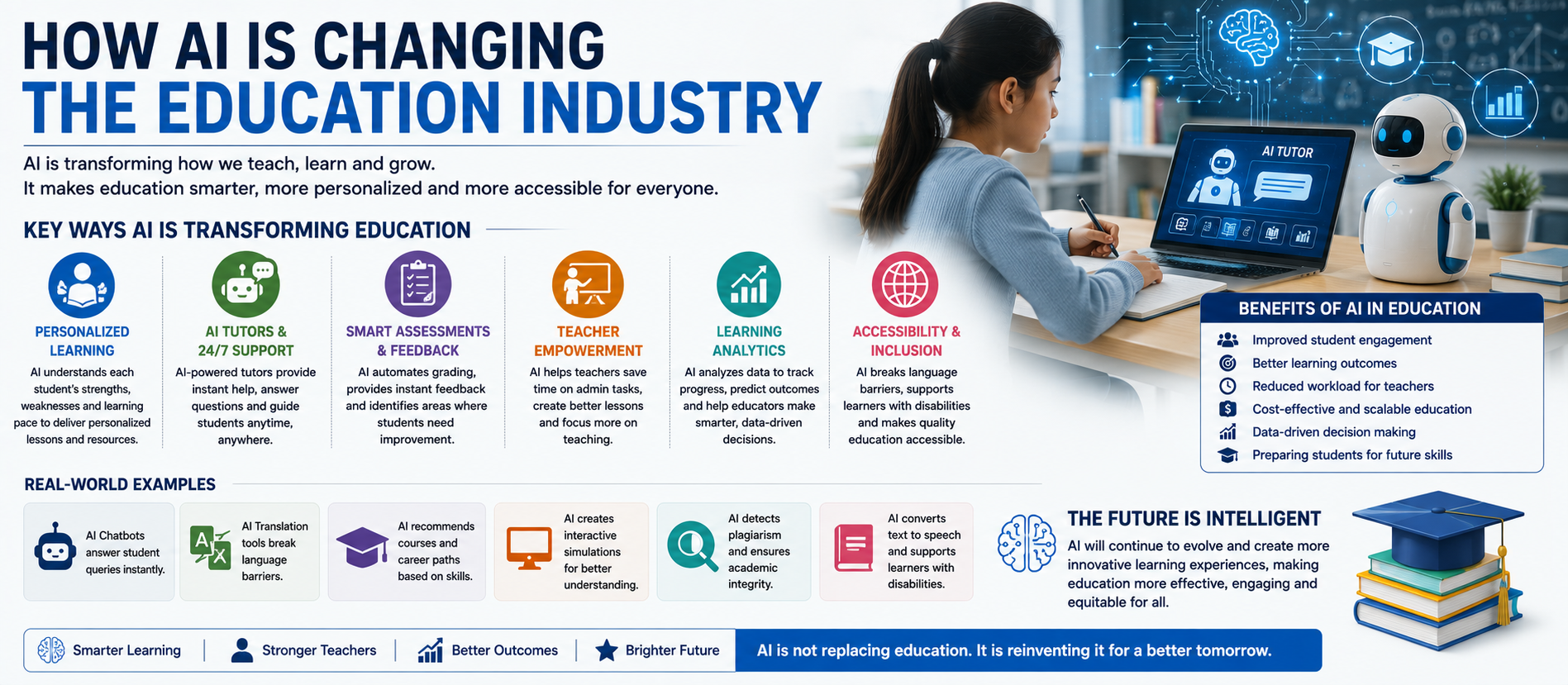
1. Personalized Learning Experiences
2. AI Tutors and Learning Assistants
3. Faster Feedback
4. Adaptive Practice and Assessments
5. AI-Assisted Course Content Creation
6. Learning Analytics
7. Accessibility and Language Support
8. Better Student Engagement
9. How AI Helps Teachers
Introduction
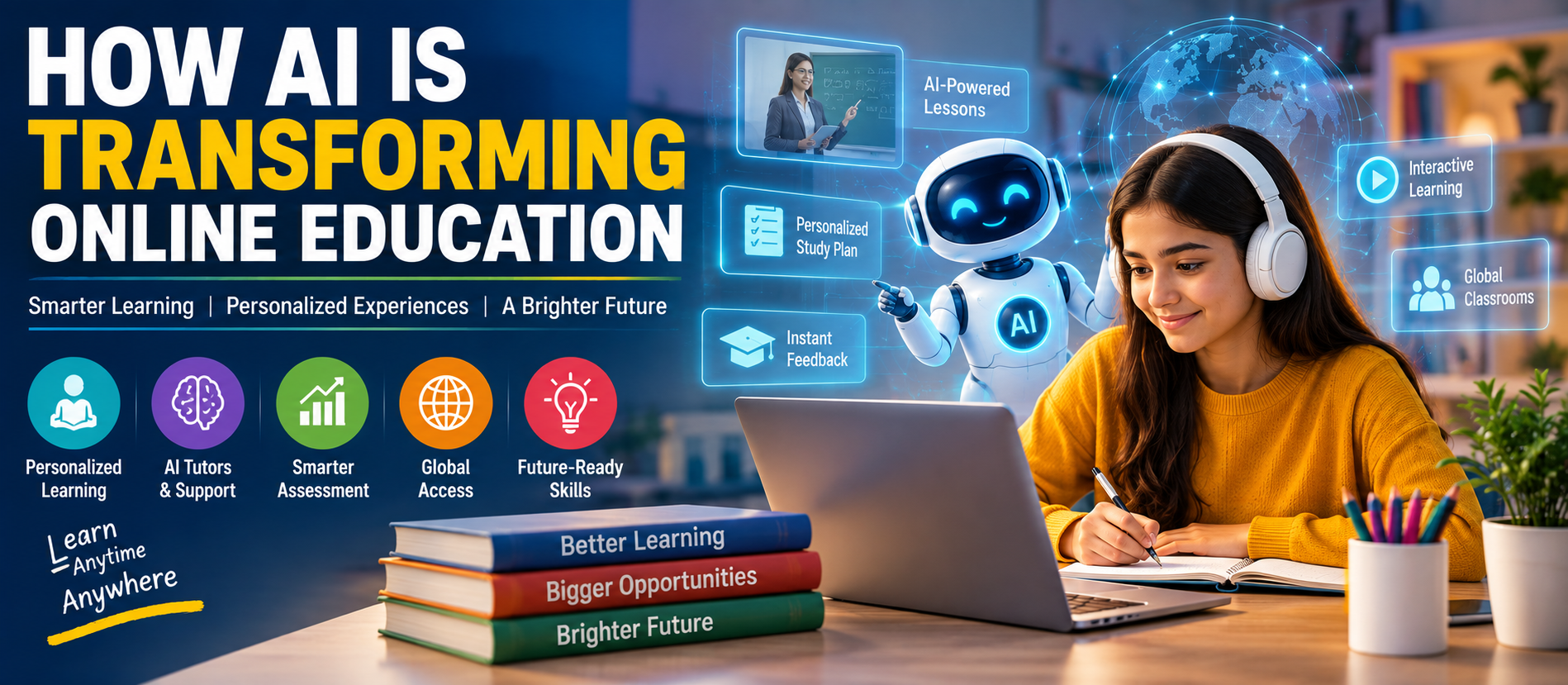
Artificial Intelligence (AI) is changing online education in practical ways. Earlier digital courses mainly depended on recorded classes, PDFs, quizzes, and discussion forums. Today, AI can make learning more interactive, personalized, and responsive.
Students can use AI tools to understand difficult topics, practice questions, organize study plans, receive feedback, and explore learning resources. Teachers can use AI to prepare lesson materials, create activities, analyze learning patterns, and reduce repetitive work.
AI does not remove the need for teachers. Education also depends on communication, motivation, judgment, creativity, mentorship, and human connection. The most useful approach is to combine intelligent tools with active students and skilled educators.
Quick Answer: How Is AI Transforming Online Education?
AI is transforming online education by supporting personalized learning, intelligent tutoring, adaptive practice, faster feedback, learning analytics, accessibility, language support, content creation, and student engagement. AI can help identify learning gaps and suggest suitable resources. However, AI outputs can contain errors, so human review, reliable sources, privacy protection, and responsible academic use remain important.
Why AI Matters in Online Education
Online learners do not all have the same goals, background, pace, or learning style. A fixed course may give everyone the same lesson even when their needs are different.
AI can make learning more flexible. It can analyze available learning information and suggest additional practice, easier explanations, or more advanced activities. For teachers, AI can reduce some routine tasks and create more time for mentoring, discussion, and complex feedback.
1. Personalized Learning Experiences
Personalized learning is one of the most important uses of AI in education. AI systems can use quiz results, learning activity, and progress information to recommend content at a suitable level.
If a student struggles with a mathematics topic, an AI-supported platform may suggest simpler examples and more practice. A student who already understands the topic may receive advanced questions.
AI can also change the way a concept is explained. A learner may request a simple explanation, a real-world example, an analogy, or a step-by-step guide. This flexibility can make online education more useful for different learners.
2. AI Tutors and Learning Assistants
AI tutors can provide academic support when a teacher is not immediately available. Students can ask questions, request examples, receive hints, and practice concepts at their own pace.
An AI tutor can explain the same idea in several ways. This is useful when a learner does not understand the first explanation or feels uncomfortable asking the same question repeatedly.
However, students should not assume every AI answer is correct. Important academic information should be checked against course materials, textbooks, teachers, and reliable reference sources.
3. Faster Feedback
Feedback helps students understand mistakes while the lesson is still fresh. AI can provide quick feedback on quizzes, structured exercises, language practice, and some types of written work.
For example, a language-learning tool can identify repeated grammar problems. A practice system can show which concepts produce incorrect answers. Teachers can also review common errors and decide which topics need further explanation.
AI feedback should support teacher judgment rather than replace it. Human educators can consider context, originality, reasoning, effort, and assignment goals.
4. Adaptive Practice and Assessments
AI can adjust practice based on previous answers. When a learner answers several questions correctly, the system can introduce more challenging tasks. When the learner struggles, it can return to foundational concepts.
This makes study time more targeted. Students can spend less time repeating material they already understand and more time working on genuine learning gaps.
5. AI-Assisted Course Content Creation
Creating online learning material takes time. Teachers may need to prepare lesson outlines, examples, quizzes, summaries, worksheets, and discussion prompts.
AI can help create early drafts or generate alternative examples. An educator can then review, correct, and adapt the material for the course.
Human review is essential. AI-generated content should be checked for accuracy, clarity, bias, relevance, age suitability, and alignment with learning objectives.
6. Learning Analytics
Online platforms generate useful learning data. This can include quiz results, lesson completion, assignment submissions, and interaction with course materials.
AI can help identify patterns that may show a learner needs support. Repeated low scores, missed assignments, or incomplete lessons can be useful signals.
These signals are not complete explanations. A student may miss a lesson because of internet problems, work, family responsibilities, or other circumstances. Teachers should consider context before making decisions based on automated data.
7. Accessibility and Language Support
AI can make online education more accessible. Speech recognition can convert spoken content into text. Text-to-speech can read digital material aloud. Translation tools can help learners access information in different languages.
AI can also simplify complex language and provide alternative explanations. Language-learning tools can support writing, pronunciation, vocabulary, and conversational practice.
These tools should complement established accessibility practices. Educational institutions should test digital resources with real users and remove unnecessary barriers.
8. Better Student Engagement
Online learning can sometimes become passive. Students may watch videos without actively working with the subject.
AI can create practice questions, role-play activities, simulations, and personalized challenges. A business learner might practice handling a customer problem. A programming student might work through coding exercises. A history learner might explore a simulated situation.
Interactive activities can encourage learners to apply information instead of only reading or watching it.
9. How AI Helps Teachers
Teachers can use AI for selected routine tasks such as drafting quiz questions, preparing lesson outlines, generating discussion prompts, organizing common questions, and creating alternative examples.
The purpose should be to reduce repetitive work, not remove teacher judgment. Educators should review AI-generated material before sharing it with students.
10. Challenges of AI in Online Education
Accuracy
AI-generated information can contain factual or reasoning errors. Important educational information should be verified with reliable sources.
Privacy
Learning systems may process student information. Institutions should understand what data is collected, why it is needed, how it is protected, and how long it is retained.
Bias
AI systems can reflect limitations in their data or design. Educators should review outputs carefully and consider whether they are appropriate and fair.
Overdependence
If students use AI for every task, they may lose opportunities to practice independent writing, reasoning, problem-solving, and creativity.
Digital Inequality
Not every learner has the same device, internet connection, software access, or digital skills. AI-based education should not create new barriers.
11. Academic Integrity and Responsible AI Use
Responsible AI use means following course rules and using AI to support learning. Students may use AI for explanations, brainstorming, practice, or feedback when those uses are allowed.
The goal of education is not simply to produce a finished assignment. It is to develop knowledge and skills. Students should keep their own reasoning, verify important information, and disclose AI use when required.
12. The Changing Role of Teachers
AI can automate selected routine activities, but teaching involves much more than delivering information. Teachers motivate learners, explain confusion, provide mentorship, guide projects, and connect academic ideas with real situations.
When AI handles suitable routine work, teachers may have more time for personalized interaction and deeper learning activities. Teacher training is therefore important. Educators need to understand both the strengths and limitations of AI tools.
13. How Students Can Use AI Effectively
- Use AI to understand difficult concepts.
- Ask for examples and alternative explanations.
- Generate practice questions.
- Try solving problems before asking for answers.
- Use feedback to improve drafts when permitted.
- Verify important information.
- Keep your own notes and reasoning.
- Follow academic integrity rules.
A useful principle is: use AI to improve learning, not to avoid learning.
14. How Educational Institutions Can Prepare
Schools, colleges, universities, and training providers should create clear AI policies. Students and teachers need practical guidance about acceptable and unacceptable uses.
Institutions can provide AI literacy training, privacy guidance, teacher development, assessment redesign, and clear expectations for AI-assisted work.
Assessment can also include projects, oral explanations, applied tasks, and demonstrations of understanding. These methods can help educators evaluate what learners actually know and can do.
15. The Future of AI-Powered Online Education
Future online classrooms may become more adaptive. A learning dashboard could show strengths, weak areas, recommended practice, completed work, and upcoming goals.
AI may also connect lessons, quizzes, discussions, projects, and revision into a more continuous learning pathway. Combined with virtual or augmented reality, AI could support simulations for science, medicine, engineering, business, and vocational education.
The future will likely focus on partnership rather than replacement. AI can provide scalable assistance, while educators provide judgment, context, mentorship, and human connection.
16. Practical AI Learning Workflow
Students can create a simple AI-supported workflow. Start with the syllabus and divide it into weekly goals. Study each topic and keep personal notes. Then ask AI for practice questions and answer them independently.
Review mistakes using reliable sources. If a concept is still unclear, ask AI for another explanation or example. Finally, explain the concept in your own words.
This creates a useful cycle: learn, recall, practice, check, correct, and repeat. AI can support several steps, but active thinking remains central.
17. SEO, AEO, GEO, and AI Search Perspective
Students increasingly discover educational information through search engines, answer engines, AI assistants, and generative search experiences. Clear content structure helps both people and AI systems understand educational topics.
Useful educational content should answer questions directly, use descriptive headings, explain terms clearly, provide practical examples, and include relevant FAQs. Readable and trustworthy content supports traditional SEO while also improving visibility across modern AI-powered search experiences.
Frequently Asked Questions
How is AI transforming online education?
AI is transforming online education through personalized learning, intelligent tutoring, adaptive practice, faster feedback, learning analytics, accessibility tools, content assistance, and student support.
Can AI replace teachers in online education?
AI can automate some educational tasks, but teachers provide mentorship, context, judgment, communication, and human support. AI is best used as a support tool.
What are the benefits of AI in online learning?
Benefits include personalized learning, faster feedback, targeted practice, flexible explanations, accessibility support, learning analytics, and assistance with routine teaching tasks.
What are the risks of AI in education?
Important risks include inaccurate information, privacy concerns, bias, overdependence, academic integrity problems, and unequal access to technology.
How can students use AI responsibly?
Students should use AI for learning support, verify important information, keep their own reasoning, follow academic policies, and avoid submitting unreviewed AI-generated work when it is not permitted.
Will AI make online learning more personalized?
AI can make learning more personalized by adapting practice, recommendations, explanations, and pacing based on available learner information.
Key Takeaways
- AI can personalize online learning.
- AI can provide faster practice and feedback.
- AI can help teachers with routine work.
- AI can support accessibility and language learning.
- AI can help identify learning patterns.
- AI outputs require human review.
- Privacy and academic integrity matter.
- Teachers remain important for mentorship and human connection.
- Students should use AI to strengthen understanding rather than avoid effort.
Final Thoughts
AI is moving online education from a mostly fixed digital experience toward a more adaptive and interactive model. Students can receive more flexible support, while teachers can reduce some repetitive work and focus more on meaningful instruction.
Technology alone does not create good education. Strong learning still depends on accurate information, effective teaching, active practice, critical thinking, accessibility, privacy, and human connection.
The future of online education will depend on how responsibly AI is used. When intelligent tools support teachers and help students learn without replacing independent thinking, AI can become a valuable part of modern education.
For more education, AI, digital technology, SEO, AEO, GEO, and AI Search insights, visit www.digiifrog.com.
Ready to Grow?
Talk to us about a strategy tailored to your brand — we will help you stand out in search, AI discovery and social.

Comments (0)
Log in to leave a comment.