📋 Quick Summary
In this article:
Quick Answer: How Does AI Improve Student Performance?
Benefits of Personalized Learning
2. AI Tutors Provide On-Demand Support
3. Faster Feedback Improves Practice
4. AI Creates Targeted Practice Questions
5. AI Explains Difficult Concepts
6. AI Supports Better Study Planning
7. AI Helps Identify Learning Gaps
8. AI Supports Writing and Communication
Introduction
Artificial Intelligence (AI) is changing how students learn. AI tools can explain difficult topics, create practice questions, provide feedback, organize study plans, and recommend learning resources. Students can use these tools in schools, colleges, universities, professional courses, and self-learning.
AI can make learning more responsive to individual needs. Students can request extra practice, harder questions, or simpler explanations based on their learning needs.
AI does not automatically produce better grades. Strong performance still depends on effort, regular practice, accurate information, good teaching, and independent thinking. AI works best when it supports learning instead of replacing it.
Quick Answer: How Does AI Improve Student Performance?
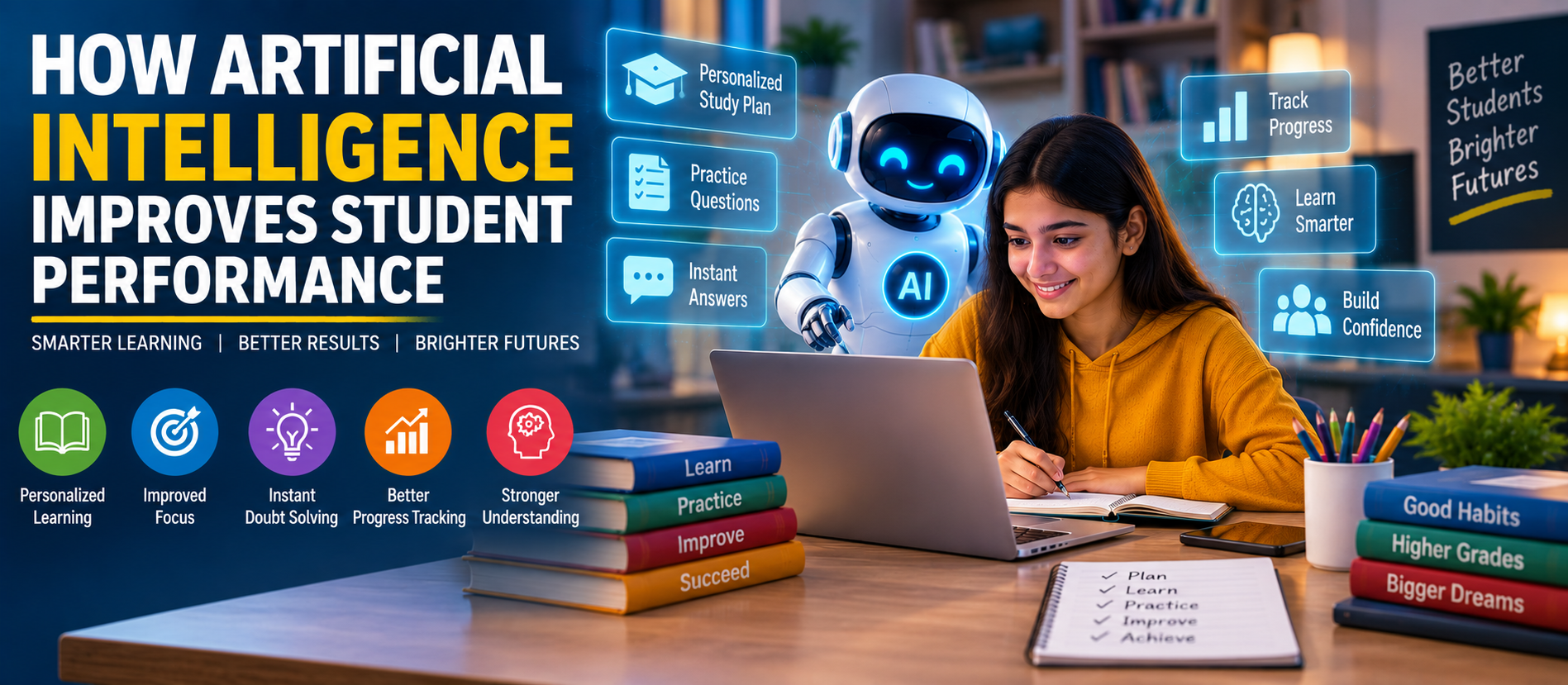
Artificial Intelligence can improve student performance by supporting personalized learning, AI tutoring, instant feedback, targeted practice, study planning, learning-gap identification, accessibility, and exam preparation. It can also help teachers reduce repetitive tasks and provide more focused support.
Students should verify important AI information, protect personal data, follow academic rules, and keep developing independent skills.
What Is AI in Education?
AI in education means using intelligent software to support teaching and learning. AI systems can process information, understand language, recognize patterns, generate content, and make recommendations.
For students, an AI tool can work as a study assistant. It may explain a concept, create questions, review a draft, suggest a study schedule, or help identify topics that need more practice.
1. Personalized Learning
Students do not learn at the same speed. Some understand a topic quickly. Others need more examples and practice. A fixed course may not meet both needs.
AI can make learning more flexible. A learning platform can use available information about quiz results and progress to suggest suitable content.
For example, if a student repeatedly struggles with fractions, an AI-supported system may suggest a short review lesson and extra practice. A student who already understands fractions may receive more advanced questions.
Benefits of Personalized Learning
- More focused practice.
- Flexible learning pace.
- More relevant recommendations.
- Different explanations for difficult topics.
- More challenge for advanced learners.
2. AI Tutors Provide On-Demand Support
AI tutors can help students when a teacher is not immediately available. Students can ask questions, request examples, receive hints, and continue learning outside normal class hours.
An AI tutor can explain one concept in several ways. A student can ask for a simple explanation, an analogy, a step-by-step guide, or a practical example.
This support can reduce the time a student spends feeling stuck. Important information should still be checked with reliable academic sources.
3. Faster Feedback Improves Practice
Feedback helps students understand mistakes. AI can provide quick feedback on quizzes, structured exercises, language practice, and some types of written work.
For example, a language-learning system can identify repeated grammar mistakes. A practice platform can show which concepts are causing incorrect answers. Students can then review the topic while it is still fresh.
AI feedback has limits. Teachers can understand assignment context, reasoning, originality, effort, and learning goals. Human feedback remains important for deeper academic development.
4. AI Creates Targeted Practice Questions
Practice is one of the most important parts of learning. AI can create questions based on a specific topic and difficulty level.
A student studying history can request multiple-choice, short-answer, and analytical questions. A mathematics student can ask for problems that become gradually harder.
The best method is to answer independently first. Students can then use AI to review mistakes and request explanations. This turns AI into a practice partner rather than an answer generator.
5. AI Explains Difficult Concepts
Sometimes students understand a subject only after hearing the idea explained in a different way. AI can provide alternative explanations without requiring the learner to wait for the next class.
A science student can request a real-world example. A programming student can ask for a small example before moving to a larger problem. A student can also request simpler language when a technical definition is difficult.
After receiving an explanation, the student should solve a problem or explain the idea independently. This checks whether the concept has actually been understood.
6. AI Supports Better Study Planning
Large syllabuses can be difficult to organize. AI can help students divide a syllabus into smaller goals and create a draft revision plan.
A useful plan can include study sessions, practice questions, revision, breaks, and time for difficult topics. Students should adjust the plan according to real progress.
AI should help students organize their time, not create unrealistic schedules. Rest and regular routines are also part of effective learning.
7. AI Helps Identify Learning Gaps
A learning gap is a topic or skill that a student has not understood well enough. AI-supported platforms can analyze available quiz results and practice patterns to identify areas that may need attention.
For example, a learner may perform well on basic algebra but repeatedly make errors in multi-step equations. Targeted practice can focus on that specific skill instead of repeating the entire course.
Learning data must be interpreted carefully. A low score may have many causes, including technical problems, language barriers, fatigue, or lack of preparation.
8. AI Supports Writing and Communication
Students can use AI to support brainstorming, outlines, grammar review, and clarity when course rules allow it.
A useful approach is to write the first draft independently. AI can then help identify unclear sentences or suggest areas for improvement. The student should review the suggestions and make the final decisions.
This method helps develop writing skills. Asking AI to create every assignment does not provide the same learning benefit and may violate academic rules.
9. AI Can Improve Student Engagement
Online learning can become passive when students only watch videos and read documents. AI can make learning more interactive through quizzes, simulations, role-play, and personalized challenges.
A business student can practice a customer conversation. A programming student can work through coding problems. A history student can explore a scenario and explain possible decisions.
Interactive practice encourages students to apply knowledge instead of only consuming information.
10. AI Supports Exam Preparation
AI can help students prepare for exams by creating practice questions, explaining difficult topics, organizing revision, and reviewing mistakes.
- Study the topic using trusted course material.
- Create your own notes.
- Ask AI for practice questions.
- Answer without looking at solutions.
- Check mistakes and verify explanations.
- Repeat similar problems independently.
This workflow keeps the student actively involved. AI provides support, while the student performs the important learning work. Students must always follow examination rules and must not use AI to bypass assessment requirements.
11. AI Supports Accessibility and Language Learning
Students have different learning and language needs. AI can support accessibility through speech recognition, text-to-speech, translation, summarization, and language simplification.
Language learners can use AI for vocabulary practice, grammar exercises, pronunciation activities, and conversation practice. These tools can make practice more convenient.
AI should complement proper accessibility practices and trusted academic resources.
12. AI Helps Teachers Support Students
Teachers can use AI for selected routine tasks such as drafting quizzes, preparing examples, organizing common questions, and creating practice activities.
Reducing repetitive preparation can give teachers more time for discussion, mentoring, project guidance, and individual feedback.
Teachers should review AI-generated material before using it. Human educators remain responsible for academic quality and context.
13. Challenges of Using AI for Student Performance
Accuracy
AI can produce incorrect or incomplete information. Students should verify important facts with reliable sources.
Overdependence
If students use AI for every task, they may lose opportunities to practice independent thinking, writing, and problem-solving.
Privacy
Students should avoid entering passwords, private records, or unnecessary personal information into AI tools. Educational institutions should also have clear data policies.
Academic Integrity
Submitting AI-generated work as personal work can violate course rules. Students should understand when AI assistance is permitted and disclose its use when required.
Unequal Access
Students do not all have the same devices, internet access, software, or digital skills. AI should not become a new barrier to education.
14. How Students Can Use AI Responsibly
- Use AI to understand difficult concepts.
- Ask for examples and practice questions.
- Try problems before requesting solutions.
- Verify important information.
- Keep your own notes and reasoning.
- Protect private information.
- Follow school, college, university, and course policies.
- Disclose AI use when required.
A rule is useful: use AI to improve your ability, not to replace your effort.
15. A Practical AI Study Workflow
A simple workflow can combine AI with normal study methods.
Learn
Study the topic using your textbook, lecture, notes, or another trusted resource.
Clarify
Ask AI about concepts that remain confusing. Request a simple explanation or example.
Practice
Generate questions and solve them without assistance.
Review
Check mistakes and compare important explanations with reliable sources.
Recall
Close the AI tool and explain the topic in your own words. This helps test real understanding.
16. Measuring Whether AI Improves Performance
Using AI does not automatically mean that learning has improved. Students should look at outcomes.
Useful indicators include better quiz performance, fewer repeated mistakes, stronger understanding, improved assignment quality, better study organization, and greater ability to solve problems independently.
The goal is not to use the most AI. The goal is to learn more effectively.
17. The Future of AI and Student Learning
AI-powered education is likely to become more personalized. Learning platforms may connect lessons, assessments, feedback, study plans, and recommendations in one learning experience.
Students may receive support based on current progress instead of following only a fixed sequence. AI may also work with simulations and interactive learning environments.
Human skills such as critical thinking, communication, creativity, collaboration, and judgment remain essential.
SEO, AEO, GEO, and AI Search Perspective
Students increasingly discover educational information through search engines, answer engines, AI assistants, and generative search. Educational content should therefore be easy for both people and AI systems to understand.
Clear headings, short paragraphs, direct answers, useful examples, definitions, and FAQs improve readability and information structure. These practices support traditional SEO and can also help educational content become more understandable in AI-powered search experiences.
Frequently Asked Questions
How does artificial intelligence improve student performance?
AI can support personalized learning, targeted practice, quick feedback, study planning, concept explanations, learning-gap identification, and exam preparation.
Can AI improve student grades?
AI can support activities that contribute to learning, such as practice, revision, feedback, and personalized explanations. Academic results still depend on many factors.
How should students use AI for studying?
Students can use AI to understand difficult topics, create practice questions, organize revision, and review their own work when permitted.
Can AI replace teachers?
AI can assist with selected tasks, but teachers provide mentorship, context, judgment, communication, encouragement, and human guidance.
What are the main risks of AI in education?
Key risks include incorrect information, privacy concerns, academic misuse, overdependence, bias, and unequal access to technology.
Is AI useful for exam preparation?
Yes. AI can create practice questions, explain difficult topics, organize revision, and help review mistakes. Students must follow exam rules.
Key Takeaways
- AI can personalize learning.
- AI tutors can provide on-demand academic support.
- Fast feedback can help students correct mistakes.
- AI can create targeted practice.
- AI can support study planning and exam preparation.
- AI can help with accessibility and language support.
- Teachers can use AI to reduce selected routine tasks.
- AI information should be verified when accuracy matters.
- Independent thinking and academic integrity remain essential.
- AI should be measured by its effect on learning, not by technology use alone.
Final Thoughts
Artificial Intelligence is changing how students study and interact with educational content. It can provide flexible explanations, targeted practice, quick feedback, personalized recommendations, and better study organization.
The strongest results come when students remain active. AI should help learners understand concepts, ask better questions, practice skills, and improve their own work.
Technology should complement teachers, textbooks, discussion, research, and independent study. When used responsibly, AI can become a valuable learning partner and support stronger student performance.
For more education, AI, digital technology, SEO, AEO, GEO, and AI Search insights, visit www.digiifrog.com.
Ready to Grow?
Talk to us about a strategy tailored to your brand — we will help you stand out in search, AI discovery and social.

Comments (0)
Log in to leave a comment.