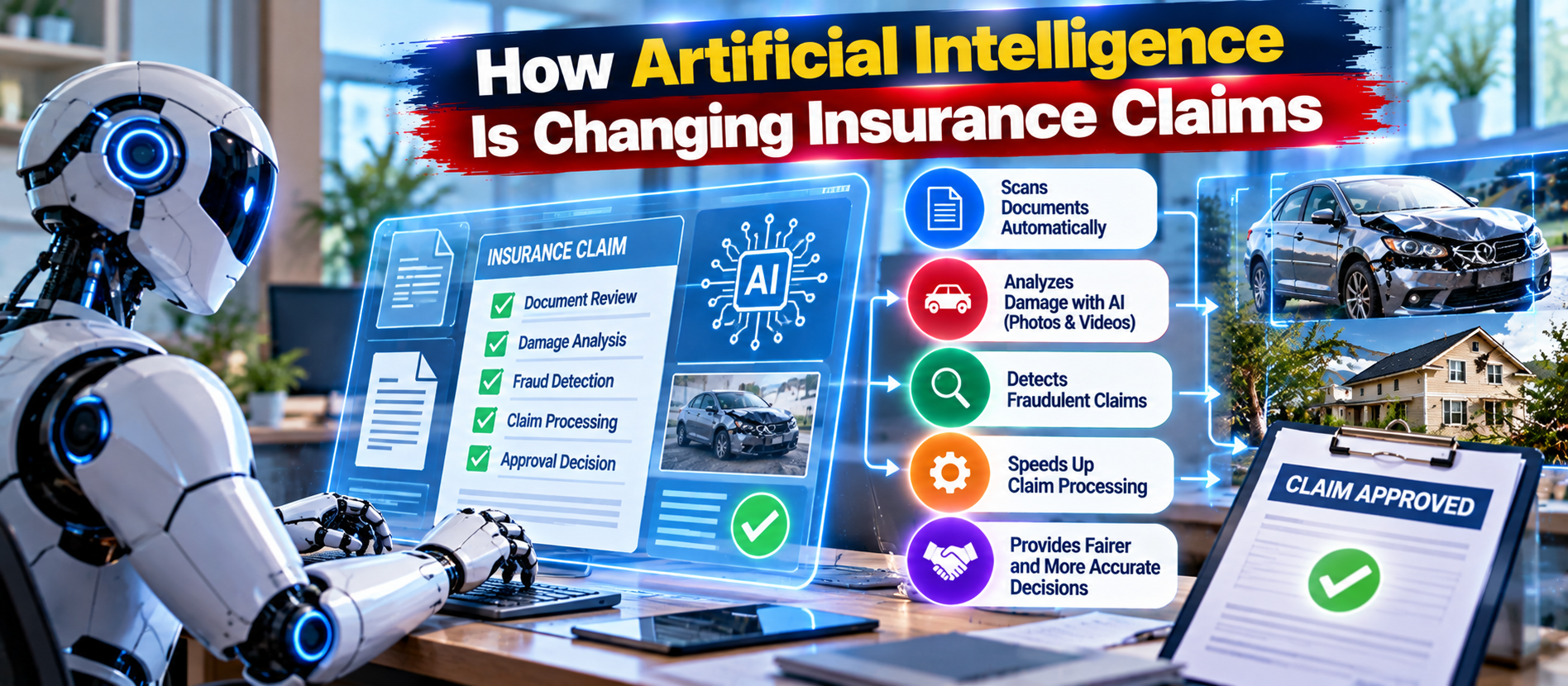
📋 Quick Summary
In this article:
Quick Answer: How Is AI Changing Insurance Claims?
What Is Artificial Intelligence in Insurance Claims?
1. Faster Claim Registration and Document Processing
2. AI-Powered Damage Assessment
3. Fraud Detection and Unusual Pattern Identification
4. Better Claim Routing and Prioritisation
5. Virtual Assistants and Faster Customer Support
6. Personalised Updates and Clearer Communication
7. More Consistent Claim Reviews
8. Supporting Claims After Natural Disasters
9. Helping Detect Duplicate Payments and Administrative Errors
Filing an insurance claim can feel stressful. A person may need to report an accident, collect documents, arrange repairs, and wait for a decision. Insurance companies also face a large amount of information to review. Artificial intelligence, often called AI, is changing how some of this work is done.
AI tools can help insurers sort documents, review photos, identify unusual patterns, and answer routine questions. These tools may speed up parts of the claims process. They can also create risks if information is incomplete or a model makes an incorrect assessment. Human review, clear communication, and strong data protection remain important.
Quick Answer: How Is AI Changing Insurance Claims?
AI is changing insurance claims by helping insurers process documents, assess damage, detect possible fraud, route claims to the right team, and respond to customers. Some tasks that once required manual review can now be supported by automated systems. This may reduce delays and improve consistency. However, AI does not guarantee a correct or fair decision. Claim outcomes still depend on policy terms, evidence, applicable law, and the insurer's review process.
What Is Artificial Intelligence in Insurance Claims?
Artificial intelligence refers to computer systems that perform tasks such as recognising patterns, understanding language, making predictions, or generating responses. In insurance claims, AI may analyse documents, images, repair estimates, medical bills, incident reports, or customer messages.
Different technologies perform different tasks:
- Machine learning: Finds patterns in data and estimates the likelihood of an outcome.
- Computer vision: Analyses images or video, such as photos of a damaged vehicle.
- Natural language processing: Helps systems read and classify written information.
- Generative AI: Can draft summaries, explain information, or help employees search large sets of documents.
- Automation: Moves information between systems and completes routine steps based on set rules.
These technologies are often used together. For example, a system may extract information from a claim form, compare it with policy records, and send the file to a human adjuster when it finds missing information or a complex issue.
AI is not one single tool. Some systems follow fixed rules, while others make estimates based on patterns in data. The type of system matters because it affects how the result should be checked.
Why Are Insurers Using AI?
Insurance claims involve many steps. A claim may include forms, photos, invoices, repair estimates, statements, policy details, and messages. Staff must review this information, check coverage, investigate the event, and explain the result to the policyholder.
When claim volumes rise after storms, floods, fires, or major accidents, manual processes can become slower. AI can help organise large amounts of information and highlight files that need attention. Insurers may use it to support employees, reduce repetitive work, and give customers updates more quickly.
The goal should be better service and more reliable decisions—not automation for its own sake. A fast answer is not useful if it is wrong, unclear, or based on incomplete evidence.
1. Faster Claim Registration and Document Processing
When a customer submits a claim, the insurer needs to capture key details. These may include the policy number, date of loss, location, incident type, and contact information. AI-powered document tools can extract details from forms, receipts, reports, and other files.
The system may then check whether required documents are present. It can flag missing pages, unreadable images, or information that does not match other records. This helps staff request corrections earlier instead of discovering a problem much later.
For example, a customer may upload a repair invoice and photos after a vehicle accident. A document tool can identify the invoice date, repair shop details, and listed charges. An employee can then review the extracted information and compare it with the claim.
What this means for customers: Clear, complete submissions may move through the intake stage more smoothly. Customers should still check every form and uploaded file. AI can misread handwriting, dates, amounts, or low-quality scans.
2. AI-Powered Damage Assessment
Images can help insurers understand the condition of damaged property. Computer vision tools can analyse photos of a car, roof, room, appliance, or other insured item. Depending on the system, they may identify visible damage, group images by damage type, or estimate the likely repair category.
In motor insurance, image tools may highlight dents, broken lights, scratches, or damaged panels. In property claims, they may help organise photos of damaged walls, ceilings, flooring, or roofing. This can help an adjuster decide which claims need an in-person inspection.
Image-based estimates have limits. A photo may not show internal damage, hidden water damage, structural problems, or the full extent of a loss. Lighting, camera angle, image quality, and the number of photos can affect the result.
For that reason, AI-generated estimates should be treated as support for the assessment, not automatic proof of the final repair cost. Complex or disputed damage may need an expert inspection and a detailed estimate.
3. Fraud Detection and Unusual Pattern Identification
Insurance fraud can increase costs for insurers and policyholders. AI systems can review large groups of claims and identify patterns that may deserve further investigation. For example, a system might flag repeated invoices, unusual timing, duplicate images, inconsistent details, or connections between records.
A flag does not prove fraud. A claim may look unusual for a valid reason. A customer may have made an honest mistake, used a repair provider more than once, or submitted documents in a different format. The system may also make a mistake.
Any serious allegation should be based on evidence and a fair review. Insurers should have processes for checking alerts, correcting errors, and giving customers a reasonable opportunity to explain relevant facts.
What this means for customers: Provide accurate information and keep copies of documents, receipts, photos, and messages. If the insurer asks for clarification, respond clearly and retain a record of your response.
4. Better Claim Routing and Prioritisation
Not all claims require the same level of attention. A simple glass repair may need fewer steps than a serious accident or a major house fire. AI can help sort claims by type, urgency, complexity, or missing information.
For example, a claim involving immediate safety concerns may need urgent human attention. A straightforward claim with complete documents may be suitable for a standard workflow. A claim involving conflicting evidence may be routed to a specialist team.
Good prioritisation can help staff focus on cases that need their experience. However, the criteria must be designed carefully. A system should not overlook a customer who needs help simply because the claim is unusual or the available data is limited.
5. Virtual Assistants and Faster Customer Support
AI chat assistants can answer routine questions at any time. They may explain how to report a claim, list commonly required documents, provide status updates, or direct a customer to the right department.
This can be useful when a customer needs basic information outside normal business hours. It may also reduce waiting times for simple questions and allow human agents to focus on more complex problems.
However, a chatbot may misunderstand a question or give an incomplete answer. Customers should be able to reach a human representative when the issue is urgent, sensitive, disputed, or not covered by the assistant's knowledge.
AI assistants should not present guesses as confirmed claim decisions. They should explain when they cannot answer and direct customers to an appropriate person or official policy document.
6. Personalised Updates and Clearer Communication
Customers often want to know what happens next. AI tools can help create plain-language summaries of claim status, outstanding documents, or the next step in a process. They may also help employees respond to common questions more consistently.
Clear communication can reduce confusion. For example, a useful update may explain that a repair estimate is still being reviewed, identify the document that is missing, and tell the customer how to submit it.
Automated messages must be accurate and specific. They should not imply that a claim is approved when only one stage is complete. Customers should receive a clear explanation of important decisions, including the reasons for a denial or a change in the amount offered, as required by the applicable rules and policy.
7. More Consistent Claim Reviews
AI can help reviewers follow the same checklist across similar claims. A system may remind an employee to verify policy dates, confirm required documents, or review a repair estimate. This can reduce some avoidable omissions.
💡 Key Insight
Consistency does not always mean fairness. If the data or rules behind a system contain errors, the system may repeat those errors across many claims. Different claims may also have important details that a standard checklist cannot capture.
Insurers should test their systems, monitor results, document important decisions, and allow staff to consider the facts of each case. Human reviewers need enough training and authority to challenge a computer-generated recommendation.
8. Supporting Claims After Natural Disasters
After a cyclone, flood, wildfire, or severe storm, insurers may receive many claims in a short period. AI can help organise incoming reports, group claims by location, review images, and identify urgent cases. Satellite imagery and other mapping tools may help assess the broad impact of an event when suitable data is available.
These tools can support coordination and help insurers understand where assistance may be needed. They do not replace local inspections or the customer's evidence. A map may show that an area was affected, but it may not reveal the condition of a particular home or the cause of a specific loss.
During a disaster, customers should follow official safety advice first. They should document damage only when it is safe to do so and contact their insurer through verified channels.
9. Helping Detect Duplicate Payments and Administrative Errors
Large claims operations process many invoices, estimates, payments, and adjustments. AI and data-matching tools can identify records that appear duplicated or inconsistent. This may help staff check whether the same expense has been entered more than once or whether figures differ between documents.
A mismatch is not automatically an error or an attempt to obtain an improper payment. Two invoices may relate to different stages of a repair, and similar amounts may be legitimate. The system should point to the issue, while a trained person verifies the facts before taking action.
10. The Main Benefits of AI in Insurance Claims
- Faster administration: Routine data entry and document sorting may take less time.
- Earlier identification of missing information: Customers can be asked for documents before the file stalls.
- More efficient photo review: Image tools can help organise visible damage for further assessment.
- Support for fraud investigations: Unusual patterns can be flagged for human review.
- Improved access to basic information: Virtual assistants may answer routine questions outside office hours.
- Better workload management: Claims can be directed to teams with the right skills.
- More structured records: Summaries and automated checks can help staff track claim activity.
These benefits are possible outcomes, not guarantees. Results depend on the quality of the technology, the data, the workflow, and the people who supervise it.
What Are the Risks and Limitations of AI in Claims?
Incorrect results
AI can misread a document, misclassify an image, or make a poor prediction. A system may perform well on common claims but struggle with unusual damage or incomplete evidence. Important outputs need appropriate checks.
Biased or incomplete data
If training data does not represent different customers, regions, property types, or claim situations, results may be less accurate for some groups. Insurers need to test for uneven outcomes and correct problems.
Limited explanations
Some AI systems are difficult to explain. A customer may not understand why a claim was flagged or why a recommendation was made. Insurers should provide meaningful explanations for important decisions and a way to ask questions or challenge errors.
Privacy and cybersecurity
Claims can contain addresses, financial details, medical information, photos, and other sensitive records. Insurers should limit data collection to legitimate needs, control access, protect stored information, and follow applicable privacy laws.
Overreliance on automation
Employees may accept a system's recommendation without checking it. This is sometimes called automation bias. Training, review rules, and clear responsibility can help reduce this risk.
Unclear accountability
Customers need to know which organisation is responsible for handling their claim. Using an AI vendor does not remove the need for the insurer to manage the process responsibly and comply with applicable requirements.
Does AI Make Insurance Claims Decisions Automatically?
Some insurers use automated systems for limited, straightforward tasks. Other claims still require review by an adjuster, investigator, medical specialist, repair expert, or claims manager. The level of automation varies by insurer, product, jurisdiction, and claim type.
AI may assist with a decision, but the policy remains central. Coverage depends on the contract, the facts of the incident, the evidence, and applicable law. A computer-generated estimate or recommendation should not be confused with the full claim decision.
For high-impact decisions, meaningful human oversight is important. Customers should ask for an explanation if they do not understand a decision and use the insurer's complaint or appeal process where appropriate. Keep copies of all letters, reports, estimates, and messages.
How Policyholders Can Prepare for an AI-Assisted Claims Process
- Read your policy: Understand coverage, exclusions, deductibles, limits, and reporting deadlines.
- Report the event promptly: Follow the insurer's instructions and use its verified website, app, or phone number.
- Submit clear evidence: Provide readable forms, dated photos where relevant, receipts, reports, and estimates.
- Check details before sending: Verify names, dates, amounts, policy numbers, and descriptions.
- Keep copies: Save every document and record when you submitted it.
- Answer questions honestly: Correct mistakes as soon as you notice them and explain any uncertainty.
- Ask for human help when needed: Request a representative if an automated answer does not address your situation.
- Challenge errors through the proper channel: Ask what information was used and provide relevant evidence if a result appears incorrect.
- Protect your information: Share claim documents only through verified channels and avoid posting sensitive details publicly.
How Insurers Can Use AI Responsibly
Responsible use requires more than installing software. Insurers should define which tasks AI can support and which decisions need human approval. They should test systems before launch and monitor performance after deployment.
Good practices include:
- Use reliable, relevant, and appropriately collected data.
- Test accuracy across different claim types and customer groups.
- Keep records of important automated recommendations and actions.
- Provide clear ways for employees to question or override a result.
- Protect customer information with access controls and security testing.
- Tell customers when automation has a meaningful role in a process, where appropriate or required.
- Offer a way to reach a person and challenge errors.
- Review vendors, model changes, complaints, and unusual outcomes.
AI governance should be an ongoing process. A model that worked well last year may perform differently when claim patterns, repair costs, weather events, or data sources change.
AI Claims Processing: Traditional Methods Compared With AI-Assisted Workflows
| Claims task Traditional approach Possible AI support What still needs attention | |||
| Document intake | Staff review and enter details manually | Extract details and flag missing information | Check extraction errors and confirm documents |
| Damage review | Adjuster reviews photos and inspection notes | Organize images and identify visible damage | Hidden damage and complex cases may need inspection |
| Fraud investigation | Investigators compare records and follow leads | Flag patterns that may warrant review | A flag is not proof; investigate fairly |
| Customer questions | Phone or email support | Answer routine questions and provide updates | Complex or disputed issues need human support |
| Claim routing | Staff assign files based on workflow rules | Suggest a team or priority based on claim details | Check urgency, fairness, and routing accuracy |
AI-assisted processes can combine automation with expert review. The aim is to use technology for repetitive tasks while preserving human judgement for complex questions and important decisions.
What Could the Future of AI in Insurance Claims Look Like?
AI tools are likely to become more connected with claim portals, repair networks, document systems, and customer service platforms. Some insurers may use tools that summarize a file for an adjuster, translate routine updates, or help customers understand which documents are needed.
Better integration could reduce repeated data entry and make status updates clearer. However, more automation will also increase the need for careful testing, secure data handling, accessible support, and clear explanations.
Future progress should be measured by more than speed. Useful measures include accuracy, customer understanding, fair treatment, complaint rates, data security, and the ability to correct mistakes. A faster process is valuable only when it remains reliable and accountable.
Frequently Asked Questions
1. What is AI in insurance claims?
AI in insurance claims means using computer systems to help analyze documents, photos, claim patterns, and customer messages. It can support tasks such as document processing, damage review, fraud detection, and customer service.
2. Can AI make insurance claims faster?
AI may speed up tasks such as data entry, document sorting, claim routing, and routine customer updates. The overall timeline still depends on the evidence, policy terms, complexity of the loss, and whether an investigation or expert review is needed.
3. Can AI reject an insurance claim?
Practices vary by insurer and jurisdiction. AI may support or automate certain parts of a workflow, but the legal and contractual requirements for claim decisions still apply. If a claim is denied, ask for the reason in writing and review the insurer's complaint or appeal process.
4. How does AI detect insurance fraud?
AI can flag patterns such as duplicate records, unusual timing, or inconsistencies between documents. These signals require investigation. A computer-generated flag alone does not prove fraud.
5. Does AI review vehicle damage photos?
Some systems use computer vision to identify visible damage and organize images. They may support an initial estimate, but hidden damage, safety issues, and complex repairs can require a qualified inspection.
6. Is my personal data safe when an insurer uses AI?
Safety depends on the insurer's data practices, security controls, vendors, and compliance with applicable law. Ask how your information is used, stored, shared, and protected. Send documents only through verified channels.
7. Can I ask a human to review an AI-assisted claim?
Available rights and procedures vary. You can contact the insurer, ask how the decision was reached, provide additional evidence, and request a human review or use the formal complaint process where available.
8. Does AI replace insurance adjusters?
AI can automate or support some repetitive tasks, but adjusters and other specialists remain important for inspections, complex facts, negotiations, and decisions that need professional judgement.
9. What should I do if an AI system has incorrect information about my claim?
Contact the insurer through an official channel. Identify the specific error, provide supporting documents, request that the record be corrected, and keep a copy of your communication.
10. Is AI used in every insurance claim?
No. Use varies by company, product, country, and claim type. Some insurers use AI in selected tasks, while others rely more heavily on traditional processes.
Conclusion: AI Can Improve Claims, but Accountability Still Matters
Artificial intelligence is changing insurance claims by helping insurers process documents, review images, flag unusual patterns, prioritize work, and answer routine questions. These tools may reduce repetitive tasks and help customers receive information sooner.
AI also has limits. It can make mistakes, reflect problems in its data, or provide a result that is hard to explain. A reliable claims process needs secure information handling, clear communication, suitable human oversight, and a fair way to correct errors.
For policyholders, the best approach is simple: understand your policy, submit accurate evidence, keep records, and ask questions when something is unclear. For more practical insurance guides, visit Digiifrog.
Disclaimer
This article is for general educational and informational purposes only. It is not legal, financial, or insurance advice. AI practices and legal requirements vary by insurer and jurisdiction. Coverage and claim outcomes depend on policy wording, the facts, supporting evidence, and applicable law. Contact your insurer or a qualified professional for advice about a specific claim.
Ready to Grow?
Talk to us about a strategy tailored to your brand — we will help you stand out in search, AI discovery and social.


Comments (0)
Log in to leave a comment.