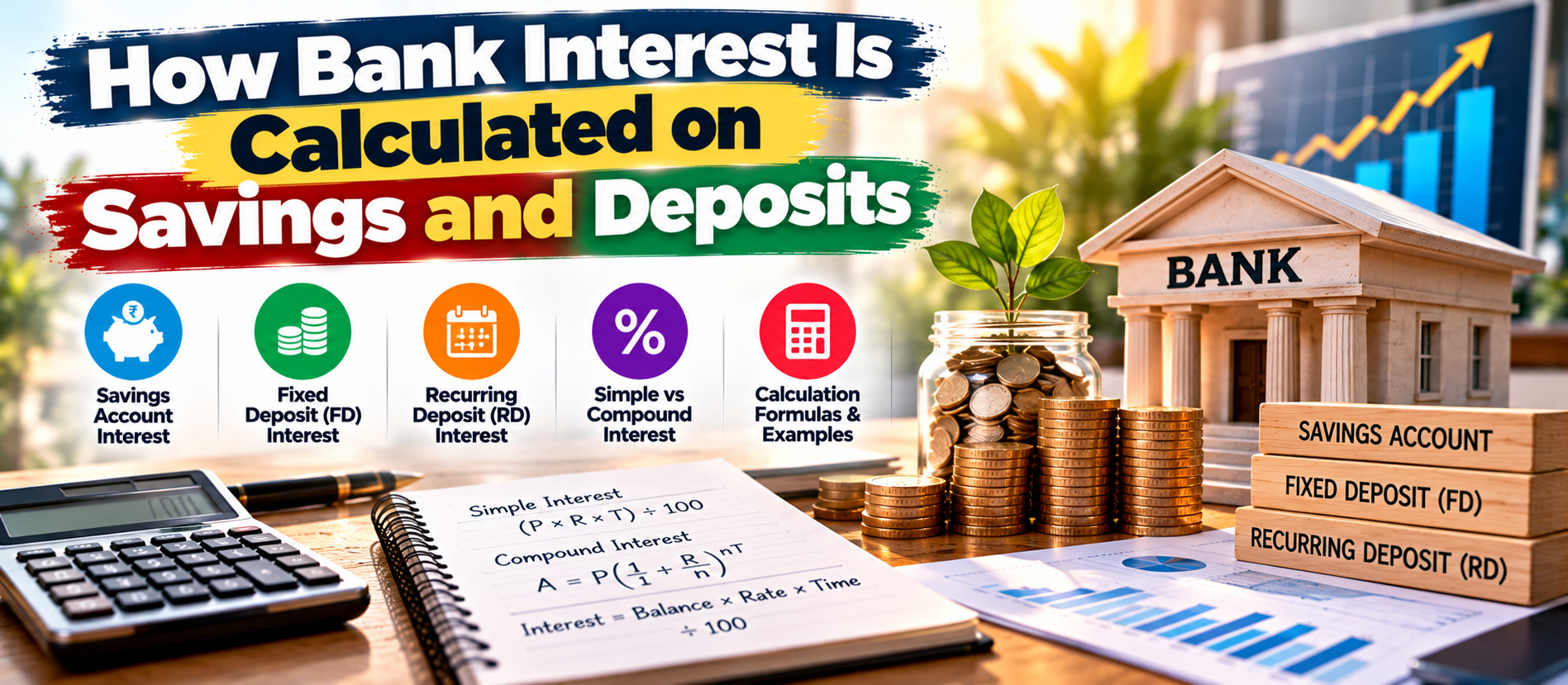
📋 Quick Summary
In this article:
How Is Savings Account Interest Calculated?
A simple daily-balance formula
Example: savings account interest
Why does the end-of-day balance matter?
When Is Savings Account Interest Credited?
How Is Fixed Deposit (FD) Interest Calculated?
Example: one-year FD using simple interest
Example: quarterly compounding
Does More Frequent Compounding Always Mean a Better FD?
When you keep money in a bank, your balance may earn interest. The amount depends on the account type, interest rate, balance, time period, and the bank’s calculation method. A savings account usually offers access to your money while earning interest. A fixed deposit (FD) allows you to invest a lump sum for a chosen period. A recurring deposit (RD) lets you save a fixed amount regularly.
These products do not always calculate interest in the same way. Savings account interest is generally based on daily balances. Fixed deposits use the rate and calculation method stated in the deposit terms. Recurring deposits calculate interest on instalments that enter the account at different times.
This guide explains the main methods in plain language, using examples in Indian rupees. The examples are illustrative, not offers from any bank. Actual rates, compounding rules, day-count conventions, payout schedules, and tax treatment can vary by product and institution.
What Is Bank Interest?
Interest is the amount paid for the use of money. When you deposit money with a bank, the bank may pay you interest under the terms of the account. The original amount you deposit is called the principal. The interest rate is usually expressed as a percentage per year, also called the annual rate.
For example, if an account pays simple interest at 4% per year on ₹10,000 for a full year, the interest would be ₹400. The total before any tax or other adjustment would be ₹10,400. This example assumes the balance stays unchanged and the simple-interest method applies.
In real banking products, the calculation may be more detailed. The bank may use the end-of-day balance, apply a rate to each day, compound interest at set intervals, or pay interest periodically. Understanding these differences helps you estimate returns and compare accounts fairly.
How Is Savings Account Interest Calculated?
For savings accounts at Indian banks, interest is generally calculated using the daily product method. In simple terms, the bank considers the eligible balance at the end of each day, applies the relevant annual interest rate for that day, and totals the interest for the calculation period. The interest is then credited according to the bank’s schedule.
The Reserve Bank of India has published guidance on daily-product calculation for savings deposits. Banks may apply different rates to different balance slabs, subject to applicable rules and their published terms. Always check the current rate table for your own account. Read the RBI explanation of deposit-interest calculation.
A simple daily-balance formula
A useful estimate for a period with a constant annual rate is:
Interest for one day ≈ Eligible end-of-day balance × Annual interest rate ÷ 365
For a leap year, or where a bank’s product terms specify a different day-count convention, the applicable denominator or method may differ. Use the bank’s published method for an exact calculation.
Example: savings account interest
Suppose your savings account balance remains ₹50,000 for 30 days and the illustrative annual rate is 3%. Using 365 days as the denominator:
- Approximate daily interest = ₹50,000 × 0.03 ÷ 365.
- Approximate interest per day = ₹4.11.
- Approximate interest for 30 days = ₹123.29.
This is an estimate before tax. The bank’s actual credit can differ because of balance changes, rate slabs, rounding, day-count rules, and the period used by the bank.
Why does the end-of-day balance matter?
Imagine that you have ₹20,000 in your account at the start of the month. You deposit another ₹10,000 halfway through the month. The bank does not necessarily calculate interest as if you had ₹30,000 for the entire month. Instead, the daily balance method reflects the balance that applies on each day.
This means the timing of deposits and withdrawals can affect the interest earned. A deposit made earlier may earn interest for more days, while a withdrawal can reduce the balance used for later days. The exact treatment of a transaction depends on when it is posted and the bank’s account terms.
When Is Savings Account Interest Credited?
Interest calculation and interest crediting are two different things. A bank may calculate interest daily but credit it to your account at regular intervals, such as quarterly or at another interval specified in the account terms. The money may therefore accumulate in the calculation before you see the credit entry.
Check your account statement for entries labelled interest, interest credit, or a similar description. If you want to estimate your return, look at the eligible daily balances and the published interest rate rather than assuming the rate is applied only to the balance shown on the final day of the month.
Do not assume that every bank uses the same crediting date or the same rate for every balance. Savings rates can change, and some banks use rate slabs. The terms in force for your account are the best starting point.
How Is Fixed Deposit (FD) Interest Calculated?
A fixed deposit is different from a savings account. You place a lump sum with a bank for a chosen tenure. The bank agrees to pay interest under the terms offered when the deposit is opened. The final amount depends on the principal, rate, tenure, compounding method, payout option, and any applicable conditions.
Banks can use different calculation methods for term deposits, but they should explain the applicable method under their deposit terms. The rate may also depend on tenure and other published conditions. Do not assume that the highest advertised rate applies to every amount or deposit period. See the RBI’s deposit-interest guidance.
Simple interest formula
For a simplified simple-interest example:
Simple interest = Principal × Annual rate × Time
Here, the annual rate is written as a decimal and time is measured in years. For example, 6% is written as 0.06.
Example: one-year FD using simple interest
Suppose you deposit ₹1,00,000 for one year at an illustrative annual rate of 6%, with simple interest:
- Principal = ₹1,00,000.
- Annual rate = 6%.
- Time = 1 year.
- Interest = ₹1,00,000 × 0.06 × 1 = ₹6,000.
- Total before tax = ₹1,06,000.
This is a teaching example, not a promise of what a real FD will pay. Many cumulative FDs use a compounding method, so their maturity value may be different.
What Is Compound Interest?
Compound interest means interest can be earned on both the original principal and previously accumulated interest. It is sometimes described as “interest on interest.” The effect can become more noticeable over longer periods, although the actual result depends on the rate and compounding schedule.
A common formula for an annual rate compounded at regular intervals is:
Amount = Principal × (1 + annual rate ÷ number of compounding periods per year)^(number of periods)
In this formula, the principal is the original deposit. The annual rate is expressed as a decimal. The number of compounding periods per year might be four for quarterly compounding. The total number of periods is the number of years multiplied by the number of periods per year.
Example: quarterly compounding
Suppose ₹1,00,000 is invested for one year at an illustrative annual rate of 6%, compounded quarterly. The rate for each quarter is 6% ÷ 4, or 1.5%. The approximate maturity amount is:
₹1,00,000 × (1 + 0.06 ÷ 4)^4 ≈ ₹1,06,136.
The interest is approximately ₹6,136 before tax. The amount is slightly higher than the ₹6,000 simple-interest example because interest is added during the year and can itself earn interest. Actual bank calculations can differ because of day counts, rounding, product terms, and how the quoted rate is defined.
Does More Frequent Compounding Always Mean a Better FD?
More frequent compounding can increase the final amount when the nominal annual rate and other conditions are identical. However, banks may quote rates and terms differently. A deposit with a lower headline rate but a different payout or compounding structure should be compared using the effective return and total amount payable.
Compare these details before choosing an FD:
- Annual interest rate and whether it is fixed or floating.
- Tenure and exact maturity date.
- Compounding frequency and calculation method.
- Whether interest is cumulative or paid out periodically.
- Premature-withdrawal rules and any penalty.
- Tax treatment and applicable TDS rules.
- Renewal instructions and what happens at maturity.
Use the bank’s own FD calculator for an estimate, then check the deposit advice before confirming. A calculator is only as accurate as the rate and options entered.
How Is Interest Calculated on a Non-Cumulative FD?
A non-cumulative FD pays interest at regular intervals instead of adding all the interest to the principal until maturity. Depending on the product, payments may be monthly, quarterly, half-yearly, or at another stated frequency.
For a simplified example, an FD of ₹2,00,000 at an illustrative simple annual rate of 6% generates ₹12,000 in interest over one year before tax. If the product pays interest quarterly, the estimated annual interest divided into four equal payments would be ₹3,000 per quarter. The actual payment may differ because of the bank’s method, day counts, and payout terms.
Regular payouts may help people who want income from their savings. However, the interest paid out is not available to compound within that FD. Compare the total cash flow, not just the payment frequency or headline rate.
How Is Recurring Deposit (RD) Interest Calculated?
A recurring deposit is designed for regular saving. You deposit a chosen amount each month for a fixed tenure. Because each instalment enters the account at a different time, each instalment earns interest for a different length of time.
The first instalment usually remains invested for longer than the last instalment. That is why you cannot accurately calculate RD interest by simply multiplying the monthly instalment by the annual rate and the full tenure as if every rupee had been deposited on the first day.
Banks use the RD product’s stated method to calculate interest and maturity value. The result depends on the monthly instalment, tenure, rate, deposit dates, compounding method, and rules for missed or late instalments. Use the provider’s RD calculator and check the terms before opening the account.
Example of how timing affects an RD
Suppose you deposit ₹2,000 each month for one year. The first ₹2,000 instalment has more time to earn interest than the final instalment. The total amount you contribute is ₹24,000. The maturity value will be higher than the total contribution if the deposit earns positive interest and no charges or adjustments reduce it, but the exact interest must be calculated using the bank’s RD method.
What Is the Difference Between Savings, FD, and RD Interest?
| FeatureSavings accountFixed depositRecurring deposit | |||
| How you add money | Deposit or withdraw as needed, subject to account terms | Usually a lump sum at opening | Regular instalments |
| Interest basis | Generally linked to daily eligible balances | Based on contracted rate and deposit method | Based on each instalment and product method |
| Access to money | Generally convenient for everyday use | Early closure may reduce interest or involve conditions | Early closure rules depend on the product |
| Interest credit | At intervals specified by the bank | At maturity or periodic payouts, depending on type | Usually included in the maturity value under product terms |
| Typical purpose | Day-to-day money and accessible savings | Investing a lump sum for a defined period | Building savings through regular contributions |
This comparison is general. Product terms vary between institutions, so always read the current account or deposit documentation.
How Do Changes in Balance Affect Savings Interest?
Because savings interest is generally based on daily balances, the amount can change from day to day. Consider an illustrative account paying 3% per year:
- For 10 days, the eligible balance is ₹20,000.
- For the next 20 days, the eligible balance is ₹30,000.
An approximate calculation is:
Interest ≈ (₹20,000 × 10 × 0.03 ÷ 365) + (₹30,000 × 20 × 0.03 ÷ 365)
This gives approximately ₹65.75 before tax and rounding. The example shows why the bank must account for the balance on each day instead of using only the starting or ending balance.
What Is an Effective Annual Return?
The effective annual return reflects the effect of compounding over a year. It can help compare products that compound at different frequencies, provided the quoted rates and other terms are comparable.
For a nominal annual rate compounded a set number of times each year, the effective annual rate can be estimated as:
Effective annual rate = (1 + annual rate ÷ compounding periods)^(compounding periods) − 1
For example, a nominal rate of 6% compounded quarterly has an effective annual rate of about 6.14%, before tax and other product-specific adjustments. This is a mathematical comparison, not a statement that every FD uses quarterly compounding or that the same rate is available from every bank.
When comparing bank products, also consider whether interest is paid out or reinvested, whether there are fees or penalties, and whether tax changes the amount you keep.
Is Bank Interest Taxable in India?
Interest income may be taxable under the rules that apply to your circumstances and the relevant tax year. The treatment can depend on the type of account, the type of deposit, your residency status, your total income, and the applicable tax regime. Do not assume that interest is tax-free simply because the bank has not deducted tax.
Tax deducted at source (TDS), where applicable, is a collection mechanism. It is not necessarily the final tax you owe. The final liability depends on the relevant tax rules and your overall tax position. Thresholds, rates, forms, and section references can change when tax laws are updated.
For current guidance, consult the official Income Tax Department e-filing portal and the Department’s published information on TDS rates. The Department has also published guidance on savings-account interest deductions, but eligibility depends on the applicable law and the taxpayer’s circumstances. Check the rules for the tax year relevant to your income.
What records should you keep?
- Bank statements showing interest credits.
- FD and RD receipts or deposit advice.
- Interest certificates issued by the bank.
- TDS details shown in official tax records, where applicable.
- Records of maturity payments and renewals.
If the bank’s interest statement differs from your records, ask the bank for clarification. For complicated tax questions, consult a qualified tax professional rather than relying on a general online example.
Why Might the Interest Credited Be Different From Your Estimate?
A calculator provides an estimate. The bank’s actual credit can be different for several reasons:
- Balance changes: Deposits and withdrawals affect the eligible balance for each day.
- Rate changes: Savings rates may change under the bank’s published terms. A fixed-rate FD generally follows its contracted terms, subject to product conditions.
- Compounding method: Cumulative and non-cumulative products calculate and pay interest differently.
- Day-count rules: A bank may use a defined day-count convention or account for the exact tenure.
- Rounding: Small differences may arise from rounding at the calculation or credit stage.
- Tax deductions: TDS, where applicable, can reduce the net amount credited.
- Premature closure or missed instalments: These can change the amount payable under the product rules.
If a difference appears unusually large, check the interest rate and dates first. Then compare the bank statement with the product’s terms. Contact the bank through an official channel if the calculation still does not make sense.
How to Compare Bank Interest Offers Wisely
A high interest rate can look attractive, but it is only one part of the decision. Use the following checklist before opening or renewing a deposit:
- Confirm the institution and product. Make sure you understand whether the product is a savings account, bank FD, RD, or another type of deposit.
- Check the rate for your exact tenure. The rate may vary by deposit period and other published conditions.
- Understand how interest is calculated. Ask whether interest is cumulative, paid periodically, or calculated using another method.
- Review access rules. Find out whether you can withdraw early and what penalty or reduction may apply.
- Check maturity instructions. Confirm whether the proceeds will be paid to your account or renewed.
- Consider tax. Compare returns after taking your likely tax position into account.
- Read the full terms. Do not rely only on a headline rate or promotional message.
For savings accounts, check the rate slabs and whether the rate changes above a particular balance. For FDs and RDs, use the maturity calculator but verify the final terms before committing your money.
Common Mistakes to Avoid
- Assuming the annual rate is paid as a full year’s interest regardless of how long money stays in the account.
- Using the ending savings balance for the entire month instead of considering daily balances.
- Confusing simple interest with compound interest.
- Assuming every FD compounds quarterly or follows the same day-count method.
- Comparing products only by the advertised rate and ignoring payout terms or penalties.
- Forgetting that RD instalments earn interest for different lengths of time.
- Assuming that no TDS means no tax may be payable.
- Ignoring the maturity date or leaving old contact details with the bank.
Frequently Asked Questions
1. Is savings account interest calculated daily or monthly?
For Indian bank savings accounts, interest is generally calculated on a daily product basis using eligible daily balances. The bank then credits interest at the intervals specified in its terms, which may be quarterly or another permitted schedule.
2. What is the formula for savings account interest?
A simplified estimate is daily eligible balance multiplied by the annual rate and divided by 365, with the daily amounts added over the period. The bank’s exact method, rate slabs, day-count convention, and rounding rules determine the actual credit.
3. How do banks calculate FD interest?
They apply the contracted rate and the product’s calculation method to the principal and tenure. A cumulative FD may compound interest, while a non-cumulative FD may pay interest at regular intervals. Check the deposit advice for exact terms.
4. Is compound interest always higher than simple interest?
For the same positive rate and period, compounding can produce a higher amount because accumulated interest can earn interest too. The result depends on the compounding schedule and whether the quoted rates and other conditions are comparable.
5. Why is RD interest different from FD interest?
An FD usually starts with one lump sum. An RD receives instalments over time. Each RD instalment is invested for a different duration, so the maturity value must be calculated using the RD product’s method.
6. When is bank interest credited to my account?
The crediting frequency depends on the account or deposit terms. A bank can calculate interest daily but credit it periodically. Check your account statement and product documentation for the exact schedule.
7. Does the bank deduct tax from all interest?
Not in every case. TDS depends on the applicable legal provisions, thresholds, account type, depositor status, and other conditions. Even when TDS is not deducted, you should review whether the interest must be reported or taxed under the rules that apply to you.
8. Can I calculate my exact FD maturity amount online?
A bank’s FD calculator can provide an estimate when you enter the correct principal, tenure, rate, and payout option. Confirm the amount in the bank’s official deposit advice because product-specific rules and rounding may affect the final figure.
Conclusion
Bank interest is calculated using the rules that apply to the account or deposit you choose. Savings accounts generally use daily eligible balances, fixed deposits use a contracted rate and product-specific method, and recurring deposits calculate returns on instalments made at different times. Compounding can increase returns, but the outcome depends on the rate, tenure, and calculation schedule.
To make a fair comparison, look beyond the headline rate. Check the interest method, payout schedule, tenure, access rules, tax treatment, and maturity instructions. Keep your bank statements and deposit records, and use official calculators and product documents to confirm the final figures.
At Digiifrog, we aim to make financial concepts easier to understand with clear, practical information. Understanding how interest works can help you compare savings options and plan with greater confidence.
Disclaimer
This article is for general educational purposes only. It is not financial, tax, or legal advice. Interest rates, bank terms, calculation methods, and tax rules can change. Examples are illustrative and are not bank quotations. Confirm current details directly with your financial institution and official government sources. Seek professional advice for decisions based on your individual circumstances.
Official Resources
- Reserve Bank of India: Deposit Interest Calculation Guidance
- Reserve Bank of India
- Income Tax Department: Official E-Filing Portal
- Income Tax Department: TDS Rates
- Digiifrog
Ready to Grow?
Talk to us about a strategy tailored to your brand — we will help you stand out in search, AI discovery and social.


Comments (0)
Log in to leave a comment.