
📋 Quick Summary
In this article:
What Is a Data Protection Policy?
Key Elements of a Strong Policy
Technology That Supports Data Protection
Zero Trust and Privacy by Design
AI-Powered Data Protection
This WordPress-ready guide explains how companies can strengthen data protection policies using modern cyber security best practices. The content is optimized for SEO, AEO, GEO, and AI Search optimization.
What Is a Data Protection Policy?
A data protection policy defines how an organization collects, stores, processes, shares, retains, and securely disposes of information. It establishes responsibilities, security controls, and compliance requirements to safeguard sensitive data throughout its lifecycle.
Why Data Protection Matters
- Protects customer and employee information.
- Reduces the risk of data breaches.
- Supports business continuity.
- Helps meet legal and regulatory obligations.
- Strengthens customer trust and brand reputation.
Key Elements of a Strong Policy
Data Classification
Classify information based on sensitivity so security controls match business risk.
Access Control
Apply least-privilege access, Role-Based Access Control (RBAC), and Multi-Factor Authentication (MFA).
Encryption
Encrypt sensitive information both at rest and in transit using modern cryptographic standards.
Retention and Disposal
Define retention periods and securely delete information that is no longer required.
Technology That Supports Data Protection
- Data Loss Prevention (DLP)
- Identity and Access Management (IAM)
- Endpoint Detection & Response (EDR)
- Extended Detection & Response (XDR)
- Security Information and Event Management (SIEM)
- Cloud Security Posture Management (CSPM)
- Backup and Disaster Recovery
Employee Awareness
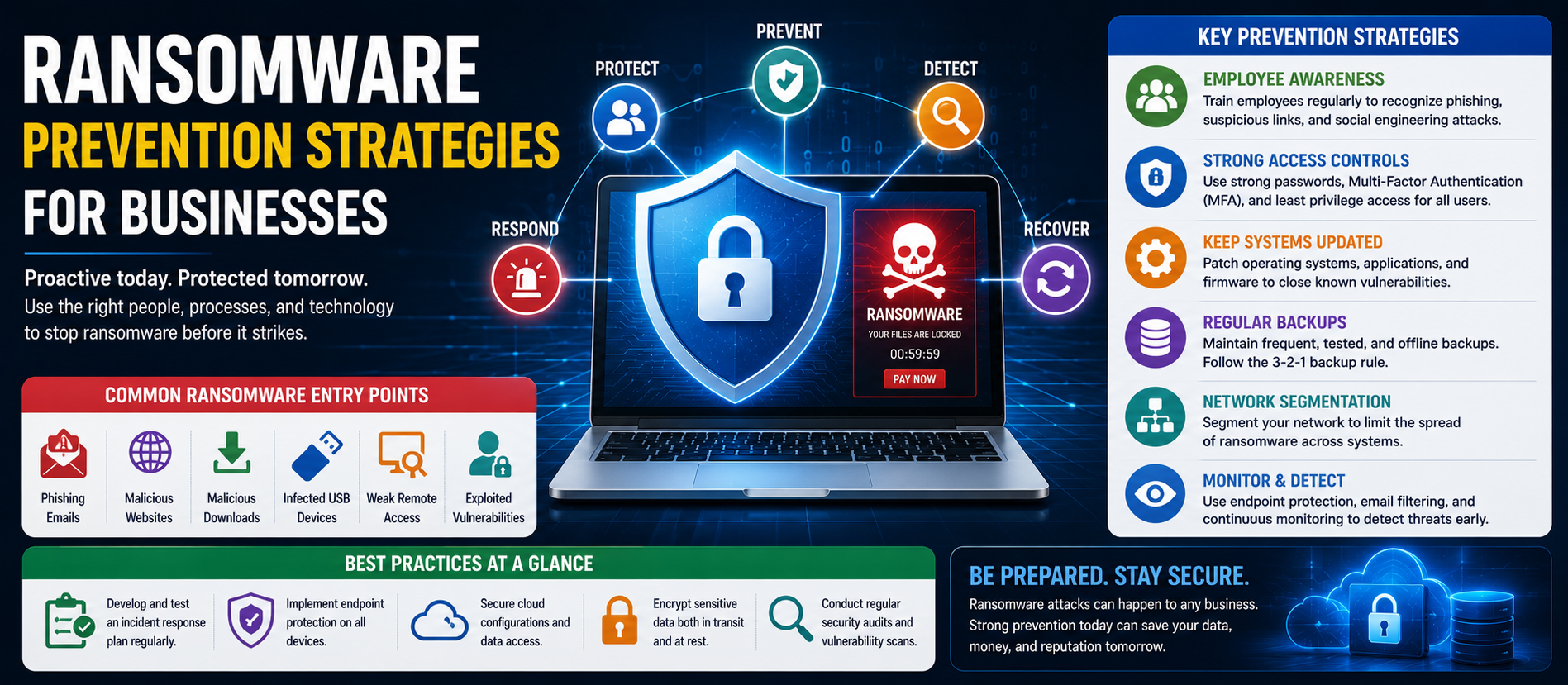
Even the best technologies cannot replace informed employees. Regular security awareness training helps staff recognize phishing, social engineering, password attacks, and data handling risks.
Zero Trust and Privacy by Design
Modern organizations should adopt Zero Trust principles and integrate privacy considerations into applications, workflows, and cloud services from the beginning.
Common Mistakes to Avoid
- Weak password policies
- Excessive user permissions
- Delayed software updates
- Unencrypted sensitive data
- Untested backup procedures
- Poor third-party risk management
AI-Powered Data Protection
Artificial Intelligence helps classify sensitive information, detect anomalies, identify insider threats, automate investigations, and accelerate incident response.
SEO, AEO & GEO Best Practices
Use structured headings, semantic keywords, concise answers, practical examples, and FAQ sections to improve visibility across Google, Bing, ChatGPT, Gemini, Copilot, and other AI-powered search platforms.
AEO & GEO Optimized FAQs
What is a data protection policy?
A documented framework that defines how an organization protects information throughout its lifecycle.
How can businesses improve data protection?
Use MFA, encryption, Zero Trust, DLP, regular backups, employee training, continuous monitoring, and periodic security assessments.
Why is employee training important?
Employees are often the first line of defense against phishing, social engineering, and accidental data exposure.
Conclusion
Strong data protection policies combine governance, modern security technologies, continuous monitoring, employee awareness, and ongoing improvement. Organizations that prioritize data protection will reduce cyber risk, strengthen compliance, and maintain customer confidence throughout 2026 and beyond.
For more expert insights on Cyber Security, Cloud Security, SEO, AEO, GEO, AI Search Optimization, and Digital Transformation, visit Digiifrog at www.digiifrog.com.
Ready to Grow?
Talk to us about a strategy tailored to your brand — we will help you stand out in search, AI discovery and social.

Comments (0)
Log in to leave a comment.