📋 Quick Summary
In this article:
Best Ransomware Prevention Strategies
Patch and Vulnerability Management
SEO, AEO & GEO Optimized FAQs
Ransomware remains one of the most damaging cyber threats facing organizations of every size. Modern ransomware groups target businesses, government agencies, healthcare providers, educational institutions, and critical infrastructure by encrypting data, disrupting operations, and demanding payment for recovery. Beyond financial loss, ransomware attacks can damage customer trust, interrupt business continuity, and expose sensitive information.
This WordPress-ready guide explains effective ransomware prevention strategies, common attack methods, recovery planning, and long-term cyber resilience. The article is optimized for SEO, AEO, GEO, and AI Search optimization.
Understanding Ransomware
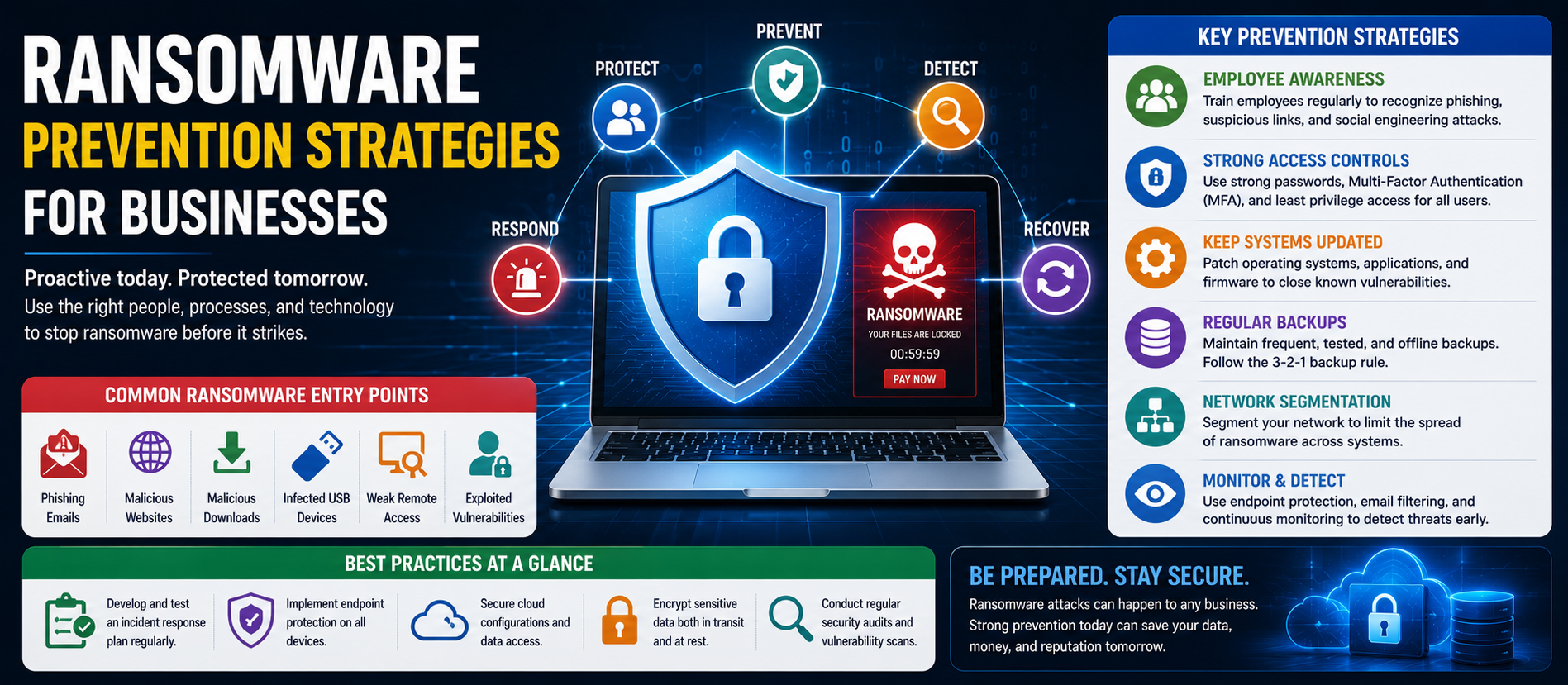
Ransomware is malicious software that prevents access to systems or data until a ransom is paid. Attackers commonly gain access through phishing emails, compromised credentials, software vulnerabilities, remote access services, or supply-chain attacks.
Why Businesses Are Targeted
- Valuable customer and financial data.
- Operational dependence on digital systems.
- Potential willingness to pay to restore operations.
- Complex IT environments with multiple attack surfaces.
Common Infection Methods
- Phishing emails and malicious attachments.
- Compromised Remote Desktop Protocol (RDP).
- Unpatched operating systems and applications.
- Weak or reused passwords.
- Malicious websites and drive-by downloads.
- Third-party software compromises.
Best Ransomware Prevention Strategies
Employee Security Awareness
Regular cyber security training helps employees recognize phishing, suspicious links, and social engineering attacks.
Strong Identity Protection
- Enable Multi-Factor Authentication (MFA).
- Use strong, unique passwords.
- Implement Role-Based Access Control (RBAC).
- Follow least-privilege principles.
Patch and Vulnerability Management
Apply security updates promptly and perform regular vulnerability assessments.
Reliable Backups
Maintain encrypted, offline, and regularly tested backups to support recovery without relying on ransom payments.
Endpoint and Network Security
- Deploy endpoint detection and response (EDR).
- Use advanced antivirus protection.
- Segment networks to limit lateral movement.
- Monitor logs and unusual activity continuously.
Incident Response Planning
Create an incident response plan, define roles and communication procedures, practice recovery exercises, and document restoration processes before an attack occurs.
Emerging Trends
AI-powered threat detection, Zero Trust architecture, security automation, behavioral analytics, and immutable backup technologies are strengthening ransomware defense strategies.
SEO, AEO & GEO Optimized FAQs
What is the best defense against ransomware?
A layered security strategy combining employee training, MFA, patching, endpoint protection, secure backups, and continuous monitoring offers the strongest protection.
Why are offline backups important?
Offline or immutable backups help organizations restore data even if production systems are encrypted.
Can small businesses be targeted?
Yes. Attackers frequently target small and medium-sized businesses because security controls may be less mature.
Conclusion
Preventing ransomware requires continuous vigilance, modern security technologies, employee awareness, and tested recovery plans. Organizations that adopt layered defenses and proactive risk management are better positioned to protect critical assets and maintain business continuity.
For more expert insights on Cyber Security, SEO, AEO, GEO, and AI Search Optimization, visit Digiifrog at www.digiifrog.com.
Ready to Grow?
Talk to us about a strategy tailored to your brand — we will help you stand out in search, AI discovery and social.


Comments (0)
Log in to leave a comment.