📋 Quick Summary
In this article:
How Compounding Works Inside a Mutual Fund
1. Reinvestment Is a Key Part of Compounding
2. Time Is More Important Than Short-Term Excitement
4. Compounding and Market Returns Are Not the Same Every Year
6. Fees Can Reduce the Benefit of Compounding
7. Expense Ratio Matters
9. A Simple Illustration of Compounding
10. Why Compounding Does Not Eliminate Risk
11. Choosing a Mutual Fund for Long-Term Compounding
13. Compounding and Long-Term Financial Goals
14. How to Make Compounding Work More Effectively
💡 Key Insight
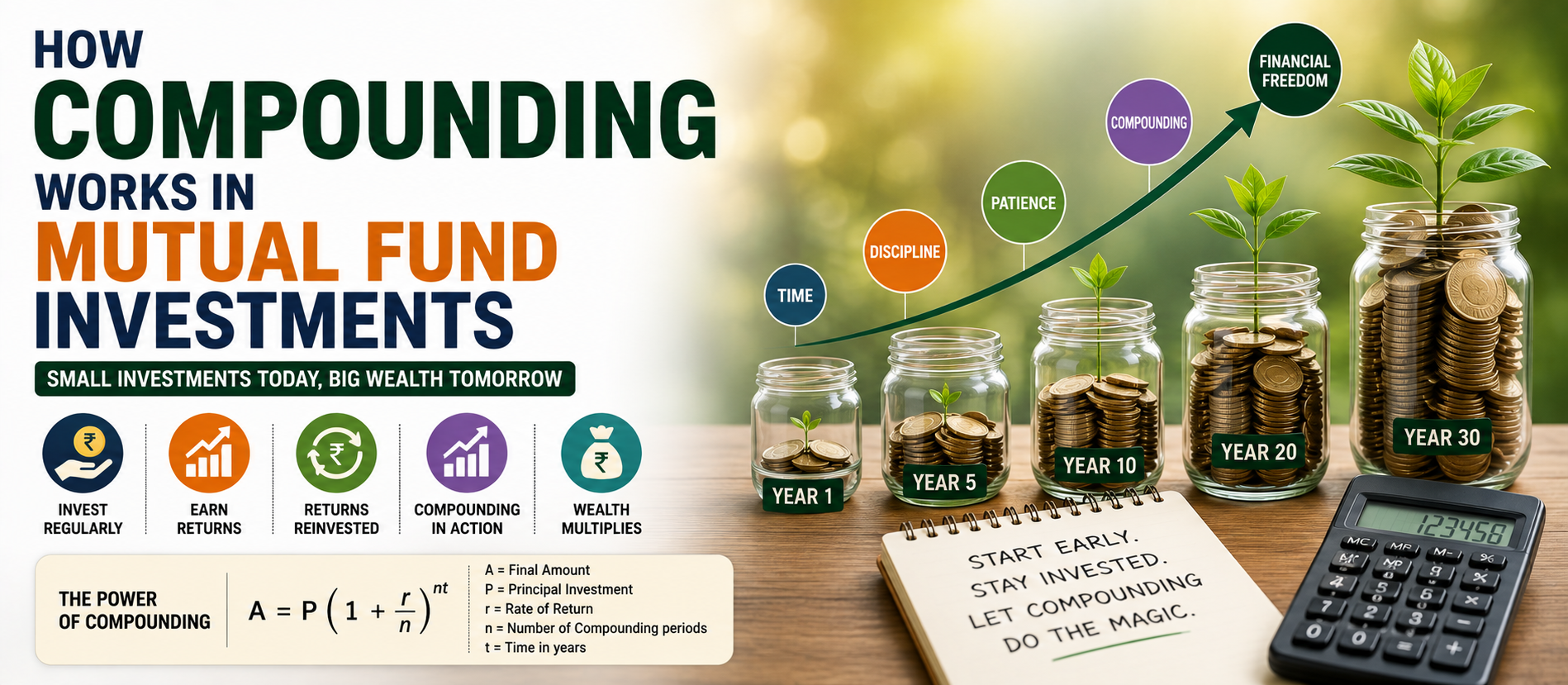
How compounding works in mutual fund investments is one of the most important concepts for long-term investors to understand. Compounding happens when investment returns remain invested and can generate additional returns over time. In a mutual fund, this process can involve growth in the value of the fund's underlying investments, dividend or interest income, capital gains distributions, and the reinvestment of distributions into additional fund shares.
A mutual fund pools money from many investors and invests in a portfolio of securities such as stocks, bonds, or other assets. Investors participate in the gains and losses of that portfolio. The SEC explains that mutual fund investors can earn returns through dividend payments, capital gains distributions, and increases in the fund's net asset value (NAV). Mutual funds may also allow dividends and distributions to be reinvested to purchase additional shares. citeturn0search2
Compounding is powerful because time allows returns to potentially generate further returns. However, compounding does not guarantee profits. Mutual funds can lose value, and fees, taxes, withdrawals, and market declines can reduce the amount available to compound.
This WordPress-ready HTML article is prepared for Digiifrog (www.digiifrog.com) with SEO, AEO, GEO, and AI Search optimization.
What Is Compounding?
Compounding means that investment growth can become part of the amount that participates in future growth. In simple terms, your money can potentially earn returns, and those returns can remain invested and contribute to future returns.
For a simple lump-sum example, the standard compound-growth relationship is represented by:
FV = PV(1+r)n
Here, FV represents future value, PV represents the starting amount, r represents the rate of return per period, and n represents the number of periods. Real mutual fund returns are not fixed, so this formula is an illustration rather than a prediction.
How Compounding Works Inside a Mutual Fund
Suppose a mutual fund owns shares of companies that increase in market value. The value of the fund's portfolio may rise, which can increase the fund's NAV after expenses and liabilities are considered. If the fund also receives dividends or interest, those amounts may be distributed to investors or reinvested depending on the investor's instructions and the fund's rules.
When distributions are reinvested, the investor acquires additional shares. Those additional shares can participate in future gains and distributions. This is one of the clearest ways compounding can operate in a mutual fund investment. citeturn0search2
1. Reinvestment Is a Key Part of Compounding
If an investor takes every distribution as cash and spends it, that money is no longer invested in the fund. If distributions are reinvested, the money remains part of the investment and can potentially contribute to future growth.
Reinvestment does not create a guaranteed extra return. It simply keeps the distribution invested so that it can participate in future market performance.
2. Time Is More Important Than Short-Term Excitement
Compounding generally becomes more noticeable over longer periods. Early in an investment journey, returns may appear modest because the investment base is relatively small. As the investment base grows, the same percentage return can represent a larger dollar amount.
This is why starting early can be valuable for long-term goals. A longer holding period gives potential returns more time to compound, although investors must still accept market risk.
4. Compounding and Market Returns Are Not the Same Every Year
A common misunderstanding is that compounding means an investment will earn the same percentage every year. Mutual fund returns can rise and fall because the securities held by the fund change in value.
For example, one year may produce a positive return while another year produces a loss. Compounding describes the process of keeping gains invested; it does not promise a constant rate of growth.
6. Fees Can Reduce the Benefit of Compounding
Fees are particularly important for long-term investors because money used to pay expenses is money that is no longer available to compound. Mutual funds may have operating expenses and, depending on the fund, shareholder fees such as sales loads, redemption fees, exchange fees, or account fees. citeturn0search1turn0search6
The SEC notes that even relatively small fee differences can produce substantial differences in portfolio value over time. Its investor education materials illustrate how different annual fee levels can change the value of a hypothetical investment after many years. citeturn0search3turn0search4
Investors should review a fund's prospectus and fee table and compare costs with similar investment options.
7. Expense Ratio Matters
The expense ratio represents the percentage of a fund's average net assets used each year for operating expenses. It can include management fees, distribution or service fees, acquired fund expenses, and other costs depending on the fund. citeturn0search5
A lower expense ratio is not automatically proof that a fund is better, but costs should be considered alongside investment strategy, risk, diversification, performance history, and the investor's goals.
9. A Simple Illustration of Compounding
Imagine a hypothetical $10,000 investment earning an average 7% annual return with all growth remaining invested. Under this simplified assumption, the balance becomes about $10,700 after one year, and future growth applies to the larger balance. This is an illustration only and ignores fees, taxes, and market fluctuations.
10. Why Compounding Does Not Eliminate Risk
Compounding works in both directions. A declining investment can reduce the amount available to participate in future growth. Mutual funds are not guaranteed or insured by the FDIC or another government agency, and investors can lose some or all of the money invested. citeturn0search2
Diversification can help spread risk across investments, but it cannot prevent losses in a falling market.
11. Choosing a Mutual Fund for Long-Term Compounding
Investors should evaluate a fund based on its objective, asset mix, risk level, diversification, fees, portfolio strategy, liquidity, and fit with their financial goals.
Past performance should not be the only selection criterion. The SEC notes that past mutual fund performance does not necessarily predict future results. citeturn0search13
13. Compounding and Long-Term Financial Goals
Compounding can be useful for retirement, education funding, long-term wealth building, and other goals where the money can remain invested for an extended period.
⚠ Watch Out
The longer the time horizon, the more important it becomes to control avoidable costs and maintain a strategy that you can follow through different market conditions.
14. How to Make Compounding Work More Effectively
- Start investing according to your financial capacity and goals.
- Contribute consistently when appropriate.
- Consider reinvesting eligible distributions.
- Compare expense ratios and other fund costs.
- Maintain appropriate diversification.
- Keep short-term emergency money separate from long-term investments.
- Review your portfolio periodically rather than reacting to every market move.
- Consider inflation and taxes when evaluating long-term goals.
SEO, AEO, GEO and AI Search Optimization
SEO content around mutual fund compounding should target useful search terms such as “how mutual fund compounding works,” “mutual fund reinvestment,” “compound growth in mutual funds,” and “mutual fund returns over time.”
AEO should answer direct questions such as “Do mutual funds compound?”, “How does reinvesting dividends create compounding?”, and “Can mutual funds lose money?”
GEO and AI Search optimization can be improved with clear definitions, concise answers, transparent examples, trustworthy sources, structured headings, FAQs, and explanations that distinguish hypothetical illustrations from actual investment performance.
Frequently Asked Questions About Mutual Fund Compounding
Do mutual funds compound?
Mutual funds can benefit from compounding when investment growth and distributions remain invested. Reinvested dividends or capital gains can purchase additional shares, allowing the invested amount to participate in future market performance. citeturn0search2
How does reinvestment help compounding?
Reinvestment keeps eligible distributions in the investment rather than taking them as cash. The additional shares can then participate in future gains or distributions.
Is mutual fund compounding guaranteed?
No. Mutual fund returns are not guaranteed. The underlying investments can lose value, and fees, taxes, withdrawals, and market declines can reduce long-term results. citeturn0search2
Do mutual fund fees affect compounding?
Yes. Fees reduce the amount of money remaining invested and therefore can reduce the amount available to generate future returns. Even small ongoing fee differences can become significant over long periods. citeturn0search3turn0search4
Conclusion
Compounding in mutual fund investments works by allowing investment growth and reinvested distributions to remain invested and potentially generate additional growth over time. The process can become increasingly powerful as the investment period grows, but it is not a guarantee of profit.
The practical foundations are simple: invest according to clear goals, maintain an appropriate time horizon, consider regular contributions, understand reinvestment, control unnecessary costs, diversify appropriately, and avoid emotional decisions based on short-term market movements.
Mutual funds can provide professional management and diversification, but investors should understand both the potential benefits and risks. citeturn0search2
For finance websites, investment education platforms, businesses, and service providers seeking modern websites, content marketing, automated lead generation, SEO, AEO, GEO, and AI Search optimization, Digiifrog can help. Visit www.digiifrog.com.
Quick Answer: How Does Compounding Work in Mutual Funds?
Compounding in mutual funds occurs when investment growth and eligible distributions remain invested, increasing the amount that can participate in future gains. Reinvested dividends and capital gains can buy additional fund shares, while growth in the underlying portfolio can increase NAV. Over long periods, this process can significantly increase potential wealth, but returns are not guaranteed and fees, taxes, withdrawals, and market losses can reduce the result.
Important Note
Mutual funds involve investment risk, including possible loss of principal. Examples in this article are hypothetical and do not represent guaranteed returns or a recommendation to purchase any specific fund. Investment, tax, and account rules vary by jurisdiction and individual circumstances. This article is educational content, not personalized financial, investment, tax, or legal advice.
Ready to Grow?
Talk to us about a strategy tailored to your brand — we will help you stand out in search, AI discovery and social.


Comments (0)
Log in to leave a comment.