📋 Quick Summary
In this article:
What Is a Consumer Protection Court?
Why Consumer Protection Laws Exist
Common Cases Handled by Consumer Protection Courts
Who Can File a Consumer Complaint?
When Should You Approach a Consumer Court?
How to File a Consumer Complaint
Step 1: Gather Evidence
Step 2: Send a Formal Notice
Step 3: Prepare the Complaint
Step 4: Submit the Complaint
💡 Key Insight
Consumers purchase products and services every day, expecting quality, safety, and fair treatment. However, defective products, misleading advertisements, poor services, unfair trade practices, hidden charges, and warranty disputes continue to affect millions of consumers worldwide. When businesses fail to resolve complaints, consumer protection courts provide an important legal remedy.
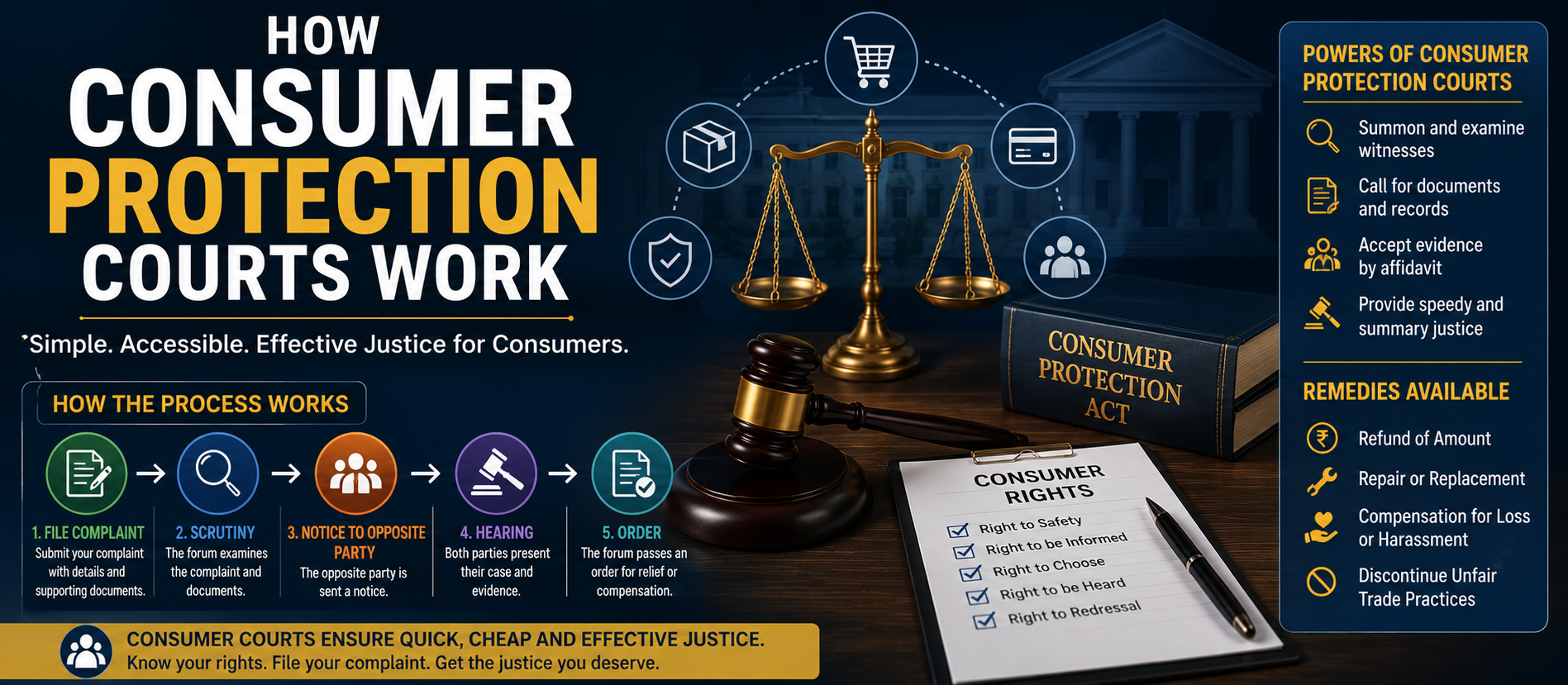
Consumer protection courts are specialized forums designed to resolve disputes between consumers and businesses efficiently and affordably. These courts help consumers seek compensation, refunds, replacements, and other remedies when their rights have been violated.
This comprehensive guide explains how consumer protection courts work, who can file a complaint, the types of cases handled, legal procedures involved, available remedies, and how consumers can effectively protect their rights in 2026.
What Is a Consumer Protection Court?
A consumer protection court is a specialized legal forum established to hear and resolve disputes involving consumers and sellers, manufacturers, service providers, businesses, and commercial organizations.
Unlike traditional civil courts, consumer forums are designed to offer:
- Faster dispute resolution
- Simplified procedures
- Affordable legal access
- Consumer-friendly processes
- Efficient complaint handling
The primary objective is to ensure that consumers receive fair treatment and effective remedies when businesses engage in unfair practices.
Why Consumer Protection Laws Exist
Consumer protection laws were created to balance the relationship between businesses and consumers.
These laws aim to:
- Protect consumer rights
- Prevent unfair trade practices
- Promote product safety
- Ensure transparency
- Provide legal remedies
- Encourage ethical business conduct
Without consumer protection laws, consumers would face significant challenges when dealing with large corporations and service providers.
Understanding Consumer Rights
Most consumer protection frameworks recognize several fundamental consumer rights.
- Right to safety
- Right to information
- Right to choose
- Right to be heard
- Right to seek redressal
- Right to consumer education
Consumer courts play an important role in enforcing these rights.
Common Cases Handled by Consumer Protection Courts
Consumer courts address a wide variety of disputes.
- Defective products
- Poor service quality
- Warranty disputes
- Insurance claim issues
- Banking complaints
- E-commerce disputes
- Medical negligence claims
- Telecommunication complaints
- Real estate disputes
- Misleading advertisements
These courts provide consumers with a dedicated mechanism for seeking justice.
Who Can File a Consumer Complaint?
Consumer protection laws generally allow various individuals and groups to file complaints.
- Individual consumers
- Consumer associations
- Legal representatives
- Groups of affected consumers
- Government agencies in certain situations
Eligibility requirements vary depending on jurisdiction and applicable laws.
When Should You Approach a Consumer Court?
Consumers should usually attempt to resolve disputes directly with the business before filing a complaint.
Legal action may become necessary when:
- The business refuses compensation
- Complaints are ignored
- Defective products are not replaced
- Refund requests are denied
- Service failures continue
- Consumer rights are violated
Maintaining records of communication can strengthen your case.
How to File a Consumer Complaint
Although procedures vary by jurisdiction, the complaint process generally includes several common steps.
Step 1: Gather Evidence
Collect all documents related to the dispute.
- Invoices
- Receipts
- Contracts
- Warranty documents
- Email communications
- Screenshots
- Photographs
Strong documentation increases the likelihood of success.
Step 2: Send a Formal Notice
Many disputes can be resolved by sending a formal written complaint to the business.
The notice should clearly explain:
- The problem
- The desired remedy
- Relevant dates
- Supporting evidence
This demonstrates good-faith efforts to resolve the dispute.
Step 3: Prepare the Complaint
The complaint should include:
- Consumer details
- Business information
- Description of the dispute
- Supporting evidence
- Requested relief
Accuracy and clarity are important when drafting complaints.
Step 4: Submit the Complaint
Depending on local procedures, complaints may be filed online or through designated consumer forums.
Some jurisdictions provide digital complaint systems that simplify filing and case tracking.
What Happens After Filing?
Once a complaint is submitted, the court or consumer forum typically reviews the filing.
Possible next steps include:
- Case registration
- Notice to the business
- Response submission
- Evidence review
- Hearings
- Mediation opportunities
The court examines the facts before making a decision.
Role of Mediation and Settlement
Many consumer disputes are resolved through mediation before a final judgment.
Mediation offers several benefits:
- Faster resolution
- Reduced legal costs
- Mutually acceptable outcomes
- Less formal procedures
Successful settlements often save time for both parties.
How Consumer Court Hearings Work
Hearings allow both sides to present evidence and arguments.
During hearings:
- Consumers explain their claims
- Businesses provide defenses
- Evidence is examined
- Questions may be asked
- Legal issues are reviewed
The decision is based on the evidence presented.
Possible Remedies Available to Consumers
Consumer protection courts may grant various remedies depending on the facts of the case.
- Refunds
- Product replacement
- Repairs
- Compensation
- Removal of defects
- Corrective action orders
- Discontinuation of unfair practices
The goal is to restore fairness and address consumer harm.
E-Commerce and Online Shopping Complaints
Online shopping has significantly increased consumer disputes.
Common issues include:
- Non-delivery of products
- Counterfeit goods
- False product descriptions
- Refund delays
- Unauthorized charges
- Warranty disputes
Consumer courts increasingly handle digital commerce cases.
Consumer Protection in Banking and Financial Services
Financial institutions are also subject to consumer protection requirements.
Common complaints include:
- Unauthorized transactions
- Hidden fees
- Misleading financial products
- Loan disputes
- Insurance claim denials
Consumer forums help ensure accountability within financial sectors.
Medical Services and Consumer Rights
Healthcare-related complaints may also be addressed through consumer protection mechanisms where applicable.
Examples include:
- Service deficiencies
- Billing disputes
- Misrepresentation of services
- Administrative negligence
Special rules may apply depending on jurisdiction.
How Long Do Consumer Cases Take?
Resolution timelines vary depending on:
- Case complexity
- Evidence requirements
- Court workload
- Settlement opportunities
Consumer forums are generally intended to resolve disputes faster than traditional civil litigation.
Common Mistakes Consumers Should Avoid
- Failing to keep receipts
- Ignoring warranty terms
- Waiting too long to complain
- Providing incomplete evidence
- Not documenting communications
- Accepting verbal promises without proof
Proper documentation often determines the strength of a consumer complaint.
Digital Consumer Protection in 2026
As digital commerce expands, consumer protection laws continue evolving.
Modern concerns include:
- Data privacy
- Subscription traps
- Digital products
- Online fraud
- AI-generated marketing claims
- Cross-border e-commerce disputes
Consumer courts increasingly address issues arising from digital transactions.
SEO, AEO, GEO, and AI Search for Consumer Education
Consumers frequently research their rights online before filing complaints.
SEO (Search Engine Optimization) helps educational legal content rank on Google and Bing.
AEO (Answer Engine Optimization) improves visibility in featured snippets and answer engines.
GEO (Generative Engine Optimization) enhances discoverability in AI-generated responses.
AI Search Optimization ensures consumer rights information remains accessible through emerging AI-powered search platforms.
Accessible information empowers consumers to make informed decisions.
Frequently Asked Questions
What is a consumer protection court?
A consumer protection court is a specialized forum designed to resolve disputes between consumers and businesses efficiently and affordably.
Do I need a lawyer to file a consumer complaint?
Many consumer forums allow individuals to file complaints without hiring a lawyer, although legal advice may be beneficial in complex cases.
What evidence should I keep?
Maintain invoices, receipts, contracts, emails, screenshots, photographs, and warranty documents.
Can online shopping disputes be taken to consumer court?
Yes. Many consumer protection systems address e-commerce disputes involving products and services.
What remedies can consumer courts provide?
Possible remedies include refunds, replacements, repairs, compensation, and orders to stop unfair business practices.
Conclusion
Consumer protection courts play a vital role in safeguarding consumer rights and ensuring accountability among businesses. By providing accessible legal remedies, these forums help resolve disputes involving defective products, poor services, misleading advertising, financial complaints, and online transactions.
Consumers who understand their rights, maintain proper documentation, and follow complaint procedures are better positioned to achieve fair outcomes. As commerce becomes increasingly digital, consumer protection mechanisms continue adapting to new challenges and technologies.
For more expert insights on legal awareness, business compliance, digital growth, SEO, AEO, GEO, and AI Search strategies, visit Digiifrog.
Digiifrog
Website: www.digiifrog.com
Digital Marketing, SEO, AEO, GEO & AI Search Solutions for Modern Businesses.
Ready to Grow?
Talk to us about a strategy tailored to your brand — we will help you stand out in search, AI discovery and social.

Comments (0)
Log in to leave a comment.