📋 Quick Summary
In this article:
Why Small Businesses Are Targeted
Essential Protection Strategies
Multi-Factor Authentication (MFA)
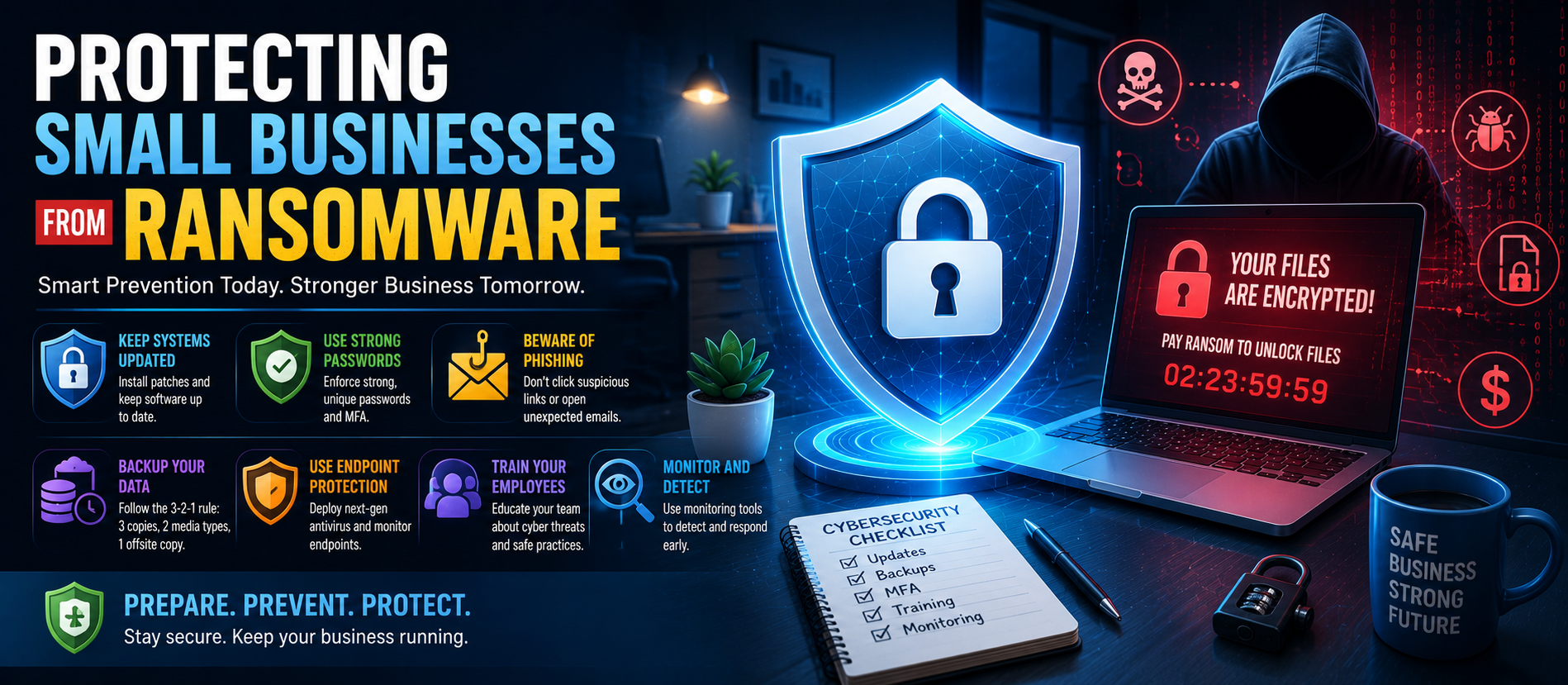
Ransomware remains one of the most destructive cyber threats facing small businesses. Criminal groups target organizations with limited IT resources because they often have weaker security controls and are more likely to pay to restore operations. A successful ransomware attack can encrypt files, disrupt business operations, expose sensitive customer information, and result in significant financial losses.
This WordPress-ready guide explains how ransomware works, why small businesses are frequent targets, and the practical steps every organization should take to improve cyber resilience. The content is optimized for SEO, AEO, GEO, and AI Search optimization.
What Is Ransomware?
Ransomware is malicious software that encrypts files or systems and demands payment in exchange for a decryption key. Modern ransomware groups may also steal sensitive information before encryption and threaten to publish it if payment is not made.
Why Small Businesses Are Targeted
- Limited cyber security budgets.
- Outdated software and hardware.
- Weak passwords and poor identity management.
- Lack of employee security awareness.
- Insufficient backup and recovery planning.
Common Infection Methods
- Phishing emails and malicious attachments.
- Compromised Remote Desktop Protocol (RDP).
- Unpatched software vulnerabilities.
- Malicious downloads.
- Supply chain compromises.
Business Impact
- Operational downtime.
- Financial losses.
- Customer trust damage.
- Compliance and legal risks.
- Loss of important business data.
Essential Protection Strategies
Multi-Factor Authentication (MFA)
Protect administrator, cloud, and remote access accounts with MFA.
Regular Backups
Follow the 3-2-1 backup rule and test recovery procedures frequently.
Patch Management
Apply operating system and application security updates promptly.
Endpoint Protection
Deploy modern Endpoint Detection and Response (EDR) solutions.
Employee Training
Teach employees how to recognize phishing emails, suspicious links, and social engineering attacks.
Network Segmentation
Limit lateral movement by separating critical systems.
Modern Security Technologies
- Zero Trust Architecture
- EDR & XDR
- Security Information and Event Management (SIEM)
- Email Security Gateways
- Cloud Security Posture Management (CSPM)
- Data Loss Prevention (DLP)
AI and Ransomware Defense
Artificial Intelligence helps identify unusual behavior, detect encryption activity, prioritize threats, and automate incident response before ransomware spreads.
Incident Response Checklist
- Isolate affected devices immediately.
- Notify internal response teams.
- Preserve logs and forensic evidence.
- Restore systems from verified backups.
- Review security controls and remediate vulnerabilities.
SEO, AEO & GEO Best Practices
Publish authoritative content with structured headings, semantic keywords, direct answers, and FAQ sections to improve visibility across Google, Bing, ChatGPT, Gemini, Copilot, and other AI-powered search platforms.
AEO & GEO Optimized FAQs
Why are small businesses targeted by ransomware?
Many small businesses have fewer security resources, making them attractive targets for cybercriminals.
What is the best protection against ransomware?
Layered security including MFA, secure backups, patch management, employee awareness, endpoint protection, and continuous monitoring.
Should businesses pay a ransomware demand?
Organizations should follow legal guidance and incident response procedures. Paying does not guarantee recovery and may encourage further attacks.
How often should backups be tested?
Backups should be verified regularly to ensure they can be restored successfully during an emergency.
Conclusion
Small businesses can significantly reduce ransomware risk by combining strong cyber hygiene, employee awareness, Zero Trust principles, AI-powered monitoring, and reliable backup strategies. Investing in prevention and recovery planning today helps protect business continuity, customer trust, and long-term growth in 2026 and beyond.
For more expert insights on Cyber Security, Cloud Security, SEO, AEO, GEO, AI Search Optimization, and Digital Transformation, visit Digiifrog at www.digiifrog.com.
Ready to Grow?
Talk to us about a strategy tailored to your brand — we will help you stand out in search, AI discovery and social.
Comments (0)
Log in to leave a comment.