📋 Quick Summary
In this article:
What Is a B2B Marketing Funnel?
1. Define Your Ideal Customer Profile
2. Map the Buying Committee
3. Understand Buyer Intent
4. Build a Clear Value Proposition
5. Design the Awareness Stage
6. Create Middle-of-Funnel Content
7. Build Strong Bottom-of-Funnel Assets
8. Create Lead Magnets With Real Value
9. Optimize Landing Pages for Conversion
Introduction
A B2B marketing funnel is more than a path from website visitor to sales lead. It is a system that helps potential buyers understand a problem, evaluate solutions, build trust, and take the next step.
For B2B companies, the journey is usually longer than a typical consumer purchase. Several people may influence the decision. A buyer may research a problem today, compare providers later, involve colleagues, and contact sales only after much of the research is complete.
That makes funnel design critical. A business cannot rely on one advertisement, one blog post, or one sales email to create demand. It needs a connected experience across search, content, social media, email, landing pages, webinars, sales conversations, case studies, and follow-up.
Current 2026 B2B marketing guidance increasingly treats the funnel as a buyer-centered system rather than a simple linear sequence. Buyers may move forward, return to earlier questions, involve new stakeholders, or research anonymously before contacting sales.
What Is a B2B Marketing Funnel?
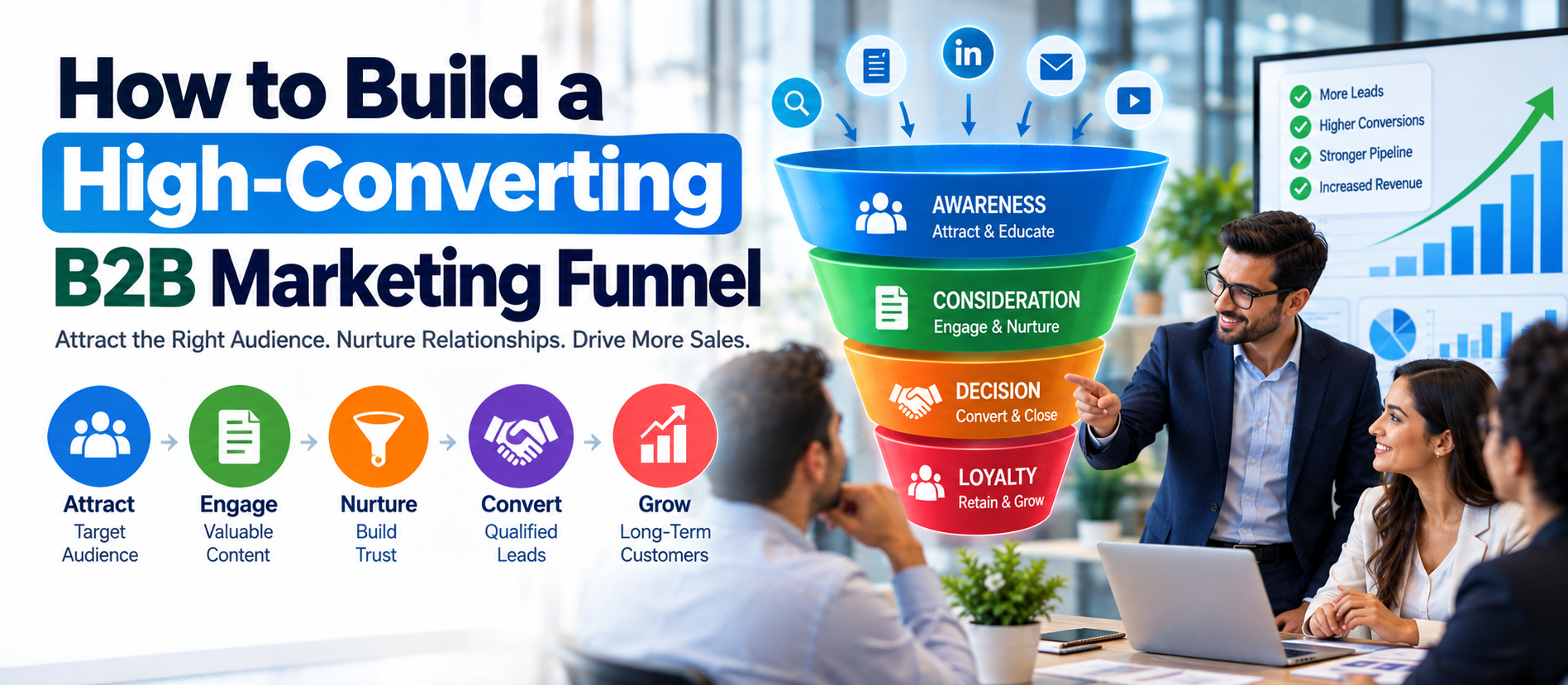
A B2B marketing funnel is a structured system that moves potential business customers from initial awareness toward engagement, evaluation, purchase, and long-term growth.
- Awareness: The buyer recognizes a problem, need, or opportunity.
- Interest: The buyer starts researching possible approaches.
- Consideration: The buyer evaluates providers, products, services, and alternatives.
- Intent: The buyer shows meaningful signals such as requesting pricing, booking a demo, or contacting sales.
- Decision: Stakeholders compare risk, value, cost, implementation, and fit.
- Purchase: The buyer becomes a customer.
- Expansion: The business retains, cross-sells, upsells, or grows the customer relationship.
The exact stages can vary. A simple funnel is often better than a complicated model that nobody uses consistently.
Why B2B Funnels Are Different
B2B purchases often involve multiple stakeholders, larger budgets, longer evaluation periods, and greater perceived risk.
For example, a company buying a marketing platform may involve a marketing manager, sales leader, finance team, IT department, procurement team, and executive decision-maker. Each person asks a different question.
- The marketing manager asks whether the solution will improve campaign performance.
- The sales leader asks whether it will create better pipeline.
- Finance asks whether the investment is justified.
- IT asks whether the system is secure and easy to integrate.
- Procurement asks about terms and commercial risk.
- The executive team asks whether the solution supports business goals.
A high-converting B2B funnel must provide useful information for the buying group, not just one individual.
1. Define Your Ideal Customer Profile
The first step is defining who the funnel is designed to attract.
An Ideal Customer Profile, or ICP, describes the type of organization most likely to benefit from your product or service and become a valuable customer.
- Industry
- Company size
- Revenue range
- Geographic market
- Technology environment
- Business model
- Growth stage
- Typical problems
- Buying triggers
- Budget range
Do not stop at company characteristics. Identify the problems that create buying urgency. “Mid-sized B2B software companies” is broad. “B2B SaaS companies losing qualified leads because sales and marketing data are disconnected” is much more useful for funnel design.
2. Map the Buying Committee
After defining the ICP, identify the people involved in the buying process. Create content for different roles and questions.
| RoleMain ConcernUseful Content | ||
| Problem owner | How do we solve this problem? | Guides, checklists, webinars |
| End user | Will this make work easier? | Demos, tutorials |
| Finance | What is the business value? | ROI analysis, pricing |
| IT | Is it secure and compatible? | Security and integration content |
| Executive | Will this support strategic goals? | Case studies, business outcomes |
3. Understand Buyer Intent
Not every visitor has the same intent. Someone searching “what is B2B lead generation?” may be learning. Someone searching “best B2B lead generation agency” is closer to a commercial decision.
- Informational: The buyer wants to understand a topic.
- Problem-aware: The buyer understands a problem and wants solutions.
- Commercial: The buyer is comparing products, providers, or approaches.
- Transactional: The buyer is ready to take action.
Your funnel should support all four stages rather than sending every visitor directly to a sales form.
4. Build a Clear Value Proposition
A high-converting funnel needs a clear answer to one basic question: Why should this buyer care?
A strong value proposition explains who the solution is for, what problem it solves, what outcome it creates, and why the approach is different.
Weak: “Advanced digital marketing solutions for modern businesses.”
Stronger: “Generate more qualified B2B leads with SEO, content, AI Search optimization, and automated lead nurturing.”
The second statement gives the visitor a clearer reason to continue.
5. Design the Awareness Stage
The awareness stage attracts people who may not be ready to buy. Useful content includes educational blog articles, industry guides, research reports, short videos, LinkedIn content, podcasts, infographics, and search-optimized FAQs.
Focus on the buyer's problem rather than your company. Instead of “Why Our Software Is the Best,” create content such as “How to Reduce B2B Customer Acquisition Costs” or “How to Build a High-Converting Sales Funnel.”
6. Create Middle-of-Funnel Content
Middle-of-funnel content helps buyers evaluate options. Good formats include case studies, webinars, comparison guides, implementation guides, ROI calculators, expert interviews, templates, and detailed solution pages.
The goal is to answer questions such as: Does this solution work for companies like mine? How difficult is implementation? How much does it cost? What results can we reasonably expect?
7. Build Strong Bottom-of-Funnel Assets
Bottom-of-funnel content helps buyers make a decision. Useful assets include product or service demos, free consultations, pricing pages, customer references, detailed case studies, ROI calculators, implementation plans, security documentation, comparison pages, and proof-of-concept offers.
8. Create Lead Magnets With Real Value
A lead magnet should solve a small but important problem. Examples include a B2B marketing funnel checklist, lead generation template, marketing ROI calculator, SEO audit checklist, B2B content calendar, sales qualification template, industry benchmark report, or AI automation readiness checklist.
A generic PDF may generate downloads but not qualified leads. A specific tool or resource can create stronger intent signals.
9. Optimize Landing Pages for Conversion
Landing pages should have one primary purpose. A strong B2B landing page usually includes a clear headline, specific value proposition, short supporting copy, relevant proof, benefits, trust signals, a clear call to action, simple forms, and answers to common objections.
Remove unnecessary distractions. Do not force visitors to search for the next step.
10. Use Strong Calls to Action
A call to action should match the buyer's stage. Someone reading an introductory article may not be ready for “Buy Now.” A better CTA could be “Download the B2B Funnel Checklist.” A visitor reading a pricing comparison may be ready for “Request a Consultation.”
- Download the guide
- Get the checklist
- Calculate your ROI
- See the case study
- Compare solutions
- Book a strategy call
- Request a demo
- Talk to an expert
11. Build a Lead Nurturing System
Most B2B leads are not ready to buy immediately. Lead nurturing keeps your company useful and relevant while the buyer continues researching.
- Deliver the requested resource.
- Explain the problem in more detail.
- Share practical strategies.
- Address common mistakes.
- Provide a case study.
- Answer common objections.
- Offer a relevant consultation or demo.
The sequence should adapt to behavior. A person who clicks a pricing article may deserve different content from someone who only reads educational articles.
12. Personalize the Funnel
Personalization should be useful, not intrusive. Use industry, role, content interest, previous interactions, and funnel stage to improve relevance. A manufacturing company can receive manufacturing examples. A SaaS company can receive SaaS-focused case studies.
13. Use Lead Scoring
Lead scoring helps prioritize prospects. Combine fit and intent.
A high-fit company that downloads one article may still be early-stage. A high-fit company that visits pricing, reads a case study, and requests a demo may be sales-ready.
A simple scoring model can assign points for company fit, engagement, content consumption, website behavior, and conversion actions.
14. Align Marketing and Sales
A funnel fails when marketing and sales use different definitions. Define Marketing Qualified Lead, Sales Qualified Lead, Opportunity, Pipeline, and Sales Accepted Lead.
Also define handoff rules. For example, marketing may send a lead to sales when the account fits the ICP and the buyer completes a high-intent action. Sales should then have a defined response time and feedback process.
15. Use CRM and Marketing Automation
A CRM provides the operational foundation for tracking prospects and opportunities. Marketing automation can support lead capture, email nurturing, scoring, segmentation, routing, task creation, follow-up reminders, and campaign tracking.
Automation should reduce manual work, not create unnecessary complexity. Start with simple workflows and expand after the team understands what works.
16. Connect Marketing and Sales Data
Marketing should know what happens after a lead is handed to sales. Sales should know which content and campaigns influenced the account.
Connect campaign, CRM, website, email, advertising, and opportunity data where practical. This makes it easier to identify which channels generate real business outcomes rather than only traffic or form submissions.
17. Create Account-Based Funnel Experiences
For high-value B2B markets, account-based marketing can complement the broader funnel. Identify target companies and engage multiple stakeholders within those accounts using relevant content, case studies, targeted advertising, sales outreach, and coordinated follow-up.
18. Use Retargeting Carefully
Many visitors leave without converting. Retargeting can bring relevant prospects back to useful content, case studies, comparison pages, or offers. Segment audiences by behavior. Someone who visited a blog article should not necessarily receive the same message as someone who visited a pricing page.
19. Use Social Proof Throughout the Funnel
B2B buyers want evidence that a solution works. Useful proof includes customer case studies, testimonials, reviews, industry certifications, client logos where permitted, performance data, expert opinions, and demonstrations.
Place proof near the point where the buyer may have doubts.
20. Reduce Friction in Forms
Long forms can reduce conversions when they ask for information that is not necessary at the current stage. Ask only for information required to provide the next useful step.
For high-intent sales requests, additional qualification fields may be justified. For an early-stage content download, a shorter form may work better.
21. Build Content Around Buyer Questions
The best funnel content answers real buyer questions.
- Awareness: What is the problem?
- Problem aware: Why is it happening?
- Consideration: What solutions are available?
- Evaluation: Which solution fits our situation?
- Decision: What are the risks, costs, and expected outcomes?
- Implementation: How difficult is adoption?
- Expansion: How can we get more value?
22. Optimize for Search and AI Discovery
Search is still a major source of B2B discovery, but the search experience is changing. Google's current guidance says its generative AI search features continue to rely on core Search systems to retrieve relevant pages. It also recommends valuable, original, people-first content rather than content created mainly to manipulate AI results.
Use clear definitions, descriptive headings, direct answers, original examples, useful tables, practical checklists, FAQs, relevant internal links, and credible external references.
23. Build an AEO and GEO-Friendly Funnel
Answer Engine Optimization (AEO) focuses on making content useful for systems that answer questions directly. Generative Engine Optimization (GEO) focuses on improving visibility and usefulness in generative search experiences.
For B2B funnel content, answer questions clearly. For example:
What is a B2B marketing funnel?
A B2B marketing funnel is a structured system that moves potential business buyers from awareness and research toward evaluation, purchase, and long-term customer growth.
Then provide deeper explanation, examples, and supporting evidence.
24. Measure Funnel Performance
Do not measure only website traffic. A high-converting funnel needs revenue-linked metrics.
| StageImportant Metrics | |
| Awareness | Organic traffic, qualified traffic, brand searches |
| Engagement | Content consumption, email engagement |
| Lead generation | Visitor-to-lead conversion rate, cost per lead |
| Qualification | MQL rate, lead score, sales acceptance rate |
| Pipeline | Lead-to-opportunity rate, pipeline value |
| Sales | Opportunity-to-customer rate, sales cycle |
| Revenue | Customer acquisition cost, average contract value |
| Retention | Renewal, expansion, customer lifetime value |
25. Diagnose Funnel Leaks
Every funnel has friction. Look for large drops between stages.
- High traffic but few leads may indicate weak offers or landing pages.
- Many leads but few qualified leads may indicate poor targeting.
- Many MQLs but few opportunities may indicate weak qualification.
- Many opportunities but few customers may indicate pricing, product, trust, or sales problems.
- Strong acquisition but weak retention may indicate onboarding or product experience problems.
Fix the largest meaningful leak first.
26. Run Controlled Experiments
Conversion optimization should be based on testing rather than assumptions. Test headlines, offers, CTAs, form length, landing-page structure, case-study placement, email subject lines, and content formats.
Define the hypothesis, metric, test period, audience, and owner before starting.
27. Improve Funnel Speed
Speed matters at every stage. Pages should load quickly. Forms should be simple. Lead routing should happen quickly. Sales follow-up should not wait for manual spreadsheets.
Reduce unnecessary handoffs. When a high-intent lead submits a request, the next step should be clear and fast.
28. Build a Revenue Feedback Loop
A funnel should learn from closed and lost deals. Ask sales which objections appear most often, which content helps close deals, which industries convert best, why prospects choose competitors, and why opportunities stall.
Ask customer success which promises matter most, which expectations are difficult to meet, which customers expand, and which customers churn. Use this feedback to improve targeting, messaging, content, offers, and qualification.
29. Use a 90-Day B2B Funnel Plan
Days 1–30: Build the Foundation
- Define the ICP.
- Map buying committee roles.
- Audit traffic and leads.
- Map current funnel stages.
- Identify the biggest conversion leak.
- Define marketing and sales stage criteria.
Days 31–60: Build the Funnel Assets
- Create or improve core landing pages.
- Build one strong lead magnet.
- Create awareness and consideration content.
- Develop a nurture sequence.
- Configure CRM tracking.
- Set up lead routing and scoring.
Days 61–90: Optimize and Scale
- Launch conversion tests.
- Review lead quality.
- Improve sales handoffs.
- Analyze pipeline performance.
- Strengthen retargeting.
- Scale channels that generate qualified pipeline.
Common B2B Funnel Mistakes
- Trying to sell to everyone.
- Creating content without a defined buyer or business problem.
- Using the same CTA for every funnel stage.
- Collecting leads without nurturing them.
- Sending every lead directly to sales.
- Using vanity metrics instead of revenue-linked metrics.
- Ignoring buying committee members.
- Making landing pages too complicated.
- Failing to align marketing and sales.
- Automating before the process is understood.
- Creating large volumes of low-value content.
- Ignoring customer retention after acquisition.
How to Make a B2B Funnel More Effective
- Buyer-centered: Start with customer problems.
- Specific: Design messaging for defined audiences.
- Low-friction: Make the next step easy.
- Trust-focused: Show proof throughout the journey.
- Measurable: Connect performance to pipeline and revenue.
- Connected: Align marketing, sales, customer success, and data.
- Continuously improved: Test and refine the funnel.
Frequently Asked Questions
What is a high-converting B2B marketing funnel?
A high-converting B2B marketing funnel attracts the right companies, educates prospects, builds trust, qualifies intent, supports sales, and turns qualified opportunities into customers.
What are the main stages of a B2B marketing funnel?
The common stages are awareness, interest, consideration, intent, decision, purchase, and expansion. Businesses can simplify or expand these stages depending on their sales model.
How do I increase B2B funnel conversion rates?
Improve targeting, clarify the value proposition, create better offers, optimize landing pages, reduce form friction, nurture leads, improve qualification, strengthen sales follow-up, and test changes using reliable data.
What content works best for B2B lead generation?
Useful formats include educational articles, research reports, checklists, templates, webinars, case studies, comparison pages, ROI calculators, and practical guides. The best format depends on buyer intent and industry.
How important is lead nurturing in B2B marketing?
Lead nurturing is important because many B2B buyers need time to research and build internal agreement. Useful, timely content can keep the company relevant until the buyer is ready for a sales conversation.
Should every B2B lead go to sales?
No. Sending unqualified leads to sales can waste time and reduce trust between marketing and sales. Use fit and intent signals to determine when a lead is ready for sales engagement.
How does AI help a B2B marketing funnel?
AI can support content research, personalization, lead scoring, customer segmentation, conversation analysis, forecasting, chatbot experiences, workflow automation, and data analysis. Human review remains important for strategy, accuracy, brand voice, and high-impact decisions.
How does SEO support a B2B marketing funnel?
SEO attracts buyers while they research problems and solutions. Strong search content can create awareness, capture high-intent queries, support consideration, and direct prospects to relevant commercial pages.
Conclusion
A high-converting B2B marketing funnel is not simply a collection of landing pages, emails, and advertisements. It is a connected system built around the way real business buyers research, evaluate, and make decisions.
Start with a clear ICP. Understand the buying committee. Map buyer intent. Create useful content for each stage. Build strong landing pages and offers. Nurture leads. Use fit and intent for qualification. Connect marketing and sales. Measure pipeline and revenue. Then improve the biggest funnel leaks through structured testing.
In 2026, B2B buyers have more ways to research before contacting a provider. Search, AI-powered discovery, communities, reviews, social platforms, and self-service resources all influence the journey. Google continues to emphasize helpful, original, people-first content for traditional and generative search experiences.
Companies that publish genuinely useful information and connect it to a strong conversion system can build trust before the first sales conversation.
The goal is not to force prospects through a funnel. The goal is to make the buying journey easier, clearer, and more useful.
Digiifrog helps businesses build digital marketing, SEO, AEO, GEO, AI Search, automation, and growth strategies. Visit www.digiifrog.com to learn more.
Key Takeaways
- Define a precise Ideal Customer Profile before building the funnel.
- Map the needs of the full buying committee.
- Match content and CTAs to buyer intent and funnel stage.
- Use specific lead magnets that solve real problems.
- Optimize landing pages for clarity, trust, and low friction.
- Nurture leads instead of expecting immediate conversion.
- Use CRM, lead scoring, and automation to improve follow-up.
- Align marketing and sales around clear stage definitions.
- Measure qualified pipeline and revenue, not just traffic.
- Use SEO, AEO, GEO, and AI Search principles to make useful content easier to discover.
- Test the biggest funnel leaks and scale what works.
Ready to Grow?
Talk to us about a strategy tailored to your brand — we will help you stand out in search, AI discovery and social.

Comments (0)
Log in to leave a comment.