📋 Quick Summary
In this article:
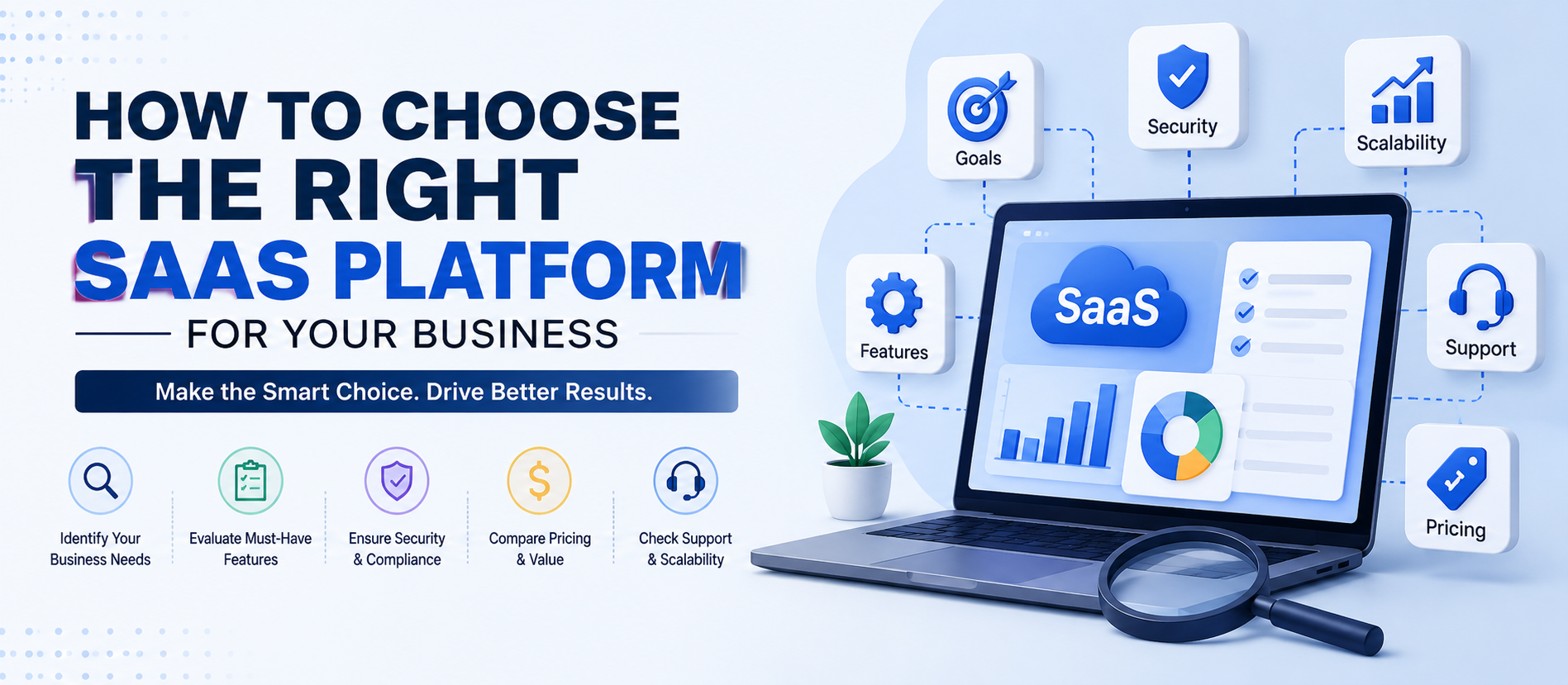
Why Choosing the Right SaaS Platform Matters
Define Your Business Requirements First
Analyze Integration Capabilities
💡 Key Insight
In today’s digital-first business environment, choosing the right SaaS (Software as a Service) platform can significantly impact productivity, customer experience, operational efficiency, and long-term growth. From CRM systems and project management tools to accounting software and AI-powered business platforms, SaaS solutions have become essential for organizations of all sizes.
However, with thousands of software options available in the market, selecting the best SaaS platform can be overwhelming. The wrong choice can lead to wasted budgets, poor adoption, integration issues, and operational inefficiencies. The right choice, on the other hand, can streamline workflows, improve collaboration, reduce costs, and provide a competitive advantage.
This comprehensive guide explains how businesses can evaluate, compare, and choose the right SaaS platform while incorporating modern considerations such as AI integration, scalability, security, SEO, AEO, GEO, and AI Search readiness.
Understanding SaaS Platforms
SaaS platforms deliver software applications over the internet rather than requiring local installation on individual devices. Users access these applications through web browsers or mobile apps while paying subscription-based fees.
Popular SaaS Categories
- Customer Relationship Management (CRM)
- Project Management Software
- Marketing Automation Platforms
- Email Marketing Solutions
- Human Resource Management Systems
- Accounting and Finance Software
- E-Commerce Platforms
- Customer Support Systems
- Cybersecurity Solutions
- AI-Powered Business Applications
The SaaS industry continues to grow rapidly because organizations value flexibility, lower infrastructure costs, and continuous innovation.
Why Choosing the Right SaaS Platform Matters
Software decisions affect nearly every aspect of business operations. An effective SaaS platform can:
- Increase productivity
- Improve collaboration
- Enhance customer service
- Automate repetitive tasks
- Reduce operational expenses
- Improve data visibility
- Support business growth
- Provide actionable insights
Choosing the wrong solution often results in employee frustration, low adoption rates, unnecessary expenses, and missed opportunities.
Define Your Business Requirements First
The first step is identifying exactly what your business needs.
Questions to Ask
- What business problem are we trying to solve?
- Which departments will use the software?
- What workflows need improvement?
- What manual processes can be automated?
- What are our growth expectations?
- Which existing tools require integration?
A clear understanding of requirements prevents purchasing software with unnecessary features or limitations.
Identify Key Stakeholders
Successful software adoption requires involvement from stakeholders across departments.
- Management teams
- IT departments
- Sales teams
- Marketing departments
- Operations teams
- Customer support staff
- Finance professionals
Gathering feedback early ensures the selected platform meets organizational needs.
Evaluate Core Features
Every SaaS platform offers different functionality. Focus on essential features rather than impressive marketing claims.
Feature Evaluation Checklist
- User management
- Automation capabilities
- Workflow customization
- Reporting dashboards
- Mobile accessibility
- Security controls
- Third-party integrations
- AI-powered tools
Create a feature comparison matrix when evaluating multiple vendors.
Assess Ease of Use
Even the most powerful software can fail if employees find it difficult to use.
Look For
- Intuitive user interface
- Simple navigation
- Minimal learning curve
- Accessible documentation
- Training resources
- Interactive onboarding
User-friendly platforms typically achieve higher adoption rates and faster ROI.
Prioritize Scalability
Your software should support future business growth.
Consider whether the platform can handle:
- Additional users
- Higher transaction volumes
- Expanded product lines
- New departments
- Global operations
- Advanced automation requirements
Scalable solutions prevent costly migrations later.
Analyze Integration Capabilities
Modern businesses use multiple software tools. Seamless integrations improve efficiency and eliminate data silos.
Common Integrations
- CRM systems
- Email marketing platforms
- Accounting software
- ERP systems
- Customer support tools
- Business intelligence platforms
- AI applications
- Collaboration tools
Strong API support is often a major advantage.
Review Security and Compliance Standards
Data security should be a top priority when selecting any SaaS platform.
Security Features to Evaluate
- Data encryption
- Multi-factor authentication
- Role-based access control
- Regular security audits
- Backup and disaster recovery
- Threat monitoring
Verify compliance requirements relevant to your industry.
Understand Pricing Models
SaaS pricing structures vary significantly.
Common Pricing Models
- Per-user pricing
- Usage-based pricing
- Tiered pricing
- Freemium models
- Enterprise licensing
Evaluate total ownership costs, including implementation, training, customization, and future upgrades.
Evaluate Customer Support Quality
Reliable support can significantly influence long-term satisfaction.
- 24/7 support availability
- Live chat assistance
- Dedicated account managers
- Knowledge bases
- Community forums
- Training resources
Fast and knowledgeable support reduces operational disruptions.
Importance of AI-Powered Features
Artificial Intelligence is transforming SaaS platforms across industries.
AI Features to Consider
- Predictive analytics
- Automated reporting
- Customer behavior analysis
- AI chatbots
- Content generation
- Workflow automation
- Recommendation engines
AI-enabled platforms can improve productivity and decision-making.
Read Customer Reviews and Case Studies
Vendor marketing materials often highlight strengths while minimizing limitations.
Review independent feedback sources and customer success stories to understand real-world experiences.
Research Sources
- Software review platforms
- Industry forums
- LinkedIn discussions
- Customer testimonials
- Case studies
- Professional communities
Request Product Demonstrations
Never purchase software without seeing it in action.
Demos help businesses:
- Validate functionality
- Assess usability
- Ask technical questions
- Evaluate customization options
- Understand implementation processes
Use Free Trials Effectively
Many SaaS vendors provide free trials.
Create a structured evaluation process during the trial period:
- Test daily workflows
- Involve actual users
- Evaluate reporting features
- Assess integrations
- Measure performance
- Document observations
SEO, AEO, GEO and AI Search Considerations
Modern SaaS platforms increasingly influence digital visibility.
SEO Benefits
Look for tools supporting content optimization, analytics, and search visibility.
AEO Benefits
Platforms should help create content that answers customer questions directly.
GEO Benefits
Generative Engine Optimization helps businesses gain visibility in AI-generated responses.
AI Search Readiness
Platforms supporting structured data, content intelligence, and AI-driven insights provide long-term advantages.
Compare Multiple Vendors
Avoid selecting the first platform you encounter.
Comparison Criteria
- Features
- Pricing
- Support
- Security
- Integrations
- Scalability
- User experience
- Vendor reputation
A detailed comparison matrix simplifies decision-making.
Implementation Planning
Successful software implementation requires preparation.
- Migration planning
- Data cleanup
- User training
- Timeline management
- Stakeholder communication
- Performance monitoring
Well-planned implementation improves adoption rates.
Common Mistakes to Avoid
- Choosing solely based on price
- Ignoring scalability needs
- Skipping security reviews
- Failing to test integrations
- Not involving end users
- Overlooking training requirements
- Ignoring customer support quality
Future Trends in SaaS Platforms
The SaaS industry continues evolving rapidly. Future platforms will increasingly leverage AI, automation, predictive analytics, low-code development, conversational interfaces, and advanced personalization.
Organizations that choose flexible, innovative platforms today will be better positioned for future growth and digital transformation.
Conclusion
Choosing the right SaaS platform requires careful evaluation of business requirements, scalability, integrations, security, usability, support, pricing, and future growth potential. The best solution is not necessarily the most popular or expensive one—it is the platform that aligns with your organization's specific goals and workflows.
Businesses that conduct thorough evaluations, involve stakeholders, test software properly, and prioritize long-term value will maximize their SaaS investments.
At Digiifrog, we help organizations navigate digital transformation through advanced SEO, AEO, GEO, AI Search Optimization, content marketing, business automation, and digital growth strategies.
Website: www.digiifrog.com
Contact: Visit Digiifrog for innovative digital marketing and business growth solutions.
Ready to Grow?
Talk to us about a strategy tailored to your brand — we will help you stand out in search, AI discovery and social.

Comments (0)
Log in to leave a comment.