📋 Quick Summary
In this article:
What Are Multiple Streams of Income?
Why Create More Than One Income Stream?
1. Start by Understanding Your Current Finances
2. Build a Strong Primary Income First
3. Turn an Existing Skill into Freelance Income
4. Create a Service-Based Side Business
5. Create and Sell Digital Products
6. Build Content That Supports Long-Term Income
7. Consider Affiliate and Referral Income Carefully
8. Explore Investment Income with a Long-Term Plan
9. Use Savings and Interest-Bearing Accounts Strategically
10. Consider Rental or Asset-Based Income
Focus Keyword: How to Create Multiple Streams of Income
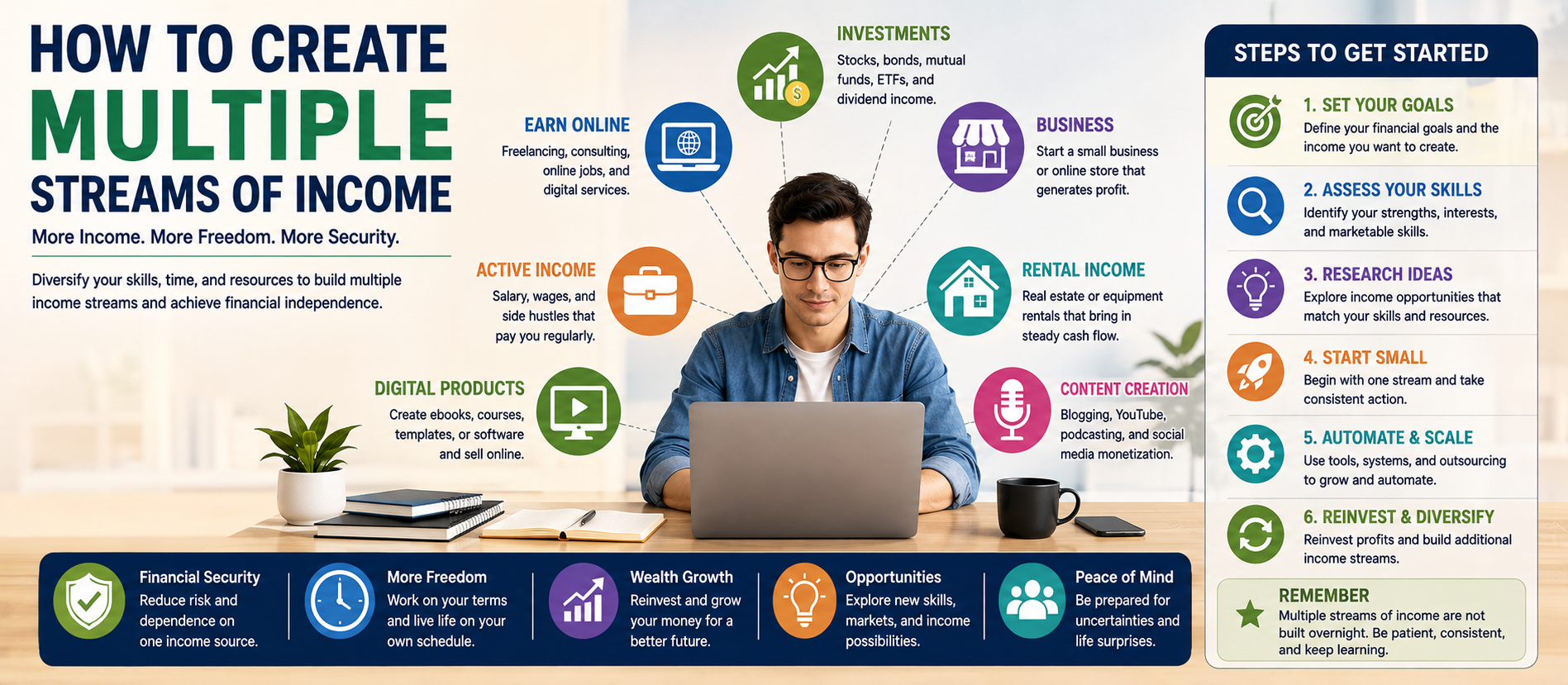
Relying on one source of income can make your finances vulnerable. A job loss, business slowdown, health issue, or unexpected expense can quickly affect your financial plans. Creating multiple streams of income can help reduce dependence on a single source and give you more flexibility over time.
However, building multiple income streams is not the same as finding a shortcut to instant wealth. Most income sources require time, skills, money, systems, or ongoing management. Even so-called passive income usually requires work at the beginning or periodic attention later.
The best strategy is to start with your current financial situation, identify skills or assets you already have, and build one additional income stream at a time.
This guide explains how to create multiple streams of income using practical methods that can work for employees, freelancers, business owners, and people who want to build long-term financial flexibility.
What Are Multiple Streams of Income?
Multiple streams of income means receiving money from more than one source. These sources can be active, semi-passive, or investment-based.
Examples include:
- A salary or wages from a primary job.
- Freelance or consulting work.
- A small business.
- Rental income.
- Interest income.
- Dividends or other investment income.
- Royalties or licensing income.
- Digital products.
- Affiliate or referral income.
The goal is not to create ten income sources immediately. A better approach is to create a stable foundation and add carefully selected sources that match your skills, available time, financial capacity, and risk tolerance.
Why Create More Than One Income Stream?
A second or third income source can provide flexibility when one source becomes weaker. It may also help you save more, reduce debt, invest for long-term goals, or fund a future business.
Multiple income streams can provide:
- Less dependence on one employer or client.
- More flexibility during financial changes.
- Additional money for savings or debt reduction.
- Opportunities to develop valuable new skills.
- A potential path toward long-term financial goals.
Diversification does not eliminate risk. Different income sources can fail at the same time, and investments can lose value. The purpose is to avoid depending entirely on one source when practical.
1. Start by Understanding Your Current Finances
Before starting a side business or making an investment, understand where your money comes from and where it goes.
List your current income, fixed expenses, debt payments, savings, and regular spending. A simple monthly budget can show how much time or money you can realistically dedicate to a new project.
You should know:
- Your total monthly income.
- Your essential expenses.
- Your debt obligations.
- Your emergency savings.
- How much money you can afford to invest or risk.
- How many hours you can realistically commit each week.
Building additional income is easier when your basic finances are organized. Start small rather than borrowing heavily or risking money you need for essential expenses.
2. Build a Strong Primary Income First
Your main job or business can often be the first place to increase income. Before searching for several side projects, consider whether you can improve your primary earning ability.
You may increase your income by:
- Developing an in-demand skill.
- Seeking a promotion.
- Changing to a higher-paying role.
- Negotiating compensation where appropriate.
- Improving your business services or pricing.
A stronger primary income can provide the cash and stability needed to build additional streams. It can also reduce the pressure to accept poor opportunities simply because they promise quick money.
3. Turn an Existing Skill into Freelance Income
Freelancing is one of the simplest ways to create a second income stream because it can begin with skills you already use.
Examples include writing, graphic design, web development, marketing, bookkeeping, translation, video editing, photography, tutoring, consulting, and technical support.
Start by choosing one specific service. Instead of offering everything, solve a clear problem for a specific type of client.
For example, a designer could focus on social media graphics for local businesses. A writer could focus on blog content for technology companies. A marketing professional could offer local SEO audits.
Specialization can make your offer easier to explain and market.
4. Create a Service-Based Side Business
A freelance service can grow into a small business when you create repeatable processes. You may develop packages, standard pricing, templates, and a clear client onboarding system.
The goal is not necessarily to work more hours forever. Over time, you can improve efficiency by using better systems, automation, documented processes, or qualified support.
Start with a simple offer and test demand before spending heavily on branding, software, or advertising.
5. Create and Sell Digital Products
Digital products can become an additional income source because they can be sold more than once after the initial work is completed.
Examples include:
- Templates.
- Guides and e books.
- Online courses.
- Checklists.
- Design assets.
- Spreadsheets.
- Software tools.
- Educational resources.
The best products solve a specific problem. Instead of creating a broad e book on “business,” create a useful resource for a clearly defined audience.
Research the audience before building the product. Look for repeated questions, common problems, and tasks that people want to complete faster.
6. Build Content That Supports Long-Term Income
A website, blog, newsletter, video channel, or educational platform can support several income models. These may include advertising, sponsorships, affiliate relationships, product sales, memberships, or leads for your own services.
💡 Key Insight
Content income usually takes time. Publishing a few articles or videos does not guarantee traffic or revenue. Consistent, useful content and a clear audience are important.
Focus on expertise and usefulness. Create content that answers real questions and helps people make decisions.
For businesses, SEO can help content become discoverable in search engines. AEO, GEO, and AI Search optimization can help make answers clearer for modern search and generative systems.
7. Consider Affiliate and Referral Income Carefully
Affiliate or referral income can be earned by recommending products or services and receiving compensation when qualified actions or purchases occur.
This approach works best when recommendations are relevant to the audience. Promoting products only because they offer a high commission can damage trust.
Use clear disclosures where required. Review the terms of each program and understand how payments are calculated.
Affiliate income should be based on useful content and genuine audience needs rather than misleading promises.
8. Explore Investment Income with a Long-Term Plan
Investment income may come from interest, dividends, distributions, or the sale of investments. The type of income and risk depend on the investment.
⚠ Watch Out
Before investing, define your goals, time horizon, liquidity needs, and ability to tolerate losses. Avoid investing money that you may need soon for essential expenses.
Diversification can help manage risk, but it cannot guarantee profits or prevent losses. A portfolio should match your individual circumstances.
Start by learning the basics before committing money. If you need personal investment advice, consider consulting a qualified and appropriately regulated professional in your jurisdiction.
9. Use Savings and Interest-Bearing Accounts Strategically
For many people, the first step toward investment income is not a complex portfolio. It is building a cash reserve and using suitable savings or interest-bearing products.
Emergency savings can reduce the need to borrow during an unexpected financial problem. Once your basic financial needs are covered, you can make more deliberate decisions about longer-term investments.
Compare safety, liquidity, fees, returns, and access conditions before choosing a product.
10. Consider Rental or Asset-Based Income
If you own an asset that has legitimate rental demand, it may create an additional income source. Depending on the situation, this could involve real estate, equipment, storage space, vehicles, or other assets.
Rental income is not completely passive. Owners may face maintenance, vacancies, taxes, insurance, financing costs, regulation, and management responsibilities.
Calculate all costs before deciding whether an asset is likely to produce a reasonable return.
11. Build a Small Online Business
An online business can create another source of income through products, services, subscriptions, software, education, or digital marketplaces.
Start by identifying a real problem. Then create a simple solution and test whether customers are willing to pay.
A small business does not need to begin with a large investment. In many cases, a basic website, a clear offer, and direct customer feedback can help validate an idea before major expansion.
12. Use Automation to Make Income Streams More Efficient
Automation can reduce repetitive work. Email sequences, appointment scheduling, payment systems, customer relationship tools, and workflow automation can help a small business operate more efficiently.
Automation should support a proven process. Do not automate a confusing or unprofitable system. First understand the work, then improve it.
The best systems save time without reducing customer trust or quality.
13. Reinvest Part of Your Additional Income
When a new income stream starts generating money, avoid assuming that all of it should immediately become lifestyle spending.
You may choose to use additional income to:
- Build emergency savings.
- Reduce high-interest debt.
- Improve tools or skills.
- Market a profitable business.
- Invest according to a suitable long-term plan.
Reinvestment can help a small income stream become more useful over time.
14. Avoid the Myth of Completely Passive Income
Many income opportunities are described as passive even though they require significant work, money, or management.
A rental property may require repairs and tenant management. A digital course requires research, production, marketing, and updates. An investment portfolio requires planning and periodic review.
A more useful question is: how much ongoing time, money, and risk does this income source require?
Understanding the real workload helps you choose opportunities that fit your life.
15. Build One Stream at a Time
Trying to launch five businesses at once often leads to poor execution. Choose one opportunity, test it, learn from the results, and improve the system before adding another.
A practical sequence might look like this:
- Stabilize your primary income and budget.
- Build emergency savings where possible.
- Start one skill-based side income.
- Develop repeatable systems.
- Use part of the additional income to strengthen your financial position.
- Add a second stream only when you can manage it.
This approach may feel slower, but it can be more sustainable.
16. Track Every Income Stream
Use a spreadsheet, accounting tool, or other simple system to track revenue and expenses for each activity.
Tracking helps answer important questions:
- Which income source is actually profitable?
- How much time does it require?
- What expenses are increasing?
- Which activity has the greatest growth potential?
Revenue is not the same as profit. A project that generates a large amount of sales may still produce little profit after advertising, software, labor, taxes, refunds, and other costs.
17. Understand Tax and Legal Responsibilities
Income from freelance work, digital sales, investments, rentals, or business activity may have different tax and reporting requirements. These rules vary by country and can change.
Keep accurate records from the beginning. Save invoices, receipts, payment records, and relevant business documents.
If your activity becomes a significant source of income, seek advice from a qualified tax or legal professional who understands the rules that apply to your location and situation.
SEO, AEO, GEO, and AI Search Strategies for Income-Focused Content
If your income strategy involves a website, digital product, or online business, search visibility can become an important asset.
SEO helps relevant pages appear for useful search queries. AEO focuses on direct answers to questions. GEO and AI Search optimization focus on making information clear, structured, and easy for generative systems to understand.
Useful content can answer questions such as:
- How can I start a second income stream?
- What skills can I sell online?
- How do digital products generate income?
- What is the difference between active and passive income?
- How can a small business use automation?
Use clear headings, simple language, original examples, transparent disclosures, and practical next steps. Avoid guaranteed income claims. Search visibility can support growth, but traffic and rankings are never guaranteed.
Frequently Asked Questions
How many income streams should I have?
There is no ideal number. Start with one stable primary source and add another stream only when you have the time, skills, and financial capacity to manage it.
What is the easiest second income stream to start?
For many people, a skill-based service is a practical starting point because it can use skills they already have. The best option depends on your experience, time, and local market.
Is passive income truly passive?
Usually not completely. Many income sources require upfront work, capital, maintenance, marketing, or periodic management.
Can I create multiple income streams without much money?
Yes, some service-based activities, freelancing, tutoring, consulting, and digital products can begin with limited capital. They still require time, skills, and consistent effort.
Should I invest borrowed money to create another income stream?
Borrowing increases risk and costs. Do not take on debt without understanding the repayment obligations, possible losses, and worst-case outcomes. Consider professional financial advice when appropriate.
Final Thoughts
Learning how to create multiple streams of income is a process of building financial flexibility, not chasing every new opportunity.
Start by understanding your finances. Strengthen your primary income. Choose one additional opportunity that matches your skills and resources. Test it on a small scale, track the results, and improve the system.
Over time, you may combine active income, business income, digital products, rental income, and suitable investments. Each source will have its own level of effort and risk.
The strongest strategy is usually simple: build carefully, avoid unrealistic promises, keep records, protect your financial foundation, and focus on long-term sustainability.
For practical SEO, AEO, GEO, and AI Search optimized digital content, visit Digiifrog at www.digiifrog.com.
Disclaimer: This article is for general informational and educational purposes only. It is not financial, investment, tax, legal, or business advice. Income opportunities involve risk, and results vary based on skills, market conditions, time, capital, expenses, and individual circumstances. Consult qualified professionals for advice relevant to your situation.
Ready to Grow?
Talk to us about a strategy tailored to your brand — we will help you stand out in search, AI discovery and social.


Comments (0)
Log in to leave a comment.